
Articles By

-
 O&M
O&MImproved Performance from Priority-Based Intelligent Sootblower Systems
When sootblower operation frequency is too high, a plant risks losing power generation from tube leaks; but when sootblower frequency is too low, there is a risk of boiler pluggage. Intelligent sootblowing finds the right balance between tube erosion and plant economic operation.
-
 Nuclear
Airtight Cover Completed for Daiichi 1
Tokyo Electric Power Co.’s (TEPCO’s) Fukushima Daiichi 1 reactor—a unit that suffered a core melt and hydrogen gas explosion after the March 11 earthquake in Japan and subsequent tsunami devastated the six-reactor facility—was fully encased in an “airtight” cover in October.
-
 Gas
GasGE Develops FlexEfficiency 50 for Increased Operational Flexibility
The newest member of the 60% thermal efficiency combined cycle club is GE Energy’s FlexEfficiency 50. In an era when flexible grid operation is growing in importance, this 50 Hz, single-shaft combined cycle also holds its design point efficiency down to 87% load and features turndown to 40% of rated load.
-
 Waste to Energy
Does Cow Power Pay Off?
Since a 2008 University of Texas-Austin study showed that converting farm animal droppings into renewable power could generate enough power to meet up to 3% of North America’s consumption, interest in cow power has been piling up.
-
 Geothermal
Can U.S. Geothermal Power Fulfill Its Potential?
Geothermal power and conventional fossil fuel–powered technologies have similar power production cycles, and both generation types can be dispatched. Geothermal power’s primary advantage is its renewable fuel. Its primary disadvantage is that its fuel requires large investments over many years to characterize uncertain sources. Enhanced recovery techniques that use fracking may be the future of this renewable resource.
-
Business
POWER Digest (December 2011)
Fluor Enters Small Modular Reactor Market, Backs NuScale. Fluor Corp. on Oct. 13 announced it planned to invest more than $30 million in NuScale Power, an Oregon-based small modular reactor (SMR) technology company. As part of its investment, Fluor has purchased the company’s shares that had previously been in U.S. Securities & Exchange Commission receivership […]
-
 News
NewsUltrasonic Flow Meters
Sierra Instruments has introduced a new lineup of its popular transit-time ultrasonic flow meters, which now include improved next-generation Innova-Sonic 203, 205i, and portable 210i models. The Innova-Sonic 205i is Sierra’s highest performing dedicated clamp-on instrument. It incorporates the latest developments in digital signal processing to offer excellent accuracy and repeatability for a wide variety […]
-
 O&M
O&MTools at Height
A structure or mechanical system that requires fasteners also demands tools to maintain it properly. In power sectors such as wind, fossil fuel, and nuclear, some work areas may be several hundred feet in the air. While working at those extreme heights, or even just 10 feet off the ground, it’s simply unacceptable to drop anything. That’s why the concept of “tools at height” is being embraced as a way to improve safety and efficiency on the worksite.
-
 News
NewsSpacer Cable Systems
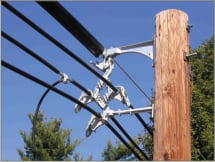
Hendrix Wire & Cable, a provider of overhead and underground power distribution products, introduced its Spacer Cable Systems, a “green” solution for overhead distribution circuits. Because Spacer Cable is more compact and can withstand temporary contact with branches without causing outages, Hendrix Spacer Cable Systems can help reduce the amount of vegetation that must be […]
-
 O&M
O&MMicrons Matter: Proper Design of Fogging Nozzles
Inlet fogging systems for combustion turbines achieve their effect at the molecular level: The cooling effect occurs by converting thousands of gallons of water into single evaporated molecules suspended in the air. The right fog pattern comes down to a matter of selecting the best nozzle design and proper placement in the inlet air stream.
-
 News
NewsEco-Friendly Absorbent Pads
Oil Eater Naturals is a new line of eco-friendly absorbent pads made of natural plant by-products. Featuring woven construction, the pads are designed to provide a safer and cleaner workplace and help users meet OSHA and EPA requirements. The line includes Oil-Only Pads and Rolls that soak up oil and repel water; Universal Pads and […]
-
 O&M
O&MUsing Temperature- Measuring Indicators
Correct welding procedures are extremely important elements of the work done by the PSEG Central Maintenance Shop (serving Public Service Electric and Gas Co., PSEG, a New Jersey utility). We have, for example, a Critical Weld Inspection Program for high-temperature pressure piping whose goal is to identify cracks in high-temperature piping welds.
-
 News
NewsElectric Wire Rope Hoists
Harrington Hoists launched the RHN Series, a new line of electric wire rope hoists, offered in two configurations: the deck/base-mounted hoist in 2–20 metric tons and ultra-low-headroom trolley hoist in 2–15 metric tons. Both versions are dual speed. The deck/base-mounted hoist features a compact, modular design that is perfect for stationary applications or combined with […]
-
News
FERC Proposes Annual Charge for Federal Land Hydropower Licensees
The Federal Energy Regulatory Commission (FERC) earlier this month issued a proposal to revise the methodology for calculating rental rates for the use of government lands by hydropower projects. Under the proposal, FERC-regulated hydropower licensees must compensate the federal government for the use of federal lands, significantly increasing annual charges for many hydropower projects occupying federal lands.
-
News
Google Retires Solar Power Tower Research Initiative, Citing Plunging PV Prices
Google, the Internet search giant that has invested millions in solar power technology, last week quietly abandoned a four-year-old project to make renewable power cheaper than coal-fired power. The company, which cited the recent dramatic decline of photovoltaic panel prices and design limitations, said other institutions were “better positioned” to take research to the “next level.”
-
News
Large-Scale Distributed Solar Project Gets Major Boost from Private Financial Backer
SolarCity Corp., a solar power company that lost a $344 million conditional loan guarantee from the Department of Energy (DOE) in the political rumpus following the Solyndra’s failure, today announced it would move ahead with an ambitious five-year plan to build more than $1 billion in solar power projects for privatized U.S. military housing communities across the country.
-
News
NERC: EPA Rules Could Stress the Nation’s Grid
The cumulative impact of rules proposed and finalized by the Environmental Protection Agency (EPA) could, over the next six years, stress the nation’s power grid "in ways never before experienced," the North American Electric Reliability Corporation (NERC) warns in a new report.
-
News
Ameren Quits Federally Backed Clean Coal Project
The FutureGen Alliance, a nonprofit coalition of coal producers, coal users, and coal equipment suppliers, on Monday said it was negotiating an option to buy portions of the Meredosia Energy Center in Illinois from Ameren Corp. to continue development of the FutureGen 2.0 carbon capture and storage project, an initiative begun in 2003.
-
News
Illinois Senate Brings Tenaska IGCC Project Back to Life
Illinois’ Senate on Tuesday revived Tenaska’s plan to build its $3.5 billion Taylorville Energy Center (TEC), a 602-MW integrated gasification combined cycle (IGCC) power plant designed to capture more than 50% of its carbon emissions.
-
General
Abolish This!
By Kennedy Maize Washington, D.C., November 17, 2011 — Let’s stipulate: Texas Gov. Rick Perry is a doofus. I’ve elsewhere characterized him as “a stuffed shirt, in an empty suit, talkin’ through his hat.” I was being kind. In his recent debate “Oops!” moment, Perry was able to name only two of the three federal […]
-
News
EPA Grants First GHG Permit to Texas Facility
The U.S. Environmental Protection Agency (EPA) on Thursday issued the first greenhouse gas (GHG) permit in Texas. The move comes nearly a year after Texas refused to implement federal GHG regulations that require air permits for high-emission projects and the EPA seized the state’s authority to grant permits.
-
News
Report: Wind Power Could Reach Parity with Gas Power by 2016
Power costs from onshore wind turbines are expected to plunge 12% over the next five years due to the availability of lower-cost equipment and gains in output efficiency—and, in areas offering fair wind conditions, this could make wind power “fully competitive” with power produced from combined cycle gas turbines by 2016, new research from Bloomberg New Energy Finance shows.
-
News
Dominion Begins Restart of North Anna Reactors
Dominion Virginia Power on Friday began the restart of North Anna Power Station after garnering the Nuclear Regulatory Commission’s (NRC’s) permission and more than two months of inspections, testing and engineering, and seismic analysis to investigate effects of the Aug. 23 5.8-magnitude quake whose epicenter was only about 11 miles away from the company’s twin-reactor station in Mineral, Va.
-
News
Energy Efficiency Measures Could Cut Power Consumption Between 5% and 15% by 2020, Study Says
A survey of 50 energy experts released on Tuesday by economists at The Brattle Group reveals that energy efficiency is likely to cause a drop of 5% to 15% in U.S. electricity consumption by the year 2020, relative to forecast trends. Electric peak demand is likely to drop by 7.5% to 15% and natural gas consumption is expected to drop by 5% to 10% compared to forecast trends.
-
News
Council Throws Out Plans for Major Scottish CCS Plant
A plan to build a controversial $4.7 billion coal-fired power plant in Scotland’s Ayrshire County that would have been fitted with experimental carbon capture and storage (CCS) technology was last week thrown out by the North Ayrshire Council, and citizens lodged more than 20,000 objections with the legislative body.
-
News
Senate Defeats Two EPA Rule-Curbing Measures
The U.S. Senate on Thursday blocked two key bills proposed by Republicans that would have thwarted the Environmental Protection Agency (EPA) from promulgating rules they say are unrealistic and would harm the economy. One measure was Sen. Rand Paul’s (R-Ky.) resolution to disapprove the EPA’s Cross-State Air Pollution Rule (CSAPR), and the other was Sen. John McCain’s (R-Ariz.) bill that would have required agencies to get congressional approval for federal rules that cost more than $100 million.
-
News
Administrative Judge: Pollution Controls Are Least Cost Option for Coal-Fired Big Stone
A Minnesota administrative judge on Thursday backed a $489 million plan to retrofit the 36-year-old coal-fired Big Stone power plant in South Dakota with an air quality control system (AQCS) rather than scrap the plant.
-
News
Calif. Consumer Advocate Division Decries CPUC Approval of “Overpriced” CSP Project
The California Public Utilities Commission’s (CPUC’s) approval on Thursday of Abengoa Solar’s 250-MW Mojave Solar concentrating solar power (CSP) parabolic trough facility in San Bernardino County—the second “overpriced renewable contract” approved by the CPUC in recent weeks—was disappointing, the regulatory commission’s Division of Ratepayer Advocates (DRA) said in a statement.
-
News
White House Threatens to Veto CSPAR-Blocking Senate Resolution
If the Senate votes on a measure this week to overturn the Cross-State Air Pollution Rule (CSAPR) using the Congressional Review Act, as has been spearheaded by Sen. Rand Paul (R-Ky.), President Obama would veto the resolution.
-
News
EPA Moves Forward with GHG Regulations for Power Plants
The Obama administration on Tuesday posted a notice on the White House Office of Management and Budget (OMB) website that indicates the Environmental Protection Agency (EPA) has filed a copy of proposed rules to limit greenhouse gas (GHG) emissions from new, modified, and existing power plants.