
states
-
 Nuclear
State Leaders Work to Advance U.S. Nuclear Energy Projects
Governors from 11 states, working through the National Association of State Energy Officials (NASEO), have launched the Advanced Nuclear First Mover Initiative to propel a more standardized, scalable approach to deliver advanced nuclear power capacity rapidly, safely and cost-effectively to ensure consumers and businesses across the U.S. have reliable and affordable electricity. The 11 states […]
-
 Legal & Regulatory
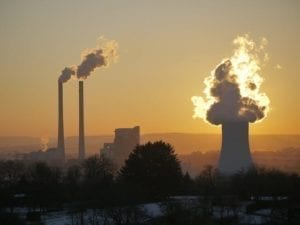
States, Trade Groups Sue EPA Over New Fossil Fuel Rules
More than two dozen states and a handful of trade groups filed separate lawsuits in the U.S. Court of Appeals for the D.C. Circuit, challenging parts of the Environmental Protection Agency’s (EPA’s) suite of new final environmental regulations targeting fossil-fired power plants. The challenges respond to the publication in the Federal Register on May 9 […]
-
 Markets
Market Transitions: The MOPR Merry-Go-Round
The PJM Interconnection’s Minimum Offer Price Rule (MOPR) was introduced in 2006 as a floor to bar new generators from artificially depressing capacity auction clearing prices through below-cost bids.
-
 News
NewsFERC-NARUC Task Force Will Tackle Transmission Issues
Two groups concerned with issues regarding the regulation and production of U.S. electricity have announced formation of a joint federal-state task force on power transmission, an effort to better identify the costs and benefits associated with electric power projects, and support the buildout of renewable energy resources. The Federal Energy Regulatory Commission (FERC), an independent […]
-
 Commentary
Lessons From New Jersey on Power Grid Protection
After Superstorm Sandy pummeled the great State of New Jersey in 2012, more than two million households were without power, many for close to two weeks. A silver lining is that this disaster occurred in the fall, after the heat of summer and before the onset of freezing conditions. With Sandy, New Jersey and the […]
-
 Workforce
Power Industry Pleads for Priority COVID-19 Testing, PPE for Mission-Essential Workers
The U.S. power sector is rallying together to implore state and local governments to treat sector-wide “mission-essential employees” with higher priority and ensure they have top-level access to testing and personal protective equipment (PPE) amid the intensifying COVID-19 pandemic. In a four-page April 2 white paper presumably addressing federal leadership, the Electricity Subsector Coordinating Council […]
-
 News
NewsStates to FERC: Promote Market Designs That Recognize State Priorities
Attorneys general from 11 states ramped up pressure on the Federal Energy Regulatory Commission (FERC) to recognize state policy goals as it makes decisions related to market design, siting of new gas pipelines and storage facilities, and grid reliability. The measure is the latest in a string of recent pushes by states to ensure federally […]
-
 News
NewsTHE BIG PICTURE: Renewable Portfolio Standards
As of August 2019, 29 U.S. states and the District of Columbia had renewable portfolio standards (RPSs), and eight others had non-binding renewable portfolio goals. Three states also had clean energy standards, which set targets for low-carbon non-renewables, like nuclear, and two had clean energy goals. Shown in the bars below are the shares of generation by source […]
-
News
PJM Will Hold Capacity Auction Under Current Rules in August
PJM Interconnection said it will hold its 2022–2023 capacity auction under current market rules on Aug. 14, 2019, though the Federal Energy Regulatory Commission (FERC) has yet to issue a decision on the grid operator’s plan to revamp its Minimum Offer Price Rule (MOPR). In an April 10 filing, however, PJM asked FERC to clarify that […]
-
 Infographics
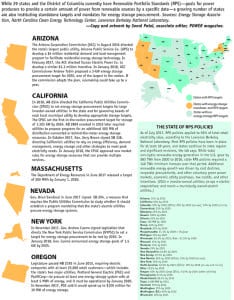
The Big Picture: Energy Storage Mandates
While 29 states and the District of Columbia currently have Renewable Portfolio Standards (RPS)—goals for power producers to provide a certain amount of power from renewable sources by a specific date—a growing number of states are also instituting standalone targets and mandates for energy storage procurement. Sources: Energy Storage Association, North Carolina Clean Energy Technology Center, Lawrence Berkeley […]
-
 Legal & Regulatory
D.C. Circuit Vacates Parts of EPA Ozone Regulations
The D.C. Circuit last week struck down parts of an Environmental Protection Agency (EPA) rule concerning implementation of its 2008 ozone standards, creating new regulatory limbo for the entities required to comply with the rule. Ruling in a set of cases consolidated under South Coast Air Quality Management District v. EPA (No. 15-1115), the federal […]
-
 Legal & Regulatory
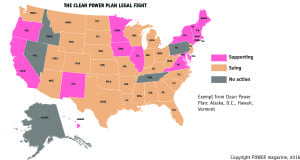
Don’t Let EPA Stall on Clean Power Plan, 17 States Tell Federal Court
The Environmental Protection Agency’s (EPA’s) recent request that the D.C. Circuit hold a case challenging the Clean Power Plan in additional abeyance until it concludes rulemaking has been strongly opposed by 17 states and several cities. The EPA, in its latest 30-day court-required status report filed on January 10, asked the federal court for continued […]
-
 Legal & Regulatory
What States Told FERC About the DOE’s Grid Resiliency Rule [INFOGRAPHIC]
Comments on the Department of Energy’s (DOE’s) proposed grid resiliency rule from an assortment of state agencies, trade groups, environmental organizations, and organized market entities flooded the Federal Energy Regulatory Commission’s (FERC’s) docket before the tight three-week timeframe expired Oct. 23. The DOE’s “Grid Resiliency Pricing Rule” proposed on Sept. 29 directs FERC—an independent regulatory […]
-
 Wind
WindSix Things You Didn’t Know About the Offshore Wind Power Sector
The world’s offshore wind sector, which has been at near-standstill in the U.S. owing to high costs and technical limitations, is poised to see a fierce developmental gust that can be attributed to several factors. While much of the enthusiasm at the American Wind Energy Association’s (AWEA’s) WINDPOWER 2017 annual event in Anaheim, Calif., was […]
-
 Legal & Regulatory
The Future of Clean Energy Is Dependent on States and Utilities
U.S. coal production in 2016 reached its lowest level since 1978. However, in its Annual Energy Outlook published in February 2017, the U.S. Energy Information Administration (EIA) expects coal-fired power to
-
 Legal & Regulatory
Northeastern States File Suit to Force EPA Action on Ozone Transport Region Expansion
Six northeastern states are suing the Environmental Protection Agency (EPA) to force it to act on controlling air pollution blowing in from coal-fired power plants located in nine Midwestern and southern states. New York, Connecticut, Massachusetts, New Hampshire, Rhode Island, and Vermont on October 7 filed a lawsuit in the U.S. District Court for the […]
-
Legal & Regulatory
EPA Issues Updated CSAPR Rule in Push for Compliance with More Stringent 2008 Ozone NAAQS
Updates finalized by the Environmental Protection Agency (EPA) to its Cross-State Air Pollution Rule (CSAPR) identify nitrogen oxide emission (NOx) reductions from power plants in 22 states to help states address transported pollution under the agency’s more stringent 2008 ozone air quality standards. It marks the first time the EPA has updated an existing program […]
-
 Legal & Regulatory
Clean Power Plan Backers Petition Court in Support of EPA
A diverse coalition of major investor-owned utilities, public power authorities, and one of the largest independent power producers, as well as a combination of cities and states, clean energy groups, and environmental groups, filed briefs with the D.C. Circuit Court of Appeals in support of the Environmental Protection Agency’s (EPA’s) Clean Power Plan. The involved […]
-
 Legal & Regulatory
D.C. Circuit Denies Stay of Clean Power Plan
A federal court has denied the motions for stay requested by 27 states and numerous industry groups to block the Clean Power Plan from taking effect. “Petitioners have not satisfied the stringent requirements for a stay pending court review,” the court said in its two-page order on January 21. The court also ordered that consideration of the […]
-
 Legal & Regulatory
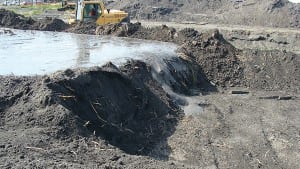
New Coal Ash Bill Unveiled in the Senate
Senators John Hoeven (R-N.D.) and Joe Manchin (D-W.Va.) have introduced a much-awaited coal ash bill in the Senate that they say will provide more certainty than will the Environmental Protection Agency’s (EPA’s) final rule alone. The bill introduced on July 17 is companion legislation to a measure introduced by Reps. John Shimkus (R-Ill.) and David […]
-
Environmental
NARUC Promotes State Coordination for Clean Power Plan Compliance
The National Association of Regulatory Utility Commissioners (NARUC) and the Eastern Interconnection States Planning Council have released a resource guide to help states overcome institutional barriers and coordinate on Clean Power Plan compliance. The Multistate Coordination Resources for Clean Power Plan Compliance guide—which was funded by the Energy Department—includes a multi-state planning checklist, a legislative […]
-
Business
Report: Utility Spending on Energy Efficiency Soars as Supportive State Policies Are Expanded
Electric utility spending and budgets for customer-funded energy efficiency programs have seen a 30% boost compared to 2010 levels and could double by 2025, thanks to expanding state policies, an updated report from the Institute for Electric Innovation (IEI) suggests. The report, “State Electric Efficiency Regulatory Frameworks,” outlines policy developments that support utility investments in […]
-
 Renewables
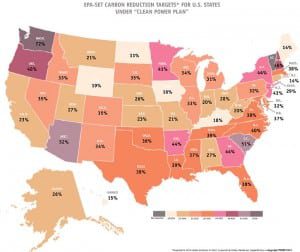
[UPDATED] Viewpoints on the EPA’s Clean Power Plan Abridged
The Environmental Protection Agency’s (EPA’s) proposed carbon rules for existing power plants amassed more than 1.6 million remarks before the public comment period ended on Monday. Here’s a snapshot of what states, regulators, industry groups, and environmental alliances told the agency about its Clean Power Plan. States Connecticut, Delaware, Maine, Maryland, Massachusetts, New Hampshire, New York, […]
-
 Coal
CoalEight States Petition EPA to Force Upwind States to Curb Pollution
As the Supreme Court heard arguments on the Cross-State Air Pollution Rule (CSAPR), eight Northeast and Mid-Atlantic states petitioned the Environmental Protection Agency (EPA) to force nine “upwind” states to slash their emissions of nitrogen oxides (NOx) and volatile organic compounds (VOCs), which contribute to the formation of ozone to the north and east. EPA […]
-
 Nuclear
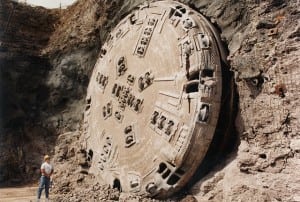
Federal Court Orders NRC to Continue Yucca Mountain Nuclear Waste License Review
In an apparent legal victory for the states of Washington and South Carolina, a divided federal court on Tuesday directed the Nuclear Regulatory Commission (NRC) to continue its legally obligated review of a license application to build the proposed permanent nuclear waste repository in Yucca Mountain, Nev. The U.S. Court of Appeals for the D.C. […]