
scr
-
 Gas
GasDirect Injection SCRs Lower Cost of NOx and CO Removal at Data Centers
In a 2023 report, McKinsey & Company projected 35 GW of new power will be needed for data centers in the U.S. by 2030. This forecast doubled the required power consumption from data servers, up from 17 GW in 2022. The explosive growth in data center infrastructure driven by investments in artificial intelligence (AI) is […]
-
 O&M
O&MUnderstanding Selective Catalytic Reduction Systems and SCR Design Considerations
Selective catalytic reduction (SCR) is an important emissions control technology utilized at many coal, biomass, waste-to-energy, and gas-fired power plants. Many items must be considered when designing SCR
-
 Gas
GasCould SCR Catalyst Technology Adoption Be a Roadmap for Power Plants Seeking Economical and Efficient CO2 Point-Source Solutions?
As the quest to develop a net-zero carbon emissions electricity grid marches on, global entities like the International Energy Agency (IEA) increasingly point to a big role for carbon capture, utilization, and storage (CCUS). The IEA goes so far as to say reaching net-zero will be nearly impossible without CCUS. Proposed governmental greenhouse gas emissions […]
-
 Legal & Regulatory
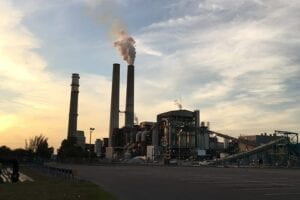
EPA Projects Final ‘Good Neighbor Plan’ Will Result in 14 GW of Coal Retirements
The Environmental Protection Agency (EPA) on March 15 issued the final “Good Neighbor Plan,” its latest iteration of the Cross-State Air Pollution Rule (CSAPR) that could require coal, oil, or gas steam power plants in 22 states to reduce their nitrogen oxide (NOx) emissions levels by 50% by 2027 compared to the 2021 ozone season. […]
-
 Marmaduke
Marnie Surfaceblow—Standing Up for Safety: Maya Sounds the Alarm, but Will Anyone Listen?
With her plant preparing to demonstrate a new selective catalytic reduction and desulfurization system to visiting VIPs, Maya identifies a serious problem and halts the work. See how stepping up for safety led
-
 Gas
GasSCR Design Considerations: Retrofit Challenges and Ratcheting Emissions Level Requirements
Selective catalytic reduction (SCR) projects often focus on the final NOx emissions levels achieved, but a successful project is about much more than that. Facility owners must consider the complete scope associated with an SCR installation, from supply chain issues and ultra-low NOx emissions levels to customization requirements associated with a given application’s pressure drop […]
-
Coal
CORMETECH Announces the Success of Its Breakthrough DustBuster™ Coal SCR Catalyst
DustBuster™ SCR catalyst has proven performance in over 11,000 MW of coal-fired power units since 2016 CHARLOTTE, N.C.–(BUSINESS WIRE)–In making the announcement, Mike Mattes, President & CEO of CORMETECH said, “Demand continues to be strong as utilities worldwide recognize the benefits of DustBuster™ and are looking to improve their coal-fired generation SCR performance and meet […]
-
 Top Plant
SCR Project Upgrades Two Units at Four Corners
The numbers tell the story of how the addition of selective catalytic reduction (SCR) technology helped an iconic New Mexico coal-fired plant reduce its emissions, keeping the plant in operation and continuing
-
 Gas
GasThe POWER Interview: GE Unleashing a Hydrogen Gas Power Future
Since the 1940s, when General Electric (GE), launched its gas turbine operations, the company has pioneered and commercialized a lengthy list of gas turbine technologies, large and small. As the decarbonization movement gains pace and more renewables flood the landscape, the company’s gas turbines have taken on new crucial roles to provide dispatchability and flexibility. […]
-
 Environmental
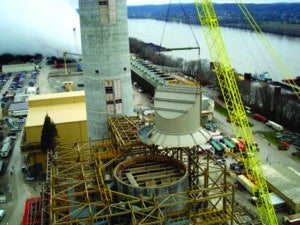
The Impact of Environmental Regulations on Power Generation
For many years, air pollution control (APC) rules and regulations have governed the design and economics of the world’s power generation fleet. These rules have had a tremendous impact, improving air quality
-
 Coal
CoalClean Air Program Makes Shawnee Power Plant a Winner
Emissions standards have changed a lot since the Shawnee Fossil Plant entered service during President Eisenhower’s second term in office, but the Tennessee Valley Authority has done its part to help the
-
 Coal
CoalIndia’s Power Industry Struggles to Solve Pollution Problems
In a bid to tamp down pollution, India’s government in December 2015 notified the country’s coal generators they would need to meet—for the first time—new emissions limits for nitrogen oxides (NOx), sulfur dioxide (SO2), and mercury, as well as tightened limits for particulate matter (PM) and water consumption. The gazetted notification gave new plants until […]
-
 Renewables
IPL to Retire or Repower Coal Units in Iowa Under PSD Settlement With Feds
Interstate Power and Light (IPL) will be forced to spend $620 million to retire 10 coal-fired units and retire, refuel, or install pollution controls at several others in Iowa under a settlement reached with the federal government. The Alliant Energy subsidiary has long anticipated the settlement announced on July 15 by the Environmental Protection Agency […]
-
 Legal & Regulatory
NSR Settlement Requires New Pollution Controls for Four Corners Coal Plant
Several Arizona and New Mexico–based utilities will be required to install pollution controls at the coal-fired Four Corners Power Plant to curb sulfur dioxide (SO2) and nitrogen oxide (NOx) under a settlement reached with the Environmental Protection Agency and the Justice Department. The settlement involves the Arizona Public Service Co. (APS), the operator and primary […]
-
 O&M
O&MKeeping Pollution Control Devices Online with Good Operating Practices
In order to comply with the Clean Air Act and subsequent regulations covering emissions, coal-fired utilities have installed multiple pollution control devices. Understanding key operating aspects of this equipment can help you avoid costly maintenance activities and forced shutdowns. Since the passage of the Clean Air Act in 1970, the regulatory environment for control of […]
-
 Coal
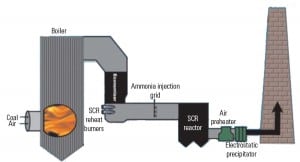
CoalSCR Reheat Burners Keep NOx in Spec at Low Loads
Selective catalytic reduction (SCR) systems installed in steam generators for NOx reduction are ordinarily designed for full boiler load conditions, when SCR inlet temperatures normally exceed unit-specific
-
 O&M
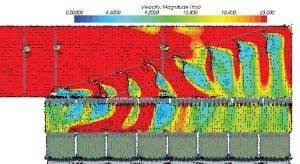
O&MReducing SCR Fly Ash Accumulation with Improved Reactor Inlet Airflow
The Kansas City Power & Light (KCP&L) La Cygne Generating Station provides 1,532 MW of peak power from its site south of Kansas City. La Cygne Unit 1 is an 815-MW Babcock & Wilcox cyclone boiler