
A new think tank assessment argues that economics, proliferation concerns, and waste management barriers have shifted enough to make commercial nuclear fuel recycling viable in the U.S.—but only if Washington acts before the window closes.
A think tank has warned the Trump administration that it has a narrow window to make the U.S. the first country in the world to fully close its nuclear fuel cycle commercially.
The Energy Innovation Reform Project’s (EIRP’s) new assessment, made public on April 6, argues that three obstacles that had stymied American fuel recycling for half a century—economics, waste management, and proliferation risk—have shifted enough to warrant a national policy commitment. EIRP is a nonpartisan Fairfax, Virginia-based nonprofit that bridges energy technology research and federal policy.
The report calls on the White House to issue a formal national policy statement endorsing recycling, urges Congress to modernize the Atomic Energy Act of 1954 and the Nuclear Waste Policy Act, and urges the Department of Energy (DOE) to back construction of production-scale commercial recycling facilities through financing guarantees and service contracts. The recommendations constitute the most comprehensive federal roadmap for commercial recycling any policy organization has put forward since the Bush administration’s Global Nuclear Energy Partnership (GNEP) collapsed in 2009.
Nuclear fuel recycling—the recovery and refabrication of valuable actinides, including transuranics, from used reactor fuel into new fuel for reuse—has never been pursued commercially in the U.S. at scale. Reprocessing, which involves the recovery of those materials without the refabrication step, has a longer but equally troubled history in the U.S. Both have been stymied by decades of low uranium prices, persistent concerns about the proliferation risks of separated plutonium, and a volatile national policy environment.
The report was written by Dr. Christina Leggett, who directs fuel cycle technology at advanced nuclear technology firm Oklo Inc. and is actively designing the company’s commercial recycling facility in Oak Ridge, Tennessee; Paul J. Saunders, a former senior advisor to the undersecretary of state for global affairs in the Bush administration and current senior advisor and board member at EIRP; and Samuel Thernstrom, EIRP’s founder and a former White House Council on Environmental Quality official.
“By enacting supportive policies and taking associated federal actions, the U.S. can responsibly reduce the burden of nuclear waste, enhance energy security, secure critical minerals, and reestablish global leadership in nuclear innovation—all steps that could have far-reaching economic and security benefits,” the report says.
A Policy Window, Decades in the Making
The report arrives the same week DOE’s request for information (RFI) deadline closed on April 1 for states seeking to host Nuclear Lifecycle Innovation Campuses. That January 2026-launched initiative seeks to modernize the nation’s full nuclear fuel cycle through voluntary federal-state partnerships, proposing “campuses” that would support activities spanning the full fuel lifecycle—conversion, enrichment, fuel fabrication, recycling of used nuclear fuel, and final waste disposition. Utah, South Carolina, Tennessee, and Washington have each signaled interest, while 11 “First Mover” states, co-chaired by Indiana, Kentucky, New York, Tennessee, and Wyoming, submitted a joint response through the National Association of State Energy Officials (NASEO).
On March 27, notably, Utah Gov. Spencer Cox and Lt. Gov. Deidre Henderson ceremonially signed three nuclear-related measures in Tooele County—SB 135, which directs the state’s Office of Energy Development to promote Utah as a nuclear recycling site; HB 78, which establishes a state nuclear energy regulatory office; and SCR1, which declares Utah’s intent to pursue expanded NRC agreement state status. Four days later, on April 1, Utah submitted its formal RFI response—as part of “Operation Gigawatt”—proposing a roughly 300-square-mile Corridor in Tooele County, approximately 50 square miles of which is state-controlled SITLA trust land, as the site for a full-lifecycle campus encompassing all 17 functions outlined in the DOE RFI, including reprocessing, enrichment, fuel fabrication, and waste disposition. Utah has executed memoranda of understanding with Oklo, TerraPower, Holtec, Curio, EnergySolutions, and Valar Atomics, among others, and is targeting initial campus operations by 2027.
South Carolina state Sen. Tom Davis, meanwhile, filed a joint resolution in February directing a unified state response to the DOE RFI, though as of March 31, the resolution remained in committee.
However, the conditions driving interest in nuclear recycling have been ripening for years, as POWER detailed in September 2025. While Congress laid the economic foundation through the Infrastructure Investment and Jobs Act (2021), it passed the Prohibiting Russian Uranium Imports Act (2024), which banned Russian low-enriched uranium (LEU) imports (with full enforcement phasing in by 2028) and unlocked $2.72 billion for domestic LEU and high-assay low-enriched uranium (HALEU) production. The House Appropriations Committee, in report language accompanying its fiscal year 2025 energy and water bill, went further, directing the DOE to dedicate at least $10 million toward reprocessing research and development “with the goal of commercial application by 2033.”
More recently, in June 2025, Reps. Bob Latta (R-Ohio) and Scott Peters (D-Calif.) introduced the Nuclear REFUEL Act (H.R. 3978) in the House, the same week Sens. Jon Husted (R-Ohio) and Sheldon Whitehouse (D-R.I.) introduced a Senate companion (S. 2082), which cleared the Senate Environment and Public Works Committee in October 2025 without amendment but has not yet received a floor vote. The bill would amend the Atomic Energy Act to exclude facilities that reprocess spent fuel without isolating pure plutonium from the “production facility” definition in an effort to remove a primary licensing barrier facing modern pyroprocessing and co-recovery operations.
Advanced nuclear licensing, meanwhile, received a boost from the July 2024 ADVANCE Act. Commercial reprocessing facility licensing, however, has remained dormant since the Nuclear Regulatory Commission (NRC) suspended its Part 7x rulemaking in 2016 for lack of industry interest (and formally discontinued it in 2021, given it did not anticipate reviewing a license application within 10 to 20 years). In December 2022, Oklo began pre-engagement with the NRC to support a planned fuel recycling technology facility—unveiled in September 2025 for siting in Oak Ridge, Tennessee—but it will likely pursue licensing through an existing regulation pathway.
Four executive orders signed by President Trump on May 23, 2025, packed on more ambition, targeting three reactor criticalities by July 4, 2026, and 400 GW of installed nuclear capacity by 2050, a quadrupling of the existing fleet in under 30 years. Critically for nuclear recycling, Executive Order 14302 declared it U.S. policy to “maximize the efficiency and effectiveness of nuclear fuel through recycling, reprocessing, and reinvigorating the commercial sector.” The order directed DOE to deliver a recommended national policy on spent fuel management, a statutory gap analysis, and recommendations within 240 days for the “efficient use of uranium, plutonium, and other products recovered through recycling and reprocessing.” However, that report—which was due in mid-January 2026—has not been publicly released.
Still, the gap between ambition and execution is concerning, several experts have said. In March testimony before the Senate Energy and Natural Resources Committee, Idaho National Laboratory (INL) Director Dr. John Wagner noted that no commercial-scale HALEU production exists outside Russia and China, and that commercial supply “remains effectively monopolized by Russia’s Tenex.”
While Centrus Energy’s demonstration facility in Ohio had produced approximately 900 kilograms of HALEU as of June 2025—the first domestic HALEU enrichment in over 70 years—projected demand through the 2026–2030 period from advanced reactor demonstrations, military deployments, and early commercial orders “will far exceed current production capacity,” he warned. “Advanced-reactor demonstrations, military deployments, and potential commercial orders will all compete for limited HALEU supplies during this critical period. This is why recent decisions to pursue nuclear fuel recycling and maximize the beneficial use of DOE-owned material inventories are so critical.”
Meanwhile, the Nuclear Waste Policy Act of 1982, as amended in 1987, “reflects national priorities from four decades ago, designed for a nuclear landscape dominated by large light-water reactors with no consideration of advanced-reactor fuel cycles, potential recycling pathways, or the need for consolidated interim storage while permanent disposal solutions are developed,” Wagner said. “Only Congress can provide the updated framework needed to address the full spectrum of spent-fuel management challenges facing our expanding nuclear enterprise,” he added, noting that the need “has only grown more urgent as the advanced reactor fleet begins to take shape” and that “the time to begin is now.”
According to the EIRP report, the stakes are even more delicate—and point to a timing mismatch, and potentially, a national security vulnerability. “The U.S. ban on importing Russian natural or enriched uranium has created a gap between domestic uranium demand and available supply, as Russia holds 44% of the world’s uranium enrichment capacity and provided 35% of the U.S. supply of uranium prior to the ban,” the report notes.
“Although the U.S. briefly engaged in commercial recycling of UNF more than five decades ago, several factors—evolving government policy, concerns about proliferation, and market conditions—combined to chill interest in commercial recycling until recently,” it adds. “During America’s absence from the field, France and Russia secured global leadership. Russia further uses its expertise to offer other countries fuel and recycling services (along with reactor construction and financing) in a comprehensive package; the aim is to help the state nuclear monopoly Rosatom win attractive, multidecade contracts for nuclear construction and fuel services with other countries, including nuclear newcomers. China may be developing a similar approach.”
The Case for Acting Now
For now, approximately 94,000 metric tons of used nuclear fuel (UNF) is safely stored in spent fuel pools and dry storage casks at 79 sites in over 30 states, but it is slated to grow by approximately 2,000 metric tons each year, the EIRP report notes. That figure already exceeds the capacity of the defunct Yucca Mountain repository, which was designed to hold 70,000 metric tons of high-level waste.
By contrast, France, after 40 years of recycling its own annual UNF inventory, had accumulated just 3,650 cubic meters of high-level waste as of the end of 2016 —and is planning to construct the Cigeo deep geologic repository (DGR) in the eastern part of the country to hold 10,000 cubic meters of high-level waste (HLW). That would be “sufficient for many decades of nuclear power that will meet the majority of electricity demand in France,” the report says.
Multiple approaches to recycling UNF could reduce volumes of conditioned HLW requiring disposal by over 80%, the report says, citing an OECD Nuclear Energy Agency study. “It is difficult to understand how siting and building multiple DGRs at an unknown future time is preferable to reducing the quantity of waste needing long-term disposal in the near future,” the authors wrote.
What hasn’t kept pace with the technology, the report suggests, is the conventional wisdom about its costs. The dominant technology used globally today is PUREX (plutonium uranium reduction extraction), an aqueous chemical process that France and Russia have operated for decades to separate reusable material from radioactive waste. The EIRP report argues that a newer approach—pyroprocessing, a nonaqueous electrochemical separation technique pioneered over 30 years at INL—is simpler, more modular, and projected to be significantly cheaper. INL, notably, has developed a zirconium extraction (ZIRCEX) process to recover HEU from a range of used fuels, then downblend the recovered uranium to HALEU levels.
According to the EIRP report, a first-of-its-kind pyroprocessing facility capable of processing 400 metric tons per year is estimated to cost between $500 million and $1 billion—with or without associated fuel fabrication facilities. That would represent a fraction of the multi-billion-dollar scale historically associated with legacy PUREX plants, which a 2003 study cited in the report found would require uranium prices to reach $370 per kilogram to break even. Unlike PUREX, pyroprocessing is amenable to modularization, which the report says could yield additional cost savings.
INL has been demonstrating pyroprocessing on an engineering scale for 30 years and is already using it to recover and downblend UNF to produce an interim HALEU supply for advanced reactors. South Korea’s PRIDE facility, meanwhile, already provides supporting cost data. At the same time, since 2022, ARPA-E has funded two programs—ONWARDS and CURIE—specifically seeking to further reduce construction and operating costs.
U.S. Companies Staking Out the Nuclear Recycling MarketSeveral U.S. companies are already readying for early-2030s market entry in commercial nuclear fuel recycling, though each taking a distinct technical approach. Oklois pursuing a vertically integrated model spanning power generation, fuel fabrication, and recycling, seeking to ultimately close the loop by processing used fuel from its own Aurora fast reactors into new fuel, using electrochemical separation in molten salts adapted from INL’s process. The company has initiated site prework on its flagship recycling facility in Tennessee, completed NRC pre-application engagement, initiated a rolling NRC readiness review, and secured DOE recycling R&D funding. Oklo has also signed an agreement with TVA to explore fuel recycling and announced a joint venture initiative with Centrus around deconversion. Curio’s NuCycle systemintegrates oxidative decladding, selective fluoride volatility, and exhaustive electrolysis into a single platform, targeting a commercial facility capable of processing 4,000 metric tons per year by the mid-2030s. In February 2026, Curio received a DOE cost-share award (part of more than $19 million DOE distributed across five recycling companies) to advance NuCycle from detailed engineering into pilot-scale equipment development, in collaboration with INL and PNNL. The DOE’s award, notably, also included Alpha Nur, a startup focused on research reactor fuel management, which received funding to research and validate a process for recovering HEU from used fuel produced by U.S.-based research reactors and transforming it into HALEU suitable for reuse in small modular reactor designs. Flibe Energy, the Alabama-based developer of a thorium-fueled molten salt reactor, received funding to study electrochemical methods for processing used nuclear fuel, work that aligns directly with its liquid-fluoride reactor concept and the broader push to develop non-aqueous separation techniques that avoid isolating pure plutonium. SHINE, drawing on its medical isotope production expertise, is planning a 100-metric-ton-per-year pilot using aqueous co-extraction processes that keep uranium and plutonium mixed—a deliberate proliferation safeguard—and in July 2025 announced a partnership with Standard Nuclear to supply recycled uranium, plutonium, and heat-generating isotopes, including strontium-90 and americium-241 for TRISO fuel production and radioisotope power systems. Orano, operator of France’s La Hague plant—which has processed more than 40,000 metric tons of UNF—is making its U.S. entry primarily through enrichment rather than reprocessing. In January 2026, the DOE selected the company for a $900 million award toward its $5 billion Project IKE enrichment facility in Oak Ridge, Tennessee, designed to replace Russian LEU imports ahead of the 2028 full ban, with an NRC license application expected in the first half of 2026. |
Beyond waste reduction, the report makes an equally pointed case for fuel supply. Recycled uranium and transuranic elements from existing UNF stockpiles could be used to produce uranium/transuranic (U/TRU) fuel in certain advanced reactors in place of HALEU, the report says, which could serve as a crucial “stopgap fuel until sufficient domestic HALEU enrichment capabilities are established and could continue to supplement fuel material needs thereafter.”
The report cites a 2014 DOE fuel cycle evaluation that screened thousands of scenarios and determined that the most promising fuel cycles combine fast-neutron reactors with continuous recycling of uranium, plutonium, and minor actinides—a configuration projected to yield significant reductions in waste requiring disposal and greatly improved fuel utilization. A 2024 Argonne National Laboratory study sponsored by DOE’s Office of Nuclear Energy, meanwhile, found that recycled HALEU retaining more than 7% U-235 enrichment at discharge “is more economical than a once-through HALEU fuel cycle,” the report notes.
“Additionally, any use of material recovered via recycling for fuel reduces the amount of natural uranium ore resources requiring enrichment to make fresh fuel, just as mixed oxide fuel produced using recycled UNF in France is expected to reduce French demand for uranium ore by 25%,” the report says.
Could Used Nuclear Fuel Become a Domestic Source for Critical Minerals?
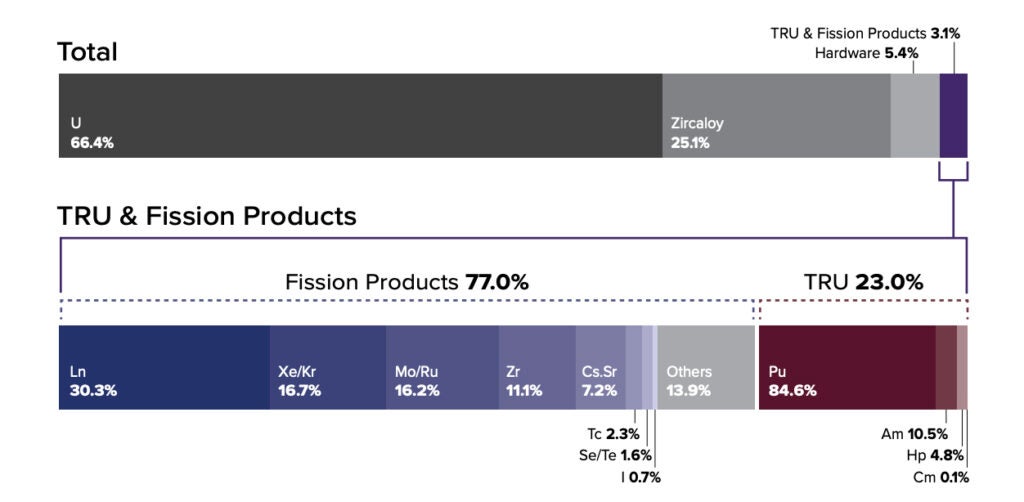
The EIRP report, notably, also identifies a domestic critical minerals opportunity. The nation’s 94,000 metric tons of UNF contains recoverable quantities of zirconium, lanthanides, cesium, strontium, cobalt, platinum-group metals including palladium and rhodium, tritium, tellurium, xenon, and krypton, it suggests.
Many of these elements are present in sufficient quantities that they could be recovered and sold economically for a range of industrial, medical, and space applications, the report adds. In 2024, for example, the U.S. sourced 100% of five critical minerals and 50% or more of 28 additional critical minerals from foreign nations, including China and Russia. Recovery of such isotopes—in some cases after a suitable decay time—could create an additional revenue stream for recycling facilities, while also improving repository management by reducing the heat load and the overall volume of waste requiring permanent disposal, the report suggests.
To address proliferation—which has historically been the most cumbersome objection to reprocessing—the report points to modern recycling technologies and safeguards. Advanced recycling methods co-recover plutonium with other actinides rather than isolating it, making diversion more technically difficult, it explains. Meanwhile, near-real-time material monitoring has replaced older accounting methods.
“To date, there have been no confirmed instances of plutonium being diverted from domestic reprocessing plants,” the authors wrote. At the same time, “U.S. abstention from recycling has visibly not discouraged other nuclear weapons states from using the technology and does not seem likely to do so, especially in an era of escalating geopolitical tension,” the report says.
Still, the authors acknowledge a 2023 National Academies report that concluded all UNF could be safely stored in a system of one or more DGRs without recycling, and that transitioning to a recycling-based fuel cycle “does not solve the waste problem, which is large and multifaceted.” While the EIRP authors did not dispute the finding, they argued, “Scientific and technical possibility do not automatically generate political reality.” In practice, “building a single DGR has been a decades-long challenge that the U.S. has so far failed to meet,” they wrote.
A Four-Part Policy Agenda
Ultimately, the EIRP report lays out four recommendations. First, it calls on the White House to adopt a formal national policy statement endorsing nuclear fuel recycling, modeled on the approach taken in the Bush administration’s 2001 National Energy Policy, which ultimately led to GNEP’s establishment in 2006.
The authors argue that EO 14302 provides a foundation, but that a dedicated policy statement would send a clearer signal to the DOE, industry, and private investors. “After GNEP’s establishment in 2006, several entities interested in commercial recycling via the public-private partnership established by DOE’s Office of Nuclear Energy submitted letters of interest or support to both the NRC and DOE,” the report notes. “In addition to collaborations between DOE and industry, the NRC began an accelerated parallel effort in consultation with DOE to develop an efficient regulatory framework for recycling facilities in anticipation of future license applications.”
Second, EIRP calls for a comprehensive, integrated long-term nuclear waste strategy that incorporates recycling alongside (not instead of) permanent disposal. “Commercial UNF recycling, once established, could reduce HLW volume and aid in DGR management over time—but recycling alone is not intended to be the sole solution to permanent waste disposal,” the report says. “It can reduce the waste burden and thus improve the feasibility of DGR, but both recycling and DGR are critical elements of a comprehensive waste strategy.”
The third recommendation urges the DOE to actively support the construction of production-scale commercial recycling facilities through a range of financial mechanisms. These include increased congressional funding for the DOE Office of Nuclear Energy, financing guarantees through DOE’s Office of Energy Dominance, service contracts to companies for UNF recycling services, and tax credits for utilities that recycle used fuel.
Notably, the report ties the federal financial case to the federal legal obligation: “Given that the federal government is responsible for the long-term disposal of commercial UNF, federal support could, at a minimum, be tied to the expected savings to the government in reduced disposal costs from recycling UNF,” it says.
Finally, the authors call for modernizing the Atomic Energy Act of 1954 and the Nuclear Waste Policy Act to account for modern recycling technologies. When the Atomic Energy Act was passed in 1946 and amended in 1954, all recycling facilities were designed to recover weapons-grade pure plutonium, so the law treated any recycling facility as a plutonium production facility and licensed it accordingly, the authors explain.
New advanced recycling facilities, however, “may not recover pure plutonium and would not pose the same safety and environmental risks as older recycling facilities; consequently, they do not need to be licensed in the same manner,” the authors wrote.
The proposed REFUEL (Recycling Efficient Fuels Utilizing Expedited Licensing) Act, which has cleared Senate committee but has not yet received a floor vote, directly addresses this licensing mismatch. Without it, companies pursuing modern pyroprocessing-based recycling face a regulatory framework written for a technology they are not using.
—Sonal Patel is senior editor at POWER magazine (@sonalcpatel, @POWERmagazine).