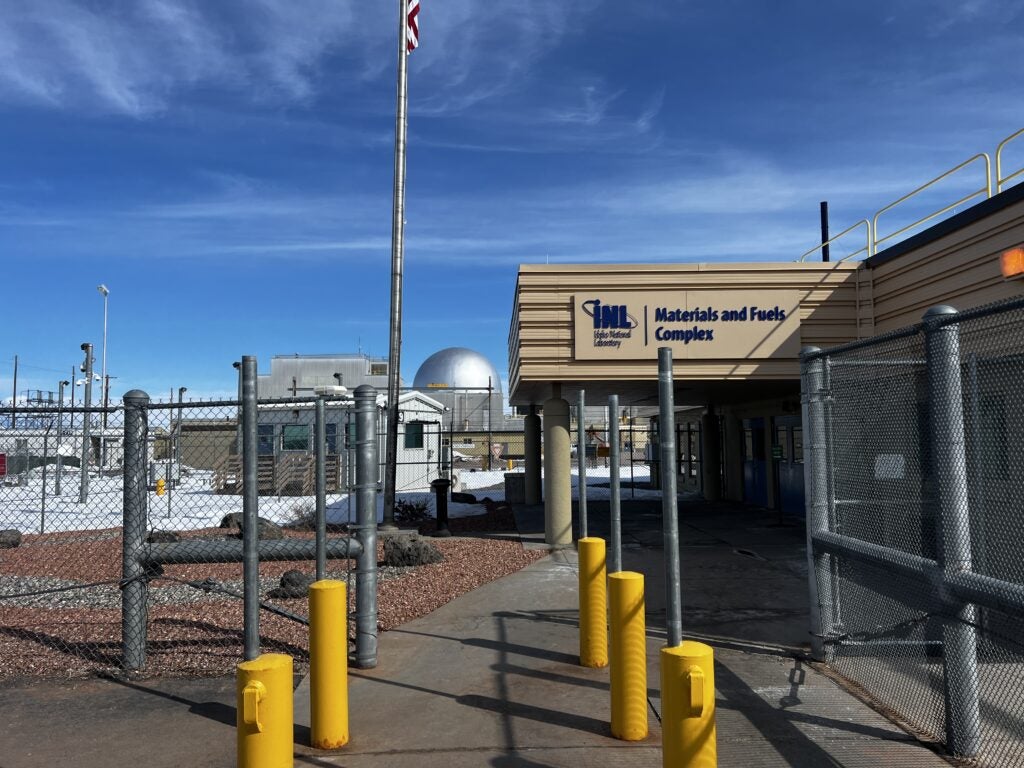
Idaho National Laboratory (INL) has teamed up with artificial intelligence (AI) computing giant NVIDIA to advance “PROMETHEUS,” INL’s first-of-its-kind demonstration of an autonomous nuclear reactor driven by AI, to execute a key challenge under the Department of Energy’s (DOE’s) Genesis Mission. The move adds momentum to DOE’s push to apply AI across the full reactor lifecycle—including design, licensing, manufacturing, construction, and operations—to compress deployment timelines and materially reduce operating costs.
The partnership marks the first public execution of the DOE’s “Delivering Nuclear Energy that is Faster, Safer, Cheaper” Genesis Mission challenge, which the agency outlined last week in a 28-page technical roadmap that specifies 26 AI challenges across energy, science, and national security. The Genesis Mission, launched in November 2025 under the Trump administration’s Executive Order 14363, seeks to “double the productivity and impact of American science and engineering within a decade” by pairing scientists and engineers with AI systems that can reason, simulate, and experiment across DOE’s national laboratories and user facilities.
As POWER reported, the DOE’s nuclear deployment challenge envisions an “at least 2x schedule acceleration” for commercial nuclear power and greater than 50% reductions in operational costs through human‑in‑the‑loop AI workflows spanning the full plant lifecycle. The DOE said it plans to deploy “explainable AI,” including surrogate modeling, agentic workflows, autonomous labs, and digital twins, across design, licensing, construction, and operations to compress deployment cycles and expand firm U.S. capacity, leveraging national laboratory infrastructure, including INL’s Advanced Test Reactor (ATR) and Transient Reactor Test (TREAT) facilities.
INL on Feb. 17 said its collaboration with NVIDIA for PROMETHEUS will focus on applying AI across reactor design, licensing, manufacturing, and operations, supported by large-scale model training on DOE supercomputers and validation against real-world data from INL facilities. The effort also includes accelerating key nuclear simulation codes on NVIDIA graphics processing units (GPUs) and expanding industry and regulatory engagement around digital and increasingly autonomous capabilities.
PROMETHEUS will address “two critical national priorities: harnessing artificial intelligence to drive a new industrial and scientific revolution; and meeting surging electricity demand to power the economy of the next century,” the lab noted. The collaboration with NVIDIA is “designed to create a virtuous cycle where AI enables rapid nuclear deployment, and nuclear energy provides the baseload power required for next-generation AI infrastructure,” it said.
According to Rian Bahran, deputy assistant secretary of energy for nuclear reactors, the initiative reflects DOE’s broader strategy to embed AI directly into nuclear deployment at scale. “This public-private partnership presents a targeted approach to AI-acceleration that goes beyond incremental ‘uplift’ improvements,” he said on Tuesday. “It has the potential to transform the paradigm for how we deploy nuclear energy in addition to how we advance R&D and discovery.”
Bahran has described AI and nuclear energy as mutually reinforcing systems that drive what he calls “peaceful nuclear deployment” at speed. The urgency is fueled in part by surging commercial demand, including a growing roster of power purchase agreements, direct financing commitments, and colocation partnerships between hyperscalers, data center operators, and nuclear developers—deals that Bahran noted are generating headlines “every month” as AI companies seek the firm, reliable, high-availability baseload capacity that nuclear can provide. Against that backdrop, the DOE under Energy Secretary Chris Wright has been tasked with giving “every nudge” the federal government can to accelerate nuclear deployment, Bahran explained, and the Genesis Mission’s AI platform—which integrates the DOE’s 17 national laboratories, $1 trillion in combined federal and private R&D investment, and 40,000 scientists and engineers—is designed to tackle that challenge at scale.
“This is the moment to decisively advance AI-accelerated nuclear energy deployment, increasing America’s energy affordability while also catalyzing the development of artificial intelligence in the U.S.,” Bahran said on Tuesday.
The NVIDIA-PROMETHEUS Collaboration
In House testimony on Jan. 7, INL Director John Wagner described PROMETHEUS as “America’s nuclear moonshot,” a first‑of‑a‑kind demonstration of an autonomous reactor that will be “designed, analyzed, manufactured, and operated by AI systems with minimal human intervention.” By validating “a complete AI-driven pipeline—from generative design and autonomous safety analysis to advanced manufacturing and operations—PROMETHEUS promises up to fivefold schedule acceleration and multi-billion-dollar cost savings, enabling rapid deployment of reactors for critical applications such as AI data centers and national-security missions,” he said.
On Tuesday, INL outlined several strategic initiatives for its collaboration with NVIDIA under PROMETHEUS. These include “AI-powered nuclear design, licensing, manufacturing, construction, and operation,” spanning generative AI, digital twins, and “agentic workflows.” Generative AI tools will likely propose and refine plant and component designs, while digital twins—essentially high-fidelity virtual replicas of reactor systems—could allow engineers to test those designs under a wide range of operating and safety scenarios before construction. Agentic workflows are AI systems that coordinate and hand off tasks across simulation codes and datasets, linking design, safety analysis, manufacturing data, and operational information within a continuous workflow.
INL said a key objective is to broaden industry adoption of accelerated computing and AI tools, and to provide regulators with clearer insight into “state-of-the-art autonomous and digital nuclear capabilities.” The collaboration “may expand to include additional stakeholders, including nuclear reactor developers, utilities, investors, and other national laboratories, to establish a comprehensive ecosystem for AI-driven nuclear deployment,” it noted.
For now, the lab indicated the project’s computational work will be split across scales. The partners plan to use DOE leadership-class supercomputers for large model training and high-fidelity multiphysics simulations, while evaluating on-premises NVIDIA AI systems for real-time operations, potentially where models interface directly with plant data and operator inputs.
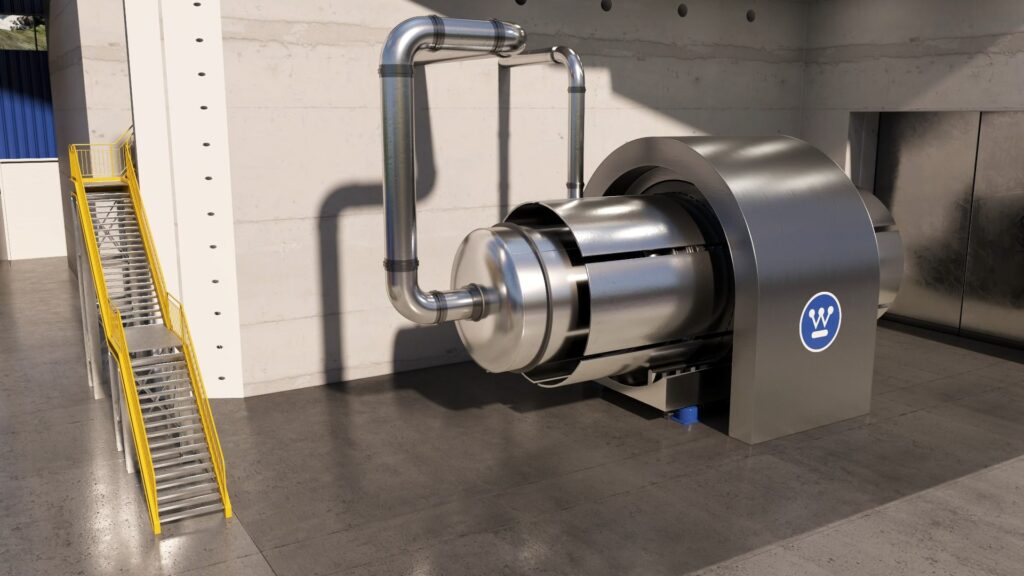
And, to keep models grounded, PROMETHEUS will draw on “legacy nuclear data, laboratory data, and on-site reactors—including the Neutron Radiography Reactor, or NRAD, and the Microreactor Applications Research Validation and Evaluation, or MARVEL,” INL said. NRAD, brought online in 2020 after an overhaul, is a 1977–built 300-kW TRIGA (Training, Research, Isotopes, General Atomics) research reactor that provides non-destructive post-irradiation examination of nuclear fuel and material samples. MARVEL, a sodium-potassium cooled microreactor designed to generate 85 kWe, is expected to connect to INL’s first nuclear microgrid by late 2027 or early 2028. (In December 2025, INL tapped five commercial teams—including AWS, GE Vernova, Radiation Detection, DCX USA, and Shepherd Power [now part of Natura Resources]—that will use MARVEL to demonstrate advanced applications, including data center integration.) NRAD and MARVEL will “provide real-world data for digital twin validation,” INL noted.

Code acceleration is another crucial objective. INL and NVIDIA plan to advance key nuclear simulation tools—including the MOOSE (Multiphysics Object-Oriented Simulation Environment) framework and applications such as BISON, Griffin, and Pronghorn—on NVIDIA GPU architectures “to unlock unprecedented simulation capabilities.” MOOSE, INL’s open-source multiphysics framework for reactor and fuel modeling, is used across DOE’s Nuclear Energy Advanced Modeling and Simulation (NEAMS) program, while BISON models fuel performance, Griffin handles core neutronics, and Pronghorn solves thermal‑hydraulics for advanced reactor concepts. Running these tightly coupled, multi‑physics workloads on GPUs is intended to deliver higher fidelity and faster turnaround for design iterations, safety analyses, and qualification work, building on earlier efforts to prepare MOOSE‑based codes for accelerator hardware documented in DOE technical reports on MOOSE and GPU integration.
INL’s Multi-Vendor AI Ecosystem
However, in House testimony on Jan. 7, Wagner suggested PROMETHEUS is just one part of the Genesis vision. INL is also developing VULCAN under the Genesis Mission signature, to tackle materials discovery and qualification, which he called “one of the most-persistent bottlenecks in nuclear innovation.” Through AI-driven discovery, “high-throughput autonomous experimentation, and regulatory-compliant data generation, VULCAN could compress decadal timelines to years, unlocking revolutionary alloys and fuels essential for advanced reactors. Together, these initiatives redefine what is possible in nuclear energy, ensuring that America leads the world in safe, efficient, and AI-enabled nuclear technologies,” he said.
While Wagner on Tuesday acknowledged INL’s partnership with NVIDIA “represents a transformative approach” that brings it closer to its quest to leverage AI to design, license, and operate reactors, over the past year, the development has followed other significant AI collaborations with other prominent tech giants.
Under a July 2025 agreement with Amazon Web Services (AWS), the national lab said it gained access to AI models, GPUs, and specialized cloud services, including Amazon Bedrock, which will allow INL researchers to use many leading foundation models to build nuclear energy applications. “Amazon offers customized chips such as Inferentia and Trainium, specialized tools such as Amazon SageMaker, and solution architects to partner our laboratory with the commercial AI industry,” explained Chris Ritter, division director of Scientific Computing and AI at INL, in July. The lab will use the AWS compute and AI tools “to develop a digital twin of a small modular reactor,” which “is an important step toward using AI for autonomous operation,” it noted.
In parallel, as part of a collaborative effort with Microsoft announced in July 2025, the lab will use a Microsoft-developed solution built on Azure AI services to generate engineering and safety analysis reports. While the standard reports are typically submitted as part of applications for construction permits and operating licenses for nuclear power plants, they are large and detailed, time-consuming, and expensive, given that they require “compilation of safety data and language from multiple sources,” INL said. “The technology is designed to ingest and analyze nuclear engineering and safety documents, and generate documentation required by the U.S. Nuclear Regulatory Commission (NRC) and DOE for nuclear licensing.” The tool could be used for new light-water reactors (LWRs) and LWR upgrades and “especially useful” for licensing advanced reactors, “which often have different designs, fuels, coolants and materials than the conventional reactors typically reviewed by the NRC. The technology can generate reports for any nuclear facility licensed through NRC or DOE authorization, including nuclear energy test facilities,” INL noted.
NVIDIA’s Broader Nuclear Positioning
NVIDIA, whose GPU architectures and AI computing platforms have become the de facto standard for training large-scale AI models and running high-performance computing workloads across scientific research, data centers, and national laboratories, announced in late 2025 that it would join DOE’s Genesis Mission as a private‑sector partner. Under a memorandum of understanding, the company has said it will provide AI and high‑performance computing tools for “climate modelling, manufacturing, robotics, nuclear energy, and quantum research.” That agreement explicitly calls out fission, fusion, digital twins, and autonomous laboratories.
So far, NVIDIA and Oracle have agreed to build what DOE has described as its largest AI supercomputer for scientific discovery at Argonne National Laboratory—Solstice and Equinox, two systems slated to deliver a combined 2,200 exaflops of AI performance for security, science, and energy applications. On the fusion side, NVIDIA has highlighted a high‑fidelity digital twin of General Atomics’ DIII‑D tokamak built on its Omniverse and GPU platforms, which the partners say enables exploration and refinement of plasma scenarios “orders of magnitude faster.”
And outside the lab complex, NVIDIA is making a direct bet on nuclear power as a source of energy for AI infrastructure. In 2025, its venture arm, NVentures, led a $650 million funding round for Bill Gates–backed TerraPower, which is building the much-watched Natrium project in Wyoming, the first commercial advanced reactor under a demonstration backed by the DOE. NVIDIA is simultaneously building its AI stack into nuclear plant operations through partners such as Atomic Canyon, which is using NVIDIA platforms to bring generative AI and advanced analytics into nuclear operations and work management.
“NVIDIA is honored to collaborate with the U.S. government to apply AI and accelerated computing to advance nuclear energy, while reducing energy costs for Americans,” said John Josephakis, global vice president of Sales and Business Development for HPC/Supercomputing at NVIDIA on Tuesday. “Combining INL’s decades of nuclear expertise with NVIDIA AI infrastructure will put AI to work to design, license, and operate reactors faster, safer, and at lower cost—delivering the abundant energy needed to power scientific discovery.”
—Sonal Patel is a POWER senior editor (@sonalcpatel, @POWERmagazine).