
Business
-
Legal & Regulatory
Postmortem: U.S. Electric Transmission Siting Policy
Despite high-powered congressional legislation in 2005, the U.S. is still unable to site high-voltage interstate transmission lines in a timely fashion. Two new reports suggest ways out of the gridlock.
-
Finance
MIT: Uranium Supplies Adequate
Uranium remains plentiful around the world, says a new resource study from MIT, obviating the need to "close" the nuclear fuel cycle by reprocessing and developing breeder reactors.
-
Business
Look Before You Leap into the Cloud
Given cloud computing’s potential to lower operating costs and increase flexibility, it’s no wonder that it is on the cusp of sending the corporate world into a paradigm shift.
-
Finance
The Pitfalls of Pollution Allowance Trading
The process of banking allowances under the existing schemes for creating markets for pollution reductions has created a set of difficult problems as those programs have changed, wiping out significant value from the allowances.
-
Legal & Regulatory
A Really Basic Checklist for Employee Benefits in Mergers and Acquisitions
As mergers and acquisitions in the power sector heat up again, questions arise about how employee benefits are affected by these complex business deals.
-
Distributed Energy
Smart Grid 2011: More than Meters
The concept of a smart grid may have been born in the U.S.A., but it’s hitting an adolescent growth spurt just about everywhere else first. Meanwhile, in the U.S., both the regulators and companies that see great potential in a smarter grid are realizing that making substantial smart grid progress will first require making both people and policies smarter. There’s one exception, one piece of the smart grid, that could face fewer obstacles to adoption, and that’s because it offers more obvious and visible benefits to its users: electric vehicles (EVs).
-
Business
POWER Digest (Jan. 2011)
TANE and Shaw to Provide EPC Services for South Texas Expansion. Nuclear Innovation North America LLC (NINA), the nuclear development company jointly owned by NRG Energy and Toshiba Corp., on Nov. 29 announced that it awarded the engineering, procurement, and construction (EPC) contract for South Texas Projects Units 3 and 4 to a restructured EPC […]
-
 Coal
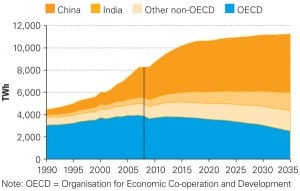
CoalIEA: Global Power Demand to Surge 2.2% Annually Through 2035
Though electricity generation has entered a key period of transition—as investment shifts to low-carbon technologies—world electricity demand is set to grow faster than any other “final form of energy,” the International Energy Agency (IEA) says in its latest annual World Energy Outlook.
-
 Business
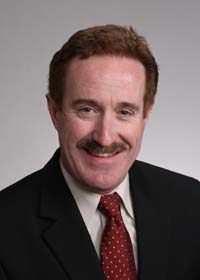
Strong Technology Portfolio Positions Alstom for a Strong 2011
Timothy Curran, head of power for Alstom Power, USA, recently shared his company’s view of 2011 and beyond with POWER’s editor-in-chief.
-
 Business
GE Leverages Leading-Edge Technology and a Balanced Product Portfolio in 2011
Paul Browning, vice president, thermal products for GE Power & Water, sees the greatest short-term business opportunities beyond the U.S., in “high-speed” countries.
-
 Smart Grid
Which Side of the Meter Are You On?
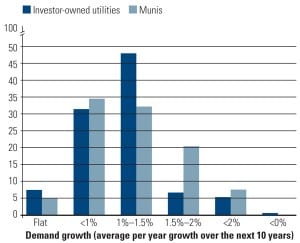
Utilities have achieved success by supplying electricity from central station plants (the supply side) to a grid that carries electricity to customers (the demand side). One way to improve the efficiency of this supply chain is by adopting smart grid technology. The weak link in that chain is convincing customers to use, and regulators to invest in, the smart grid.
-
 Business
Mitsubishi Looks to High-Efficiency Combustion and Wind Turbines in 2011
Bill Newsom—vice president, sales & marketing, Mitsubishi Power Systems Americas Inc.—talks about taking the long view with the company’s U.S. investments.
-
 Business
Siemens Energy Introduces Efficient and Flexible Products in 2011
Dr. Michael Weinhold, chief technology officer of Siemens Energy, discusses the company’s 2011 business plans and the role of the smart grid in the future’s energy infrastructure.
-
 Wind
WindFinding Fault: Improving Wind Farm Availability
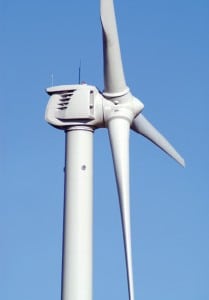
Survey wind turbine manufacturers about how to calculate wind farm availability and you will get countless different definitions and exceptions to the rule.
-
Legal & Regulatory
Regulatory Options for Feed-in Tariffs
Feed-in tariffs (FITs) have been used by European countries to foster the growth of renewable generation resources, notably solar. These tariffs generally require electric distribution companies to purchase power produced by a specified class of generators at above-market rates. The object of the tariffs is to encourage development of the favored generation resources by ensuring the existence of a profitable market for their power production.
-
 Solar
SolarA Winning Combination: Government and Utilities Partner on Renewable Energy Projects
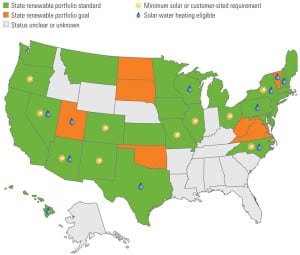
Recent mandates require government facilities to develop energy policies that enable energy conservation, increase the use of renewable energy, and improve energy security. Utilities with government facilities in their service territory may have opportunities to develop solar and other renewable energy projects that help them meet state renewable portfolio standards while increasing a government facility’s usage of renewable energy. The key to such a win-win proposition is careful structuring of the project agreement to leverage each party’s assets.
-
 Hydro
HydroThe Rush to Renewables
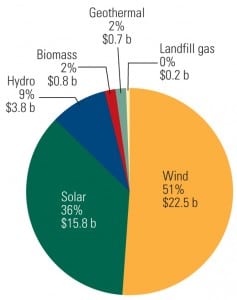
In 2010 investment in wind power continued to accelerate, particularly in California and Texas. California also entered several solar projects in the race for financing. The finish line that renewable power developers and their partners are racing to meet is a December 31 deadline to qualify for federal cash grants.
-
Smart Grid
How the U.S. Grid’s Unpredictability Increases Its Security
Experts have decried congressional and academic reliance on a mathematical model for understanding complex systems that suggests an attack on a small part of the U.S. power grid could disrupt the entire power system network.
-
Business
POWER Digest (December 2010)
Iberdrola Renovables Starts Up National Wind Turbine Control Center. Iberdrola Renovables, a company that owns 41 operating wind farms (3,900 MW in nameplate capacity) in the U.S., on Sept. 26 began operating its National Control Center (NCC), a facility based in Portland, Ore., that has operational control over some 800,000 inputs from 2,500 wind turbines […]
-
Legal & Regulatory
TREND: Smart Grid Complications
Despite a trendy moniker and lots of hype and interest, the smart grid has been facing some major setbacks of late, as regulators and customers begin challenging some of the claims for what interconnected smart meters will deliver in the way of tangible benefits.
-
Legal & Regulatory
Uranium Enrichment: Boom or Bust?
The prospects of a worldwide nuclear power renaissance have spawned many plans for increasing uranium enrichment capacity. Could those plans swamp the world in SWUs?
-
Legal & Regulatory
NRC Chairman Floats Plan for Long-Term Spent Fuel Storage
A sea change in thinking about how to deal with spent nuclear fuel in the U.S. appears to be on the policy and political horizon, rekindling battles last fought in the 1980s about how to pay for the disposal of nuclear waste and where to put it. Holes in the ground look increasingly unlikely.
-
Legal & Regulatory
Dodd-Frank: Legislation and Magical Misdirection
Here’s how, with almost no attention, recent financial reform legislation changes how business must deal with whistleblower employees and affects other seemingly nongermane issues.
-
Business
Turkey Joins European Grid
Turkey, a country that has long vied to become part of the European Union, is finally part of its grid, at least. The nation’s power system was synchronized with Continental Europe’s interconnected grid this September, marking the beginning of a year-long trial period in which security and performance will be monitored.
-
HR
Social Media: Watch Your Words and Fingers
Letting loose on Facebook, Twitter, and email, no matter how tempting and satisfying, can be a prescription for big trouble for you and your organization. Watch out for the dangers of social media on the job.
-
Business
POWER Digest (November 2010)
TVA’s 550-MW Combined-Cycle Plant Starts Operations. The Tennessee Valley Authority (TVA) on Sept. 30 officially began operating the Lagoon Creek Combined Cycle Plant, a 550-MW natural gas–fired plant, near Brownsville, Tenn. The federal utility said that the new plant, the first new power generation source built by TVA since 2002, would provide power during days […]
-
HR
The Five Most Common Workforce Strategy Mistakes
Business planning that doesn’t carefully consider workforce issues can result in economic and management headaches.
-
 Nuclear
Collaborative Team Investigates Long-Term Nuclear Operations
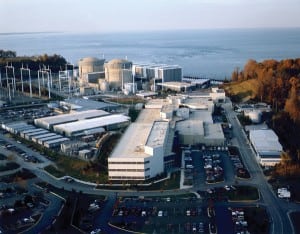
The Atomic Energy Act originally established the length of a U.S. commercial nuclear reactor license as 40 years and made it renewable for another 20 years. The U.S. Nuclear Regulatory Commission has stated that it bases the length of these licenses (and the 50+ renewed licenses granted to date) not on any particular technical limitation but on whether the plant meets current safety requirements. Does this mean there could be reactor life after 60?
-
 Nuclear
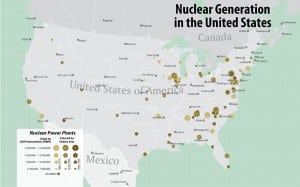
Map of Nuclear Generation in the United States
Courtesy: Platts Data source: POWERmap All rights reserved. No reproduction allowed. For full-sized maps, contact Platts.
-
 Nuclear
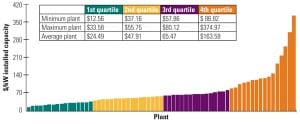
Benchmarking Nuclear Plant Capital Requirements
The EUCG Nuclear Committee’s primary goal is to optimize the costs and reliability performance of participating plants by publishing for its members a comprehensive database of performance metrics and best practices derived through surveys of its membership. Earlier reports examined staffing and performance data. In this exclusive EUCG report, we examine nuclear plant capital requirements.