A California-headquartered advanced nuclear energy company said it has received U.S. Dept. of Energy (DOE) approval of the Documented Safety Analysis for the company’s Mark-0 reactor. Antares, which is building compact nuclear microreactors, on April 7 said the DOE’s approval confirms the agency’s acceptance of the final design for the Mark-0, along with the safety case supporting it.
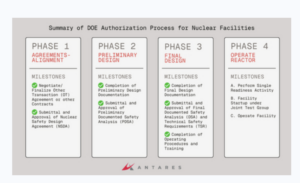
Tuesday’s announcement comes after the DOE approved a Preliminary Documented Safety Analysis for the technology in January of this year. The safety approval comes under DOE standard 1271, part of a streamlined regulatory pathway for nuclear power technology.
Antares will now start the DOE Readiness Review process, which is the final phase before the DOE approves startup of the company’s reactor pilot. Antares on Tuesday said it is on track for the pilot to achieve criticality before July 4 of this year. The DOE wants to achieve criticality for at least three advanced nuclear reactors by July 4 as part of a “Reactor Pilot Program,” which is designed to accelerate commercial deployment of nuclear power technology. The initiative has targeted deployment of 400 GW of nuclear power generation capacity by 2050.
POWER is at the forefront of coverage for research and development of advanced nuclear power. Read this commentary from Lucian Niemeyer, a former White House official and co-founder of the United Coalition for Advanced Nuclear Power, about how the U.S. government must lead the way when it comes to deployment of nuclear power generation technologies. And read the recently published “Nuclear Sprint: DOE and Industry Race to Meet Trump’s Target,” part of POWER’s extensive library of nuclear power articles.
“We are entering the final innings, and that’s incredibly exciting,” said Jordan Bramble, CEO and founder of Antares, in a statement provided to POWER. “Getting here was only possible with strong support from our partners at Idaho National Laboratory and BWXT [a nuclear technology group], and leadership at DOE, along with relentless work from the Antares team.”
Bramble added, “We developed this timeline in 2023, and we have hit every milestone since. This is a clear sign that we are proving our safety basis every step of the way, and I’m proud of the way this team has cleared key checkpoints, on schedule, again and again.”
“The Department of Energy is pleased to see Antares reach this important milestone,” said Rian Bahran, the DOE’s Deputy Assistant Secretary of Energy for Nuclear Reactors. “We remain committed to working with innovative companies like Antares to reach the president’s ambitious goal of ensuring at least three reactors reach criticality before July 4, 2026.”
The Mark-0 demonstration will validate reactor physics, neutronics models, and the instrumentation and control system that will also be used in the Mark-1 electricity-producing reactor planned for 2027. Fuel fabrication for the company’s first reactors has been underway through BWX Technologies since October 2025, using HALEU fuel secured through a DOE allocation.
Antares said that after the Mark-0 demonstration, it will use the same test facility and fuel batch for its Mark-1 reactor in 2027, advancing toward initial deployments for defense and space customers in 2028.
—Darrell Proctor is a senior editor for POWER.