Westinghouse has asked the Nuclear Regulatory Commission (NRC) to renew and update the design certification for its AP1000 reactor, formally proposing Vogtle Unit 4’s as‑built configuration as the new standard reference plant for future AP1000 projects in the U.S.
If accepted and docketed, the submittal—Revision 20 of the AP1000 Design Control Document (DCD)—would establish “a validated baseline” based on the Vogtle 3 and 4 units that entered service in Georgia in 2023 and 2024, the NRC said in an April 6 statement. That “could facilitate streamlined licensing for future applicants to replicate, which could lead to faster licensing approvals, lower regulatory uncertainty and costs, and increased deployment of new nuclear plants to meet the rising electricity demand,” it said.
Westinghouse, which asked the NRC to approve the revision within the 2026 calendar year, said the filing is part of a “strategic plan to enable a fleet-scale deployment of the advanced AP1000 modular reactor and support President Trump’s vision to build a U.S. fleet of large nuclear reactors.”
“The AP1000 stands alone as the only fully designed, licensed, and operating advanced modular reactor that is ready for construction right now. Establishing Vogtle Unit 4 as the standard as-built reference plant for all new AP1000 projects will enable Westinghouse and its partners to rapidly deliver multiple industry-leading AP1000 units simultaneously with more predictability,” said Dan Sumner, Westinghouse’s interim CEO, on Monday. “For our customers, the ability to deploy a standard plant based on an as-built and operating unit without the technology risk associated with a first-of-a-kind, never-built design is a game changer for unlocking fleet-scale deployment.”

Fleet Blueprint and Federal backing
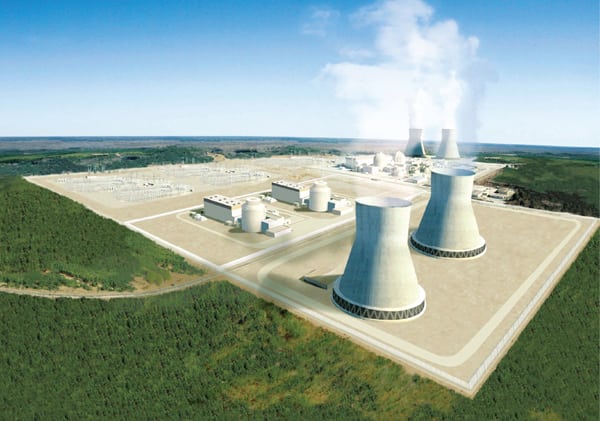
Westinghouse’s AP1000 is a 1,100‑MWe‑class pressurized water reactor (PWR) that the company characterizes as a Generation III+ design with fully passive safety systems, modular construction, and a relatively small site footprint per megawatt.
The reactor design is one of a small number of large light-water reactor designs the NRC has certified under 10 CFR Part 52. Generally, “DCDs define the technical details of a standard reactor design to ensure it meets all regulatory and safety requirements and serve as the primary reference for licensing new units, Westinghouse explained on Monday. “Revision 20 formally implements the as-built Vogtle Unit 4 as the standard reference unit for all new AP1000 projects, accelerating new AP1000 combined license (COL) applications and enabling a rapid fleet deployment of AP1000 plants.”
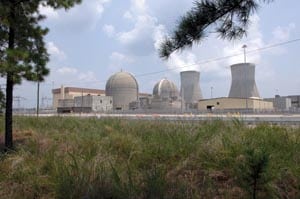
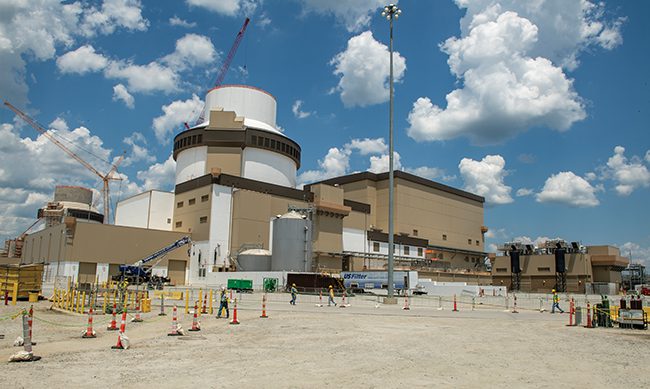
Westinghouse says six AP1000 units are now operating—Sanmen 1 and 2 and Haiyang 1 and 2 in China, which entered commercial service in 2018–2019, and Vogtle Units 3 and 4 in Georgia, which entered commercial operation in 2023 and 2024. Vogtle Units 3 and 4, which POWER recognized as its 2024 Plant of the Year, entered commercial operation in 2023 and 2024 after a prolonged construction and licensing effort that remains a cornerstone of much of the AP1000’s U.S. experience to date.
According to Westinghouse, another 14 AP1000 units are under construction, and five others are under contract worldwide, it suggests. The company notes that the technology has been selected for national programs in Poland, Ukraine, and Bulgaria and is under consideration at other sites in Europe, the Middle East, and North America.
But in March, Westinghouse released a PricewaterhouseCoopers study built around a ten‑unit AP1000 fleet in the U.S. PwC assumed an 80‑year operating life and found that the construction phase of a 10‑unit fleet could generate more than $92.8 billion in U.S. GDP and support 44,300 high‑paying jobs annually for 13 years, and that the operating fleet would add a further $1.03 trillion in GDP over its lifetime and support 22,500 jobs per year. The study says ten AP1000 units could “directly support U.S. goals of quadrupling nuclear generation to 400 GW by 2050,” and it presents the fleet as a way to align Westinghouse’s deployment plans with federal nuclear‑capacity targets.
While no new large U.S. reactor projects have broken ground since Vogtle Units 3 and 4 entered service, Westinghouse’s owners have meanwhile pushed for a federal framework for additional builds. In October 2025, asset manager Brookfield and uranium producer Cameco announced a binding term sheet with the U.S. government that would see the government arrange financing and facilitate permitting and approvals for new Westinghouse reactors in the U.S., for an aggregate investment value of at least $80 billion, including near‑term financing for long‑lead components. The companies had then said the partnership is intended to accelerate the deployment of Westinghouse reactor technologies and leverage supply chains developed during the construction of Vogtle 3 and 4.
That deal remains murky, however. In March, Canary Media reported that negotiations between the Trump administration and Westinghouse’s owners have dragged on and that officials have begun sounding out rival large‑reactor vendors.
On March 20, the Commerce Department announced a package of projects stemming from the $550 billion trade deal with Japan that includes a proposed “up to $40 billion” deployment of 10 GE Vernova–Hitachi BWRX‑300 small modular reactors in Tennessee and Alabama, totaling 3 GW of capacity. Multiple industry sources suggest the proposal is likely to center on prospective BWRX‑300 deployments at the Tennessee Valley Authority’s Clinch River site in Tennessee—where a BWRX-300 project is already taking shape—and the long‑stalled Bellefonte project in Alabama.
And while Westinghouse has not publicly disclosed a ranked list of committed customers, in March the NRC released a site-level mapping (as part of SECY-26-0034) outlining where large light-water reactors could be licensed most rapidly. NRC staff identified 17 U.S. sites with active, terminated, or suspended COLs, along with six sites holding early site permits, and described the most expeditious licensing pathway for each.
The table—which NRC staff emphasized “does not reflect any known or stated intent by the entities identified”—identifies two sites with active AP1000 COLs that have not broken ground: the William States Lee III Nuclear Station in South Carolina and Turkey Point Units 6 and 7 in Florida. For those sites, the most direct pathway (Pathway 1A) requires only notification to the NRC of intent to initiate construction, the regulatory body noted. Westinghouse executives have separately signaled a growing pipeline, including efforts to restart construction at the V.C. Summer site in South Carolina and proposals by Fermi America to deploy four AP1000 units in Texas, while noting that additional projects remain under nondisclosure agreements. V.C. Summer site in South Carolina—where AP1000 construction began but was later abandoned and the COL terminated—would require submission of a new COL application, although prior safety and environmental reviews could still be leveraged, the NRC noted.
Six additional sites—Clinton, Grand Gulf, North Anna, Vogtle, Salem/Hope Creek, and Clinch River—hold early site permits and could support new COL applications under Pathway 4. Site reviews would be based on approved plant parameter envelopes.
A Fresh DCD Revision
The new AP1000 filing builds on nearly two decades of NRC licensing and design certification activity for large light-water reactors under 10 CFR Part 52. So far, the agency has certified four standardized large LWR designs—the ABWR, AP1000, APR1400, and ESBWR—and issued multiple combined licenses and early site permits that can be leveraged for future projects.
The AP1000 design was first certified in 2006 and amended in 2011, with a subsequent 2021 update extending its certification. In August 2025, the NRC further extended the duration of reactor design certifications from 15 years to 40 years for the five designs still in effect—ABWR, AP1000, ESBWR, APR1400, and NuScale—while leaving the expired System 80+ and AP600 certifications unchanged because no timely renewal applications were filed, to effecively give vendors a longer window to deploy these standardized designs before needing to seek renewal.
On Monday, meanwhile, the NRC noted that many design changes introduced during construction of the Vogtle expansion were approved as license amendments that departed from the original certified design. “Future applications referencing the updated AP1000 should benefit from efficiencies introduced through standardized, nth-of-a-kind licensing and the incorporation of lessons learned from Vogtle’s licensing, construction, and startup,” it noted.
The NRC has linked the AP1000 update to its wider effort to prepare for a new wave of large LWR projects. In SECY‑26‑0034 and its enclosures, staff describe “regulatory pathways for referencing a prior licensing action” and other measures intended to make reviews of near‑term large LWR applications more efficient and predictable when they rely on existing design certifications, COLs, or early site permits.
On Monday, the NRC confirmed the planned amendment process is part of that effort “to streamline design certification updates and combined license application reviews for reactors referencing approved designs, enhancing regulatory predictability while maintaining the agency’s high safety standards.”
—Sonal Patel is a POWER senior editor (@sonalcpatel, @POWERmagazine).