
POWER
-
 Nuclear
Problems Plague Russia’s Nuclear Power Ambitions
"The Russian Nuclear Industry: Status and Prospects," a February report from a Canadian-based think tank, Centre for International Governance Innovation, examines a revival of Russia’s Soviet-era plans for a massive nuclear expansion within the current state of the country’s nuclear power industry. It concludes that although the industry has been greeted with renewed funding and enthusiasm, achieving its ambitious plans will require the federation to overcome considerable problems and limitations.
-
 News
NewsKnife Gate Valve for Heavy Slurry Applications
Red Valve Company Inc. launched Series DX Slurry Knife Gate Valve, a durable and user-friendly gate valve that has been designed especially for heavy slurry applications in the power and mining industries. When the valve opens, the reinforced elastomer sleeves seal against each other and provide a 100% full port opening, minimizing turbulence, which in […]
-
 Wind
WindTurbines Spinning at Antarctica’s First "Zero-Emissions" Station
About 110 years after the Belgica expedition — a polar voyage organized by the Geographical Royal Society to establish the world’s first Antarctic scientific research program — a new, unique research station sponsored by the Belgian Federal Government has been commissioned. Inaugurated on Feb. 15 after two years of construction, the Princess Elizabeth Station (Figure 4) is the only polar base to run entirely on renewable energies.
-
Commentary
Transforming the U.S. Grid
Al Gore, in his recent New York Times op-ed titled "The Climate for Change," calls for a "$400 billion investment over ten years to construct a national smart grid to distribute renewable energy." Echelon supports these proposed investments. We also believe the answer is not just in constructing something new but in transforming the existing […]
-
 Environmental
Researchers: Spanish Electricity Model Is Unsustainable
The current Spanish electricity model is unsustainable: Carbon dioxide (CO2) emissions are hard to control, demand shows no sign of weakening, and the country is overly dependent on imported fuel. These are the conclusions of a team of scientists from the Institute for Research in Technology of the University of Pontificia Comillas in Madrid, who looked at how the Spanish electricity sector would evolve in four different scenarios.
-
 Gas
GasConsider CHP for LNG Vaporization
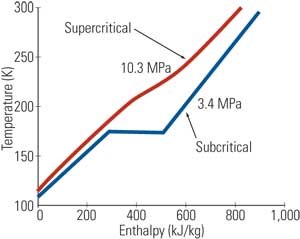
The conversion of liquefied natural gas (LNG) to pipeline-quality gas requires large quantities of low-grade thermal energy that may be available from industrial waste streams, steam power plants, or ocean water at the point of discharging LNG from the tanker. Alternatively, heat may be provided by the combustion of LNG or another fuel. In either case, the large temperature differences between these heat sources and the temperature of the LNG can be used to operate an engine that will offset or eliminate the pumping or fuel costs incurred.
-
 Waste to Energy
Compact, Portable System Converts Trash to Energy
Post-consumer waste could be the newest, ubiquitous fuel source for distributed energy generation if a mobile waste-to-energy conversion system launched this January finds its way onto the parking lots of facilities that produce more than two tons of waste daily. According to its developer, Massachusetts-based IST Energy, the GEM system can process up to 3 tons of waste daily — which can include paper, plastic, food, wood, and agricultural materials — and produce up to 120 kWe and 240 kWth.
-
 O&M
O&MHydrokinetic Plant Piggybacks on Existing Hydro Plant
Hydrokinetic energy — which generates power by using underwater turbines that harness moving water — is on the rise in the U.S. In January, the first U.S.-licensed, commercial, grid-connected hydrokinetic project installed the first of two 100-kW nameplate-rated turbines downriver from an existing run-of-river hydroelectric plant on the Mississippi River.
-
 Waste to Energy
New Biogas Plant Runs Purely on Nonedible Materials
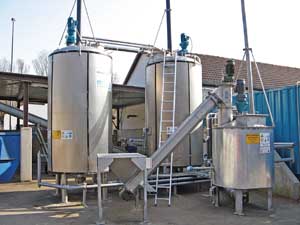
German researchers in February said they had developed the first-ever biogas plant to run purely on waste instead of edible raw materials. The team from the Fraunhofer Institute for Ceramic Technologies and Systems IKTS (Institut Keramische Technologien und Systeme) in Dresden said that the plant, which uses a fuel cell to convert the gas into electricity, exclusively uses agricultural waste such as corn stalks — and it generates 30% more biogas than conventional plants.
-
 Coal
CoalCERAWeek 2009: Floundering Economy Eclipses Renewable, Carbon Plans
For the past 26 years, Cambridge Energy Research Associates (CERA) has hosted an annual conference in Houston that is world-renowned for its high-profile speakers and attendees’ willingness to exchange ideas and share industry forecasts. The consensus this year was that the power industry remains strong but market and political forces, often working at cross-purposes, make bringing any new power generation to market more problematic than ever.