Wind
-
Wind
In Bid for Immediate Extension, AWEA Proposes Gradual Phase-Out of Wind PTC
The American Wind Energy Association (AWEA), an industry trade group that has forcefully been lobbying for an extension of the production tax credit (PTC) that is set to expire on Dec. 31, on Wednesday asked congressional lawmakers to instead consider a future phase-out of its primary federal incentive. The group said that even if temporary, an extension of the performance-based market mechanism was critical "to allow the industry to invest in the cost-saving technologies required to finish the job."
-
Solar
New Batteries and Energy Storage Hub Aims to Improve Grid and EV Performance
U.S. Secretary of Energy Steven Chu announced on Oct. 30 that a multi-partner team led by Argonne National Laboratory in Illinois has been selected for an award of up to $120 million over five years to establish a new Batteries and Energy Storage Hub.
-
Coal
EIA Projects Faster Growth of Natural Gas Production, Gas Generation
Compared to projections from last year, an Early Release Overview of the Energy Information Administration’s (EIA’s) Annual Energy Outlook 2013 (AEO2013) released on Wednesday foresees higher gas production and, with it, a higher share of gas generation by 2040. The outlook also projects a growing share of renewable and nuclear power, but dampened future coal use.
-
Wind
DOI Unveils First-Ever Competitive Lease Sales for Wind Energy Along Atlantic Coast
The Department of the Interior (DOI) on Friday announced that the nation’s first competitive lease sales on the Outer Continental Shelf (OCS) for wind energy will be held next year. The lease sales cover 277,550 acres in two wind energy areas (WEAs) over federal waters along the Atlantic Coast that have a high wind resource potential.
-
 Wind
WindOf Giant Turbines and Rotor Blades
Offshore wind turbine technology experienced a brief gust in October as Siemens Energy began field testing of its new 154-meter (m) rotor for the 6-MW offshore wind turbine, and Norwegian technology company Sway Turbine unveiled a 10-MW offshore turbine.
-
 Wind
WindTOP PLANT: Walney Offshore Windfarms, Irish Sea, UK
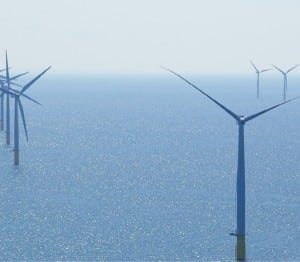
Officially commissioned in February 2012, the two Walney Offshore Windfarms—Walney 1 and Walney 2—together have 102 wind turbines with a total capacity of 367.2 MW. With their combined capacity, the windfarms qualify as one of the world’s largest offshore wind energy facilities and provide clean electricity to approximately 320,000 UK households.
-
 Hydro
HydroRenewable Energy Development Thrives During China’s 12th Five-Year Plan
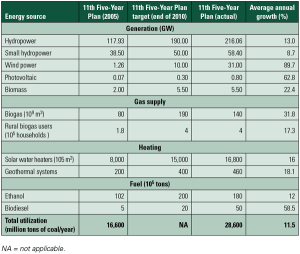
China’s 12th Five-Year Plan calls for expanding the use of renewable energy in all forms throughout the country. From solar and wind to biomass gas and briquettes, China has a true “all of the above” renewable energy policy.
-
Wind
Massachusetts Approves Second PPA for Offshore Cape Wind Farm
The Massachusetts Department of Public Utilities (DPU) on Wednesday approved a 15-year Power Purchase Agreement (PPA) between Cape Wind and NSTAR for 27% of power generated by the Cape Wind project, the nation’s first offshore wind farm.
-
Hydro
Hawaii’s Largest Wind Project Online as State Struggles to Integrate Renewables
On Monday, as First Wind announced its 69-MW Kawailoa Wind Project had gone into commercial operations on Oahu, other news underscored the difficulty the island state faces in trying to substitute renewables for expensive, imported fossil fuels.
-
Wind
Energy Storage Startup Gets $37.3 Million from High-Profile Investors
Berkeley, Calif., startup LightSail Energy, which aims to produce “the world’s cleanest and most economical energy storage systems,” has secured $37.3 million in a Series D round that included three big-name investors: Bill Gates, Vinod Khosla, and Peter Thiel.
-
Hydro
Trend Shows Growth of Renewables on Contaminated Lands
Renewable energy projects installed on potentially contaminated lands, landfills, and mine sites have increased by 40% since 2008, a new list released last week by the Environmental Protection Agency (EPA) shows. Solar photovoltaic (PV) systems make up the bulk of about 184.7 MW installed at 60 sites in 25 U.S. states.
-
 Solar
SolarMaintaining Grid Reliability with a High Renewables Portfolio
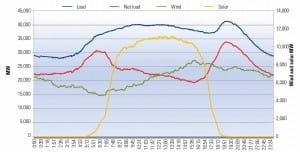
The first problem with high renewable penetration is that wind and solar are not dispatchable.
-
Solar
California’s Streamlined DG Interconnection Process Bodes Well for Solar
The California Public Utilities Commission (CPUC) last week approved a deal involving the state’s major utilities and renewable energy advocates that is aimed at streamlining the process for connecting distributed generation (DG) resources to the grid. The CPUC’s action will make it easier for small amounts of distributed resources—such as rooftop solar photovoltaic (PV) systems—to connect to the grid. The agreement also revises upward the amount of DG that can be connected to a specific power line segment without the need for supplemental studies.
-
Coal
Congressional Briefs: Back from Recess
Congress has returned from its summer break. As the House prepares to vote on its Upton-Stearns "No More Solyndras Act," lawmakers also expect to focus on a bill that could prohibit finalization of any Environmental Protection Agency (EPA) power plant rules that curb greenhouse gas emissions while carbon capture and storage technology is commercially unavailable. House Democrats, meanwhile, called for hearings to examine the impacts of climate change on the nation’s generators.
-
 Wind
WindWhere More Is Not Merrier: The Battle Between Wind and Water in the Pacific Northwest
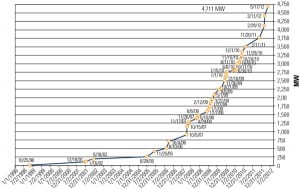
Bonneville Power Administration is torn between delivering the tremendous amount of inexpensive hydroelectric power produced in its region and a rapidly growing wind energy industry that has been ordered to reduce generation when hydroelectric plants are dispatched to protect fish habitats. Which renewable energy asset will win?
-
 Coal
CoalChile’s Power Challenge: Reliable Energy Supplies
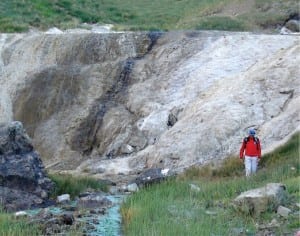
Droughts, unreliable gas imports, and protests against proposed projects have hampered the Chilean power sector and its largest economic driver, the copper-mining industry. Recent policies designed to foster more reliable supplies are a move in the right direction, but remaining obstacles are formidable.
-
Solar
Trade Representatives Request Investigation on U.S. Renewables in Global Context
The U.S. Trade Representative on Monday asked the U.S. International Trade Commission (ITC) to investigate how U.S.-provided renewable energy services affect development of renewable energy projects worldwide. The ITC’s report, expected by June 28, 2013, will focus on the development, generation, and distribution of renewable energy—specifically onshore and offshore wind and solar energy.
-
Wind
FAA Issues No-Hazard Determination for Cape Wind Project as Congressional Probe Continues
The Federal Aviation Administration (FAA) issued a determination on Wednesday that finds construction of Cape Wind’s 130 wind turbines in Nantucket Sound, Mass., would pose no hazard to air navigation. The decision was issued as a congressional House committee probes whether the FAA disregarded safety concerns when it issued a prior approval of the nation’s first offshore wind project.
-
Wind
DOE Report: Wind Industry Could See Dramatically Slowed Growth in 2013 and Beyond
A new report from the Department of Energy (DOE) highlights sizeable increases in U.S. wind power capacity and recent improvements in the cost and performance of wind power technology, but it says the U.S. continues to trail several countries in wind energy penetration and warns that the industry is facing "serious federal policy uncertainty" looking into 2013 and beyond.
-
 Hydro
HydroMajor Developments for Solid Oxide Fuel Cells
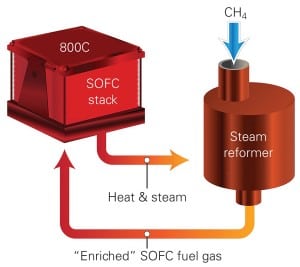
Solid oxide fuel cells (SOFCs), which oxidize a fuel to produce electricity, have received much attention of late for the technology’s myriad benefits, including high efficiency, long-term stability, fuel flexibility, and low carbon emissions—all at a relatively low cost.
-
 Wind
WindThe Age of the Mammoth Wind Turbine Blade
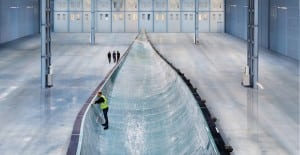
Siemens Energy in June announced it had produced the first batch of its new B75 Quantum wind turbine rotor blades, fiberglass components 75 meters (m) in length that were cast in one piece (Figure 3). The blades were manufactured to be installed this fall on Siemens’ second prototype of the German firm’s SWT-6.0 6-MW offshore […]
-
Commentary
Wind Energy Blown Away by Natural Gas
The environmental push for renewables and mandates to force them into existence are rightly facing some serious headwinds. The American Renewable Energy Production Tax Credit Extension Act of 2011 foundered in Congress, and more states are experiencing significant power rate increases to cover renewable energy production costs. While renewables are generally not ready for prime time in large quantity on today’s power grid, that doesn’t mean environment concerns ought to be trashed, especially when a more effective off-the-shelf solution is available.
-
Wind
House Republicans to Scrutinize Political Sway in FAA’s Cape Wind Decision
Two Republican lawmakers are probing whether the Federal Aviation Administration (FAA) disregarded safety concerns and approved the Cape Wind project—the nation’s first offshore wind project—for political reasons.
-
Wind
DOI Releases Environmental Statements for Massive Wyo. Wind Project, Offshore Wind Leases
The Department of the Interior (DOI) on Monday announced the release of final environmental impact statements for a proposed wind power complex in Wyoming with a nameplate capacity of 3,000 MW and publication of an environmental assessment for commercial wind leases and site assessment activities on the Outer Continental Shelf (OCS) offshore Rhode Island and Massachusetts.
-
Hydro
FERC Rule 1000: What Does It Mean?
The Federal Energy Regulatory Commission (FERC) has the responsibility for ensuring just and reasonable rates and preventing undue discrimination by public utility transmission providers. Last year FERC defined a new framework for public utilities and regional transmission organizations planning new transmission networks. The framework is provided in Order No. 1000—Transmission Planning and Allocation by Transmission Owning and Operating Public Utilities. The Final Rule was issued on July 21, 2011, and reaffirmed by Order No. 1000-A on May 17, 2012.
-
 Coal
CoalPower in India: Opportunities and Challenges in a Fast-Growing Market
India’s long-term annual economic growth rate is projected at over 7%, and the country is investing in its hydroelectric, nuclear, and renewable resources. However, the primary fuel used to produce electricity remains coal, and the government has ambitious plans to significantly increase coal-fired capacity. Those plans have been challenged by a number of unexpected factors that threaten to stifle India’s economic growth. India’s long-term annual economic growth rate is projected at over 7%, and the country is investing in its hydroelectric, nuclear, and renewable resources. However, the primary fuel used to produce electricity remains coal, and the government has ambitious plans to significantly increase coal-fired capacity. Those plans have been challenged by a number of unexpected factors that threaten to stifle India’s economic growth.
-
 Hydro
HydroUtility Perspectives on Ramping Up Renewable Power
Panelists at ELECTRIC POWER discussed how U.S. utilities choose renewable power generation technologies based on their geographic locations, state requirements, economics, and other criteria—including reliability and federal regulations.
-
 Coal
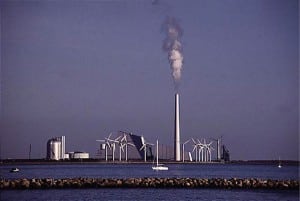
CoalDenmark Extends Renewables Standard to 100% by 2050
Denmark’s parliament in late March agreed to a new energy strategy seeking to wean the country off oil and gas. It could result in the Nordic country cutting its greenhouse gas emissions 34% by 2020, compared to 1990 levels, and decreasing energy consumption by more than 12%, compared to 2006.
-
Wind
Gamesa Scraps U.S. Offshore Wind Prototype Project
Spanish wind turbine manufacturer Gamesa on Monday said it would start the permitting process for the installation of its first offshore prototype, the 50-Hz G128-5.0 MW at Arinaga Quay in Spain’s Gran Canary Island—not Cape Charles, Va., as it had initially proposed. The decision was driven by technical and wind resource considerations, offshore market trends, and investment return criteria, the firm said.