
Nuclear
-
 Nuclear
The Big Picture: DOE Loan Guarantees
Of the $35.9 billion in loan guarantees awarded by the U.S. Department of Energy (DOE) since 2009, roughly $26.5 billion have financed nuclear and renewable power projects across the nation through the Section 1703 and 1705 loan guarantee programs.
-
Coal
Editors Select Top Five Stories of 2011
The POWER editorial staff’s picks for the most significant stories of 2011.
-
 Coal
CoalWorld Energy Outlook Forecasts Great Renewables Growth
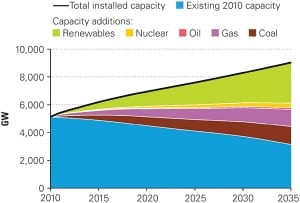
Driven by policies to limit carbon emissions, as well as government subsidies, the share of worldwide nonhydro renewable power is set to grow from just 3% in 2009 to 15% in 2035, the International Energy Agency (IEA) forecasts in its recently released World Energy Outlook 2011. Under the same scenario—which assumes that carbon pricing, explicit […]
-
 Nuclear
NRC to Implement Lessons Learned from Fukushima
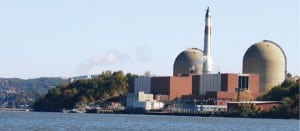
The U.S. Nuclear Regulatory Commission (NRC) in October directed staff to begin implementing seven safety recommendations put forth by the federal body’s Near-Term Task Force on lessons learned from the nuclear accident at Tokyo Electric Power Co.’s Daiichi power plant in Japan’s Fukushima prefecture last March. The recommendations affecting all 104 nuclear reactors (Figure 1) […]
-
 Coal
CoalU.S. Confronts Pipeline Gaps While Europe Juggles Renewables and Debt
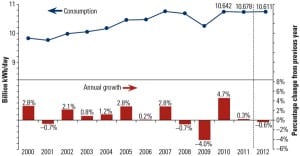
U.S. optimism has been restored by reports of abundant, reasonably priced natural gas to fuel most new generation; however, huge gaps in the fuel delivery system (thousands of miles of pipelines are needed) will soon challenge gas plant development. Meanwhile, the cloud of sovereign debt hangs over all major capital projects in Europe, where the UK moves ahead with new nuclear projects while many of its neighbors shut the door on nuclear and struggle to finance their commitment to renewables.
-
 O&M
O&MEPRI Bridges Industry R&D Gaps
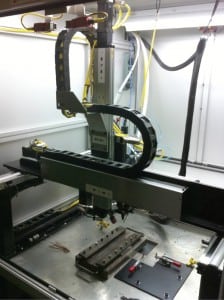
The technologies used to generate and distribute electricity will be radically transformed during the coming decade. Amid that change, the power industry must continue to meet customer reliability, safety, and cost-of-service expectations. Achieving the right balance among these often-conflicting goals is the primary focus of every utility. The Electric Power Research Institute is helping utilities achieve that balance with R&D programs for many new and emerging technologies.
-
 Coal
CoalChina’s 12th Five-Year Plan Pushes Power Industry in New Directions
The Five-Year Plan is the expression of the centralized planning goals for China’s economy. The 12th Five-Year Plan, approved by the Chinese Government on March 14, 2011, established many social and economic goals, including significant expansion of the country’s power generation industry in many new directions.
-
 Nuclear
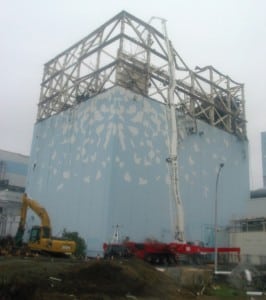
Airtight Cover Completed for Daiichi 1
Tokyo Electric Power Co.’s (TEPCO’s) Fukushima Daiichi 1 reactor—a unit that suffered a core melt and hydrogen gas explosion after the March 11 earthquake in Japan and subsequent tsunami devastated the six-reactor facility—was fully encased in an “airtight” cover in October.
-
 Coal
CoalRestructuring the South African Power Industry
South Africa is at a critical turning point. An uncertain environment for private investment, escalating electricity prices, and a lack of available power threaten South Africa’s position as an attractive investment destination for many of the country’s most important industries. Power has been placed at the forefront of the government’s agenda, but South Africa needs a collaborative effort to meet the country’s energy demands and diversify its generation portfolio in order to drive economic growth.
-
 Nuclear
ITER Gets New Life
The International Thermonuclear Experimental Reactor (ITER) in southern France, the world’s biggest nuclear fusion research project, is seeing a revival. After a budget shortfall last year and cost projections that continue to escalate, in September, the project got the European Parliament’s (EP’s) backing for an autonomous budget that seeks to guarantee transparent and reliable financing while limiting cost overruns. Japan also announced that it would increase its budget for ITER by 50% (the current ITER director-general is Japanese). Also in September, scientists announced that after an 18-month shutdown to upgrade the Joint European Torus (JET)—the world’s largest magnetic fusion device—the machine is ready to test materials to be used inside ITER (Figure 5).
-
Nuclear
THE BIG PICTURE: Reactors Under Construction
For seven years in a row, the number of new nuclear construction starts increased markedly. Then the accident at Japan’s Fukushima Daiichi plant occurred, prompting shutdowns of existing plants and a rethinking of future plans in many countries. Nevertheless, the International Atomic Energy Agency (IAEA) expects “continuous and significant growth” in the use of nuclear […]
-
 Nuclear
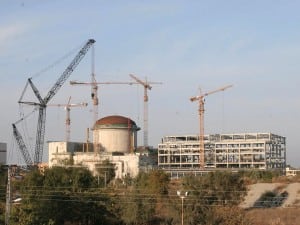
Top Plants: Four Plants Demonstrate Global Growth of Nuclear Industry
The global nuclear industry is moving forward at a brisk pace, only slightly slowed by the Fukushima Daiichi accident. The International Atomic Energy Agency’s most realistic estimate is that 90 new nuclear plants will enter service by 2030. Ten new nuclear plants went online over the past two years. We profile four of them as POWER’s nuclear Top Plants for 2011.
-
 Nuclear
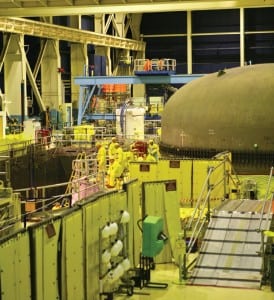
The U.S. Spent Nuclear Fuel Policy, Part 2: Playing Hardball
Ongoing investigations into cancellation of the Yucca Mountain project have revealed an astonishing number of irregularities by agencies responsible for the project. Those investigations have exposed a broken system that failed to properly manage the project and that surrendered to political pressure. Worse still, the draft report of President Obama’s Blue Ribbon Commission on America’s Nuclear Future gave the industry little reason to hope that there would ever be a long-term nuclear waste fuel repository.
-
 Nuclear
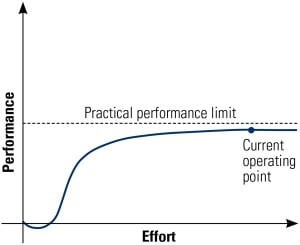
Crossing the Digital Divide
One of the great successes of the power generation industry over the past two decades has been the significant increase in nuclear plant reliability and other performance standards. However, there is reason to be concerned that the design, operation, and maintenance practices used by the current fleet of plants do not leverage all the possible advantages from a digital controls upgrade. Perhaps past success is the biggest barrier to future success.
-
 Nuclear
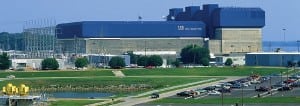
Browns Ferry Unit 1 Restart: World-Class ALARA Performance
TVA completed the $1.9 billion restart of the 1,100-MW Browns Ferry Unit 1 in 2007. That restart project provided the opportunity to incorporate state-of-the-art materials and radiation-reduction techniques to ensure that Unit 1 would be an industry-leading low-ALARA-exposure plant when it returned to service. The reductions achieved were significant.
-
 Nuclear
Combustion Gas Analyzer
Building on the success of the Fluegas 2700 combustion gas analyzer, the new SERVOTOUGH FluegasExact integrates Servomex’s unique Flowcube flow sensor technology to give users even more confidence in their combustion gas measurements. The analyzer features a patented zirconium oxide cell for oxygen measurement and a thick film catalytic sensor for measuring carbon monoxide (CO) […]
-
 Nuclear
Siemens Joins Trend to Quit Nuclear
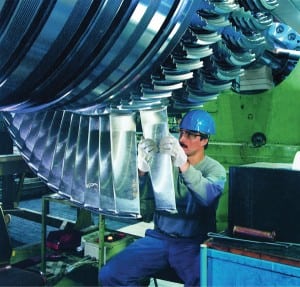
The number of companies pulling out of the nuclear business continues to grow. Just weeks after Louisiana-based engineering firm The Shaw Group announced it would sell its 20% stake in the nuclear company Westinghouse back to partner Toshiba, German engineering conglomerate Siemens said that, prompted by the German government’s decision to phase out nuclear power by 2022, it would quit the nuclear business.
-
Nuclear
German Court Questions Legality of Nuclear Tax
A German finance court in September questioned the constitutionality of a controversial tax on fuel used in nuclear power plants, a decision that could influence rulings in various finance courts around the country that are reviewing complaints by nuclear operators regarding the levy.
-
 Nuclear
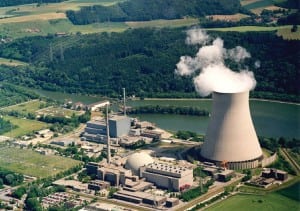
Germany’s Nuclear Phase-Out Has Widespread Implications
The German government in July finalized a package of bills that will phase out nuclear’s 23% contribution to the country’s power supply by 2022 and increase renewable generation from the current 17% to 35%. In August, the Federal Network Agency ( Bundesnetzagentur) said it wouldn’t rely on power from seven of the nation’s oldest reactors […]
-
 Nuclear
Ling Ao 4 Starts Up While Sanmen Gets First AP1000 Reactor Vessel
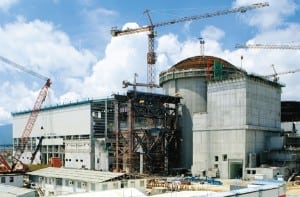
In China this August, as Ling Ao Unit 4—the second unit of the Ling Ao Phase II nuclear plant—started commercial operation, Westinghouse and its consortium partners marked the milestone of receiving the reactor vessel for the Sanmen nuclear power plant—the world’s first AP1000—in China’s Zhejiang province. The start-up of Ling Ao Unit 4 in Guangdong […]
-
 Coal
CoalCWA 316(b) Update: Fish Guidance and Protection
The U.S. Environmental Protection Agency (EPA) has proposed new Clean Water Act section 316(b) regulations for once-through cooling water intake structures. Comments on the proposed rules closed in August, and a final rule is expected mid-2012. The EPA estimates that at least half of the power plants using once-through cooling will be required to implement a best technology available solution in coming years. That typically means barriers and screens, but you may want to consider other options.
-
 Coal
CoalTHE BIG PICTURE: Lights Out
Heat waves, droughts, and other weather and climate phenomena; economic woes; aging or inadequate infrastructure; fuel shortages. These are some of the most obvious causes that have led to record peaks in power demand or sudden drops in available capacity. The results have been sometimes debilitating load-shedding, brownouts, and blackouts around the globe this summer (and, in some cases, for much longer). Here’s an overview of which countries are affected by which difficulties. For a more detailed look at the extent of shortages and what’s causing them, visit Web Exclusives at https://www.powermag.com
-
 Nuclear
China Begins Operation of Experimental Fast Reactor
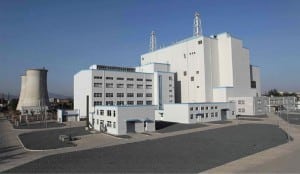
China in July flicked on its experimental fast reactor—the first built in the nation, and the first of many more to come. The China Experimental Fast Reactor (CEFR), whose development began in 1995, is a pool-type sodium-cooled reactor with a thermal output of 65 MW and an electrical output of 20 MW. The reactor is housed in a 44,000-square-meter (473,610-square-foot) building.
-
 Nuclear
India’s Indigenous Nuclear Program Advances While U.S.-India Trade Stalls
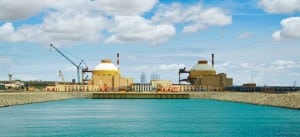
Since a landmark 2008 deal that lifted global sanctions and allowed countries to conduct nuclear trade with India, the nation struggling to keep up with domestic power demand has signed deals with the U.S., France, Russia, Canada, Mongolia, Kazakhstan, Argentina, Namibia, and, in August, South Korea, for construction of large nuclear power plants (in technical collaboration with foreign vendors) or for nuclear fuel.
-
Coal
POWER Digest (September 2011)
Australia Pursues Carbon Tax. Australia’s Prime Minister Julia Gillard on July 10 laid out an ambitious plan to cut national greenhouse gas emissions by 5% of 2000 levels by 2020 by imposing a A$23 (US$23.4) per metric ton carbon tax, starting next year. If parliament approves the plan before year-end, the carbon tax will increase […]
-
 Coal
CoalBest Practices for Natural Gas Line Cleaning
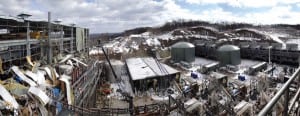
As barriers to new coal-fired generation expand and enthusiasm for nuclear plants wanes, the commissioning of natural gas–fired plants promises to increase. However, gas plants pose hazards, too. An explosion last year that was caused by unsafe use of natural gas to blow residue from a gas pipeline during commissioning of a gas-fired power plant has focused regulator and industry attention on finding safer alternatives for this task. Fluor shares its gas pipeline cleaning best practices.
-
Commentary
Advancing America’s Nuclear Infrastructure
It is fair to say that 2011 is bringing some uncertainty into the nuclear energy industry. The tsunami and subsequent events at Fukushima present Japan and our industry with new challenges but also serve as a catalyst for continuous improvement. In the U.S., we are learning from these events and improving our operations, designs, and emergency response approaches to make our plants safer, more efficient, and more environmentally friendly.
-
O&M
BIG PICTURE: Lights Out (Web Supplement)
A web supplement to the September issue with details of global power shortages.
-
Nuclear
The Fukushima Fallout: Six Months After the Nuclear Crisis
(WEB EXCLUSIVE) Much has transpired during the nearly six months following the Great East Japan Earthquake—a 3-minute, magnitude 9.0 temblor that generated a series of tsunami waves as tall as 38.9 meters (130 feet), killed more than 25,000 people, and set off the worst nuclear disaster in 25 years.
-
 Nuclear
THE BIG PICTURE: Underground Nuclear Waste Disposal
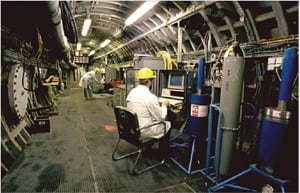
According to the International Atomic Energy Commission, deep disposal in stable geological formations is the only sustainable way to safely manage spent fuel and high-level waste (HLW) from nuclear power reactors. No permanent geological repository has yet been built, but some countries have found a location for a future repository. Others are researching the option…