
Coal
-
 Coal
CoalIEA Chief: U.S. Energy Security “Golden Age” Is an Illusion
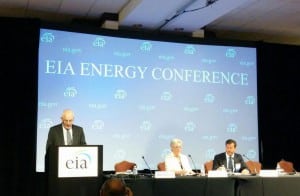
Optimism about U.S. energy security, which is rooted in the abundant supply of fossil fuels alone, is misplaced, Maria van der Hoeven, head of the International Energy Agency (IEA) told attendees at an energy conference in Washington, D.C., on Monday. The U.S. has seen a dramatic reversal in its energy fortunes over the past seven […]
-
 Legal & Regulatory
Construction Begins on World’s Largest Carbon Capture Retrofit
The Department of Energy (DOE), NRG Energy Inc., and JX Nippon Oil & Gas Exploration Corp. announced on July 15 that construction has begun on the first commercial-scale post-combustion carbon capture retrofit project on an existing coal-fired power plant in the U.S. The Petra Nova Carbon Capture Project is expected to capture 90% of the […]
-
 Coal
CoalWyoming Works to Advance Carbon Solutions to Keep Coal Viable
Gov. Matthew Mead is taking an active role in developing an integrated test center to be constructed at a coal-fired power plant in Wyoming to research commercial uses for carbon. As the top coal-producing state in the U.S.—producing more than three times the amount of coal as second-place West Virginia in the first half of […]
-
 Coal
CoalCoal Stockpiles Fall to Lowest Level Since 2006
On June 30, the U.S. Energy Information Administration (EIA) issued its “Quarterly Coal Report” covering the first quarter of 2014. The report includes data on coal production, exports, imports, receipts, prices, consumption, quality, stocks, and refined coal. U.S. coke production, consumption, stocks, imports, and exports are also provided in the EIA report. Of particular note […]
-
 Renewables
DOE Issues $4B Renewables Loan Guarantee Solicitation, Cuts Application Fees for Fossil Energy Program
Over the past week, the Department of Energy (DOE) made available $4 billion in additional loan guarantees for U.S. renewable energy and energy efficiency projects as it slashed application fees by more than a third for its $8 billion Advanced Fossil Energy Projects Loan Guarantee Solicitation. The agency on July 3 issued a loan solicitation to […]
-
 Coal
CoalLegal Fight Over Sunflower Coal Plant Resumes
The battle over Sunflower Electric Cooperative’s plans to build an 895-MW coal-fired power plant in Holcomb, Kan., returned to court on Friday. The Sierra Club, represented by Earthjustice, filed a lawsuit challenging a new air pollution permit recently issued by the Kansas Department of Health and Environment (KDHE) to Sunflower to build its proposed Holcomb […]
-
 Infographics
The EPA’s Clean Power Rule in Three Infographics
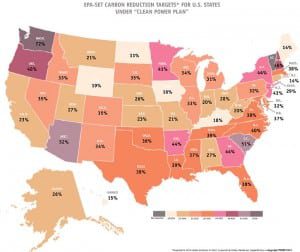
Under rules proposed by the Environmental Protection Agency (EPA) on June 2, 2014, existing fossil fuel–fired U.S. power plants must comply with state-specific goals to lower carbon pollution from the power sector by 2030, while modified and reconstructed power plants will be subject to technology-based performance standards. The EPA’s “Clean Power Plan” rule affecting existing […]
-
 Renewables
RWE’s Thomas Birr on Corporate Strategy in a Changing German Electricity Ecosystem
RWE AG is Europe’s third-largest electricity and fifth-largest gas marketer, with holdings in upstream oil and gas production, power grids, and energy trading. Its German power subsidiary has been the utility poster child for the effects of the Energiewende, the transformation of the Germany power system away from nuclear and coal toward renewable energy and […]
-
 Renewables
The EEI’s Campaign for Electric Utility Industry Supremacy
At the Edison Electric Institute (EEI) annual meeting this week in Las Vegas, the tone was one of collaboration with partners from Washington to distributed generation companies. Those partnerships will be needed as the investor-owned utility (IOU) industry fights not so much a war on coal as a war for mindshare and wallet share in […]
-
 Coal
CoalSpringerville Generating Station Earns PRBCUG 2014 Honors
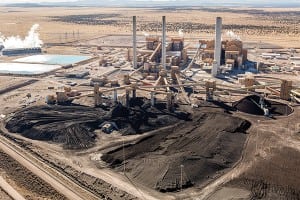
The Springerville Generating Station has been a work in progress since the first unit entered service in 1985. The PRBCUG recently recognized Springerville with its 2014 Plant of the Year award for implementing industry best practices, continual improvements, and worker safety. The presentation of the Powder River Basin Coal Users’ Group (PRBCUG) Plant of the […]
-
 Coal
CoalDoes IGCC Have a Future?
Once touted as the savior of coal power and the future of clean coal generation, integrated gasification combined cycle (IGCC) technology has seen its prospects swamped by soaring costs and technological challenges. Though it remains controversial, its proponents are not ready to give up. If you’re an energy sector observer with an interest in integrated […]
-
 Coal
CoalSupreme Court Chips EPA GHG Authority, Says Agency Has No Power to “Tailor” Laws to Policy Goals
A divided Supreme Court on Monday partly reversed a 2012 federal court decision, ruling that the Environmental Protection Agency (EPA) exceeded its authority under the Clean Air Act when it required permitting for stationary sources based on their greenhouse-gas (GHG) emissions. In a 5–4 ruling, the court’s right-leaning majority concluded that the agency may not […]
-
 Coal
CoalTwo Dead in Kosovo Coal Plant Explosion
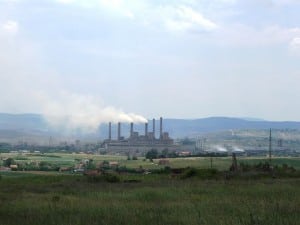
Two workers were killed and at least 14 injured in an explosion at a coal-fired power plant in Kosovo last week. Plans to restart part of the damaged plant were underway on Thursday. The explosion, which could be heard six miles away in the capital, Pristina, occurred at about 10 a.m. on June 6 in […]
-
 Coal
CoalDuke Commits to Funding Full Dan River Cleanup
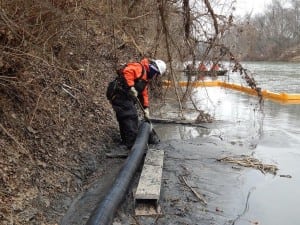
Duke Energy on Monday signed an agreement with the state of North Carolina and the U.S. Fish and Wildlife Service to clean up the Dan River coal ash spill that occurred in February. Significantly, the agreement is financially open-ended in that it does not set a cost cap on the amount Duke must spend to […]
-
 O&M
O&MConveyor Inspections: Could a Contractor Help You?
Conducting conveyor inspections and maintenance can pose significant risks to employees, as these activities bring workers into close proximity with the conveyor system under potentially dangerous conditions. Staff members are exposed to moving belts, rolling components, and pinch points, all in an environment that is commonly dirty, distracting, and sometimes noisy. As plants struggle with […]
-
 Renewables
Carbon Rules Proposed for Existing Power Plants
Existing fossil fuel–fired U.S. power plants must comply with state-specific goals to lower carbon pollution by 2030 under rules proposed by the Environmental Protection Agency (EPA) today. The so-called “Clean Power Plan,” which applies to existing power plants, seeks to cut carbon emissions from the power sector by 30% from 2005 levels by 2030. It […]
-
Renewables
Shining a Light on South Africa’s Power Plans
South Africa’s critical power situation has been the subject of much talk and speculation since 2008, when the country experienced its first electricity crisis after enjoying a surplus of cheap electrcity since the 1980’s. Download the report.
-
Commentary
Who’s Talking About Climate Change?
Everyone, it seems. From Bloomberg Businessweek to Rolling Stone, from ELECTRIC POWER (EP) to Platts Global Power Markets conferences, this spring everyone was talking about climate change. The topic is no
-
Coal
POWER Digest (June 2014)
Australia Releases Emissions Reduction Fund White Paper. Australia’s Ministry of Environment on April 24 released its Emissions Reduction Fund (ERF) White Paper, formally setting out the final design of the
-
Coal
FERC Takes First Steps in Harmonizing Gas and Electricity Markets
After two years of work, about a dozen conferences and meetings, and multiple rounds of comments, the Federal Energy Regulatory Commission (FERC) announced on Mar. 20 that it was ready to begin the process of
-
 O&M
O&MSite-Specific Factors Are Critical for Compliance with Final 316(b) Existing Facilities Rule
On May 16, 2014, the Environmental Protection Agency (EPA) is scheduled to release its long-delayed final 316(b) rule for existing facilities. The rule—which was supposed to have been issued Apr. 17 after
-
 O&M
O&MFuel Flexibility Is the Gift That Keeps Giving
All power plants must continually strive to control operating expenses, but it is particularly important for coal-fired facilities to cut costs these days to stay competitive while meeting ever-more-stringent
-
 Renewables
Report: Power Plant Emissions Down Substantially
According to a report released on May 28, NOX and SO2 emissions in 2012 were 74% and 79% lower, respectively, than they were in 1990 when Congress passed major amendments to the Clean Air Act. Although power plant CO2 emissions have actually increased 13% from 1990 levels, the trend has been down in recent years, […]
-
 Legal & Regulatory
Final Nuclear, Coal, Oil, and Gas Effluent Guidelines Rule Delayed Until 2015
A final rule establishing national technology-based effluent limitations guidelines and standards to reduce discharges of pollutants from nuclear and fossil fuel power plants to U.S. waters won’t be issued until at least September 2015, the Environmental Protection Agency (EPA) has confirmed. This April, the agency and environmental groups Defenders of Wildlife and the Sierra Club […]
-
 Coal
CoalDuke Energy and EPA Reach Agreement on Dan River Coal Ash Cleanup
The U.S. Environmental Protection Agency (EPA) and Duke Energy have signed an agreement regarding cleanup of the coal ash release that occurred at the retired Dan River coal-fired power plant in North Carolina in February. As part of the deal, the EPA will oversee the cleanup and Duke will reimburse the agency for its oversight […]
-
 Coal
CoalFlooding Threatens Coal-Fired Power Plant
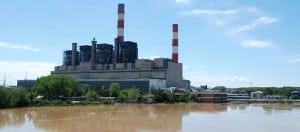
While the rainfall has stopped for now, the risk of flooding continues for the Nikola Tesla coal-fired power plant located on the Sava River near Obrenovac, Serbia (Figure 1). 1. Flooding from the Sava River has affected many parts of Obrenovac, Serbia. Courtesy: EPS The 1,502-MW “A” plant (Figure 2) has six units and is […]
-
 Coal
CoalEPA Issues Final Cooling Water Intake 316(b) Rule
A final rule released by the Environmental Protection Agency (EPA) today will affect cooling water intake structures at 544 U.S. power plants and provide those plants with lower-cost compliance options than previously proposed to reduce fish impingement and entrainment. The final rule issued under Section 316(b) of the Clean Water Act applies to facilities that […]
-
 Coal
CoalDuke Energy to Replace Florida Coal Units with Gas Generation
Duke Energy Florida will retire five coal-fired units in response to environmental rules, but it plans to replace them with new gas-fired generation, including a $1.5 billion combined cycle plant in Citrus County that could come online as soon as 2018, the company said on Tuesday. Duke Energy’s Florida-based subsidiary said it would retire Units […]
-
 Legal & Regulatory
Federal Court Hands EPA Legal Victory on Fine Particulate Matter
A three-judge panel of the U.S. Court of Appeals for the District of Columbia last week upheld the Environmental Protection Agency’s (EPA’s) primary National Ambient Air Quality Standards (NAAQS) for fine particulate matter (PM2.5), dispensing to the agency its third major legal victory on air pollution in a month. The EPA in December 2012 issued […]
-
 Coal
CoalStudy Finds Existing Coal Fleet Is Vital for Meeting U.S. Power Needs
In late January, Secretary of Energy Ernest Moniz requested a study of existing U.S. coal-fired power plants to assess options for enhancing capacity, efficiency, and emissions profiles of the present generation fleet. On May 14, the National Coal Council (NCC), an advisory group that provides recommendations to the Secretary of Energy on policy matters relating […]