The U.S. Nuclear Regulatory Commission (NRC) has proposed the first dedicated federal licensing framework for commercial fusion machines, setting out a technology‑inclusive, risk‑informed approach under its 10 CFR Part 30 byproduct material rules rather than the power‑reactor framework used for fission plants. The proposed rule seeks to place regulatory oversight of fusion‑generated radioactive material within NRC’s existing materials program, clarifying how tritium, activation products, and other fusion byproducts will be licensed and overseen as the sector moves toward commercial deployment.
Published Feb. 26 in the Federal Register as “Regulatory Framework for Fusion Machines,” the proposal would revise the NRC’s existing byproduct material regulations in 10 CFR Part 30—“Rules of General Applicability to Domestic Licensing of Byproduct Material”— to explicitly include fusion machines that possess, use, or produce radioactive material.
The amendments focus largely on adding new definitions and establishing fusion-specific application requirements under Part 30, while making targeted related changes elsewhere in the agency’s regulations. Proposed revisions to Part 20 (Standards for Protection Against Radiation) seek to address radiation protection standards and introduce a site intruder assessment requirement for certain fusion waste streams. And, changes to Part 51 (Environmental Protection Regulations for Domestic Licensing and Related Regulatory Functions) would require applicants to submit an environmental report for construction and operation of a fusion facility. Other updates to Parts 37, 50, 72, 110, 150, 170, and 171 seek to align cross-references and definitions of “byproduct material” with statutory changes enacted in the 2024-enacted ADVANCE Act.
The proposal stems from a regulatory debate that has spanned more than 15 years. In 2009, the NRC asserted jurisdiction over commercial fusion devices but directed staff to hold off on rulemaking until the technology’s deployment timeline became more predictable. “Since 2009, commercial companies worldwide have continued development of fusion technologies using a variety of designs and fuel cycles,” the proposal says. “Design proof of concept, including exceeding scientific break-even (i.e., Q > 1) and net power production, is now targeted for some commercial fusion machine concepts as soon as the mid-to-late 2020s, with commercial deployment projected to follow in the late 2020s and early 2030s.”
Congress added statutory momentum in 2019 with passage of the Nuclear Energy Innovation and Modernization Act (NEIMA), which required the NRC to develop the regulatory infrastructure to support the development and commercialization of advanced nuclear reactors, including both fission reactors and fusion machines. In 2023, after evaluating multiple regulatory pathways, the NRC formally tasked staff to proceed with a rulemaking under the byproduct material framework, and it selected the Part 30 approach over alternatives that would have regulated fusion machines as utilization facilities under a reactor-style regime. The NRC on Thursday said the proposal also reflects direction enacted in the 2024 ADVANCE Act, which clarified that radioactive material produced by a fusion machine falls within the Atomic Energy Act’s definition of byproduct material.
Part 30: The Focus on Byproduct Material, Not a Reactor License
The central policy choice embedded in the NRC’s proposal—which fusion developers had lobbied to secure—essentially treats fusion machines as byproduct material facilities rather than as “utilization facilities” subject to the Part 50 or Part 53 reactor licensing frameworks. Notably, as it deliberated its direction, the NRC considered three options: a full utilization-facility approach under Part 53, a byproduct-material approach under Part 30, or a hybrid pathway, but in April 2023, it unanimously directed staff to proceed under Option 2—the Part 30 framework.
The proposal notes that a key objective was to cover fusion machines for both commercial and research and development purposes that are “contemplated for deployment in the near term.” Citing the Fusion Industry Association’s (FIA’s) July 2025 Global Industry Report, about 29 fusion companies have been so far established in the U.S., “including several that are constructing proof-of-concept facilities,” the proposal says.
However, because 38 of 39 Agreement States (states that have entered formal agreements with the NRC to assume regulatory authority over certain radioactive materials within their borders) have jurisdiction over byproduct material under the National Materials Program, state radiation control programs—as opposed to the NRC directly—will serve as the primary licensing body for most commercial fusion facilities in the country. The NRC is proposing a Compatibility Category B designation for the new “fusion machine” definition, meaning Agreement States would be expected to adopt essentially identical language to ensure regulatory uniformity for facilities that may cross jurisdictional lines.
FIA, which backed the proposal, said it will submit comments and noted that, if finalized, the rule would make the U.S. the second country—after the UK—to establish a fusion-specific regulatory framework. The group called it “an important, nearly final, step in the process for solidifying clear and specific fusion regulations in the U.S.” and said the rule’s formal definition of fusion machines as particle accelerators “allow[s] legal precedent from the long history of accelerator regulation to inform fusion regulation.” Fusion energy, FIA argued, “should not be regulated like nuclear fission, and should not require the same lengthy permitting processes for each facility.”
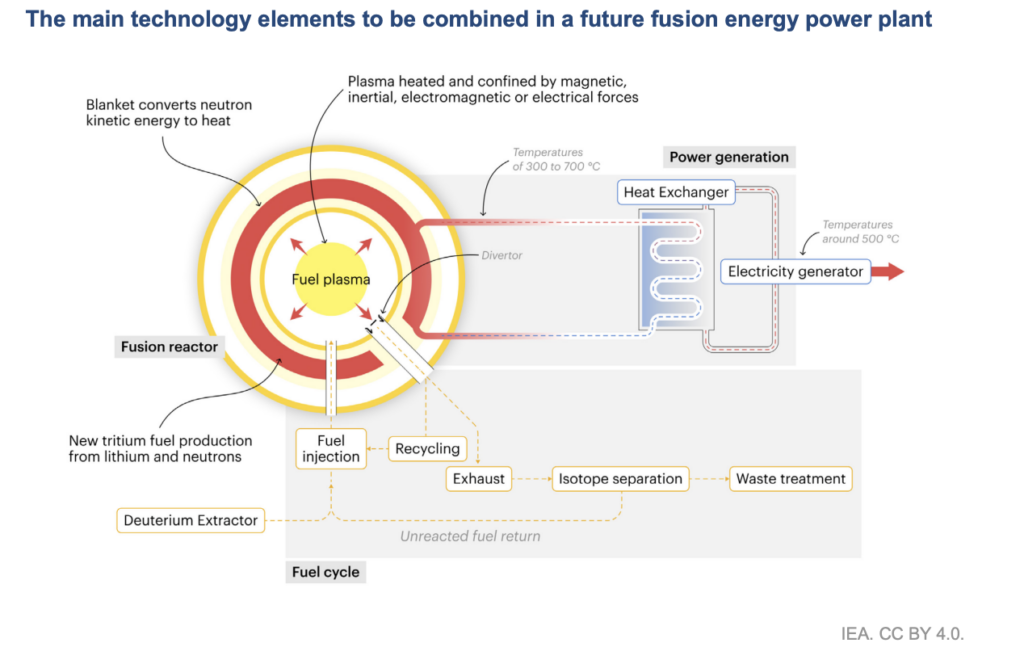
“Near-term” fusion machines, the NRC’s proposal notes, are fundamentally different from fission reactors in their hazard profile. Fusion energy is produced by combining light atomic nuclei—most commonly isotopes of hydrogen such as deuterium and tritium—at extremely high temperatures to form heavier nuclei, releasing energy in the process. Unlike fission, which depends on a self-sustaining neutron chain reaction in fissile material, fusion reactions occur only when precise plasma conditions are actively maintained. If confinement, heating, or fuel injection systems fail, the plasma rapidly cools, and the reaction stops.
Crucially, as the NRC noted, “no fissile material is present, and criticality (a self-sustaining neutron chain reaction) is not possible.” Energy and radioactive material production “cease without any intervention in off-normal events or accident scenarios,” and active engineered systems—such as plasma confinement mechanisms, vacuum systems, fuel injection, and external heating—are required to sustain fusion reactions. The agency further concluded that active post-shutdown cooling of structures containing radioactive material “is not necessary to prevent a loss of radiological confinement.”
As a result, “radionuclides present in the fusion machine, in processing or storage, or in activated materials, in any significant mobilizable amount are expected to result in low doses to workers and members of the public during credible accident scenarios,” generally below 1 rem (10 mSv) offsite.
For now, the main radiological concerns associated with near-term fusion machines involve “significant quantities” of tritium—a radioactive isotope of hydrogen used as fusion fuel and produced in the reaction—that may be located on the site, including within the vacuum vessel, in processing, in storage, and permeated into structural materials. Commercial designs have communicated expected tritium inventories of roughly 5 to 10 million curies. That compares to the maximum inventory of tritium at the International Thermonuclear Experimental Reactor (ITER) of about 40 million curies.
During operation, fusion machines also produce intense neutron and gamma radiation, which require shielding, and neutron bombardment activates structural components, leading to the accumulation of activation products over time. In addition, plasma–surface interactions inside the vacuum vessel may generate dust containing tritium and activation products, the NRC says.
What the Rule Proposes
At its core, the proposal embeds fusion machines within the NRC’s existing byproduct material framework. It amends the definition of “byproduct material” across multiple parts of Title 10 to expressly incorporate radioactive material produced by a fusion machine, implementing Section 205 of the 2024 ADVANCE Act, which amended the Atomic Energy Act to clarify that fusion-machine-produced radioactive material falls within the statutory definition of byproduct material. The rule would establish fusion-specific application requirements under Part 30, requiring applicants to provide a description of the machine, radiation safety organization and procedures, operating and emergency protocols, training programs, inspection and maintenance plans, and methodologies for tracking radioactive material inventories.
The NRC describes this framework as “technology-inclusive and performance-based,” allowing applicants to demonstrate the safe possession, use, and production of byproduct material across varied fusion configurations.
Environmental and emergency planning requirements remain aligned with existing Part 30 standards. Applicants would submit an environmental report unless a categorical exclusion applies, and an emergency plan would be required if a credible release could exceed 1 rem (10 mSv) effective dose equivalent offsite. Finally, the proposal also clarifies disposal pathways for fusion-generated waste under Parts 20 and 61 (acknowledging that existing Part 61 classification tables were developed for fission-era waste streams and may not explicitly address certain fusion activation products). According to the NRC, after a broader Part 61 update is completed, novel waste streams will likely be classified under existing regulatory provisions or directed to disposal facilities that have conducted site-specific intruder assessments demonstrating compliance with dose limits.
For now, the NRC plans to accept comments on the proposed rule for 90 days, through May 27, 2026, and the agency has committed to holding at least one public meeting during the comment period. Comments can be submitted at Regulations.gov under Docket ID NRC-2023-0071.
The proposal, however, leaves several items for future action. These include fee structures for fusion machine licenses, which will be addressed in a separate annual fee rulemaking. The Part 61 waste classification framework—developed around fission-era waste streams—will require a parallel update before novel fusion activation products have explicit disposal classifications, and a separate NRC report to Congress on licensing frameworks for mass-manufactured fusion machines to address a category of devices that falls outside the scope of this rule.
The NRC’s unified regulatory agenda targets a final rule by October 2026, ahead of the NEIMA-mandated Dec. 31, 2027, deadline for establishing a technology-inclusive framework for advanced reactors, including fusion machines.
Fusion Investment Surges as Federal Policy and Licensing Framework Take Shape
The proposed rule arrives as private investment in fusion is seeing a substantial ramp-up, backed by federal policy that is coalescing around a mid-2030s deployment target. Combined private and public investment in fusion has stepped up to roughly $10 billion between 2021 and 2025, according to industry tracker Fusion Energy Base.
Scrutiny of fusion’s progress is frequently pegged to hype surrounding fusion’s potential since it was proposed in the 1950s. “Since the mid-1970s, around USD 100 billion (in 2024 USD) has been spent by governments around the world on fusion energy R&D,” says a Feb. 16, 2026, IEA report on the state of energy innovation. “Due to the high costs and risks of each experiment, this funding has been spent with a much higher level of international co-operation than for any other area of energy innovation.”
But as one of POWER’s February “Groundbreaker” series reports suggests, several companies are making tangible progress.
Commonwealth Fusion Systems (CFS) is building its SPARC tokamak at its magnet factory campus in Devens, Massachusetts, targeting the world’s first commercially relevant net-energy fusion machine and a stepping stone to the ARC power plant, a grid-scale facility planned in Chesterfield County, Virginia, in partnership with Dominion Energy. Construction is now in full assembly phase: the first half of SPARC’s vacuum vessel—the largest single component and the heart of the tokamak—arrived at the Devens site in October 2025. All 300 of the superconducting “pancake” coil subassemblies needed for the 18 toroidal field magnets have been manufactured, the first completed TF magnet has been shipped, and CFS expects to stack the full magnet ring over the coming months. In late 2025, CFS closed an $863 million fundraising round from global investors, including a Japanese consortium, Google DeepMind, and NVIDIA. NVIDIA, notably, is partnering on AI-enabled digital twins for fusion power plant design, and Google has already contracted to purchase half the power output of the first ARC plant in Virginia. Italian energy company Eni has signed on to purchase the remainder for industrial heat applications.
Meanwhile, Helion Energy broke ground on its Orion fusion power plant in Malaga, Washington, in July 2025, targeting power delivery to Microsoft as early as 2028. It also holds an agreement with Nucor to develop a 500-MW plant to supply baseload electricity to a steelmaking facility. The company reported a significant technical advance in February 2026: its seventh-generation Polaris prototype became the first privately developed fusion machine to demonstrate measurable deuterium-tritium fusion and achieved plasma temperatures of 150 million degrees Celsius, breaking its own commercial industry record set by the prior Trenta prototype and surpassing the 100 million degree threshold generally considered necessary for a commercially relevant machine.
Type One Energy is developing the Bull Run Energy Complex in Clinton, Tennessee—the site of the Tennessee Valley Authority’s (TVA’s) retired coal plant—as a full fusion development campus that will feature three overlapping projects. The company’s Infinity One stellarator testbed is currently under construction there, and in 2025 it completed the first formal design review of its 350-MW Infinity Two stellarator pilot plant, which TVA is evaluating as a potential host. Separately, DOE’s Oak Ridge National Laboratory, Type One Energy, and the University of Tennessee are building a high-heat flux facility at the same site—slated for completion at the end of 2027. It could become the only domestic facility to include pressurized helium gas cooling, the leading coolant candidate for Type One’s stellarator design.
TAE Technologies announced a $6 billion all-stock merger with Trump Media & Technology Group in December 2025, a transaction that is targeted to close in mid-2026, which could create one of the first publicly traded fusion energy companies. The company’s roadmap, filed with the Securities and Exchange Commission (SEC), targets siting and construction of a 50-MW utility-scale plant in 2026, first plasma in 2029, and initial power operations in 2031. Canadian developer General Fusion filed a Form F-4 registration statement with the SEC on Feb. 24 in connection with a proposed business combination with Spring Valley Acquisition Corp., targeting a mid-2026 close at an implied equity value of approximately $1 billion. General Fusion says the transaction would make it the first publicly traded pure-play fusion company. The company’s LM26 magnetized target fusion demonstration machine—which the company says is the first built at a commercially relevant scale—has been operating since early 2025. Separately, Thea Energy, spun out of the Princeton Plasma Physics Laboratory, plans to begin operation of its first integrated fusion system by 2030.
Those companies still represent a fraction of the broader field. The DOE’s Milestone-Based Fusion Development Program—which is modeled after NASA’s Commercial Orbital Transportation Services initiative—has selected eight companies for pay-for-performance funding, including Zap Energy, Xcimer Energy, Realta Fusion, Tokamak Energy, and Focused Energy alongside CFS, Type One Energy, and Thea Energy.
Still, none of these companies, however, can reach commercial operation without a federal licensing pathway. Outside of the NRC’s efforts, in October 2025, the DOE released a Fusion Science and Technology Roadmap, which outlined private-sector commercial deployment by the mid-2030s, and in November 2025, established a standalone Office of Fusion Energy reporting directly to the Under Secretary for Science.
The DOE’s report calls for “regulatory frameworks with proportional risk defined for fusion energy” and argues that fusion’s “unique operational features”—which “do not involve special nuclear material such as plutonium, high-level waste, or the possibility of chain reactions that lead to meltdown”— justify a regulatory approach distinct from fission.
The DOE, notably, also links regulatory design directly to innovation speed, stating that “the relationship between regulatory burden and innovation speed” means that thoughtfully calibrated licensing regimes carry “outsized societal value.” To that end, the agency suggests it will expand tritium measurement and accountancy programs and invest in technologies to address activation waste streams, acknowledging that “large volumes of low-level radioactive (e.g. Class C) waste may be inherent in early-stage fusion power plants.”
—Sonal Patel is a POWER senior editor (@sonalcpatel, @POWERmagazine).