
Speaking of Power
-

Rope-a-dope politics
Republican presidential candidate John McCain made reference to the word “fight” 25 times during his September 4 nomination acceptance speech. While watching McCain’s histrionics, my mind wandered back to another historic fight—the “Rumble in the Jungle.” Muhammad Ali, arguably the best boxer who ever stepped into the squared circle, was pitted against then-World Champion George […]
-
 Environmental
Gore knows best
Al Gore, self-appointed father of the climate change movement, astonished his most ardent supporters with a plan to produce 100% of the nation’s electricity from renewable energy and carbon-free sources within 10 years. “The quickest, cheapest, and best way to start using all this renewable energy is in the production of electricity. In fact, we […]
-

The man with a plan
I haven’t always been a supporter of former President Jimmy Carter’s politics, but I did vote for him, mainly because we shared the Navy experience and he was educated as an engineer. His later opposition to nuclear power surprised many of us in the power business at the time, and I found his suggestion to […]
-

It’s all about power
—Dr. Robert Peltier, PE Editor-in-Chief The Lieberman-Warner Climate Security Act (L-W) that proposes to cut carbon emissions by two-thirds by 2050 was delivered stillborn on the Senate floor in early June, as expected. Faced with public outcry over record-high gasoline prices, no senator was able to breathe life back into a bill that is estimated […]
-

The fallout from shifting nuclear alliances
—Dr. Robert Peltier, PE Editor-in-Chief In the late 1880s’ “War of the Currents,” Thomas Edison used every outrageous tactic to promote direct current (DC) as superior to alternating current (AC), which was championed by George Westinghouse. Edison’s most overblown public display was the electrocution of Topsy, a Coney Island circus elephant, to prove the dangers […]
-
 News
NewsGuns and Moses
Charlton Heston’s legacy will surely rest on his iconic performance as Moses in The Ten Commandments and his unwavering support of the Second Amendment. I had the privilege of watching a classic Heston performance at the 2000 National Rifle Association convention in Charlotte, N.C., when he raised a handmade Brooks flintlock above his head and […]
-
 Smart Grid
Reducing gridlock
North America’s electricity grid has been described as the world’s most complex machine. The grid is unique among utility infrastructure systems for its need to have supply and demand—generation and load—balanced at all times. There still are no technologies for storing large quantities of electricity akin to liquefied natural gas tanks, voice mail, or […]
-

Conservation and the law of the jungle
—Dr. Robert Peltier, PE Editor-in-Chief Ever wonder why many utilities receive so little respect from the public? In America, open competition requires every business to earn customers’ trust before making a sale. Unfortunately, many utilities exploit their monopoly position to avoid the hazards of competition, including losses. It’s no wonder that public utilities, as a […]
-
 Nuclear
U.S. a paper tiger in nuclear power
I was talking with a utility executive the other day about his recent vacation in India. It’s certainly not your usual holiday destination, but he’s the adventurous type, eager to mingle with different cultures and sample their cuisine. The exec did a lot more than tour the Taj Mahal and get a glimpse of endangered […]
-
 Nuclear
Renew Indian Point’s fission license
Early last month, Governor Eliot Spitzer and Attorney General Andrew M. Cuomo—both New York Democrats—asked the U.S. Nuclear Regulatory Commission (NRC) to reject Entergy Nuclear’s application to extend the operating licenses of Indian Point Units 2 and 3 for 20 years. The units, each rated at about 1,000 MW, are a major source of […]
-

Carbon credits and debits
Carbon control legislation made it out of a subcommittee of the U.S. Senate Committee on Environment and Public Works in late October, but no one is happy with it. The bill, S. 2191, America’s Climate Security Act of 2007, would direct the U.S. EPA to establish a program to decrease emissions of greenhouse gases (GHGs). […]
-
 Business
This month in POWER…
During this 125th anniversary year, Retrospective has surveyed the evolution of the power industry as chronicled in POWER. The magazine’s original focus in the 1880s was to fill the fledgling industry’s technical information vacuum and share common operating experiences. Our goals today are remarkably similar, as technology continues to change and operators continue to learn […]
-
 Nuclear
Do the math
The eyes of Texas—and the rest of the world—are upon NRG Energy after its September application for licenses for two new reactors at South Texas Project (see Global Monitor). The filing was the first of its kind in nearly three decades and the first of up to 30 like it expected over the next few […]
-
 Business
This month in POWER . . .
POWER began its life in October 1882 as a tabloid-size publication originally entitled Steam. About the same time, two young Boston advertising salesmen decided to launch a new magazine about textile mill steam plants, called POWER. They bought Steam prior to publishing POWER’s first issue, so early issues of this magazine carried the flag “POWER, […]
-
 News
NewsEnergy industry needs a Sputnik
The 1940s and 50s are considered the golden age of science fiction literature. After my kids saw the movie, I, Robot, a few years ago, they were surprised to learn that Isaac Asimov—a giant of the genre with more than 500 books to his credit—had written a series of nine short stories with the same […]
-
 Nuclear
Nuclear plants: Something old, something new
The recent restart of Tennessee Valley Authority’s (TVA’s) Brown’s Ferry Unit 1 following a five-year renovation brings to 104 the number of nuclear plants operating in the U.S. Their 100 gigawatts of capacity represent about 20% of the nation’s electricity supply. If American electricity demand doubles by 2030 (as the U.S. Energy Information Administration predicts), […]
-
 News
NewsThis month in POWER . . .
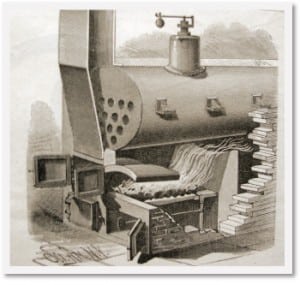
September 1886 Four years after this magazine was launched, the editors reviewed the latest improvements to industrial boilers, beginning with the Backus furnace (Figure 1). 1. The Backus furnace. “This furnace is provided with a brick arch placed just back of the fire-doors, that is intended to deflect the currents of air that are admitted […]
-
 Synfuel
Fueling around
Europeans didn’t know that corn existed before Columbus "discovered" America. It had been cultivated by indigenous North Americans for thousands of years before the Italian brought home what was to become a favorite food for many. The more adventuresome even figured out how to distill corn into something more to their liking. Fast-forward five hundred […]
-

Is ratepayer funding of utility R&D outdated?
Southern California Edison Co. (SCE) is requesting regulatory approval to recover over $50 million from ratepayers to analyze the feasibility and cost of a "commercial-scale" clean hydrogen power generation (CHPG) facility that would gasify coal to fuel a combined-cycle power plant and sequester the associated carbon emissions underground. If the study demonstrates the CHPG technology […]
-
 News
NewsRetrospective
August 1886 POWER reported on one of the first twin-cylinder "Otto" natural gas–fired engines that had recently appeared in the U.S. power market. The report notes that "engines of 100 horsepower are being now economically used where gas is low in price, as in England and other European countries" (Figure 1). 1. A twin-cylinder "Otto" […]
-
 News
NewsJust say no to power poaching
The Energy Policy Act of 2005 gave the Federal Energy Regulatory Commission (FERC) the authority to override state and local opposition to the construction of interstate transmission lines if the agency determines that they will reduce system congestion. In April, the Department of Energy designated two regions that might qualify for such treatment as "national […]
-

New math
James Thurber once said that it is "easier to ask some of the questions than to come up with all the answers." As a magazine editor, I get to ask lots of questions and make plenty of suggestions. Not everyone likes my suggestions, but I trust the readers of POWER to make their own studied […]
-
 News
NewsRetrospective
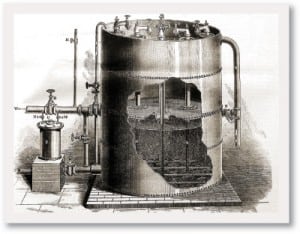
June 1886 POWER reported on the art and science of water treatment and its effect on boiler performance in the cover story this month. "Dr. J.G. Rogers, an authority on steam generation, is quoted as stating that one-sixteenth of an inch of scale in a boiler will require the extra consumption of 15% more fuel; […]
-
 News
NewsNot your grandfather’s power industry
In 1882, Americans talked of John L. Sullivan, the bare-knuckles boxing heavyweight champion of the world, as horse-drawn carriages jingled along city streets. The spidery cables of the Brooklyn Bridge spanned the East River and hundreds of workmen scrambled to complete the great project. Railroads crossed the continent, but sporadic Indian warfare still plagued […]
-
Nuclear ambitions
Ten years ago, any self-respecting U.S. utility executive might have been drawn and quartered for publicly promoting a nuclear power revival. How times have changed. Today, more than half of America’s nuclear plants have outsourced their operations to specialty firms, and the prospect of a nuclear renaissance in the U.S. (see Cover Story) is brighter […]
-
 News
NewsThis month in POWER…
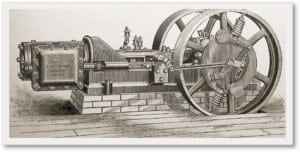
April 1884 POWER reported on the latest offering from Philadelphia-based Southwark Foundry and Machine Co. (Figure 1) as its lead story. "This is a self-contained, high speed automatic cut-off engine. It has been designed with special reference to simplicity, and solidity of parts, and to heavy and continuous work. 1. The Southwark engine was the […]
-

Unequivocal bragging rights
The new congressional leadership has promised a "new" agenda for fighting climate change based on reducing the quantities and rate of growth of greenhouse gases (GHG) discharged to the atmosphere. My first question to the Democrats: Where have you been the past few years? My second: How much are you willing to spend to make […]
-
 News
NewsThis month in POWER …
March 1886 POWER reported on the latest development of a new and improved engine: "The chief feature of the Corliss engine [from Kendall & Roberts, Cambridgeport, Mass.] is the valve gear, which consists of four cylindrical valves, two each for admission and exhaust, operated from a central swing or stud plate; the steam valves being […]
-
 News
NewsThis month in POWER . . .
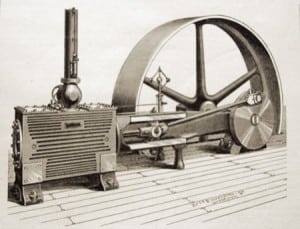
February 1885 The cover story examined the latest in reciprocating engine technology: the Greene automatic cut-off engine (Figure 1). Here is how the editors described it: "The engine has a girder frame; guides case separate and dowelled and bolted to the bed plate; four-part main boxes; Porter governor. There are two steam and two exhaust […]
-
 Commentary
Will FERC’s transmission siting rule create more jurisdictional conflict?
Federal Energy Regulatory Commission (FERC) Order No. 689, issued on Nov. 16, 2006, established requirements and procedures for granting permits to build transmission facilities within "national interest electric transmission corridors" designated by the U.S. Department of Energy (DOE). After summarizing the statutory and regulatory background, this opinion piece addresses jurisdictional conflict between FERC and states, […]