Abilene-based Natura Resources, which won the first federal construction permit for a liquid-fueled molten-salt reactor in 2024, will work with NGL Water Solutions Permian to explore deploying its 100-MWe reactor design alongside thermal desalination systems to transform briny drilling waste into usable water—while powering data centers and other industrial loads hungry for around-the-clock electricity.
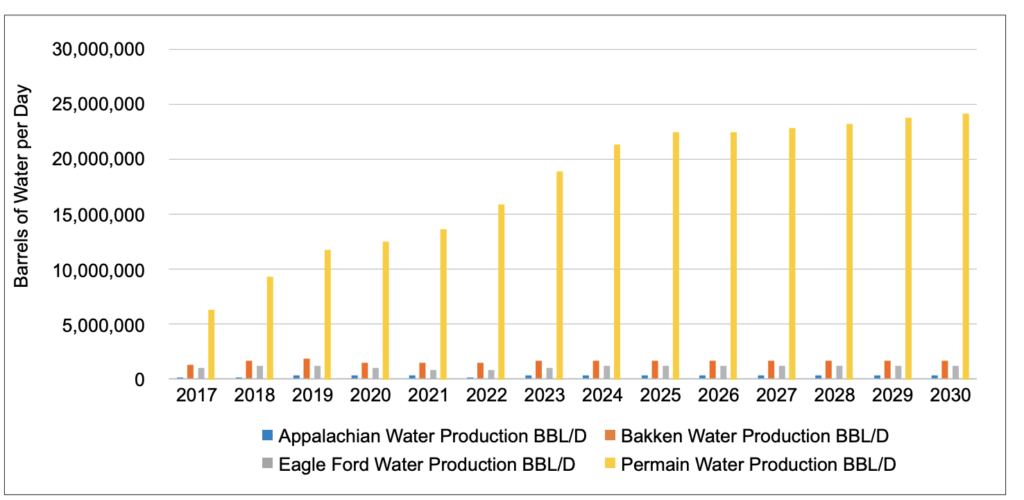
The agreement announced on Feb. 3 hones in on collaborative opportunities in the Permian Basin, the sprawling oil and gas formation spanning West Texas and southeastern New Mexico, where oil and gas operations produce more than 20 million barrels of produced water daily as a byproduct of unconventional drilling that typically contains high concentrations of salts, minerals, and hydrocarbons.
Under the memorandum of understanding, NGL, which already handles more than 3 million barrels per day of produced and flowback water across the basin, will contribute water treatment and desalination expertise and leverage an expected Texas Pollutant Discharge Elimination System (TPDES) permit that would allow discharge of treated effluent to surface waters. Natura will provide its MSR-100, a 100-MWe commercial-scale reactor design the company expects to deploy in 2029, to supply continuous baseload power and high-temperature process heat for thermal desalination operations.
While the companies have not disclosed capital costs or a final investment timeline for the proposed combined nuclear-powered treatment facility, NGL has identified Reeves County, Texas, as a target location and confirmed that the project would be paired with the company’s TPDES outfall in the Delaware Basin, where permitting is advancing toward issuance early this year.
“The combined system will have potential application for treating produced water from oil and gas operations on an industrial scale and will generate power and clean water for potential beneficial use in data centers, agriculture, and as a new water source for other industries,” the companies said.
The integrated system is also expected to support NGL’s development “of critical mineral extraction from its produced water,” which could include lithium and other critical minerals that federal researchers have identified in produced water streams, particularly in the Permian Basin, where volumes and concentrations present the largest potential recovery opportunity.
Addressing the Energy-Water Nexus
The collaboration seeks to address a converging concern about rising electricity demand from data centers and industrial loads in West Texas, chronic produced-water disposal constraints, and the need for new freshwater sources in the arid region.
Data centers alone are driving unprecedented load growth across the Electric Reliability Council of Texas (ERCOT) grid. In a December 2025 system planning update to its board, ERCOT reported it was tracking approximately 226 GW of large loads seeking interconnection as of mid-November—up from 63 GW in December 2024—with roughly 73% of those requests tied to data centers. ERCOT noted that many individual projects exceed 1 GW in size, which underscores the scale of demand now moving through the interconnection queue. While not all proposed projects are expected to materialize, ERCOT warned that even partial realization of these requests would materially reshape system planning assumptions. The grid operator’s analysis shows that large-load demand seeking interconnection by 2030 has increased by roughly 142 GW, or 270%, since the beginning of 2025, driven primarily by data centers and other energy-intensive industrial loads.
Meanwhile, the Permian Basin produces substantial daily volumes of produced water, which is wastewater brought to the surface during oil and gas extraction that typically contains high concentrations of dissolved salts, heavy metals, naturally occurring radioactive materials, and residual hydrocarbons. For decades, the dominant method for managing produced water has been deep subsurface injection into saltwater disposal wells, where fluids are pumped into porous rock formations thousands of feet below the surface, a practice long viewed as both cost-effective and protective of surface water resources.
However, managing this volume has become a significant operational constraint for oil and gas producers as disposal options narrow. Deep injection wells have been linked to induced seismicity, prompting the Railroad Commission of Texas to impose restrictions, including enhanced monitoring requirements and volume limits in seismic response areas. Those restrictions, combined with rising reservoir pressures in disposal formations, have constrained available injection capacity. Industry analysis indicates that operational disposal capacity in the Texas Permian is estimated at approximately 31 million barrels per day—roughly 40% below permitted capacity—due to reservoir pressure constraints and regulatory restrictions.
A Nuclear-Powered Desalination Opportunity
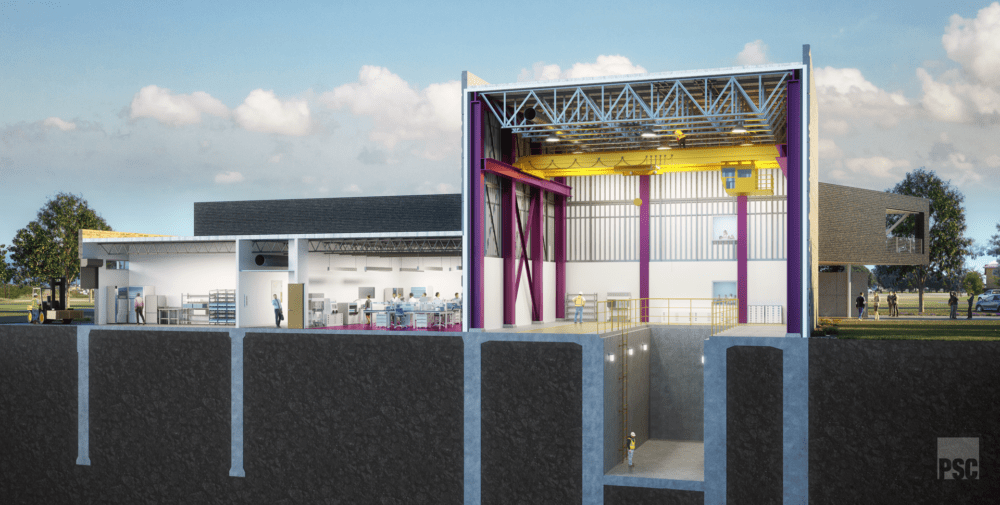
According to Natura, the collaboration could model molten-salt nuclear technology as a dual-purpose infrastructure solution, a concept the company has pursued since forming the Nuclear Energy eXperimental Testing (NEXT) Research Alliance in 2019 with Abilene Christian University (ACU), Georgia Institute of Technology, Texas A&M University, and The University of Texas at Austin. In November 2022, the Nuclear Regulatory Commission (NRC) accepted ACU’s construction permit application for Natura’s 1-MWth Molten Salt Research Reactor (MSRR), and in September 2024, the agency issued the construction permit—the first for a liquid-fueled reactor in U.S. history and the first for a research reactor in decades.
In July 2024, notably, Natura partnered with the Texas Produced Water Consortium (TxPWC) at Texas Tech University to explore deployment of its molten salt reactor (MSR) technology in the Permian Basin for dispatchable energy paired with produced water treatment facilities. TxPWC, a state-supported research entity created by the Texas Legislature in 2021, is tasked with providing guidance on policies for beneficial use of treated produced water. That partnership sought to demonstrate how commercialized molten salt reactors in remote areas could achieve economic feasibility for treating new water sources while providing additional electric generation capacity, according to the announcement.
“Texas is facing a serious, long-term challenge of ensuring that there is enough energy and clean water to sustain the current economy and support growing demands for power and water,” said Doug Robison, founder and CEO of Natura Resources. “Our molten salt reactor combined with thermal desalination can provide a sustainable, competitive solution by generating clean, economic power; treating industrial water for beneficial use; and freeing up natural gas supplies for higher value applications. Collaborating with NGL allows us to advance the application of our breakthrough nuclear technology where it can make a measurable difference for industry, communities, and the environment.”
Natura has said its molten-salt reactor design is structured to support direct coupling with thermal desalination and other industrial heat applications because it operates at high temperature and near-atmospheric pressure, which allows reactor heat to be used for industrial processes without the constraints associated with pressurized, water-cooled systems.
The company’s liquid-fueled architecture circulates fissile material dissolved in a molten fluoride salt, which serves simultaneously as fuel and coolant and operates at temperatures exceeding 600C—conditions compatible with heat-driven water treatment technologies such as multi-effect distillation and related thermal separation processes. Because the system does not rely on large volumes of cooling water and does not operate under high pressure, it reduces balance-of-plant complexity while enabling continuous baseload operation suited for large-volume desalination loads, it says.
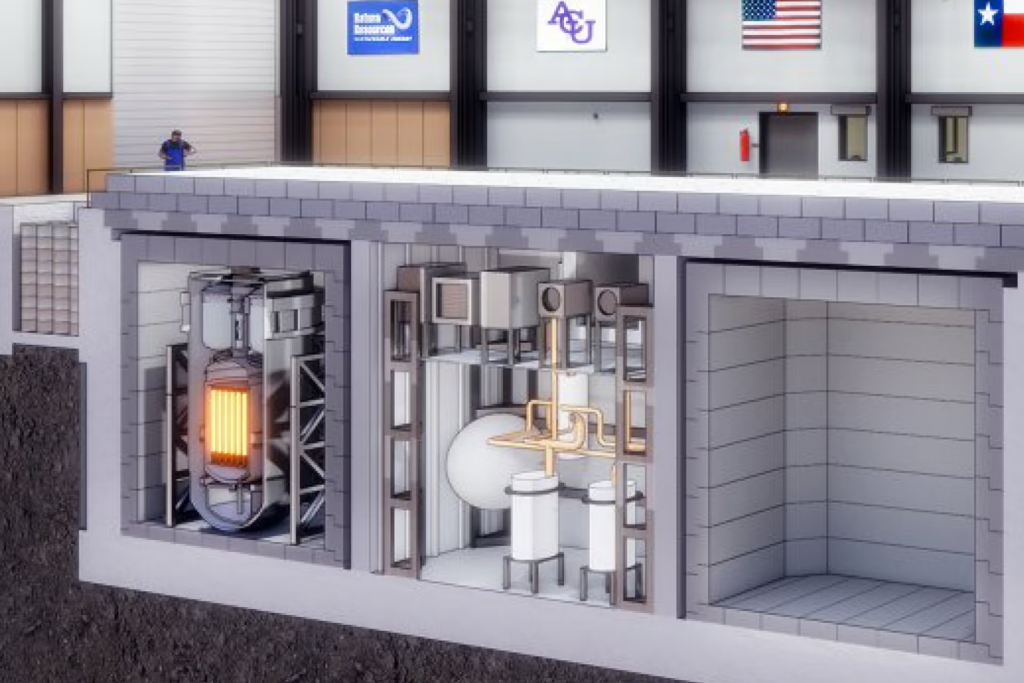
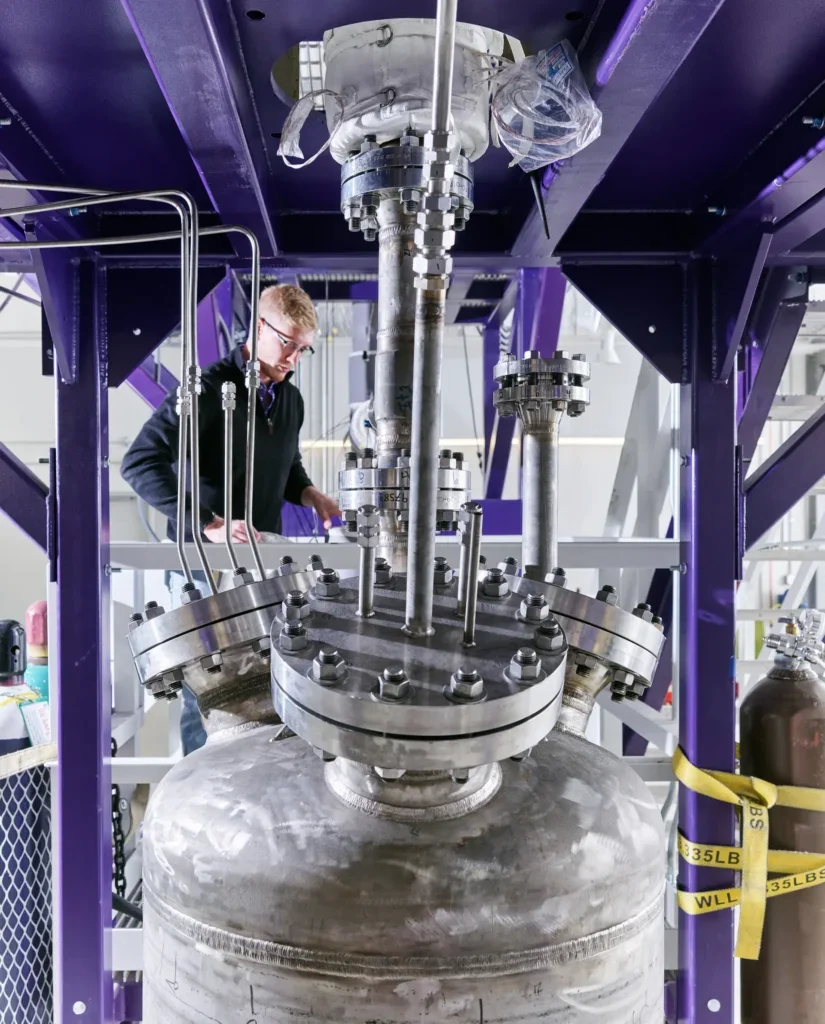
Courtesy: Natura Resources / Abilene Christian University.
“Natura’s modular construction, smaller footprint and reduced water requirements make it an ideal nuclear power technology for collocation with thermal desalination,” the company said on Tuesday. “Its lower capital costs and shorter construction timelines will generate power that is cost-competitive with other clean, 24/7 sources, including natural gas. Natura’s liquid-fuel, molten-salt system also will operate at atmospheric pressure, enhancing safety, reducing waste, and enabling the potential use of different fuels, including recycled nuclear fuel.”
The company’s development program appears to have advanced beyond early-stage design. Natura is participating in the DOE’s Reactor Pilot Program through an executed Other Transactional Agreement, under which the company is pursuing DOE authorization to bring its 1-MWth molten-salt research reactor (MSR-1) to initial operation and criticality at ACU. The DOE has conditionally committed to supplying High-Assay Low-Enriched Uranium (HALEU) for the MSR-1 deployment. In January 2026, the DOE also selected Natura to receive an allocation of lithium-7–enriched fluoride salt (FLiBE) that was used in the historic Molten Salt Reactor Experiment (MSRE) at Oak Ridge National Laboratory, a measure that cleared a key materials milestone required for MSR-1 to achieve criticality and keep the project on track for deployment in 2026.
In parallel, Natura is advancing plans to scale the technology. The company expects to deploy its first commercial reactor, the 100-MWe MSR-100, in Texas by 2029, likely at Texas A&M University’s RELLIS Campus. Separately, in February 2025, Natura announced a memorandum of understanding with TTU, ACU, and TxPWC to explore a potential Permian Basin deployment integrating molten-salt reactor technology with produced-water desalination.
NGL: Scaling Treatment Through Heat, Volume, and Phased Investment
For NGL Energy Partners LP, the memorandum of understanding with Natura reflects a longer-running strategic push to move produced water management beyond injection disposal and toward large-scale treatment and reuse, driven by seismicity constraints, pressure limitations, and tightening regulatory scrutiny across the Permian Basin.
NGL, notably, operates one of the largest produced-water handling systems in the U.S., overseeing roughly 90 water treatment and disposal facilities and approximately 194 disposal wells across the Permian Basin and other major producing regions. That footprint is supported by more than 800 miles of large-diameter water pipelines and a combined permitted disposal capacity of about 6.5 million barrels per day, with more than 88% of volumes now transported via pipeline rather than truck.
Speaking during the company’s recent earnings call on Tuesday, Doug White, executive vice president of NGL Water Solutions, said that NGL has been evaluating alternatives to injection for several years and has prior experience operating desalination systems. “We continue to explore the alternatives to injection based on seismicity, poor pressure increasing, just being prudent operators, we’ve continued for several years to be looking for other alternatives to injection,” he said. “You might remember our very successful desalination project in Pinedale, Wyoming. We have a history and experience in the [desalination] part of the business.”
White said recent policy shifts and customer pressure have sharpened the company’s focus on scaling produced-water treatment beyond injection disposal. He pointed in particular to Texas’ passage of a statewide water funding program that commits roughly $1 billion per year to developing new water supplies, alongside growing federal support for domestically sourced critical minerals. At the same time, White said producer customers are increasingly pressing NGL for alternatives to traditional disposal options. “Our customers are paying attention, the producers, and saying, ‘Hey, NGL, where are you going to take my water?’” he said.
At the core of NGL’s strategy is scale. White said large-volume treatment becomes economic only where several conditions align, starting with sustained produced water throughput. “You have to have produced water volumes that support an [economically] scaled plant,” he said. “We checked that box. Our large system is the reason we applied for our outfalls on our Texas Pollutant Discharge Elimination System permit in Reeves County—because we can deliver 800,000 barrels a day of water to that location.”
Energy supply is the second critical variable—and where nuclear enters the equation. White stressed that the value proposition is not primarily electricity, but heat. “Nuclear power generation produces about 60% waste heat,” he said. “We would use that waste heat to do thermal desalination of our water. It’s not really about the electricity—the 40% electricity that’s produced—it’s really about the waste heat.” White added that the approach effectively treats energy production itself as part of the water treatment process and could enable thermal desalination at scales that would be difficult to support with grid-connected or fuel-constrained systems alone.
Still, under NGL’s phased approach, large-scale desalination would not be built all at once. “We won’t go straight to a giant-scale treatment,” he said. “Maybe we start with a 50,000-barrel-a-day plant that’s able to be scaled.” Initial facilities will likely be powered by natural gas and expanded over time as customer contracts, downstream water demand, and project economics mature, he said.
White also added that the MOU with Natura does not alter NGL’s near-term capital plans. “There will be no CapEx demand to NGL on the nuclear side,” he said, noting that any larger investment would follow permitting milestones and contracted volumes. If both projects advance, “we would put the two projects together to really create a unique and exciting project,” he said.
NGL’s leadership framed the effort as part of a longer transition away from a disposal-only model. “The future of our business five to 20-plus years from now is not dependent upon drilling more and more saltwater disposal wells,” said H. Michael Krimbill, CEO of NGL Energy Partners. “Ultimately, we must treat the produced water to a quality that can be released on the surface for irrigation, industrial, and municipal use. The Natura agreement and the anticipated discharge permit are two of the steps in that direction.”
—Sonal Patel is a POWER senior editor (@sonalcpatel, @POWERmagazine).