Latest
-
 Legal & Regulatory
EPA Mulls Revising Nuclear Plant Radiation Standards
The Environmental Protection Agency (EPA) is calling for public comment and information on approaches to updating radiation protection standards for nuclear power operations. The standards have not been updated since they were originally issued in 1977. The agency issued an Advanced Notice of Proposed Rulemaking on Feb. 4 in the Federal Register and related fact […]
-
 Wind
WindWest Coast Floating Offshore Wind Project Gets DOI Green Light to Advance
The first offshore wind project proposed in federal waters off the West Coast garnered approval from the Department of Interior (DOI) on Wednesday to submit a formal construction plan. The Bureau of Ocean Energy Management (BOEM) gave Principle Power the green light to submit a formal plan to build a 30-MW pilot project that will […]
-
 Legal & Regulatory
EPA to Hand Over GHG Permitting Authority to Texas
The Environmental Protection Agency (EPA) last week proposed to approve revisions to a Texas state plan to regulate greenhouse gas (GHG) emissions in the state. If finalized, likely later this year, the EPA will rescind its Federal Implementation Plan (FIP) that is currently in place and grant the state GHG permitting authority. According to the […]
-
 Coal
CoalEPA Reports Toxic Air Releases Down Due in Part to Coal Plants
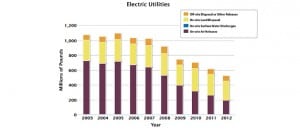
The Environmental Protection Agency (EPA) reported on Feb. 4 that total releases of toxic chemicals decreased 12%, while toxic air releases were down 8% in its annual Toxics Release Inventory (TRI) report. The data—from 2012—was compiled from 21,024 facilities that are required to report to TRI. Of that total, only 582 of the facilities fall […]
-
 Coal
CoalDuke’s Dan River Station Suffers Coal Ash Spill [UPDATED]
[Update Feb. 10] Duke Energy workers have succeeded in permanently stopping the leak from its coal ash pond at the Dan River Steam Station, the company reported on Feb. 8. A storm drain under the pond broke on Feb. 2, releasing coal ash and contaminated water into the Dan River. The leak was not plugged […]
-
 Renewables
The Power Potential of Southern Africa
Power produced by South Africa represents 40% of Africa’s total—yet that country is facing a crippling supply shortfall. Emergencies are offset with imports from its neighbors in southern Africa, some of which are electricity poor, and others that are latent supply giants. “Power Africa,” the recently announced U.S. initiative that earmarks $7 billion in public […]
-
 General
New Products (February 2014)
The RCTrms-3ph current transducer from Power Electronic Measurements offers a relatively convenient, safe, and accurate solution for measuring current in three phases. It has a thin, clip-around, flexible
-
 Coal
CoalTexas and the Capacity Market Debate
On Feb. 2, 2011, a winter storm gripped the Lone Star State, bringing freezing temperatures and heavy ice loads onto the state’s electric infrastructure. Texas experienced a series of unexpected rolling
-
 Instrumentation & Controls
Generation Cybersecurity: What You Should Know, and Be Doing About It
Cybersecurity has become a topic of interest over the past year in generation, owing to new developments in North American Electric Reliability Corp. Critical Infrastructure Protection (NERC CIP) regulations