
Latest
-
 Coal
PRB Tech Notes: New Plant/Old Plant: Are We Applying What We’ve Learned?
In the last issue of COAL POWER, I urged readers to give coal handling the priority it deserves. The coal yard warrants as much attention as boilers and combustion systems, turbine-generators and auxiliaries, and postcombustion emissions control — the other three “zones” within the plant perimeter — because it is an equally valuable business unit. […]
-
 O&M
Coal Plant O&M: Continuous On-line Monitoring Cuts Downtime, Costs
As gencos seek to improve plant reliability and availability, many are turning to on-line condition monitoring for help. Huge advances in the capabilities of on-line diagnostics have occurred over the past five years. By using this technology, plant personnel can spot early warning signs of impending equipment failure and take action to correct the underlying […]
-
 Coal
SO3 Control: AEP Pioneers and Refines Trona Injection Process for SO3 Mitigation
Using a selective catalytic reduction (SCR) system to reduce the emissions of nitrogen oxides (NOx) from a coal-fired power plant is rapidly becoming the norm, rather than the exception. But for many plants, adding an SCR system has unintended consequences: greater oxidation of sulfur dioxide (SO2) to sulfur trioxide (SO3), and a rise in stack […]
-
 O&M
SO3 Control: Dominion Demonstrates CleanStack Technology
Dominion Generation (DG) has installed selective catalytic reduction (SCR) systems on many of the large coal-fired generating units it operates. The catalyst used has an SO2 to SO3 oxidation rate of about 1%, which roughly doubles the SO3 concentration at the outlet of the boiler economizers. The magnitude of the increase was proportional to the […]
-
 O&M
SO3 Control: How Many Coal Plants Might Have Opacity Issues Due to SO3 Emissions?
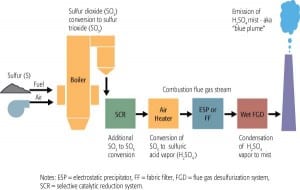
Flyash and condensed sulfur trioxide (SO3) are the major components of flue gas that contribute to the opacity of a coal plant’s stack emissions (stack opacity). Estimates are that 75% to 85% of bituminous coal-fired plants with selective catalytic reduction (SCR) and/or wet flue gas desulfurization (FGD) systems are likely to produce enough SO3 vapor […]
-
 Coal
The Coal Pile
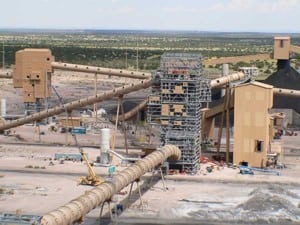
This month’s photo was submitted by David Carter, power generation supervisor at Springerville Generating Station. Readers of POWER may recall that Springerville Unit 3 — the first pulverized coal – fired unit built in the U.S. in more than a decade — was that magazine’s 2006 Plant of the Year. Located in northeastern Arizona, the […]
-
 Environmental
Birds in the hand for CO2
The January call for a national policy on greenhouse gas (GHG) emissions by a coalition that includes some of America’s largest companies and electric utilities—GE, Alcoa, Dupont, Duke, FPL, and PG&E—makes clear that carbon management is now as much of a raison d’être for CEOs as it has been for environmentalists. The momentum to reduce […]
-
 Gas
Global Monitor (February 2007)
China to buy four AP1000 reactors / Midwest Gen, Blagojevich reach pollution deal / Behold, the carpet gasifier / AREVA casks green-lighted by NRC / Brookfield Power upgrades Oswego Falls / Korea fires up 50-MW landfill gas project / Alstom lands big Russian deal / POWER digest / Correction
-
 O&M
Focus on O&M (February 2007)
The compliance clock is ticking / First-class maintenance in a developing country / Bypass losses squander big bucks / Revised operating procedures
-
 Legal & Regulatory
The tyranny of the final, nonappealable condition
The financing of power generation projects increasingly depends on the execution of a long-term power-purchase agreement (PPA). A common prerequisite for considering a PPA to be “effective” is a “final and nonappealable” regulatory order approving it. Purchasing utilities justifiably insist on such certainty to immunize their PPAs from after-the-fact regulatory scrutiny and possible penalty. Unfortunately, […]