
Latest
-
 Environmental
Help Build the Global Energy Observatory
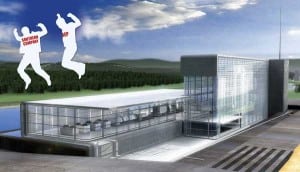
How would you like to be able to access data on all the power plants in the world and all of their performance metrics, analyze that data, and map it? Those abilities are part of the vision behind the Global Energy Observatory (GEO), an OpenModel website that serves as a wiki for global energy data.
-
 Coal
CoalRevived FutureGen Faces Renewed Funding Obstacles
A little more than a year after the Bush administration abruptly withdrew its support for the FutureGen project, the Department of Energy has again announced it will back the proposed Illinois gasified coal power plant and carbon capture initiative. Though the 275-MW project may be different in technical aspects — it will be initially designed for 60% carbon capture, not 90%, and gasify only Illinois Basin Coal (Figure 2) — it is still riddled with many of same funding problems. Making matters worse, it may have been revived too late: Since the DOE withdrew its support, several major carbon capture and storage (CCS) projects and alliances have sprouted in the U.S., and these could give FutureGen a run for its money.
-
Coal
How Much Coal Does the U.S. Really Have?
The U.S. Geological Survey (USGS), a federal mapping agency, has of late been propounding the difference between "resources" and "reserves." It says that although the two terms are used interchangeably, the distinction is simple: Reserves are a subset of resources. Coal resources, as an example, include those in-place tonnage estimates determined by summing the volumes for identified and undiscovered deposits of coal, whereas coal reserves are those resources considered "economically producible" at the time of classification, even though extraction facilities are not in place and operative.
-
 Coal
CoalOf Fracking, Earthquakes, and Carbon Sequestration
Hydraulic fracturing — the process of drilling and then pumping fluid deep into a formation to generate fractures or cracks, typically for extracting natural gas from shale formations — has been under fire lately, owing to concerns that it contaminates drinking water. But while Congress debates proposed legislation that would impose new restrictions on the technology, an entirely different concern related to fracturing — or "fracking" — is emerging: It may trigger earthquakes.
-
 Wind
WindFloating and Flying Wind Turbines
After months of preparation, Norway’s StatoilHydro and Germany’s Siemens in June erected the world’s first large-scale floating deepwater wind turbine some 7 miles offshore Karmøy, southeast Norway, on the 720-feet-deep waters of the Amoy Fjord. The developers are now gearing up to connect the Hywind turbine to the local grid, and it could begin producing power as early as mid-July.
-
 Coal
CoalMajor Scottish Coal Plant Starts CCS Pilot Program
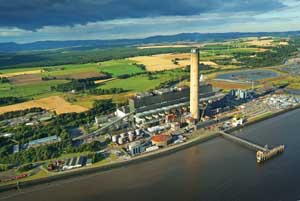
Energy provider ScottishPower on May 29 flicked on the switch of a carbon capture and storage (CCS) pilot program at its 2,304-MW coal-fired Longannet power plant, in Fife, Scotland, marking the beginning of a seven-month test — and the first time a UK coal-fired power plant has reportedly attempted to capture its carbon emissions.
-
 Solar
SolarEuropean Interest in Saharan Solar Project Heats Up
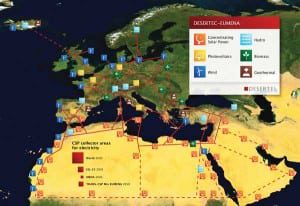
Plans to install a series of solar panel farms in the Sahara Desert to power Europe and North Africa are heating up. The idea was discussed in May as part of the newly formed Mediterranean Union, launched at a summit in Paris, and it now has the backing of both UK Prime Minister Gordon Brown and French President Nicolas Sarcozy.
-
 Waste to Energy
Turning Sewage into Renewable Energy
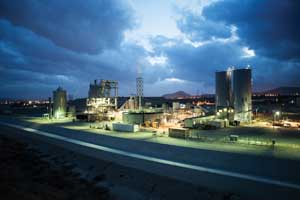
News has been emerging from around the world about several projects that seek to turn human sewage — arguably the dirtiest of manmade wastes — into clean energy.
-
 O&M
O&MManaging Minimum Load
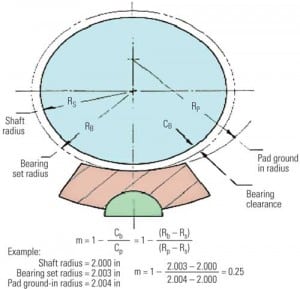
Reducing the minimum load at which a steam turbine can reliably operate is one way to increase revenue for marginal base-loaded units during periods of low electrical demand. For this reason, it is not unusual to see merchant plants operating at "super minimum" load levels that are well below the typical 25% rated full-load limits. However, such units are operating well outside the original equipment manufacturer (OEM) design basis, and owners may experience undesirable damage to their turbines for a number of reasons. That’s why it is important for owners to understand the trade-offs and risks that come with such operation.
-
 O&M
O&MPolymeric Solution for Pump Cavitation
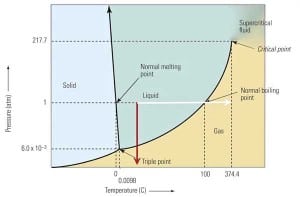
Cavitation is defined as the phenomenon of forming and imploding vapor bubbles in a region where the pressure of the liquid falls below its vapor pressure. Cavitation and the resultant damage can occur in any fluid-handling equipment, especially in pumps. Technological advances in industrial protective coatings and composite repair materials have made it possible to repair pumps operating in a cavitating environment rather than simply replacing them after damage occurs. Cavitation-resistant (CR) elastomers have the ability to retain adhesion under long-term immersion, dissipate energy created under high-intensity cavitation, and provide outstanding resistance to corrosion and other forms of erosion.