
Energy and analytics group Enverus said it has launched an artificial intelligence (AI)-based platform that will serve as a new execution layer for the energy industry.
The company on April 7 said its Enverus ONE system is “built on decades of data, intelligence and workflows across the energy sector … accelerates the work of energy by embedding into existing processes, automating tasks, and surfacing answers in minutes that used to take days.”
Enverus, a partner with POWER on the latter’s POWER Plant ID (Intelligence Database), on Tuesday said Enverus ONE was built to end the fragmentation that can occur across data, documents, models, systems, and teams working on energy projects.
“Enverus ONE is live,” said Manuj Nikhanj, CEO of Enverus. “We have spent decades building the intelligence layer of the energy industry. Enverus ONE is what we have always been building toward: a single, governed platform where fragmented energy work resolves into execution. This is the platform energy runs on. The gap between the companies that move now and the companies that wait is going to be significant and it is going to compound.”
The company on Tuesday said that Enverus ONE pairs “frontier AI models with Astra, Enverus’ proprietary energy model. Frontier models provide general intelligence. Astra provides the operating context required to evaluate assets, validate costs, interpret contracts, and resolve energy workflows that generic AI cannot efficiently execute with reliability.”
Enverus ONE can serve several energy sectors, including electric utilities and power generators. The company said Enverus ONE is launching “with four execution-ready Flows designed to eliminate the manual, fragmented processes that slow land, operations, and development teams. Many more Flows are in production and slated for future releases.”
The current FLOWS include:
- AFE Evaluation: AFE Evaluation ingests AFEs, validates ownership, and runs offset-based economics automatically compressing evaluation cycles that typically take weeks into hours so teams can determine whether to participate, non-consent, or market their interest with greater speed and defensibility.
- Current Production Valuation: Current Production Valuation automates the sequence of well selection, production data loading, forecasting, and economic analysis into one connected workflow, reducing manual error and compressing the path from evaluation to action.
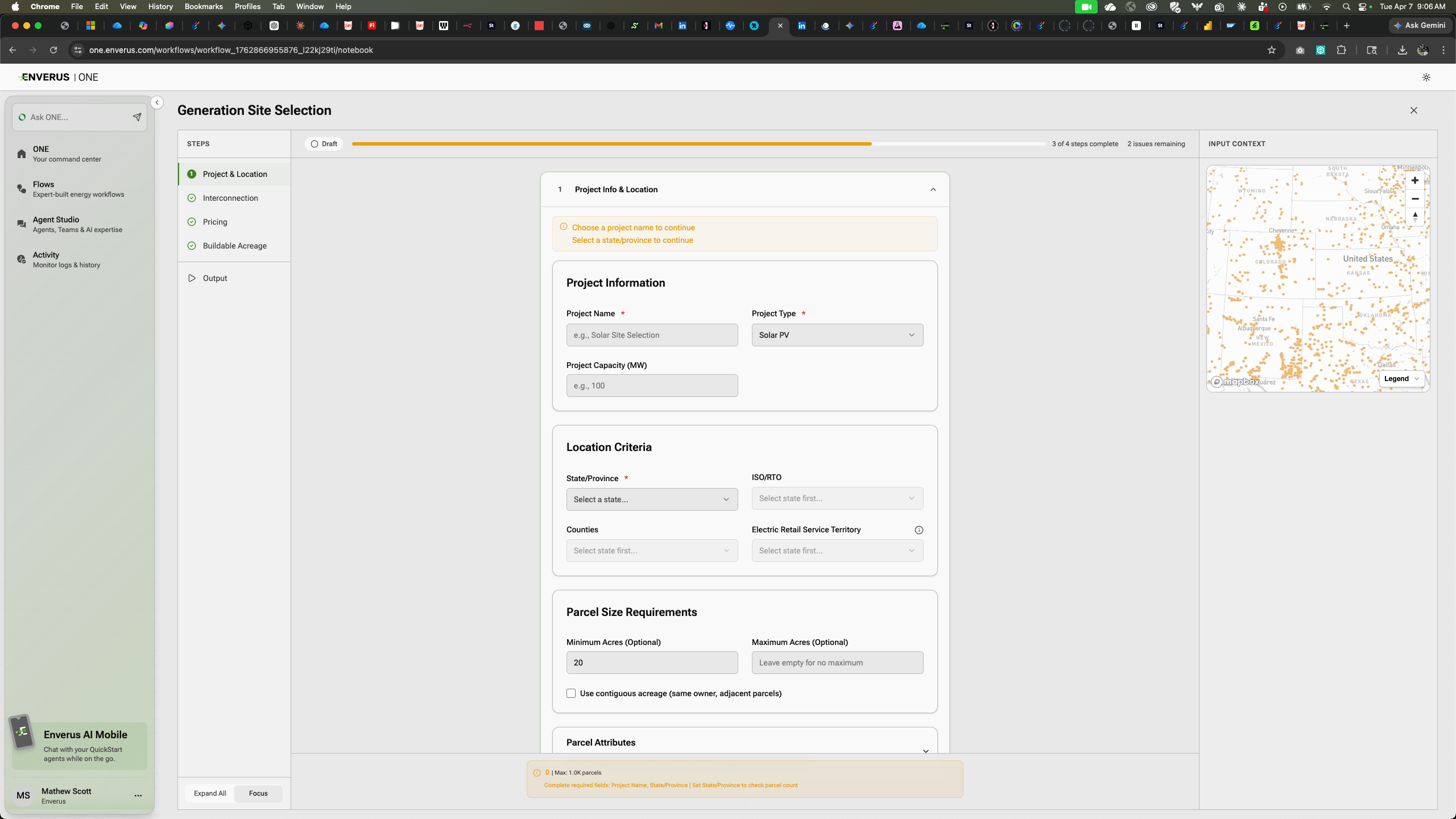
- Project Siting: Project Siting enables developers and analysts to apply multi-criteria filters across land parcels and generate structured multi-site reports, compressing weeks of evaluation across competition, infrastructure access, land availability, grid constraints, permitting realities, and other critical variables into a disciplined workflow.
- QuickStart: QuickStart allows teams to upload internal documents and immediately stand up a secure knowledge layer for secure conversational Q&A. Instead of losing time across PDFs, presentations, spreadsheets, reports, and internal files, users can begin working against proprietary information from day one.
“For energy companies, the barrier to AI adoption is control,” said Jimmy Fortuna, chief product officer at Enverus. “Sensitive operational, commercial, technical, and financial data cannot be pushed into loose AI systems and public models. Enverus ONE was built so every interaction is governed, auditable, and contained within a SOC 2 Type II certified private environment. That is what it takes to responsibly move from experimentation to execution at scale.”
—Darrell Proctor is a senior editor for POWER.