
Articles By

-
News
Bait and Switch
The Boxer-Sanders “Climate Protection Act” and its sister bill, the “Sustainable Energy Act” are the latest, and perhaps the most onerous, in a series of legislative proposals that seek to tap the immense revenue stream promised by taxing carbon.
-
Business
Flavor of the Decade: What Energy Utilities Can Learn from Verizon
The experience of telecommunications giant Verizon shows why taglines that promise clear, relevant benefits to customers can be invaluable, as long as the company follows through.
-
 Business
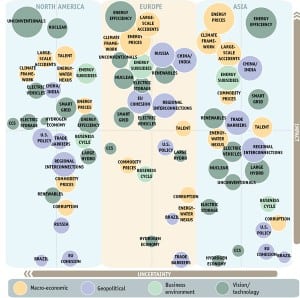
THE BIG PICTURE: Critical Energy Agendas
The global energy sector will need to invest half of current world gross domestic product over the next two decades in order to address a number of critical issues and expand and adapt the energy infrastructure, the London-based World Energy Council (WEC) says in its recently released World Energy Issues Monitor. Here are the most […]
-
Nuclear
mPower: It’s Now or Never
Christofer Mowry, president of Babcock & Wilcox mPower Inc. and CEO of Generation mPower LLC, a joint company of Babcock & Wilcox and Bechtel to design and build the mPower small modular reactor that won a competition for a Department of Energy cooperative funding agreement, discusses the machine and the market.
-
Commentary
Utility Mergers: Who Has a Vision?
Is bigger better for the energy business? Says a veteran energy lawyer, it depends more on why and how a utility choose to grow. Unfortunately, few regulators are thinking much about it.
-
 Coal
CoalIndia’s First Coal Mine–Integrated Supercritical Plant Synchronized
India’s Reliance Power in March synchronized the first of six 660-MW units of its Sasan Ultra Mega Power Plant (UMPP) in the state of Madhya Pradesh, readying it to supply power to 14 distribution companies across seven states. The plant (Figure 1) has been hailed as India’s first supercritical project to integrate a coal mine—an important achievement in a country that is battling chronic coal shortages. Though India has large coal reserves, domestic mining companies are struggling to keep up with demand needed to sustain its existing coal plants, which account for 55% of its generation.
-
Commentary
Partnering With the Right People
Finding the right people to work with is critical to success, but getting there is no accident.
-
 Nuclear
Construction Begins at Two U.S. Nuclear Reactors
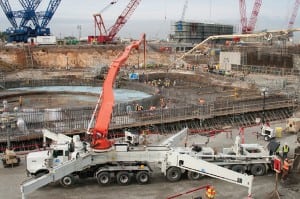
In the U.S., where construction of new nuclear reactors has stalled for three decades, two separate nuclear projects completed placement of basemat structural concrete for new AP1000 reactors a few days apart this March. SCANA Corp.’s South Carolina Electric & Gas Co. (SCE&G) marked the milestone on March 11 (Figure 2), completing concrete placement of the nuclear island basemat for its V.C. Summer Unit 2 in Fairfield, S.C., while Southern Co.’s Georgia Power completed placement for a nuclear island at its Vogtle Unit 3 nuclear expansion site near Waynesboro, Ga., on March 14 (Figure 3).
-
 Coal
CoalChina Wrestles with Power Shortages
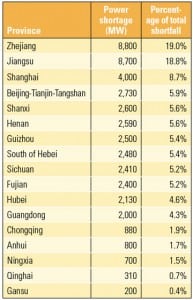
China has gone through three periods of nationwide power shortages since 1978. The previous two shortages were mostly caused by the lack of installed generation capacity. However, the third—which has severely restricted economic development—is a consequence of institutional problems that must be corrected.
-
Commentary
Workplace Drama: Courageous Course Correction
It’s never fun to realize you’re wrong. But effective leaders know when to admit it and take their lumps.
-
 Solar
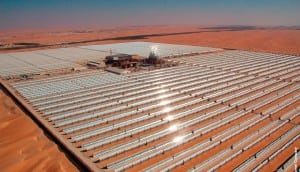
SolarSolar Thermal Gains in UAE, Spain, and California
Solar thermal technologies are experiencing increased popularity around the world. Three recent deployments illustrate how the technology and plant size specifics are tuned to local needs.
-
 O&M
O&MMicrobial Control in Cooling Water Improves Plant Performance
Microbial inhibition, as part of a robust cooling water treatment program, presents a special challenge because of the variability in makeup water sources, plant processes, and discharge permits. Failure to maintain a proper microbial inhibition program will affect your bottom line as a result of heat rate degradation.
-
Commentary
Let’s Dump the ‘Tipping Point’ Metaphor into the Waste Tip
Climate rhetoric has become increasing obsessed with "tipping points." But this sloppy metaphor risks taking good science over the cliff.
-
Nuclear
Too Dumb to Meter, Part 11
As the book title Too Dumb to Meter: Follies, Fiascoes, Dead Ends, and Duds on the U.S. Road to Atomic Energy implies, nuclear power has traveled a rough road. In this POWER exclusive, we present the 20th and 21st chapters, “Out of Sight and Mind” and “Holey Kansas,” the first two chapters of the “Waste Is a Terrible Thing to Mind” section.
-
 Hydro
HydroFirst Power for 1-MW Tidal Stream Turbine
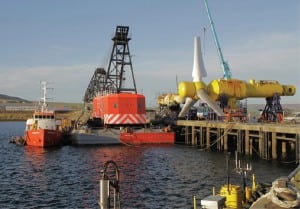
In a milestone for the fledgling marine power sector, Alstom’s 1-MW tidal turbine (Figure 6) generated power for the first time at the European Marine Energy Centre’s tidal test site in Orkney, Scotland.
-
Nuclear
Mexico Uses Nuclear Plant Simulator for Safe Training
Mexico’s Federal Electrical Commission needed a safe way to train new operators at its Laguna Verde Nuclear Power Plant in Veracruz, so it developed a stand-alone process simulator that allows trainees to practice a wide variety of plant operations and responses to incidents without putting the plant itself at risk.
-
Supply Chains
TREND: Rare Earth Minerals and Free Markets
Far from precipitating a crisis in high-tech manufacturing, the Chinese attempt to corner the market on rare earth minerals has instead inspired some healthy competition and adaptation.
-
Business
POWER Digest (May 2013)
Cuadrilla Delays UK Fracking Project to Conduct More Assessments. The UK’s largest shale gas explorer, Cuadrilla Resources Holdings, on March 14 said it would delay hydraulic fracturing operations at its Anna Road project until 2014, after data it had gathered from exploration of the Bowland Basin Shale in Lancashire confirmed assessments that the 1,200-square-kilometer license […]
-
 Coal
CoalCFB Scrubbing: A Flexible Multipollutant Technology
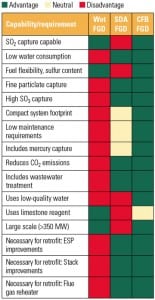
The number of regulated air emission constituents is increasing while the acceptable amounts for release are decreasing. In the long run, picking the most flexible multipollutant technology is surely the least cost option.
-
Nuclear
Nuke Waste: Same Old Same Old, Won’t Work Won’t Work
By Kennedy Maize Washington, D.C., April 29, 2013 – Last week, a bipartisan group of Senators, all of them mired in a failed paradigm, proposed a solution to the nation’s long-festering problem of what to do with what comes out of the back end of nuclear power plants. It’s nasty stuff, that’s for sure. But […]
-
Store
Kemper Cost Rises for Southern Company
By David Wagman Denver, April 25, 2013 — Southern Company said the 582-MW Kemper County integrated gasification combined cycle power plant under construction for its Mississippi Power utility will cost as much as $333 million more than the $2.88-billion cost cap state regulators are allowing for the project. The company said during an April 24 […]
-
Business
FERC Proposes Adoption of New Cybersecurity Standards
The Federal Energy Regulatory Commission (FERC) last week proposed a rule that it says could strengthen cybersecurity for the bulk electric system. The rule intended to improve the security posture of responsible entities was submitted in January 2013 by the North American Electric Reliability Corp. (NERC), and it constitutes version 5 of the Critical Infrastructure Protection (CIP) Reliability Standards.
-
Coal
Settlement Between Feds, Wisconsin Utilities Mandate More Coal-Plant Retirements
A settlement between the federal government, the Sierra Club, and Wisconsin Power and Light Co. (WPL) on Monday could require the Madison-based Alliant Energy subsidiary and other defendants to invest more than $1 billion in pollution controls and retire and refuel at least four units at three Wisconsin coal-fired power plants to resolve alleged Clean Air Act New Source Review violations.
-
Nuclear
Moniz Confirmation as Energy Secretary Expected This Week
The Senate Energy and Natural Resources Committee last week voted 21-1 to approve the nomination of Dr. Ernest Moniz to be Secretary of Energy. Moniz, a physicist from the Massachusetts Institute of Technology, is expected to win full Senate approval this week—with some minor hurdles.
-
Coal
EPA Proposes Revisions to Steam Electric Power Plant Effluent Guidelines
Revisions proposed on Friday by the Environmental Protection Agency (EPA) to technology-based effluent limitations guidelines and standards could set the first federal limits on the levels of toxic metals in wastewater discharges from steam electric power plants. The proposed rule would help reduce pollutants in U.S. waterways from coal ash, air pollution control waste, and other power plant waste, but they could come at a cost of between $185.2 million to nearly $1 billion a year, the agency said.
-
Hydro
Report: Global Renewable Investments in 2012 Tumble 11% as Market Shifts from West to East
Public and private investment in solar, wind, and other renewables worldwide declined 11% in 2012 from an adjusted 2011 record of $302 billion, a new survey from Pew Charitable Trusts shows. Yet the global renewable sector still registered a record 88 GW of new nameplate capacity last year, and China reclaimed the lead in global renewables investments from the U.S., it says.
-
Gas
New York State PSC Approves $2B Transmission Line from Canada
The New York State Public Service Commission (PSC) last week approved the construction and operation of a 1-GW transmission line that could stretch 330 miles from the Canadian border to Astoria, Queens, through Lake Champlain and the Hudson River.
-
Coal
Lawmakers Push for Financing Parity for Renewable Projects
Bipartisan legislation introduced on Wednesday by a bicameral group of lawmakers seeks to give renewable energy project investors access to an existing corporate structure whose tax benefits are now only available to investors in fossil fuel–based energy projects.
-
Marmaduke
FPL Completes $3B Uprate Project, Adds 500 MW to Four Nuclear Units
Florida Power & Light Co. (FPL) last week said it had completed a $3 billion five-year-long extended power uprate to add more than 500 MW to its Turkey Point and St. Lucie Nuclear Power Plants in Florida.
-
Nuclear
Japan’s Nuclear Decisions
By David Wagman Denver, April 23, 2013 — Japan’s Nuclear Regulatory Agency (NRA) is expected to release this July regulations for restarting the nation’s fleet of nuclear generating stations. Much of that capacity shut down following the March 2011 Fukushima nuclear accident. Those nuclear closures threw domestic Japanese and global energy markets into turmoil as […]