Data centers are already among the world’s hungriest power users, and artificial intelligence (AI) is pushing their energy consumption to new heights. The International Energy Agency expects data centers’ electricity use to more than double by 2030, reaching roughly 1,000 TWh. That’s a growth rate four times faster than the overall grid. In some scenarios, AI-optimized facilities could quadruple demand before the decade ends.
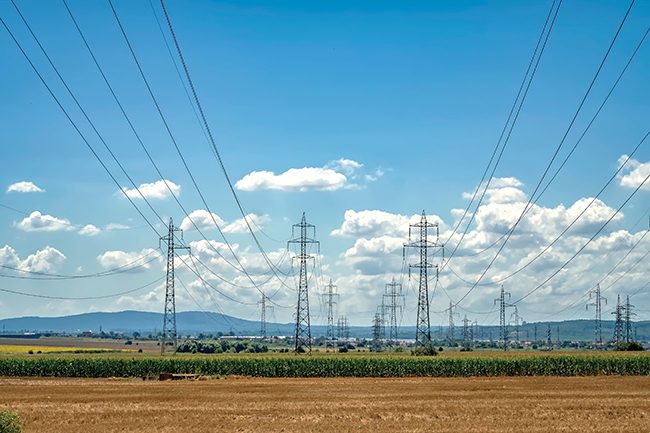
This growth collides with a U.S. grid that’s already stretched to its limit. In Virginia and Maryland, where the world’s largest cluster of data centers operates, demand is outstripping supply. Meanwhile, the country’s interconnection queues hold more than 2,000 GW of clean energy projects awaiting approval, and new transmission lines take about 10 years from concept to completion. The permit process alone takes up more than half of the timeline. This means that by the time a single high-voltage line is finished, AI’s demand could have doubled yet again.
We can expect this imbalance to result in two outcomes: higher costs and slower progress. When regions add peaker plants or stretch existing corridors, ratepayers shoulder the burden through higher tariffs and congestion fees. Given that the U.S. is investing record amounts in building power plants and transmission lines to meet the electricity demand of data centers, there is a plausible fear that the costs will inevitably be passed on to households and small businesses.
To scale AI without driving up emissions or increasing prices, we need to rethink how we power data centers. Commercial and industrial rooftops represent an untapped opportunity to generate clean and affordable electricity where it’s needed most.
The Untapped Energy Potential of Neighboring Rooftops
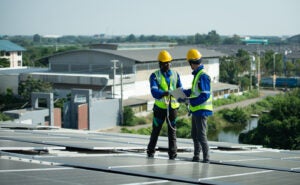
Data centers don’t exist in isolation. The facilities are housed in industrial parks and utility corridors with sites developed to address specific operational and security requirements. This surrounding infrastructure offers an immediate way to boost renewable energy generation on-site. The flat rooftops are ideal conditions for solar development, while also being close to the load and sharing the same zoning.
The National Renewable Energy Laboratory’s (NREL’s) national assessment shows the untapped potential of U.S. rooftops is enormous. The commercial and industrial (C&I) subset is particularly valuable due to roof size, structure, and nearby consumption. Most large logistics warehouses have massive roof footprints but extremely low electricity demand, and only need 5% to 10% of their roof area to meet their own consumption. The remaining 90% is ideal for hosting generation that could feed a nearby data center.
Surrounding rooftops represent a distributed solar power network that is already in place at scale, while also offering other clear advantages, which include:
- Proximity. Every kilowatt generated on a warehouse or factory roof is a kilowatt that doesn’t need to travel through a congested transmission corridor. That reduces curtailment risk, line losses, and the need for costly upgrades.
- Speed. Rooftop solar projects can go from blueprint to operation in months. Systems under 2 MW usually follow streamlined permitting and interconnection paths, helping to tackle the lengthy delays associated with utility-scale projects that sit in queues for five years or more.
- Private Financing. C&I solar projects are usually funded through power purchase agreements or solar leases, meaning developers and building owners—not ratepayers—carry the investment. That keeps electricity prices stable and predictable for 10 to 25 years.
A prime example is New Jersey, which has a significant number of data centers. With its proximity to New York and Philadelphia, the state’s commercial real estate market can cater to the growing demand of businesses looking to leverage AI and cloud computing technology in those metropolitan cities. The buildings surrounding these data centers are dormant power assets ready for development.
Recent data collected by Planno confirms that New Jersey has more than 51,000 commercial and industrial rooftops, representing more than 13.5 GW of potential energy. With adoption only at 7%, there is still 10.7 GW left on the table, making it one of the strongest C&I opportunities on the East Coast.
Strengthening Reliability and Community Through a Hybrid Model
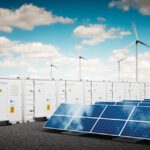
Strengthening reliability lies in pairing solar with storage. Batteries turn rooftop systems into microgrids, which are localized energy clusters that can serve loads during grid stress. This is already part of a larger industry solution to ease existing grid stress. Adding solar and battery systems near these hubs allows operators to meet part of their own demand during peaks, giving utilities breathing space to plan longer-term upgrades. It doesn’t replace the grid; it helps balance it.
Strength also comes in the form of social upsides for communities. Long-distance transmission projects that serve a few hyperscalers often shift their costs to consumers who don’t reap the benefits. Rooftop solar reverses that equation. The value stays local, offering affordable power, stronger grid resilience, and new jobs in installation and maintenance. Instead of asking taxpayers to wait a decade for a new line, communities can see results within a year.
Innovation Has to Match AI’s Energy Demands
82% of respondents in a Deloitte study believe technological innovation is the most effective way to close the gaps in today’s energy and infrastructure systems to fuel data centers, with 92% listing it as their top investment focus, pushing for smarter infrastructure and wider use of renewables. That level of alignment signals something important.
Reimagining the buildings around data centers as more than neighbors, but as potential power sources, could unlock clean, local energy without waiting years for new grid connections. AI keeps raising demand, pushing us to rethink energy at the same pace. If we focus on prioritizing this breakthrough technology, we need to place equal importance in advancing the other pieces that are detrimental to its growth, without compromising our environmental and economic sustainability.
—Daniel Domingues is founder and CEO of Planno.