
rps
-
 Trends
Rhode Island Targets 100% Renewables Procurement by 2033
Legislation passed in Rhode Island will commit the state to procure 100% of its electricity from renewable energy sources by 2033. If Gov. Daniel McKee, as expected, signs the bill into law, the Ocean State could have the nation’s fastest timeline for a 100% renewables procurement. The New England state’s legislature on June 17 approved […]
-
 News
News2020 Voters Cement Nevada’s 50% RPS, Shakeup of Energy Oversight in New Mexico
Though vote-counting continued in the tight presidential race on Nov. 5, voters in Nevada and New Mexico appear to have made headway on crucial energy initiatives on the ballot. Nevada Approves a 50% by 2030 RPS In Nevada, the presidential race remained closely contested on Thursday morning with pundits predicting that a victory there for […]
-
 News
NewsA Protocol for Making Renewable Energy Sizing and Selection Decisions
Much has been written about renewable energy, but few stories have focused on the complexity of determining the optimal mix of solar and wind generation, and the kind and amount of energy storage, that
-
 Fuel
FuelITC Probing Economic Impact of Renewable Goals, Imports to New England
Responding to a request from a Democrat-led U.S. House committee, the federal International Trade Commission (ITC) is investigating how New England’s increasing renewable targets are economically affecting the region, and what role renewable imports play in meeting those commitments. The ITC, an independent, nonpartisan and quasi-judicial federal agency that also provides fact-finding as it relates […]
-
 News
NewsMoody’s: Carbon Concerns Denting Merchant Coal Refinancing Prospects
Environmental, social, and governance (ESG) risks are diminishing the number of potential investors in U.S. merchant coal projects, and that is putting more pressure on already squeezed coal plant economics, Moody’s Investors Service said in a new sector report. The U.S. merchant coal plants, which are already grappling with persistently low power prices that […]
-
News
THE BIG PICTURE: Renewable Portfolio Standards
As of August 2019, 29 U.S. states and the District of Columbia had renewable portfolio standards (RPSs), and eight others had non-binding renewable portfolio goals. Three states also had clean energy standards, which set targets for low-carbon non-renewables, like nuclear, and two had clean energy goals. Shown in the bars below are the shares of generation by source […]
-
 Fuel
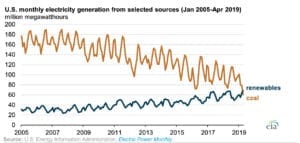
FuelAs Renewables Surge Ahead of Coal, Lawmakers Introduce National Renewable Standard
A bill introduced by Senate Democrats on June 26 establishes a national electricity standard that would require large retail suppliers to source at least 1.5% of their power from renewables by 2020 and gradually grow that share through 2035. The measure comes a day after the Energy Information Administration (EIA) revealed monthly generation from renewable […]
-
 News
NewsPJM Will Hold Capacity Auction Under Current Rules in August
PJM Interconnection said it will hold its 2022–2023 capacity auction under current market rules on Aug. 14, 2019, though the Federal Energy Regulatory Commission (FERC) has yet to issue a decision on the grid operator’s plan to revamp its Minimum Offer Price Rule (MOPR). In an April 10 filing, however, PJM asked FERC to clarify that […]
-
 Renewables
China Sets a New Renewable Portfolio Standard
China in mid-September increased its renewable portfolio standard (RPS) to 35% of electricity consumption by 2030. The country has already heavily invested in wind and solar, and it anticipates more gains will
-
 Fuel
FuelU.S. Biomass Power, Dampened by Market Forces, Fights to Stay Ablaze
Though experts say biomass should continue to play a key role in the U.S. renewable power portfolio for its baseload properties, contributions to forest management, and other reasons, a swathe of uneconomic
-
 Renewables
California Assembly Passes 100% Renewables Mandate
Lawmakers in California’s Assembly on August 28 cleared a key vote on a bill that would require the state to obtain 100% of all retail electricity sales from renewable and zero-emissions resources by 2045. The state’s Assembly voted 43–32 in favor of SB 100. The bill, which now heads to the state Senate for a […]
-
 Infographics
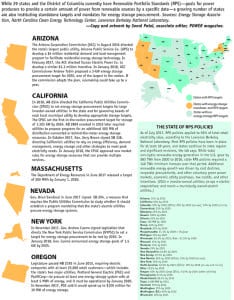
The Big Picture: Energy Storage Mandates
While 29 states and the District of Columbia currently have Renewable Portfolio Standards (RPS)—goals for power producers to provide a certain amount of power from renewable sources by a specific date—a growing number of states are also instituting standalone targets and mandates for energy storage procurement. Sources: Energy Storage Association, North Carolina Clean Energy Technology Center, Lawrence Berkeley […]
-
 Legal & Regulatory
The Big Picture: Energy Transitions [INFOGRAPHIC]
An energy transition is underway across the world. Market upheaval, defining events, and recent policy changes have accelerated a shift away from coal toward renewables. Here is how this transformation played out for some of the world’s major economies over the past decade. Graphs show percent of each fuel source of total generation for that […]
-
 Legal & Regulatory
New Mexico Clears Hurdle to Provide Power to Facebook Facility
A unanimous vote by New Mexico’s Public Regulation Commission (PRC) today determined that Public Service Co. of New Mexico (PNM) will be allowed to provide new renewable capacity to a proposed Facebook facility through a special service agreement.
-
 Legal & Regulatory
U.S., Canada, Mexico Commit to 50% Carbon-Free Power by 2025
The U.S., Mexico, and Canada today announced an unprecedented goal to procure 50% of North America’s total power generation from renewables, nuclear, carbon capture and storage (CCS), and energy efficiency technologies by 2025. President Obama, Prime Minister of Canada Justin Trudeau, and the President of Mexico Enrique Peña Nieto, announced the continental goal, part of […]
-
 Renewables
PG&E Moves to Retire 2.3-GW Diablo Canyon Nuclear Plant
Diablo Canyon, the two-reactor nuclear power plant on the central California coastline, will be permanently shuttered by 2025 under a renewables-boosting initiative announced today by its owner, Pacific Gas and Electric (PG&E). The company on June 21 unveiled a “joint proposal” with labor and environmental groups that seeks to increase investment in energy efficiency, energy […]
-
 Legal & Regulatory
Oregon Legislature Passes Bill to Eliminate Coal from State Power Supply
The Oregon Senate passed a bill on March 2 that will require electric companies in the state to eliminate coal-fired resources from their electrical supplies by January 1, 2030. The bill—which passed in the senate by a 17–12 vote—had already been passed by the Oregon House of Representatives (38–20). It now heads to Gov. Kate […]
-
 Legal & Regulatory
State RPSs Provide Significant Economic Benefits, DOE Study Says
State renewable portfolio standards (RPSs) provide around $7.4 billion in annual economic benefits and substantial reductions in water withdrawals and consumption, according to a new study from the Department of Energy’s Lawrence Berkeley National Laboratory and National Renewable Energy Laboratory released on Jan. 6. The study, “A Retrospective Analysis of the Benefits and Impacts of […]
-
 O&M
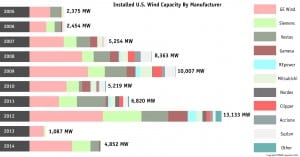
O&MDOE Report Highlights Triumph, Trouble for Wind Power Sector
U.S. wind power is becoming more widespread and costs are generally on the decline, but the sector is troubled by policy uncertainties, a new report from the Energy Department says. After a lackluster year in 2013, wind power capacity additions in the U.S. rebounded nearly 8% in 2014, driven by recent improvements in the […]
-
 Renewables
MIT Report: Uniform Nationwide RPS Program Needed
An interdisciplinary study led by the Massachusetts Institute of Technology (MIT) Energy Initiative concludes, among other things, that “state renewable portfolio standard (RPS) requirements should be replaced by a uniform nationwide program.” The report—released on May 5—focuses on the future of solar energy, suggesting that a massive expansion in solar capacity to “multi-terawatt scale” is […]
-
 Legal & Regulatory
Beyond the Renewable Portfolio Standard
Renewable portfolio standards (RPSs) have been remarkably successful in boosting renewable generation, especially in the western U.S., where most states enjoy large areas of prime wind and solar potential