
Speaking of Power
-
 News
NewsBusting Myths
The popular television show Mythbusters uses pseudo-scientific means to examine and often expose as fiction familiar urban myths. After made-for-television lab tests, the myth is then classified as either a fabrication (“busted”), entirely possible (“confirmed”), or somewhere in between (“plausible”).
-
 Coal
CoalReaching Retirement
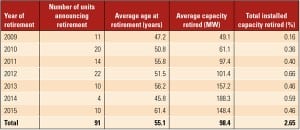
A recent Washington Post article attacks coal as a fuel with a dim future. The author points to the large number of plant retirements as evidence of its impending demise. Checking the actual data reveals a much different story.
-
News
My Top 10 Predictions for 2011
It’s time to pull my crystal ball out of storage, polish it up, and give you another round of U.S. industry predictions for 2011. I graded last year’s predictions B+ (for a complete rundown of how I graded each prediction, see page 32), but I’m convinced I’ll do better in 2011.
-
News
Three Questions About Renewable Energy
Renewable energy advocates hailed recent poll results as unquestionably demonstrating the public’s support of renewable energy resources. However, answers to follow-up questions showed that the public’s willingness to pay for increased renewable energy is lukewarm at best.
-
News
Follow the Leader
Another year has passed and the promised U.S. nuclear renaissance is still in the Dark Ages. Blame for slow progress is usually cast on the pedestrian pace of finalizing loan guarantees, the economy and slow load growth, or the rising cost of construction. The excuses end when competition increases. Two years have elapsed since the […]
-
News
Solving the Coal Conundrum
A recent U.S. Government Accountability Office (GAO) report examines two key options for reducing carbon dioxide (CO2) emissions from coal-fired power plants. The first is horribly expensive and will be years in the making. The second is blocked by current regulations in the U.S. The GAO report “Opportunities Exist for DOE to Provide Better Information […]
-
News
Cap and Trade Is Dead
Cap and trade officially died on July 22 when Senate Majority Leader Harry Reid announced at a news conference that the Democratic Caucus was unable to reach a consensus on any form of energy bill, even a recent short-lived version that proposed reducing carbon emissions from only the utility sector. I predict that carbon cap and trade is now dead for at least a decade, maybe longer.
-
News
The Edison of 1879
The cover of the July 5 special History Issue of TIME magazine features Thomas Edison holding a glowing bulb. A series of articles celebrate Edison’s many inventions and closes with this: “Edison’s laboratories were the forerunners of the interactive technological think tanks of Apple, Google, and Microsoft.” Though the sentiment lauds Edison, I think it’s an overstatement.
-
News
Carbon Controls Fail Business Case Study
Cap-and-trade programs are featured in at least two U.S. legislative proposals to reduce carbon emissions, usually by around 80% by 2050 using a 2005 baseline. The benefits that accrue from the immense investment required to reach these goals are nebulous and don’t occur until decades after the investment. Based on my back-of-the-envelope analysis, the cost-benefit ratio of these proposals does not pass a cursory cost-benefit analysis.
-
News
Scientific Calculator
Carol Browner, director of the White House Office of Energy and Climate Change Policy, trusts the latest Intergovernmental Panel on Climate Change (IPCC) report’s conclusions that anthropogenic carbon emissions are the primary cause of climate change. When pressed, the customary response of Browner and other proponents has been to rely on that oft-cited list of 2,500 scientists said to have given their full support of the report’s conclusions. Browner should check her facts.
-
News
Bridge to a Dead End
The Brattle Group released a provocative study paper in March in which the authors postulate that using more natural gas for generating electricity could reduce our dependence on coal-fired generation and reduce carbon emissions. Also discussed is an unexpected side effect: Renewables could push natural gas plants down in the dispatch mix in the future. Just because natural gas reserves are at a record high and the price is at historic lows doesn’t mean that gas demand will increase.
-
News
Bridge to a Dead End
The Brattle Group released a provocative study paper in March in which the authors postulate that using more natural gas for generating electricity could reduce our dependence on coal-fired generation and reduce carbon emissions. Also discussed is an unexpected side effect: Renewables could push natural gas plants down in the dispatch mix in the future. […]
-
News
What’s Bugging Me
I’m often asked about my source of ideas for this space each month. I have two primary sources of subject material. First, I read the industry news every day and save those items that either annoy or agitate me. At the end of the month, I go over the list, often a long one, and pick the one item that immediately motivates me to take virtual pen to paper. This month, no single item emerged as the topic for my bully pulpit, so I present a potpourri of loosely connected topics for your consideration. (It should be noted that other things bug other members of the editorial staff; we’re a diverse group and do not always agree about industry issues.)
-
News
Double-Edged Sword
A loosely knit coalition of state leaders and environmental activists petitioned the Securities and Exchange Commission (SEC) in late 2007 for interpretive guidance on the corporate obligation to disclose material information about all aspects of climate change. The petitioners received what they asked for and a little bit more.
-
News
Level the Playing Field for Open-Loop Biomass
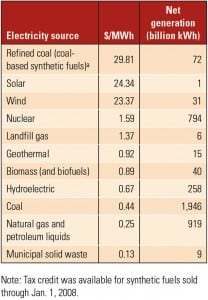
Congress snubbed the biomass power industry in 2004 when open-loop biomass power plants were given only half the production tax credits (PTCs) received by other renewable sources, such as wind, solar, and geothermal. It further dissed open-loop biomass plants by authorizing the credit for only five years (it expired December 31, 2009) rather than the 10 years given to other renewables. Why is the biomass power industry not getting the policy respect and equity with other renewable technologies that it deserves?
-
Smart Grid
My Top 10 Predictions for 2010
David Letterman has entertained us with his "Late Show" Top Ten list since 1985. In keeping with this issue’s theme of forecasting the future of the power industry, I’m going to step out with my top 10 list of what to expect in the next 12 months. 10. New Nuclear Will Progress Slowly. I don’t […]
-
Coal
What Is BACT for CO2?
Assume, for the moment, that the U.S. Congress is unable to agree on legislation aimed at reducing carbon emissions from industry, vehicles, and power plants (the carrot approach). Further, assume that the Environmental Protection Agency (EPA) eventually promulgates rules that require power plants to reduce carbon emissions (the stick approach). Have you given any thought to the range of possible best available control technologies (BACT) that the EPA might require under the Clean Air Act (CAA)?
-
News
Time Flies
July 17, 1955, was the first time electricity generated by a U.S. nuclear power plant flowed into a utility grid. The experiment required Utah Power & Light to disconnect itself from the power lines to the 1,200 residents of Arco, Idaho, and plug in the Argonne National Laboratory experimental boiler water reactor, BORAX-III. The plant produced merely 2 megawatts for more than an hour, as planned, after which linemen reconnected the town’s grid to the utility. Since then, the U.S. nuclear industry has demonstrated excellence in operations, but more than 50 years after that first nuclear power supply, it is lagging far behind even developing nations in new construction.
-
News
The Big Two
In this column last month I quoted Indian Environmental Minister Jairam Ramesh to represent India’s intention to not agree to any legally binding emissions targets at the Copenhagen Climate Change Conference in December. That conference will start formal negotiations of a follow-on agreement to the Kyoto Protocol. A number of readers wrote to say that they believe India and China, despite their protestations to the contrary, will cave to international pressure and at the end of the day agree to some binding carbon emissions limits. I disagree.
-
Environmental
Dead Man’s Hand
The stage is being set for negotiating a successor agreement to the Kyoto Protocol. The U.S. is trying to exert some leadership in the international climate change debate by attempting to build consensus for binding carbon emission reductions prior to the upcoming Copenhagen meeting. Meanwhile, carbon legislation is, thankfully, stalled in the Senate, and developing countries are rejecting our entreaties. You can’t win if other countries don’t want to play.
-
News
Politics Trump Scientific Integrity
In their recent endangerment finding draft technical support document (TSD), scientists at the U.S. Environmental Protection Agency (EPA) conclude that carbon dioxide emissions are a public health hazard and should be regulated under the Clean Air Act. Federal law requires that regulations be based on scientific information that is "accurate, clear, complete, and unbiased"; the most recent available; and collected by the "best available methods." The EPA’s TSD on carbon emissions violates all of these requirements.
-
Our Integrity Is Not for Sale
I was putting the finishing touches on this month’s editorial when I received an email from a reader who owns a company that serves the power industry. He was very complimentary of an article I recently wrote. "Goes without saying," I was thinking to myself. However, actually saying it goes a long way in my book, and I enjoy hearing from readers — at least most of the time.
-
Wind
Gone with the Wind
Secretary of the Interior Ken Salazar, speaking in Atlantic City on April 6, added more hot air to the discussion about offshore wind when he stated that windmills off the East Coast could generate enough electricity to replace most, if not all, of the coal-fired power plants in the U.S. I’m disappointed Salazar didn’t take a few minutes for fact-checking and back-of-the-envelope ciphering before his speech.
-
News
Spain Is Tilting at Windmills
President Barack Obama has praised Spain as a global leader in renewable electricity generation and has lauded its success at creating so-called "green jobs." However, a recent Spanish university study concluded that Spain’s mad rush to meet overly aggressive renewable standards has destroyed jobs and driven up the real cost of electricity, without cutting carbon emissions.
-
Proposed Federal RPS Needs Rewrite
A 16% national RPS would require almost a 500% increase in renewable generation in the next decade, or about 32,000 MW. EIA data show that the U.S. had about 8% renewables online at the end of 2007. What’s worse is that very few existing projects would count toward the requirements of this proposed legislation.
-
News
Carbon Goes Subprime
European Union (EU) carbon trading proponents are finding support for their market-based emission trading scheme (ETS) in freefall like the market price of carbon in the EU. This unanticipated consequence of the ETS really should not have come as a surprise. Free Allowances The ETS, often described by EU regulators as the world’s most advanced […]
-
Engineers Week Is Feb. 15–21
I just renewed my professional society membership dues for the umpteenth year, and while writing the check, I paused to consider if I was getting good value from them. I expect to receive another "suitable for framing" certificate this year, as the number of my membership years ends with a zero, but I wondered if there were other, more tangible benefits.
-
News
New Year’s Resolutions
Why is it that so many of our New Year’s resolutions are focused on self-enrichment, yet they are the first promises we break? The typical resolutions — "get more exercise" or "stop smoking" — are recycled yearly. Surveys find that most resolutions are abandoned or forgotten by, appropriately, Ground Hog Day. I believe it’s time to reboot our resolution-setting software and refocus on others instead of ourselves.
-
Business
Change is coming
An historic election is over and the people have spoken. President-elect Obama and an expanded congressional majority will now rebalance the economic and environmental importance of coal-fired generation in this country differently than ever before, and that change is unsettling to many. When the expected costs of the anticipated new policies are counted, I predict many voters will experience a severe case of buyer’s remorse.
-
 Nuclear
The nuclear option
Secretary of Energy Samuel Bodman spoke at the recent 2008 Nuclear Energy Summit that was convened to discuss the importance of nuclear power to a healthy U.S. economy.