
Speaking of Power
-
Commentary
Change and Continuity
Even if you missed Bob Peltier’s retirement signoff in last month’s column, you will have noticed that something has changed. POWER has a new editor at the top of the masthead (its 10th in 131 years
-
News
Blowing Smoke
President Obama’s recent comments on climate change and the need for additional federal regulation of greenhouse gases carelessly handled the science he quotes.
-
News
Four Strange-But-True Stories
Last month’s column, “Opinions à la Carte,” prompted an unusually high number of emails from readers. Unexpectedly, the responses to the different format were universally favorable.
-
News
Opinions à la Carte
Have you ever experienced a restaurant menu overflowing with so many tasty entrées that making your selection seemed an impossible decision? Your deliberation probably ended when the waiter began tapping a pen on his order pad and your dinner-mates gave you the evil eye. Picking a commentary topic each month is much like scanning the dinner menu. There are usually many topics that deserve a good slice and dice, but it’s the deadline that forces a decision.
-
News
Bait and Switch
The Boxer-Sanders “Climate Protection Act” and its sister bill, the “Sustainable Energy Act” are the latest, and perhaps the most onerous, in a series of legislative proposals that seek to tap the immense revenue stream promised by taxing carbon.
-
News
America’s Growth Corridors
The familiar Red State–Blue State map is a symbolic means of quickly communicating political preferences. The maps aren’t meant to be predictive of job, economic, or population trends, yet a recent think tank’s report suggests the metaphor may have broader significance.
-
Gas
Should the U.S. Export Natural Gas?
Controversy concerning natural gas exports flared the day the U.S. Energy Information Administration (EIA) released its estimate that U.S. natural gas exports could begin in 2021.
-
 News
NewsWhere’s the Warming?
In case you neglected to mark it on your calendar, the Kyoto Protocol to the U.N. Framework Convention on Climate Change (UNFCC) expired at midnight on New Year’s Eve. The 15-year-old treaty was by every account a failure. Global carbon dioxide emissions are up over 50%, yet global temperatures decreased over the same period. Relying […]
-
News
My Top 10 Predictions for 2013
Looking back over the past year’s predictions, I graded myself a “strong B,” slightly down from the past two years (a detailed discussion of my individual scores is available as an online supplement to this issue). Like coal, I’m expecting a comeback in 2013.
-
News
Under Siege
As I write this column on Election Day 2012, the polls are still open and both presidential candidates are predicting victory. The next dozen hours or so will prove only one candidate correct. Regardless of the outcome, wind power remains a loser.
-
News
Economic Meltdown
The bill for German Chancellor Angela Merkel’s coalition government’s knee-jerk decision to close all 17 of its nuclear plants by 2022 is coming due. Merkel’s energy plan is to radically expand the use of renewable energy to 35% of total power consumption by 2020 and to 80% by 2050. Currently, renewables represent 20% of the country’s energy mix.
-
News
Hollow Victory
Cato Institute senior fellows Jerry Taylor and Peter Van Doren in an Aug. 31 Forbes website blog suggest that the Environmental Protection Agency’s (EPA’s) carbon pollution standard for new coal-fired power plants (Standard) is a meaningless skirmish in President Obama’s “war on coal.” The Standard may have no tangible impact on the industry in the future, but it has great strategic benefit to the administration.
-
News
Perception Is Not a Science
Is your summer warmer than normal, or did your winter seem colder than in the past? We may perceive changes in weather patterns and draw conclusions, but personal experience is of limited value in science. It’s all about the data. Dr. James Hansen, a senior NASA scientist and long-time global warming apologist, first achieved notoriety […]
-
Coal
Tactical Advantage
A three-judge panel of the U.S. Court of Appeals for the D.C. Circuit on June 26 unanimously rejected all pending legal challenges against the U.S. Environmental Protection Agency’s (EPA’s) interpretation of the Clean Air Act (CAA) that allows the agency to regulate greenhouse gases (GHGs). What is the EPA’s future strategy in its war on coal?
-
News
MACT Attack
The Utility MACT Rule, the most recent skirmish in the U.S. Environmental Protection Agency’s (EPA’s) war on coal, is based on flimsy scientific evidence of actual health effects and again demonstrates the agency’s indifference to conducting rigorous scientific inquiry. The end justifies the means is not science.
-
 News
NewsSelf-Improvement Strategy
POWER marks its 130th year of service to the power generation industry with this issue. Instead of cake for the staff, we decided to celebrate the milestone in a way that will benefit our readers and supporters for many years to come.
-
News
Abundance of Minerals
What do iPads, flat screen TVs, Chevrolet’s plug-in Volt, and Raytheon’s Tomahawk cruise missiles have in common? Each uses one or more of the 17 rare earth elements in their manufacture, and over 95% of those elements come from China.
-
 News
NewsTechnology Trumps Policy
An energy policy should be the result of inclusive debate and a consensus approach to the means to leverage all of a country’s energy assets, including innovation and technology, to the advantage of its citizens. Current U.S. energy policy fails on all counts.
-
News
Abundance of Energy
President Obama’s Jan. 24 State of the Union address did not convince me that the nation should, in his words, “double down” on future clean energy investment. America’s abundance of oil and gas should be the foundation upon which to build a comprehensive national energy policy, not subsidies for government-favored energy technologies and overreaching energy regulations.
-
News
Battle of the Bulb
When then-President George W. Bush signed the Energy Independence and Security Act of 2007, he noted that, “New technologies will help usher in a better quality of life for our citizens.” One provision of the act required an increase in the efficiency of newly manufactured lightbulbs, starting with 100-watt incandescent bulbs in 2012.
-
News
My Top 10 Predictions for 2012
The New Year will be pivotal for the power generation industry, as you will read in our 2012 Industry Forecast (p. 26) and my list of predictions below. Looking back over the past year, I again gave myself a B+ on my 2011 predictions (see p. 33 for a rundown of my individual scores).
-
News
Irrational Exuberance
Germany’s government has decided to shutter all 17 of its nuclear plants (23 reactors); eight plants are now closed for business, six more will be closed by 2021, and the final three will close by 2022. What is lacking is an honest discussion of the rising cost Germans will pay for electricity for what The Economist describes as “the greatest change of political course since unification.”
-
News
It’s More Than a Process
The Office of the Inspector General (OIG) of the U.S. Environmental Protection Agency (EPA) recently concluded that the agency failed to follow prescribed policies in its peer review of the technical support document that provided the justification for its 2009 “endangerment finding” on greenhouse gases. The OIG report is timely, but in an unexpected way.
The Office of the Inspector General (OIG) of the U.S. Environmental Protection Agency (EPA) recently concluded that the agency failed to follow prescribed policies in its peer review of the technical support document that provided the justification for its 2009 “endangerment finding” on greenhouse gases. The OIG report is timely, but in an unexpected way.
-
Solar
Epic Fail
Over the past 18 months, four solar energy equipment companies have closed their doors. Each one blamed poor market conditions for its economic woes, even though each had fundamental weaknesses that went unaddressed. It now appears that the Department of Energy (DOE) did insufficient due diligence before backstopping one of those four companies, Solyndra, with a $535 million loan guarantee.
-
 Hydro
HydroChart a New Course
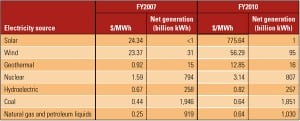
I examined the magnitude of electricity subsidies for renewables compared with conventional generation technologies in my May 2011 editorial, based on data from a 2008 report prepared by the U.S. Energy Information Administration (EIA). An updated EIA report released in July determined that federal government subsidies have risen substantially during the past three years. In fact, overall renewable energy subsidies have almost tripled, increasing from $5.1 billion to $14.7 billion. In my opinion, we aren’t getting value for the money spent.
-
News
Fracking Problems
By most estimates, natural gas is likely to become the dominant power generation fuel in the U.S. within perhaps a decade. The rapid growth in natural gas supplies follows advanced drilling techniques that can economically tap large shale gas reserves located deep beneath Earth’s crust. Unfortunately, it only takes one outlaw drilling company to frack it up for the rest of us.
-
News
Bad Gas Policy
The late Dr. Carl Sagan once observed, “We live in a society exquisitely dependent on science and technology, in which hardly anyone knows anything about science and technology (S&T).†I would add that those who know the least about S&T are often the ones responsible for determining policy and funding priorities. One good example of this problem is the piecemeal approach taken to developing carbon capture and sequestration (CCS) technologies.
-
News
Turning Gold into Lead
Despite California’s deep economic wounds, Governor Jerry Brown (D) last month signed a bill (SB 2X) that increased the state’s already ambitious renewables portfolio standard (RPS) goal from 20% to 33% by 2020. Together with the state’s Global Warming Solutions Act of 2006, which requires caps on greenhouse gas emissions starting next year, the new law will push up the price of electricity and further delay the Golden State’s economic recovery by permanently driving away irreplaceable businesses and manufacturing jobs.
-
News
Nuclear Sneak Attack
A renewed attack on nuclear power immediately followed the March 11 catastrophe at the six-unit Fukushima Daiichi nuclear power complex in Japan. At least one legislator and a multitude of anti-nuclear groups have demanded that the U.S. cease approval of all new nuclear plants for the foreseeable future and/or close our Mark I boiling water reactor (BWR) plants. This knee-jerk response adds nothing substantive to the nuclear safety debate. (Be sure to read our cover story for more on this issue.)
-
News
Spanish Wind, Revisited
Two years ago, Spain’s fixation on renewables and “green jobs” was praised by President Obama as a success story worthy of our emulation. How is Spain doing today?