
Solar
-
 Solar
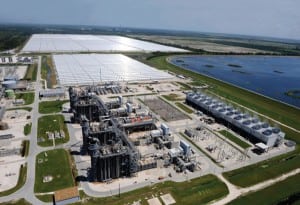
SolarTop Plant: Martin Next Generation Solar Energy Center, Indiantown, Martin County, Florida
The 75-MW Martin Next Generation Solar Energy Center is the first hybrid solar facility in the world to combine a solar thermal array with a combined cycle natural gas power plant. Because the facility uses a steam turbine, transmission lines, and other infrastructure from an existing combined cycle unit, financial savings of approximately 20% were achieved compared to what a similar stand-alone solar plant would have cost.
-
 Solar
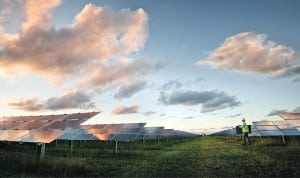
SolarTop Plant: Sarnia Solar Project, Sarnia, Ontario, Canada
The 80-MW Sarnia Solar Project is the world’s largest operational photovoltaic plant, with 1.3 million solar modules. The facility utilizes First Solar’s proven thin-film photovoltaic (PV) technology, which has the lowest environmental footprint and the fastest energy payback of current PV technologies.
-
 Coal
CoalRestructuring the South African Power Industry
South Africa is at a critical turning point. An uncertain environment for private investment, escalating electricity prices, and a lack of available power threaten South Africa’s position as an attractive investment destination for many of the country’s most important industries. Power has been placed at the forefront of the government’s agenda, but South Africa needs a collaborative effort to meet the country’s energy demands and diversify its generation portfolio in order to drive economic growth.
-
 Gas
GasNordic Nations Provide Clean Energy Leadership
In the past few years, nuclear concerns, rising oil prices, and a growing understanding of our environmental impact has given energy issues a higher profile worldwide. In this report on the Continental Nordic countries, we look at the efforts being made in much of the Nordic region to secure a sustainable energy supply for the future and at the extent to which the innovative solutions of these countries can be exported around the globe.
-
Solar
Epic Fail
Over the past 18 months, four solar energy equipment companies have closed their doors. Each one blamed poor market conditions for its economic woes, even though each had fundamental weaknesses that went unaddressed. It now appears that the Department of Energy (DOE) did insufficient due diligence before backstopping one of those four companies, Solyndra, with a $535 million loan guarantee.
-
 Solar
SolarTHE BIG PICTURE: A Solar Switch
The plummeting cost of photovoltaic (PV) panels—resulting from lower costs for high-grade silicon and advancements in thin-film technology, solar storage, and electronic control technologies—has a slew of firms rethinking concentrating solar power (CSP) projects. Although there is a CSP project pipeline (including both CSP and concentrating PV) of more than 9 GW in the U.S., […]
-
Solar
Murkowski: Renewables Future Not "All Sunshine and Roses"
There’s lots of reason for optimism about clean technologies, Sen. Lisa Murkowski (R-Alaska) told a packed crowd on Tuesday afternoon at the RETECH 2011 Keynote Session. New ideas are emerging, costs are coming down and deployment is increasing, she noted—all welcome developments for America’s energy supply and the global environment. The rapid growth of the renewables is partially due to federal policies, but much of the progress has been a "direct result of your creativity and determination."
-
 Solar
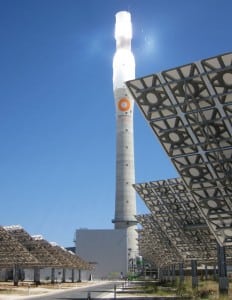
SolarSpanish Power Tower Supplies 24 Hours of Electricity
In Spain this June, a new 19.9-MW concentrated solar power (CSP) tower in Fuentes de Andalucía, Seville, reached the unprecedented milestone of storing thermal energy to its fullest capacity and supply power for an uninterrupted 24-hour period.
-
 Gas
GasWho Pays for Firming Up Variable Energy Resources?
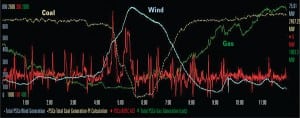
The major economic hurdle for renewable power generation technologies continues to be substantial installation costs. But another cost is associated with continuous load-balancing, made possible by backstopping that variable generation with dispatchable generators that typically consume expensive fossil fuels. Bottom line: Who pays for the capacity firming or backstopping resources?
-
 Hydro
HydroChart a New Course
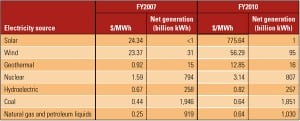
I examined the magnitude of electricity subsidies for renewables compared with conventional generation technologies in my May 2011 editorial, based on data from a 2008 report prepared by the U.S. Energy Information Administration (EIA). An updated EIA report released in July determined that federal government subsidies have risen substantially during the past three years. In fact, overall renewable energy subsidies have almost tripled, increasing from $5.1 billion to $14.7 billion. In my opinion, we aren’t getting value for the money spent.
-
 Coal
CoalUsing Fossil-Fueled Generation to Accelerate the Deployment of Renewables
It may seem counterintuitive, but the strategic coupling of simple- and combined- cycle technologies with renewable generation could establish the conditions necessary for adding more renewable megawatts to transmission grids around the world.
-
 Coal
CoalConsolidation, Market Distortions Underlie Remarks by Industry Executives
If you needed additional proof that the power industry is changing, the ELECTRIC POWER keynote and panel discussions over the past few years have provided it—top-of-mind issues have been significantly different each year. For the 2011 keynote speaker and panelists, the challenges of reliability, regulatory compliance, financing, and getting the fuel mix right took center stage. In the wake of Japan’s nuclear crisis, safety also featured prominently.
-
 Solar
SolarUtilities Increase Renewable Energy Capacity
Driven by state RPS requirements and the desire to diversify their energy sources, U.S. utilities continue to add more renewable power to their generation portfolios. As a result, they must deal with a number of important issues, including resource availability that varies geographically.
-
 Solar
SolarSunny Days Ahead for Solar
In the U.S., developers of thermal and photovoltaic solar plants face a number of challenges in their efforts to deploy more utility-scale solar power. Some trends, however, are helping solar proponents move this renewable energy source closer to becoming a mainstream generating option.
-
Solar
Countries Abandon Subsidies for Renewables en Masse
Stricken by the economic crisis and forced to implement austerity measures, several countries around the world have been forced to abandon or slash subsidies for renewable power producers.
-
 Coal
CoalSpain: A Renewable Kingdom
Spain has served as both exemplar and scapegoat when it comes to renewable energy policy. Though power policy must necessarily accommodate specific national resources and goals, Spain’s experience as an early and eager adopter of renewable energy technologies and subsidies is a cautionary tale of how the best intentions can have unintended consequences.
-
 Coal
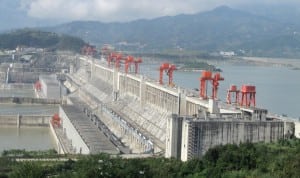
CoalChina’s Five-Year Plan Is Heavy on Non-Fossil Generation
The People’s Republic of China’s Congress approved a much-anticipated draft of the country’s 12th Five-Year Plan (2011–2015) on March 14. Along with key objectives that included boosting its gross domestic product (GDP) by 7% annually on average, the country for the first time in a five-year plan established targets to tackle climate change. It plans to reduce carbon dioxide emissions per unit of GDP by 17% from 2010 levels by 2015 and to reduce energy consumption per unit of GDP by 16% from 2010 levels by 2015.
-
 Solar
SolarInterest, Funding Buoys Floating Solar Power Plants
Like most forms of generation, solar power has its disadvantages. Two cited most by critics of photovoltaic (PV) or concentrating solar power facilities are that they require large expanses of land and that solar cell fabrication and maintenance costs are high. Several companies have been assessing a new approach to tackling these factors: installing solar plants on water.
-
 Solar
SolarEnergy Storage Enables Just-in-Time Generation
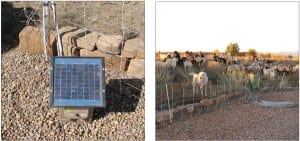
One of the main criticisms of renewable energy facilities is that they are unable to dispatch electricity when it’s needed. The great game-changer is low-cost energy storage, which would enable renewable energy production to be stored and rapidly released when needed. Here are seven promising distributed energy storage technologies that could be commercialized in the near future.
-
 Solar
SolarThe Smart Grid and Distributed Generation: Better Together
Electricity grids are slowly getting smarter. Simultaneously, the use of distributed generation is increasing. Though smart grid advocates tout the ability of a smarter grid to enable greater deployment of distributed resources, the benefits could flow in both directions.
-
 Coal
CoalCanada’s “Clean” Image Extends to Clean Power
Canada’s extensive natural resources are the driver of its powerful economy, and energy is Canada’s single most important export. Yet policy makers across the nation are currently dealing with the consequences of a generation of under-investment in the electricity system and deciding what the new grid and supply mix should look like. Several provinces are competing to lead the charge in renewable energy and grid intelligence. Policy makers hope that such efforts will not only provide for Canada’s electricity needs but also create the green economy jobs that will drive the nation’s next generation of economic development.
-
 Coal
CoalCanada’s Provincial Power Strategies
In Canada, as in the U.S., where you live determines the type of generation technology that provides your power. Here’s how the four most energy-intensive provinces in Canada are responding to the challenge of providing reliable and cheap power in a sustainable way.
-
 Solar
SolarDOI Approves Nine Solar Projects on Federal Land—So Far
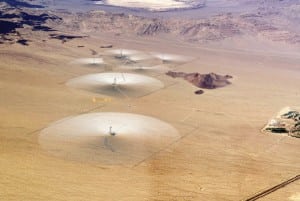
U.S. Interior Secretary Ken Salazar in late December approved—for the ninth time since October 2010—a solar power project to be built on federal lands.
-
 Coal
CoalIEA: Global Power Demand to Surge 2.2% Annually Through 2035
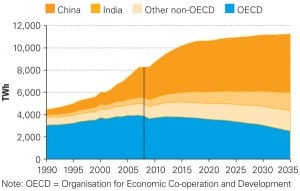
Though electricity generation has entered a key period of transition—as investment shifts to low-carbon technologies—world electricity demand is set to grow faster than any other “final form of energy,” the International Energy Agency (IEA) says in its latest annual World Energy Outlook.
-
Legal & Regulatory
Solving the Renewable Integration Puzzle
In November, California voters overwhelmingly rejected an initiative that would have put the brakes on AB 32, the state’s ambitious greenhouse gas (GHG) emissions reduction law. Given the role that California has played in climate change policy, that such a vote took place only four years into the law’s implementation process and 10 years before the emissions reduction targets were to be met was a reality check on climate change policy for those on both sides of the issue.
-
 Solar
SolarMIT Researchers Invent Self-Renewing PV Technology
Scientists at the Massachusetts Institute of Technology (MIT) have a created a set of self-assembling molecules that can turn sunlight into power, and which can repeatedly be broken down and reassembled by adding or removing solution. The scientific breakthrough—inspired by a natural process used by plants to renew light-capturing molecules that have been degraded by the sun—could mean that researchers are closer to creating a self-healing photovoltaic (PV) technology that can keep repairing itself to avoid loss in performance.
-
 Solar
SolarTop Plant: DeSoto Next Generation Solar Energy Center, DeSoto County, Florida
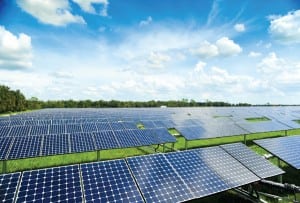
The forecast is looking sunny for the 25-MW DeSoto Next Generation Solar Energy Center, which has more than 90,000 photovoltaic (PV) panels and is the largest solar PV plant in the U.S. Completed in October 2009, it is a sustainable energy solution with minimal maintenance costs. The site uses no fuel, consumes no cooling water, has no air emissions, and creates no waste products.
-
 Solar
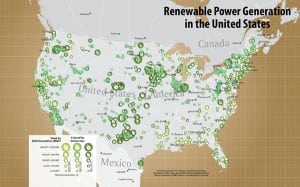
SolarMap of Renewable Power Generation in the United States
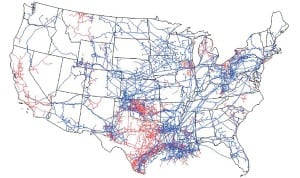
For a full-size map, contact Platts. Courtesy: Platts Data source: POWERmap All rights reserved. No reproduction allowed.
-
 Solar
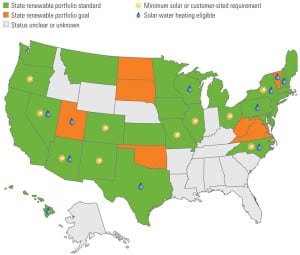
SolarA Winning Combination: Government and Utilities Partner on Renewable Energy Projects
Recent mandates require government facilities to develop energy policies that enable energy conservation, increase the use of renewable energy, and improve energy security. Utilities with government facilities in their service territory may have opportunities to develop solar and other renewable energy projects that help them meet state renewable portfolio standards while increasing a government facility’s usage of renewable energy. The key to such a win-win proposition is careful structuring of the project agreement to leverage each party’s assets.
-
 Hydro
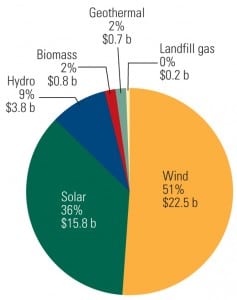
HydroThe Rush to Renewables
In 2010 investment in wind power continued to accelerate, particularly in California and Texas. California also entered several solar projects in the race for financing. The finish line that renewable power developers and their partners are racing to meet is a December 31 deadline to qualify for federal cash grants.