
Commentary
-
Commentary
The Supreme Court and Best Environmental Practices
Did a recent Supreme Court decision give a license to firms to use “best practices” concepts to gut effective environmental standards?
-
Commentary
Go Ahead, Close Oyster Creek
The U.S. Nuclear Regulatory Commission (NRC) in early April granted Entergy Nuclear an extended license for the Oyster Creek nuclear plant in New Jersey, the oldest operating nuke in the U.S. The plant will now be able to operate until 2029, unless the NRC at some point in the future grants a further license extension. Nuclear power advocate William Tucker, with tongue in cheek, advocated closing the plant and other elderly units in the Northeast, in a commentary in the National Review. Tucker’s comments are reprinted with permission.
-
Commentary
Polling on Warming No Surprise
As a democrat (that’s with a small “d” and a large “D”), I have a great deal of faith in the wisdom of the American people. That’s why I’m not surprised that the hysteria over alleged man-made global warming is in rapid decline in public opinion polls. It’s no longer in the top 10, or event the top 15, of issues that Americans care about.
-
Commentary
Energy Bubble, Anyone?
When the housing bubble burst, it exposed an unseemly alliance between special interests and the financial sector. Activists wanted homes for all at any cost, and lenders were happy to oblige despite the inherent risk.
-
 Commentary
Remembering Three Mile Island
The 30-year anniversary of the Three Mile Island accident passed with little fanfare because our nuclear plant fleet today operates with high reliability and struts an excellent safety record. That wasn’t always the case.
-
Commentary
The Communications Failures Lessons of Three Mile Island
The most lasting effect the Three Mile Island nuclear accident had on me was what it taught me about crisis communications—lessons that served me well over the 25-plus years that followed and especially after the September 11 terrorist attack on the United States.
-
Commentary
NIMBY or Concerned Citizen?
Opponents of locating new energy facilities near where they work and live are often painted with a broad brush as activists or called some other pejorative term. How do you differentiate the professional opponents of any new development from those who have valid reasons to stand up and be heard?
-
 Commentary
Let’s Stop Bailing Out on Alternative Energy
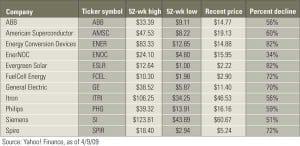
Investors are continuing to bail out of alternative energy stocks—good, promising companies such as ABB, American Superconductor, Evergreen Solar, and Itron. These companies and many like them were Wall Street darlings not that long ago. Not anymore.
-
Commentary
Transforming the U.S. Grid
Al Gore, in his recent New York Times op-ed titled "The Climate for Change," calls for a "$400 billion investment over ten years to construct a national smart grid to distribute renewable energy." Echelon supports these proposed investments. We also believe the answer is not just in constructing something new but in transforming the existing […]
-
Commentary
A U.S. Cap-and-Trade Sytem Could Be “Mostly Dead” on Arrival
President Obama’s recent comments to the Business Roundtable included two blunders that showed his misunderstanding of the fundamentals of the cap-and-trade approach to reducing carbon emissions that is the centerpiece of his 2010 budget request.
-
Commentary
Stimulus VAR Support
Can clean energy investments carry their important share of the U.S. Recovery and Reinvestment Act load? Here’s a contrarian answer: It’s up to the utility industry and its regulators.
-
Commentary
Steven Chu: His Irrelevance
The Obama administration’s energy secretary, Dr. Steven Chu, has quickly become Dr. Who. As a recent New York Times article noted, Chu has repeatedly stumbled politically, demonstrating that being a Nobelist in physics is no qualification for the bumps-and-grinds of energy politics in Washington.
-
Commentary
Energy Efficiency Takes Center Stage in Texas
For decades, it’s been well-known in the country and western (C&W) music industry that "if you’re gonna play in Texas, you gotta have a fiddle in the band." The guitars, drums, harmonicas, and piano — they’re all expected on stage. But as the legendary C&W group Alabama recognized, a fiddle is a must when performing […]
-
Commentary
The Obama Administration’s Energy Challenge
As the Obama administration takes office, energy resource allocation is both the most critical national security issue and the most critical economic issue facing us. It will be difficult to sustain and improve economic growth unless we implement policies that result in the more rational use of energy resources, especially those for which there is a finite supply.
-
 Commentary
Tough Challenges Face the U.S. Power Industry in 2009
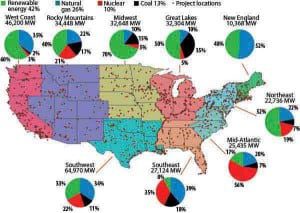
The new U.S. president will have a new set of priorities and regulatory policies that will affect the production and generation of electricity. The specifics of the new administration’s energy policy priorities were scant when this article was written, pre-inauguration, but the industry’s challenges are fairly well defined.
-
Commentary
Avoiding the Green Chill
By Roger Feldman
Public-private partnerships are a key to preventing a chill from settling over the green ambitions of the newly capital-strapped state and municipal public sectors. -
Commentary
Renewable Projects Hit Brick Wall
Dr. Robert Peltier, PE
One of the key campaign promises made by our new president was that his administration would create five million new “green” jobs by spending $150 billion dollars over the next 10 years. There are serious and substantial reasons that this level of job creation won’t happen in the near future. -
Commentary
Schleede: Buy Bulbs, Not Wind, for Stimulus
By Kennedy Maize
Congress will make a big mistake if it provides money for accelerated wind power development as part of the Obama administration’s new economic stimulus program, according to veteran energy analyst Glenn Schleede. Instead, he says in a recent privately-published paper, “Investment in energy efficient light bulbs would save more than five times as much electricity in five years as an equal dollar investment in wind turbine would produce in 20 years.” -
Commentary
Meeting the Global Energy Challenge
Meeting growing energy demand while reducing greenhouse gas (GHG) emissions is one of the most critical challenges facing our world today.
-
Commentary
Obama to Make Energy and Environment Picks
By Kennedy Maize
The Obama administration has picked Steven Chu, currently the director of the Department of Energy’s Lawrence Berkeley National Laboratory, to be secretary of energy. The selection was quite a surprise, as Chu’s name had not surfaced in any of the rumors circulating in Washington. Indeed, he’s not well know in Washington political circles. -
Commentary
Commentary: Renewable energy lessons from Europe
Europe has seen tremendous activity in the development of renewable energy as a response to climate change. As a result, some of the most important renewable energy firms operating in the U.S. are based in Denmark, Germany, and Spain. Stable, high-level policy is one reason Europe dominates this sector.
-
Commentary
The GAO Comes Clean on CCS
The Government Accountability Office (GAO), the investigative arm of the U.S. Congress, just released its report on the status of carbon capture and sequestration (CCS) technology and its view of the technology’s future development challenges. In general, the GAO concludes that the technology faces grave technological, regulatory, economic, and legal barriers that will not be […]
-
Commentary
Building a Firm Foundation for GHG Regulation
Roger Feldman
Proposed U.S. legislation appears likely to use carbon offsets or credits, although the details remain unclear. I wonder if these schemes adequately support the goal of global greenhouse gas emission reductions. -
Commentary
Out of Sight, Out of Mind
Dr. Robert Peltier, PE
The Government Accountability Office (GAO), the investigative arm of the U.S. Congress, just released its report on the status of carbon capture and sequestration (CCS) technology and its view of the technology’s future development challenges. In general, the GAO concludes that the technology faces grave technological, regulatory, economic, and legal barriers that will not be easily overcome. -
 Commentary
How unconventional fields are powering Texas
In the 1980s, Houston wildcatter George Mitchell drilled the first well into the Barnett Shale formation that stretches through north and central Texas. He tapped into what would turn out to be one of the most prolific and valuable onshore natural gas reserves in the United States.
-
 Commentary
Transmission: Lines that connect the renewable energy dots
The United States is used to transporting fuels to electric generation centers that are close to where the power supply is needed. We see trains carry coal by the carload from resource-rich areas to generation centers across the country. Natural gas is distributed through pipelines. Even uranium is transported to supply our nuclear stations. However, […]
-
Commentary
McCain, Palin Ticket Doesn’t Really Dig Coal
Kennedy Maize
Desperate to score points in a crucial state where they are in the double-digit dumps, the Republican McCain-Palin presidential ticket rolled out their heartfelt support for “clean coal technologies” at a rally in Scranton, Pa., this week. -
Commentary
Indecent Disclosure
Though former New York attorney general Eliot Spitzer may be remembered for one type of indecent exposure, the current New York attorney general is promoting a more damaging type of indecent exposure for coal-fired power plant owners.
-
Commentary
A Pragmatic Energy Policy
The already razor-thin power supply margins in the UK are likely to become nearly transparent by 2012, according to a new study prepared by Fells Associates: “A Pragmatic Energy Policy for the UK” (PDF). The report notes that the UK’s electricity shortfall will blossom to between 30 GW and 35 GW by 2027, and residents should expect periods when demand exceeds supply in just three years. If you think the UK government is worried, think again.
-
Commentary
Coal Continues to Clobber Wind
Just when you thought coal was down for the count, here’s a report from London’s Financial Times. “British coal production looks set to grow for the first time since 2001, thanks to higher prices and power generators’ new-found appreciation of domestic coal supplies.” Coal production in the UK mostly has been falling since the 1950s.