
Latest
-
 Renewables
PJM Auction Signals Trouble for Nuclear, Coal, and Even Renewables
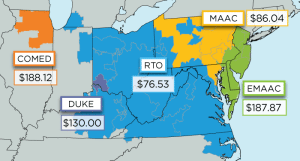
Two nuclear plants owned by Exelon Corp. in Illinois and Pennsylvania failed to clear PJM Interconnection’s latest annual capacity auction, putting one of those financially crippled units at risk of early retirement. Meanwhile, procurements for solar, wind, and demand response fell dramatically compared to last year, and drastic price declines could roil the market for […]
-
 Renewables
Trump Administration Releases Budget Slashing Energy Research
President Donald Trump wants to balance the federal budget in 10 years, and it appears he believes that to do so, deep cuts to the nation’s energy research funding are needed. The administration’s fiscal year 2018 (FY18) budget request, released Tuesday, May 23, cuts funding for the Department of Energy (DOE) by $1.7 billion, a […]
-
 Nuclear
Ohio Committee Suspends FirstEnergy’s Nuclear Power Rescue Plan
Ohio-based FirstEnergy’s plan for a rescue of its two uncompetitive Ohio nuclear plants took a nosedive May 17, as the Ohio House Public Utilities Committee suspended action on the company’s proposal to charge its customers a fee to subsidize the plants. FirstEnergy’s plan mimics programs adopted in Illinois and New York to create “zero energy […]
-
 Energy Storage
Wärtsilä Acquires Major Energy Storage Player
Finnish technology firm Wärtsilä has acquired Greensmith Energy Management Systems, a firm that specializes in energy storage optimization and integration software, for an undisclosed amount. Greensmith, which has designed and deployed more than 180 MW of energy storage at 50 sites globally, has developed a software platform, GEMS, which optimizes the performance of energy […]
-
 Legal & Regulatory
Virginia Governor Orders Power Plant Carbon Regulations
Virginia’s governor has directed the commonwealth’s environmental quality agency to establish regulations to curb its carbon emissions from power plants via a carbon trading scheme by the end of this year. Executive Directive 11 signed by Gov. Terry McAuliffe (D) on May 16 instructs the Department of Environmental Quality to develop a proposed rule to […]
-
 Nuclear
India Approves 10 New Pressurized Heavy Water Reactor Nuclear Units
India’s government has given the state-owned Nuclear Power Corp. of India Ltd. (NPCIL) the green light to develop 10 new domestically designed pressurized heavy water reactors (PHWRs). The approval means that NPCIL, the entity that owns and operates India’s 22 nuclear reactors—a total of 6.2 GW—can begin to site and build 10 more 700-MW PHWR […]
-
 Coal
CoalDTE Joins Growing Number of Power Companies with Carbon Goals
Detroit-based DTE Energy wants to slash its carbon emissions by more than 80% from 2005 levels by 2050, a reduction it said is in line with broad targets identified by scientists to address climate change. The company said on May 16 that it plans to substantially increase investments in renewables, transition its baseload capacity from […]
-
 Legal & Regulatory
Senate Committee Takes on Regulatory Reform
The Senate Committee on Homeland Security and Government Affairs May 17 advanced a number of bills that could have significant impacts on the future of energy regulation in the future. Four of the bills— the Regulatory Accountability Act (RAA), the Regulations from the Executive in Need of Scrutiny (REINS) Act, the Midnight Rules Relief Act, […]
-
Power
Capitalizing Upon Differences Between And Among PRB Coals
Register to attend this complimentary online webinar. June 6 at 11 a.m. EDT The Powder River Basin coals are recognized as both Sub-bituminous C and Sub-bituminous A ranked fossil fuels. They differ with respect to many properties including not only calorific value and bulk chemistry (including ash chemistry) but also reactivity and the evolution of potential […]
-
 News
NewsGeorgia Power, Southern Nuclear to Take Over Plant Vogtle Work
As the dust from Westinghouse’s recent bankruptcy filing begins to settle, Georgia Power has reached a deal to take over work at its Plant Vogtle nuclear expansion project when the current engineering, procurement, and construction contract on the project ends. The announcement of the intended transfer of management duties came May 12, as an interim […]