
Solar
-
 Solar
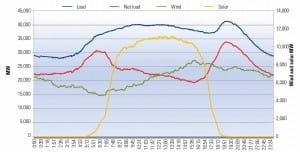
SolarMaintaining Grid Reliability with a High Renewables Portfolio
The first problem with high renewable penetration is that wind and solar are not dispatchable.
-
Solar
California’s Streamlined DG Interconnection Process Bodes Well for Solar
The California Public Utilities Commission (CPUC) last week approved a deal involving the state’s major utilities and renewable energy advocates that is aimed at streamlining the process for connecting distributed generation (DG) resources to the grid. The CPUC’s action will make it easier for small amounts of distributed resources—such as rooftop solar photovoltaic (PV) systems—to connect to the grid. The agreement also revises upward the amount of DG that can be connected to a specific power line segment without the need for supplemental studies.
-
Solar
DOE Offers $10M to Bring Down Rooftop PV "Soft Costs"
The Department of Energy (DOE) on Wednesday announced its SunShot Prize, a new competition to make it faster, easier, and cheaper to install rooftop solar energy systems. A total of $10 million in cash awards are available to the first three teams that repeatedly demonstrate the non-hardware costs, or price to plug in, can be as low as $1 per watt for small-scale photovoltaic (PV) systems on American homes and businesses.
-
Solar
Ariz. Now Home to World’s Largest Solar PV Plant
The title of world’s largest operating solar photovoltaic (PV) power plant goes to Arizona. On Monday, First Solar Inc. announced that the Agua Caliente solar project has achieved a peak generating capacity of 250 MW connected to the electrical grid. The project, under construction in Yuma County, will have a total capacity of 290 MW when completed.
-
Coal
Congressional Briefs: Back from Recess
Congress has returned from its summer break. As the House prepares to vote on its Upton-Stearns "No More Solyndras Act," lawmakers also expect to focus on a bill that could prohibit finalization of any Environmental Protection Agency (EPA) power plant rules that curb greenhouse gas emissions while carbon capture and storage technology is commercially unavailable. House Democrats, meanwhile, called for hearings to examine the impacts of climate change on the nation’s generators.
-
 Coal
CoalChile’s Power Challenge: Reliable Energy Supplies
Droughts, unreliable gas imports, and protests against proposed projects have hampered the Chilean power sector and its largest economic driver, the copper-mining industry. Recent policies designed to foster more reliable supplies are a move in the right direction, but remaining obstacles are formidable.
-
Solar
Trade Representatives Request Investigation on U.S. Renewables in Global Context
The U.S. Trade Representative on Monday asked the U.S. International Trade Commission (ITC) to investigate how U.S.-provided renewable energy services affect development of renewable energy projects worldwide. The ITC’s report, expected by June 28, 2013, will focus on the development, generation, and distribution of renewable energy—specifically onshore and offshore wind and solar energy.
-
Solar
Solyndra Story Doesn’t Get Stearns Reelected
Washington, 17 August 2012 — Poor Cliff Stearns. The soon-to-be-former Republican congressman from Florida found out Tuesday that voters in his district didn’t much care about the ruckus he’s been raising about the Obama administration and its funding of the failed Solyndra solar photovoltaic maker.
-
 Hydro
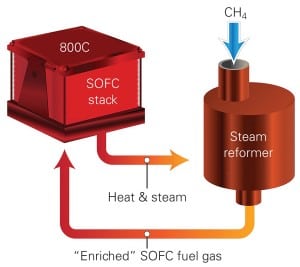
HydroMajor Developments for Solid Oxide Fuel Cells
Solid oxide fuel cells (SOFCs), which oxidize a fuel to produce electricity, have received much attention of late for the technology’s myriad benefits, including high efficiency, long-term stability, fuel flexibility, and low carbon emissions—all at a relatively low cost.
-
 Solar
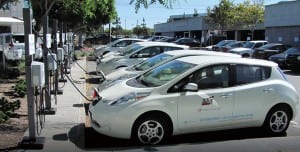
SolarSmart Grid Award: Customers Motivate San Diego Gas & Electric’s All-Inclusive Smart Grid Vision
“If you build it, they will come” has proven a risky strategy for some smart grid projects. One of California’s largest investor-owned utilities faced the opposite challenge—customers whose behaviors necessitated a smarter grid. Customer involvement in and support for smart grid plans is a major reason SDG&E’s smart grid efforts continue to garner accolades, including the 2012 POWER Smart Grid Award.
-
Solar
Solar Trade Tensions Intensify as China Launches Polysilicon Dumping Probe
Global solar trade tensions escalated on Friday as the Ministry of Commerce of the People’s Republic of China announced it would launch both anti-dumping and countervailing investigations on imports of solar-grade polysilicon from the U.S. and an anti-dumping probe on South Korean polysilicon imports. Germany on Friday, meanwhile, said it would support its solar industry in anti-dumping action against China.
-
 Solar
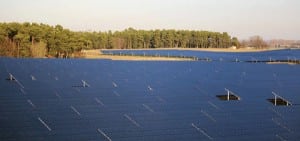
SolarLarge Thin-Film CIS Plant Goes Online in Germany
In May—as a trade war raged between Chinese solar panel manufacturers and exporters and their counterparts in the U.S. and the European Union concerning the world’s plummeting crystalline silicone photovoltaic module prices—a 28.8-MW thin-film copper indium gallium (di)selenide (CIGS or CIS) solar power plant came online. Developers Solar Frontier, the world’s largest manufacturer of CIS […]
-
 Coal
CoalPower in India: Opportunities and Challenges in a Fast-Growing Market
India’s long-term annual economic growth rate is projected at over 7%, and the country is investing in its hydroelectric, nuclear, and renewable resources. However, the primary fuel used to produce electricity remains coal, and the government has ambitious plans to significantly increase coal-fired capacity. Those plans have been challenged by a number of unexpected factors that threaten to stifle India’s economic growth. India’s long-term annual economic growth rate is projected at over 7%, and the country is investing in its hydroelectric, nuclear, and renewable resources. However, the primary fuel used to produce electricity remains coal, and the government has ambitious plans to significantly increase coal-fired capacity. Those plans have been challenged by a number of unexpected factors that threaten to stifle India’s economic growth.
-
 Hydro
HydroUtility Perspectives on Ramping Up Renewable Power
Panelists at ELECTRIC POWER discussed how U.S. utilities choose renewable power generation technologies based on their geographic locations, state requirements, economics, and other criteria—including reliability and federal regulations.
-
 Solar
SolarBoosting CSP Production with Thermal Energy Storage
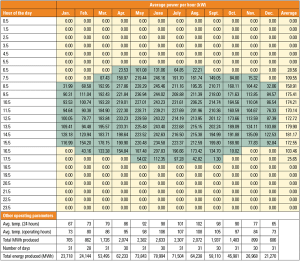
Combining concentrating solar power (CSP) with thermal energy storage shows promise for increasing grid flexibility by providing firm system capacity with a high ramp rate and acceptable part-load operation. When backed by energy storage capability, CSP can supplement photovoltaics by adding generation from solar resources during periods of low solar insolation.
-
 Solar
SolarThink Water When Designing CSP Plants
The operation of solar thermal power plants differs substantially from that of fossil-fired plants, as the sun determines the generation rather than market demand. However, design of the power island to minimize water usage is very similar to that of a fossil plant. This renewable technology requires renewed thinking of its water systems’ design.
-
 Solar
SolarSpain Inaugurates Two More Parabolic Trough Units
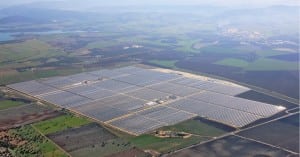
Two identical 50-MW parabolic trough plants with thermal storage in Cadiz, in the south of Spain, began operating this January.
-
 Gas
GasDesertec Ambitions Turn to Asia, Australia
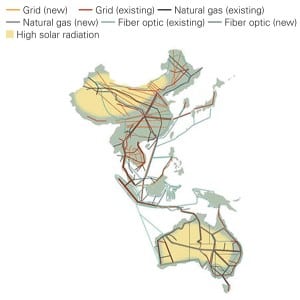
The ambitious Desertec project—a $9 billion initiative to develop, harness, and transmit 2,000 MW of renewable power from North Africa and the Middle East to Europe by 2050—has been trumped by a vaster concept that spans Asia and Australia.
-
 Coal
CoalVietnam Works Hard to Power Economic Growth
For the past 15 years, Vietnam has enjoyed enviable gross domestic product increases, averaging 7% annually. That kind of economic growth increases power demand, but financing new capacity remains a challenge. Reaching its ambitious capacity growth goals will require Vietnam to expand its financing and vendor base, attract foreign investment, and ensure future fuel supplies in a region thick with competition for those resources.
-
 Solar
SolarLarge China Energy Storage Project Begins Operation
Chinese state entity State Grid Corp. of China (SGCC) and battery maker BYD in January said they had finished construction on what they call “the world’s largest battery energy storage station”—a project in Zhangbei, Hebei Province that combines 100 MW of wind and 40 MW of solar capacity, a smart power transmission system, and 36 MWh of energy storage in arrays “larger than a football field.”
-
 Nuclear
The Big Picture: DOE Loan Guarantees
Of the $35.9 billion in loan guarantees awarded by the U.S. Department of Energy (DOE) since 2009, roughly $26.5 billion have financed nuclear and renewable power projects across the nation through the Section 1703 and 1705 loan guarantee programs.
-
 Coal
CoalAbundant Clean Energy Fuels Brazil’s Growth
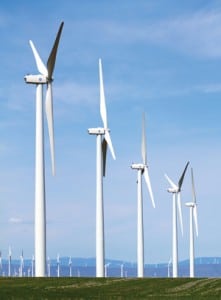
Brazil’s power industry has long been dominated by its vast hydro resources, which historically have accounted for over 80% of the country’s generation capacity. With engineering marvels like the massive Itaipú dam and the proposed Belo Monte project, the country is a leader in the development and use of hydroelectricity on a grand scale. But as the 2001 energy crisis proved, dependence on a single source leaves the country vulnerable to severe shortages. Thanks to government programs designed to take advantage of the country’s favorable climate, Brazil is committed to diversifying its energy mix while continuing to maintain a renewable energy focus.
-
Coal
Editors Select Top Five Stories of 2011
The POWER editorial staff’s picks for the most significant stories of 2011.
-
Solar
The U.S. Military Gets Smart Grid
At home and abroad, U.S. military microgrid and smart grid projects are driven by energy security concerns. The pace of such projects, however, can be slow, and the potential for civilian grids to benefit from lessons learned and technologies developed for these important installations may be limited.
-
 Coal
CoalWorld Energy Outlook Forecasts Great Renewables Growth
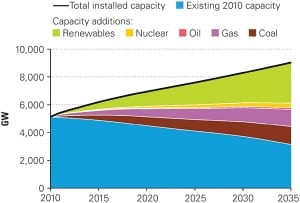
Driven by policies to limit carbon emissions, as well as government subsidies, the share of worldwide nonhydro renewable power is set to grow from just 3% in 2009 to 15% in 2035, the International Energy Agency (IEA) forecasts in its recently released World Energy Outlook 2011. Under the same scenario—which assumes that carbon pricing, explicit […]
-
 Coal
CoalU.S. Confronts Pipeline Gaps While Europe Juggles Renewables and Debt
U.S. optimism has been restored by reports of abundant, reasonably priced natural gas to fuel most new generation; however, huge gaps in the fuel delivery system (thousands of miles of pipelines are needed) will soon challenge gas plant development. Meanwhile, the cloud of sovereign debt hangs over all major capital projects in Europe, where the UK moves ahead with new nuclear projects while many of its neighbors shut the door on nuclear and struggle to finance their commitment to renewables.
-
 Coal
CoalChina’s 12th Five-Year Plan Pushes Power Industry in New Directions
The Five-Year Plan is the expression of the centralized planning goals for China’s economy. The 12th Five-Year Plan, approved by the Chinese Government on March 14, 2011, established many social and economic goals, including significant expansion of the country’s power generation industry in many new directions.
-
 Solar
SolarU.S.-China Solar Trade Dispute Gets Thornier
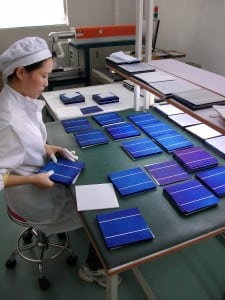
A trade row between the Chinese government and solar panel makers around the world intensified in December. As China’s Ministry of Commerce refuted allegations that the Chinese government uses illegal subsidies, discounts for raw materials, preferential loans, tax incentives, and currency manipulation to drive down prices and amplify exports of Chinese solar photovoltaic (PV) panels, the U.S. International Trade Commission (ITC) affirmed the U.S. solar industry is “materially injured” by imports, at “less than fair value,” of Chinese crystalline silicon PV cells and modules.
-
 Solar
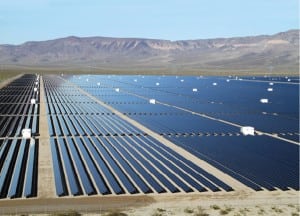
SolarTop Plant: Copper Mountain Solar 1, Boulder City, Nevada
The current largest photovoltaic plant in the U.S., the 48-MW Copper Mountain Solar 1, utilizes approximately 775,000 solar panels to generate emission-free electricity for about 14,000 homes without the use of water. The facility was constructed in less than a year—an unprecedented achievement for a project of this size.
-
 Solar
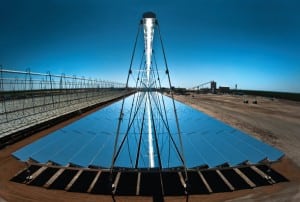
SolarTop Plant:Â Kimberlina Solar Thermal Energy Plant, Bakersfield, California
The 5-MW Kimberlina Solar Thermal Energy Station is the first to use compact linear Fresnel reflector technology developed to generate continuous superheated steam, a key element for higher-efficiency power generation and integration with new and existing plants. The facility’s innovative technology helps deliver power even during periods of transient cloud cover.