
Latest
-
News
EIA Annual Outlook Report: Fossil Fuels Dominate U.S. Generation in 2030
According to the newest Annual Energy Outlook report from the Energy Information Administration (EIA), the U.S. will add between 184 GW and 350 GW of new capacity by 2030, depending on economic growth. Coal will continue to provide the largest share of energy for the U.S. in 2030, but natural gas–fired plants will account for more than half of all capacity additions, followed by renewables at 22%, 18% for coal, and 5% for nuclear.
-
News
Canadian Government Funds Eights Private Sector CCS Projects
The Canadian government last week said it would inject up to C$140 million (US$111 million) into eight private sector projects that have proposed to research, develop, and demonstrate carbon capture and storage (CCS) technologies.
-
News
New Nuclear in the UK Kicked up a Notch
As European utilities vie in an auction for the pubic land on which the UK’s new fleet of nuclear power plants will be built, the UK government on Monday announced it would sell the UK Atomic Energy Authority’s commercial arm, an entity that provides nuclear decommissioning, waste management, and new nuclear build support services.
-
 Coal
CoalNorway Leads the Way on CCS
According to a new study from Emerging Energy Research, more than $20 billion will be spent on carbon capture and storage (CCS) projects this year at 50 power generation projects totalling 16 GW around the world. The European Union (EU), with an investment of $11.6 billion, leads all efforts, because it is pressed to achieve a target to reduce carbon emissions by 20% of 1990 levels by 2020. In December, the governing body reached agreement on a climate and energy package, which includes a framework for CCS and a directive on the way EU members and Norway will regulate licenses to ensure reliable carbon storage. The U.S. takes second place, earmarking $6 billion, and Canada is third, at $2.7 billion.
-
 Nuclear
Problems Plague Russia’s Nuclear Power Ambitions
"The Russian Nuclear Industry: Status and Prospects," a February report from a Canadian-based think tank, Centre for International Governance Innovation, examines a revival of Russia’s Soviet-era plans for a massive nuclear expansion within the current state of the country’s nuclear power industry. It concludes that although the industry has been greeted with renewed funding and enthusiasm, achieving its ambitious plans will require the federation to overcome considerable problems and limitations.
-
 Wind
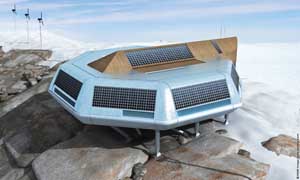
WindTurbines Spinning at Antarctica’s First "Zero-Emissions" Station
About 110 years after the Belgica expedition — a polar voyage organized by the Geographical Royal Society to establish the world’s first Antarctic scientific research program — a new, unique research station sponsored by the Belgian Federal Government has been commissioned. Inaugurated on Feb. 15 after two years of construction, the Princess Elizabeth Station (Figure 4) is the only polar base to run entirely on renewable energies.
-
 Environmental
Researchers: Spanish Electricity Model Is Unsustainable
The current Spanish electricity model is unsustainable: Carbon dioxide (CO2) emissions are hard to control, demand shows no sign of weakening, and the country is overly dependent on imported fuel. These are the conclusions of a team of scientists from the Institute for Research in Technology of the University of Pontificia Comillas in Madrid, who looked at how the Spanish electricity sector would evolve in four different scenarios.
-
 Waste to Energy
Compact, Portable System Converts Trash to Energy
Post-consumer waste could be the newest, ubiquitous fuel source for distributed energy generation if a mobile waste-to-energy conversion system launched this January finds its way onto the parking lots of facilities that produce more than two tons of waste daily. According to its developer, Massachusetts-based IST Energy, the GEM system can process up to 3 tons of waste daily — which can include paper, plastic, food, wood, and agricultural materials — and produce up to 120 kWe and 240 kWth.
-
 Waste to Energy
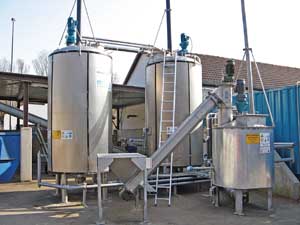
New Biogas Plant Runs Purely on Nonedible Materials
German researchers in February said they had developed the first-ever biogas plant to run purely on waste instead of edible raw materials. The team from the Fraunhofer Institute for Ceramic Technologies and Systems IKTS (Institut Keramische Technologien und Systeme) in Dresden said that the plant, which uses a fuel cell to convert the gas into electricity, exclusively uses agricultural waste such as corn stalks — and it generates 30% more biogas than conventional plants.
-