Wind power has grown over the past decade from a boutique and unappreciated generating technology to a reliable and much-sought-after resource. Bob Dylan was prescient when he wrote, "The answer, my friend, is blowin" in the wind."
Much of Dylan’s early work focused on politics, social commentary, and philosophy, marking him as an establishment outsider. But his enduring qualities have raised him to iconic status. TIME magazine named him one of the most influential people of the 20th century, and his latest album reached No. 1 on the charts this past August. His last visit there was 30 years ago.
The acceptance of wind power is following a similar course, although it will clearly become part of the mainstream faster than Bob Dylan. Overall, the wind power news is good, but many technical and commercial hurdles remain, in the opinion of POWER editors. Many readers may take issue with our appraisal. That’s fine: Spurring debate on issues of the day is what POWER magazine does best.
In this lead article of our special report on wind, we discuss a few of the siting issues that are slowing penetration of U.S. wind power. Following it is a companion article—"Wind farmers: Heed the lessons of the merchant gas-power business"—that takes a sensible look at the technology issues. Our purpose is to pragmatically explore the issues and provide a departure point for discussion and studied alternative viewpoints. If you don’t agree with our assessments, write me at editor@powermag.com. We"ll print the best of your letters in an upcoming issue.
Wind picking up speed
Today there are several unmistakable signs that wind power has reached the mainstream. Among them are the number of competing manufacturers with full production lines, major utilities such as Xcel and FPL Energy making money with diversified wind portfolios, and growth both in the number and size of projects—and opposition to them. Calling wind power mature would be premature, because not all of its application and siting problems have been solved. But solutions seem to be on the horizon.
Case in point: The integration of wind power into a power system makes predicting day-ahead loads on a real-time basis more variable and uncertain. This uncertainty naturally requires additional operating reserves (spinning and nonspinning) for not just demand and energy, but also for other ancillary services such as regulation, ramping, and load-following (Figure 1). Yet transmission-owning utilities are used to precision when dispatching their fleets of conventional plants. The expectations of your local and state regulators with regard to reliability will also influence how fast wind becomes part of your portfolio. Some regulators are pushing hard for wind generation, while others wouldn’t know a wind turbine if they walked into it. More on this issue later.
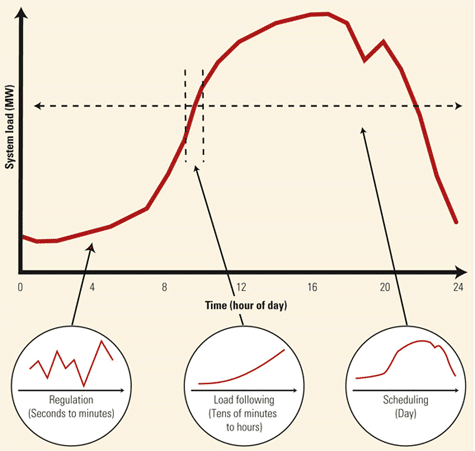
1. Like herding cats. Predicting wind generation is extremely challenging. The bubbles describe what the load profile really looks like. Source: NREL
First, the good news
In its third-quarter report, the American Wind Energy Association (AWEA) projects that 2,750 MW of wind power capacity will come on-line this year. That’s about as much generating capacity as Rhode Island has. Accounting for a big chunk of the total is FPL Energy’s just-completed Horse Hollow Wind Energy Center in Taylor County, Texas. At 735 MW, it takes the title of the largest wind farm in the U.S. The plant entered service in September and is powered by 291 GE 1.5-MW turbines and 130 Siemens Power Generation units each rated at 2.3 MW (Figure 2). FPL Energy currently operates 48 wind farms in the U.S. with a gross capacity of nearly 4,100 MW; more than 1,600 MW are in Texas alone.
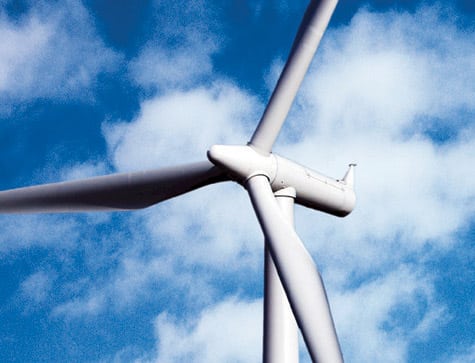
2. Big is beautiful. FPL Energy dedicated the third phase of the 735-MW Horse Hollow Wind Energy Center in Texas on October 19. It is now considered the world’s largest wind farm. One hundred and thirty Siemens Power Generation wind turbines rated at 2.3 MW apiece, like this one, do the heavy spinning there. Courtesy: Siemens Power Generation
When Horse Hollow came on-line, Texas surpassed California in total wind energy production, making the Lone Star State No. 1 in the U.S. California had been the leader for 25 years; at one point in the 1980s the Golden State was home to 8% of worldwide wind power capacity. Recent legislation calls for California utilities to get 20% of their supply from green sources by 2010. But transmission bottlenecks may make that laudable public policy goal difficult to reach.
If there’s one thing AWEA members would like from the yet-to-be-seated 109th U.S. Congress next year, it’s another extension of the federal Production Tax Credit (PTC) for wind power. The credit, which was extended for two years by the 2005 Energy Policy Act, is now set to expire in December 2007. In the past, whenever the PTC was allowed to expire, investment in wind projects was chilled by the uncertainty of future subsidies, until subsidies were reinstated. The interim result was an all-too familiar boom and bust cycle of wind project development.
"To strengthen our energy independence we need safe, domestic, and inexhaustible energy, and wind power provides just that," said AWEA Executive Director Randall Swisher. "The U.S. wind energy industry is working all-out to meet current demand for new wind farms. But the nation needs a timely and long-term extension of the wind energy Production Tax Credit to allow companies to plan beyond 2007 and continue to build a strong and secure energy future," he added.
According to the AWEA, some 1,345 MW of wind capacity already have been completed this year through the third quarter, bringing the U.S. total to 10,492 MW. The DOE’s Energy Information Administration notes that this year new wind capacity may account for 18% to 20% of total U.S. new capacity; only new gas-fired generation will add more capacity. The AWEA had projected 3,000 MW for 2007, but many projects slated for 2006 will slip into 2007, principally due to interconnection delays. Next year looks equally bright, with 3,000 to 3,500 MW projected to enter commercial service.
Pushing the limits
Every state has a unique combination of natural resources, fuel availability, and political landscape that—more or less—defines the boundaries of acceptable power generation technology. Not every state has generous reserves of coal or oil, but many are blessed with strong winds and a citizenry that wants to put that clean resource to work.
However, there are limitations on how much wind a utility or regional authority can handle. Variables include wind’s compatibility with generation types already on the power grid (natural gas and hydro work well with wind power, for example), the utility’s service area size (larger areas can handle the fickle nature of wind farm production more easily), and the distribution of generating assets (the more widely they’re spread out, the smoother the integration of wind power).
Developers and system planners seem to have a good handle on integration issues, if the number and size of wind farms recently commissioned is any guide. However, challenges do remain. Participants at a recent technical symposium on utility-scale wind power hosted by the IEEE, AWEA, the North American Electric Reliability Council (NERC), and the Utility Wind Integration Group (UWIG) identified the following three key integration issues.
Forecasting tools. Wind forecasting tools are needed to help system operators and managers make the most efficient use of the resources on a given system to minimize operational costs. Mark Ahlstrom of WindLogics (www.windlogics.com) noted that as forecasts become more accurate, they will be delivered to system operators in the format most useful for decision-making in the control room. Better dynamic models of wind turbines and aggregate models of wind plants are needed to perform more-accurate studies of transmission planning and system operation.
According to UWIG (www.uwig.org), fluctuations in the net load (load minus wind) caused by greater variability and uncertainty introduced by wind plants have been shown to increase system operating costs by up to about $5/MWh at wind penetration levels up to 20%. The largest part of this cost is associated with the uncertainty introduced into day-ahead unit commitment by uncertainty in day-ahead forecasts of real-time wind energy production.
A well-functioning hour-ahead and day-ahead market provides the best means of addressing the variability in wind plant output. According to UWIG, commercially available wind forecasting tools can substantially reduce the costs associated with day-ahead uncertainty. In one major study, state-of-the-art forecasting was shown to provide 80% of the benefits that would result from perfect forecasting.
Reliability. Overall grid reliability and post-fault response now can be improved by including wind capacity in the mix, thanks to new high-tech features of modern wind turbines (which have become significantly more reliable themselves). The latest set of bells and whistles includes low-voltage ride-through capability, reactive power control, voltage control, output control, and ramp rate control. Future designs are likely to sport post-fault machine response characteristics similar to those of conventional generators (for example, inertial response and governor response).
In one study of the impact of integrating 3,300 MW of wind power (10% market penetration) into New York’s transmission system, system post-fault response was better with than without wind turbines, according to data from Hydro-Québec presented by GE Energy. The study concluded that the 3,300 MW are expected to increase NERC’s required operating reserve margin only by 36 MW and reduce the New York Independent System Operator’s annual variable costs by $350 million.
According to UWIG, wind generation may also provide some additional load-carrying capability to meet forecasted increases in system demand. This contribution is likely to be up to 40% of a typical project’s nameplate rating, depending on local wind characteristics and the project’s compatibility with the system load profile.
System stability studies have shown that modern wind plants equipped with power electronic controls and dynamic voltage support capability can improve system performance by damping power swings and supporting post-fault voltage recovery.
Transmission constraints. Constraints—from interconnection and grid access to tariffs and grid expansion—are a big factor in determining whether wind will become a significant part of the generation mix. Federal Energy Regulatory Commissioner Nora Brownell noted that FERC wants to be a "platform for change" and help get the rules right on interconnection, imbalance, reliability, and market access. "Being ‘risk-averse’ should not mean doing things the way they were done 30 years ago," she said.
Upgrades or additions to transmission facilities may be needed to provide access to remote locations with large wind energy potential. Current transmission planning processes are able to identify solutions to transmission problems, but the time required for their implementation often exceeds the time frame of project permitting and construction by several years. This fact will be the primary reason why many utilities will miss their renewable portfolio standards (RPS) goals in coming years.
Speaking as the head of NERC’s Wind Energy working group, Mahendra Patel of the Pennsylvania-New Jersey-Maryland (PJM) Power Pool said that bringing more wind power on-line "is not a reliability issue" but rather a market issue, involving cost allocation among various sources. Truer words may never have been spoken.
How far can wind travel?
National Grid (www.nationalgridus.com) published a white paper in September that directly addressed the "current inadequacies in U.S. transmission policies that create obstacles for wind and other renewable generators in accessing the country’s electric grid."
In the paper, titled "Transmission and Wind Energy: Capturing the Prevailing Winds for the Benefit of Customers," National Grid advocates the "development of a consistent and appropriate policy approach to support the transmission investment needed to harness wind power and integrate it into the U.S. electricity grid while continuing to maintain system reliability." It adds that "obstacles to new generation sources continue to exist due to the lack of adequate transmission system access."
Access to transmission, however, is constraining not just wind power penetration but the entire electric power industry. Existing grids were designed to support monopoly utility service in a given physical territory, not a competitive regional wholesale market in which large quantities of electricity are moved long distances. Complicating the problem, investment in transmission has lagged behind load growth for more than 20 years. There are many reasons for that, including lack of comprehensive regional planning, inconsistent cost allocation rules, and lack of financial incentives. The result plagues wind projects, which tend to be located in sparsely populated areas far from load centers, as much as it does mine-mouth "coal-by-wire" projects.
The problematic approach to project interconnect that’s in universal use today requires new projects to shoulder any system reliability issues, and their resultant costs, when connecting to the grid. This piecemeal approach adds uncertainty to siting, financing, and procurement processes and consequently delays project schedules. A better approach would be to level the playing field for wind farm developers so they can economically move power from a wind-rich state to a state where there are green power sales opportunities.
Flight fight settled
Aside from noise pollution (see box), perhaps the biggest stain on wind power’s green reputation is the turbines" deadly impact on avian wildlife, especially bats and migratory birds. In 2004, the Center for Biological Diversity (CBD) sued the nine owners of wind turbines constituting the Altamont Wind Resource Area an hour east of San Francisco. The CBD claimed that birds such as golden eagles, red-tailed hawks, burrowing owls, and other protected species are routinely torn apart by turbine blades or electrocuted by the wind farm’s transmission lines. According to CBD researchers, from 880 to 1,330 raptors alone are killed each year by Altamont wind turbines. Wind turbines have been operating at Altamont Pass since 1981, and the lawsuit focused on early models.
CBD’s suit contends that the birds are part of the public trust and therefore the property of the public. In a decision issued in October 2006, an Alameda County Superior Court judge held that California citizens cannot bring suit under the public trust doctrine to prevent the continued killing of public trust wildlife.
In response, Richard Wiebe, the CBD’s attorney, said, "The court’s ruling conflicts with more than 100 years of California Supreme Court rulings that clearly establish that California’s wildlife is property owned by the people of California. It also conflicts with California Supreme Court rulings holding that citizens and public interest groups can sue to enforce public trust property rights. The bird deaths are preventable and the operators must be forced to resolve this problem. A few intransigent companies should not be allowed to needlessly slaughter wildlife and impede the expansion of renewable energy."
A year earlier, in September 2005, the Alameda County Board of Supervisors adopted new permit conditions for more than 4,000 existing, obsolete wind turbines in the Altamont Pass at the request of the CBD. The new permits require:
- Seasonal shutdowns of turbines during the winter migratory season, when bird deaths are particularly high.
- Immediate shutdown of the 2% of wind turbines shown by studies to be particularly lethal to birds.
- Monitoring of avian mortality.
- The preparation of an environmental impact report within three years to assess the problem of bird fatalities and the most effective ways to reduce them .
- Replacement of existing wind turbines by fewer, more efficient, and taller turbines over the next 13 years.
Wind now on the radar—literally
Another wind farm siting problem was the focus of a recent U.S. Department of Defense (DoD) report of obvious interest to any wind power developer. The report, titled "The Effect of Windmill Farms on Military Readiness," concludes that wind farms located in the line of sight of an air defense radar system could degrade the system’s effectiveness. The impact, of course, would depend on the number and location of the farm’s turbines.
The report, which was released this past September, was prepared in response to a congressional call for the secretary of defense to submit a report on the effects of wind farms on military readiness. Pending completion of the report, in March 2006 the DoD and the Department of Homeland Security (DHS) adopted an interim policy (pending publication of the final report in the Congressional Record) that warned that they would contest any wind farms "within radar line of site of the National Air Defense and Homeland Security radars." The Federal Aviation Administration (FAA) subsequently began issuing "Notices of Presumed Hazard" to wind projects located within 60 nautical miles of long-range radar installations.
At least 12 projects in Illinois, Wisconsin, North Dakota, and South Dakota received such notices, placing a de facto moratorium on construction. According to a statement issued by Senator Dick Durbin (D-IL) on June 2, the "overwhelming percentage of land in this country is classified as within the ‘radar line of sight’ and possibly obstructive."
The DoD’s final report evaluated several mitigation measures and defined mitigation as follows: "either an approach that completely prevents any negative impact from occurring," or an approach that sufficiently reduces any negative impacts so that "there is no significant influence on the capability of air defense or missile warning radar." The report also noted that the only proven mitigation measure is "line of sight mitigation"—in other words, not placing wind turbines within a radar’s field of view. Line of sight mitigation may be achieved by employing the "bald earth" approach (increasing the distance between the radar system and the turbines), terrain masking (hiding the turbines behind a mountain), or terrain relief (when the radar is relatively higher than the turbines).
The impact of the DoD/DHS policy and the FAA actions on wind farm developers nationwide is immediate, significant, and potentially costly. Any new project now must apply to the FAA for a hazard determination prior to starting construction on a new plant. The developer must submit a "Notice of Proposed Construction or Alteration" to the Air Traffic Division Manager of the FAA Regional Office with jurisdiction over the site location. The report notes that specific DoD bases and installations are assigned management responsibilities for specific sections of airspace. Wind developers should continue to work with local base and installation managers to eliminate potential impacts on existing facilities.