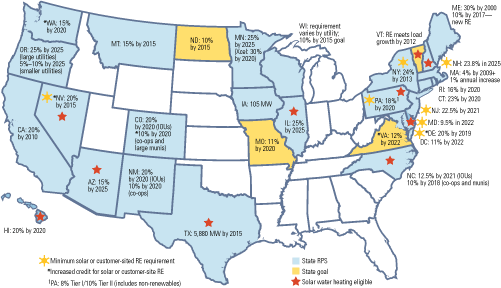
The U.S. Congress continues to debate proposals that would mandate that a set amount of the nation’s electricity come from renewable energy sources such as wind, the sun, or biomass. These discussions about adopting a nationwide renewable portfolio standard (RPS) raise significant concerns for power providers and customers alike.
Backers of a one-size-fits-all federal RPS believe it to be an essential component of a broad national energy strategy to address global climate change, improve air quality, and lower electricity price volatility. But in reality, a national RPS could disrupt existing state renewable energy programs and put added pressure on electricity prices and reliability.
Impact on state programs
States are moving forward with their own programs to promote renewable energy sources. As of September 2007, 24 states and the District of Columbia had established an RPS. Four other states had nonbinding goals for adopting renewables, and 48 states now support programs that offer consumers incentives, grants, loans, or rebates to use renewable energy resources.
Each state’s RPS plan includes carefully considered timetables and targets based upon its own unique circumstances and available energy sources. A federal RPS that imposes different targets and timetables could undercut or preempt those efforts. This would create uncertainty and drive up the cost of meeting renewable mandates even further for electricity suppliers and consumers in those states.
Even among states that have an RPS, all have chosen to add energy sources unique to their areas, such as geothermal power, which are not included in the broad-sweeping federal RPS proposals. Many state programs also include technologies such as fuel cells, as well as alternative means of compliance such as energy-efficiency programs, which are not recognized in the federal plans.
Higher power costs
Finally, not all regions of the country have abundant renewable energy sources that they can turn to for generating electricity. The cost for states in these regions to comply with a federal RPS could be high, because many of the retail electric suppliers in these areas will not be able to meet an RPS requirement through their own generation. They will be required to purchase higher-cost renewable energy from other suppliers or purchase renewable energy credits.
Thus a nationwide RPS mandate will mean a massive wealth transfer from electric consumers in states with little or no renewable resources to the federal government or states where renewables happen to be more abundant.
A federal RPS would also mean higher costs due to the need to build high-voltage electric transmission lines. Renewable energy facilities, especially wind farms, are usually located in remote areas. To deliver their electricity to the populated areas where it is needed, transmission lines would need to be built. To do so will cost approximately $1 million to $3 million per mile.
Most renewable energy sources are intermittent, meaning they do not generate power all the time. Consequently, conventional power plants (most likely fueled by natural gas) need to be built to support them, which accounts for costs in addition to the cost of building the renewable energy facilities.
A better solution
There are better ways to expand the use of renewables. Federal tax credits and increased funding for research and development are key. A long-term extension of the Production Tax Credit (PTC) could be the single most effective thing Congress could do to promote renewables.
Unlike the leading RPS proposals, the PTC is a proven means of actually getting renewable generation built and brought on-line. The current PTC is due to expire on December 31, 2008. In the past, the short-term, start-and-stop nature of the tax credit has dissuaded utilities, developers, manufacturers, and investors from maximizing the potential of renewable technologies and resources, where they are available. Extending the credit for at least five years will give the private sector the stability necessary to plan and finance renewable energy projects.
The nation’s electric utility companies support the development and greater use of renewable energy sources. Renewables, along with the full range of other climate-friendly technologies—including nuclear, energy efficiency, clean coal, carbon capture and storage, and plug-in electric hybrids—must be a part of the industry’s long-term approach to meeting the country’s steadily growing demand for electricity.
But renewables must be encouraged where they make economic sense. For this reason, a federal mandate that forces all states to generate an arbitrary amount of electricity from them, regardless of states’ individual resources, is bad for electricity customers and providers alike.
To learn more about the electric utility industry’s efforts to provide a reliable, affordable, and environmentally sensitive electricity supply, please visit www.getenergyactive.org.
—Roger Kranenburg (rkranenburg@eei.org) is director, business development for the Edison Electric Institute (www.eei.org).