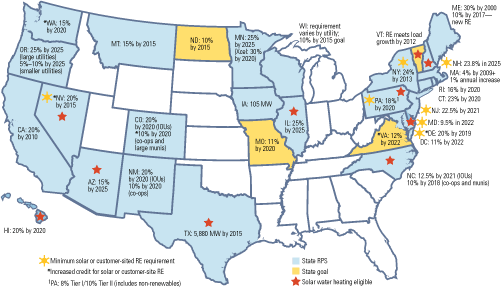

U.S. wind power is on a roll, with wind farms sprouting like weeds. But in the near future, utilities may end up paying higher prices for wind capacity because state regulators are, in effect, imposing an artificial floor on national demand for generation fueled by renewable resources. At last count, at least 20 states had enacted some form of a Renewable Portfolio Standard (RPS). Some RPSs require utility resource plans to include a minimum amount of renewable energy by a date certain. Others insist that a certain share of a utility’s sales 5%, for example-represent electricity generated by renewable "fuels" (including wind). If a utility’s share falls short, it can fill the gap by buying renewable energy credits or certificates (RECs), denominated in kilowatt-hours, on the open market. By increasing the required share of green power over time, RPS policy attempts to push its states generation industry toward greater sustainability.
Early birds get best worms
Most utilities are serious about meeting their state-mandated RPS goals. But the current market leaders FPL Energy, Xcel Energy, and Southern California Edison embraced wind power long before they had to because they realized that doing so was a good business decision. The early adopters willingness to pay early wind power’s cost premium over fossil-fueled generation has supported the industry’s growth and allowed them to lock up the projects likely to have the lowest production costs. Latecomers, by contrast, will end up with RPS portfolios full of higher-priced capacity.
Why is future wind power capacity likely to cost more Economics 101 tells us that increased demand for anything raises its price, unless supply grows to fill the gap. Wind may be a renewable resource, but its supply how often and how strongly the breezes blow over the proposed site of a wind farm must be considered locally limited. More-efficient turbines will continue to lower wind power production costs, but not enough to offset the effect of market forces.
Accordingly, I’d advise state regulators to look to the near future, when choice wind farm sites will be in shorter supply. Regulators should recognize that, for example, ratcheting up RPS requirements before there is enough cost-effective wind power capacity for utilities to choose from could result in higher retail electricity prices.
Too green, too soon?
Some utilities already are failing to meet their RPS standard due to factors beyond their control. A recent report for the California Energy Commission (CEC) by Kema Inc. concludes that large renewable capacity solicitations may have overall contract failure rates of 20% to 30%, with some experiencing rates as high as 50%.
The report sampled a total of 21,500 MW of renewable energy contracts of 18 utilities and government entities outside of California. About half of the total represented wind power capacity. Only a little more than half of the 74 contracts were considered successful. Southern California Edison reports that six of the eight projects totaling 1,353 MW with which it has signed capacity contracts are unlikely to be on-line by 2010, well beyond their planned start-up dates. Elsewhere, only 22% to 63% of renewable-capacity auctions conducted in New Jersey, New York, Pennsylvania, and Massachusetts were judged a success.
Another factor beyond the control of wind power developers is transmission. Because many wind farms are at remote locations, new power lines often must be built to get their output to market. However, such projects may take as long as seven years to permit and complete. This may render a wind power project uneconomic, force the developer to move on, and possibly leave a utility with a hole in its RPS plan. A utility could, of course, hedge its bets by contracting for twice the capacity it needs. But that’s not a particularly compelling resource planning strategy, either.
Incentivizing compliance
How much should a utility be penalized for failing to comply with an RPS mandate? The short answer is: enough to make it economically painful to meet the standard by purchasing RECs. In the federal SO2 allowance trading program, a utility must pay $2,000 for each excess ton of SO2 it emits far more than the going rate for SO2 credits. This penalty is so high that the U.S. EPA has not had to take any enforcement actions to date; utilities find it far more cost-effective to comply than not.
In Massachusetts, when a utility cannot purchase enough RECs to meet its RPS goals, it is fined a certain amount. Significantly, the spot market price for Massachusetts RECs has settled right at that amount. This proves that incentives cease to be helpful when the fine is cheaper than the cost of compliance.
One preliminary finding of the Kema report should be particularly troubling to utilities accustomed to working with firm resource plans: In California, half of renewable energy projects have failed since the state began mandating RPS procurements in 2002. Unless the levels and penalties in the 20 existing state RPS programs are adjusted to reflect wind power’s national supply limits, the entire RPS process could collapse under its own weight when the other 30 states adopt their own programs. That would be a shame, because wind and other renewable resources deserve a chance to compete with fossil fuels and nuclear power in the generation arena.