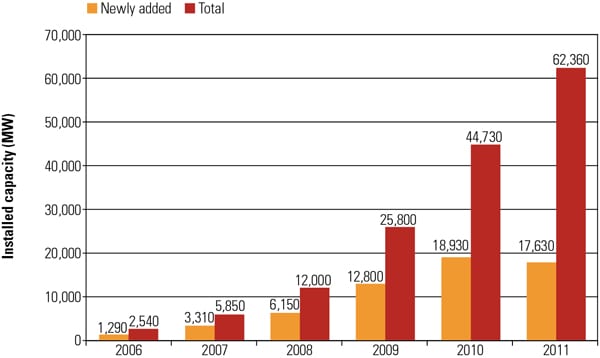
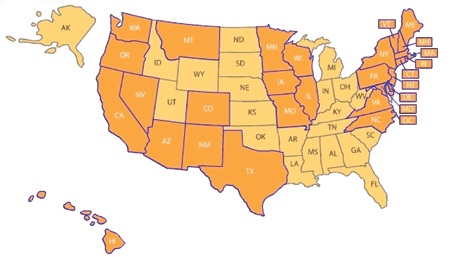
Renewable portfolio standards (RPSs) of various forms have been adopted by 28 states and the District of Columbia (Figure 1). Some set voluntary goals with long implementation schedules; others—like those of Texas, which call for 5,880 MW of renewable power sales by 2015—mandate both an absolute value and a near-term deadline. Several RPSs (like those of Illinois, Minnesota, and Oregon) aggressively target a penetration goal as high as 25% but allow plenty of time to meet it (2025, in all three cases).
California’s scramble for renewable energy resources has been, for the most part, legislatively driven. In 2002, California passed Senate Bill (SB) 1078, which created an RPS for California’s three investor-owned utilities (IOUs): Southern California Edison, Pacific Gas and Electric Co., and San Diego Gas & Electric Co. The goals of this RPS included increasing total annual retail power sales from eligible renewable resources by at least 1% per year, and attaining 20% aggregate annual retail sales by 2017. Although municipal utilities were exempted from the specific provisions of SB 1078, the legislation did require them to develop their own renewables programs with the same objective as SB 1078.
|
1. In the majority. More than half of all U.S. states (darker) have enacted a renewable portfolio standard. Source: U.S. Department of Energy’s Energy Efficiency and Renewable Energy program
|
n 2005, California’s Energy Action Plan and the California Energy Commission’s Integrated Energy Policy Report revised the 20% penetration level goal by calling for it to be met seven years earlier, in 2010. The acceleration made California’s RPS one of the nation’s more aggressive standards. Many expect it to become even more aggressive within a year or two, because Governor Schwarzenegger is pushing to make the minimum penetration level 33% by 2020.
State RPSs have proven to be necessary, but hardly sufficient, for renewables project development. For example, California IOUs have seen about 60% of the renewables projects proposed to them fail to evolve into viable power plants. Historically, the fatal blow has usually been an inability to secure financing, a site, or a grid interconnection for a project. Recently, however, a new obstacle has arisen in one segment of the renewable generation market: a shortage of wind turbines that has made both IOUs and municipal utilities less confident in the ability of otherwise suitable projects to help them meet their RPS goals on time.
Major wind turbine manufacturers are currently so inundated with orders that 18 months may elapse between the signing of a contract for multiple units and their delivery to a developer. Naturally, vendors are more likely to fast-track larger orders for at least 100 MW worth of total installed capacity. But that practice increases backlog times for smaller orders from the same manufacturer and limits utilities’ choice of suppliers to second-tier players with fewer commitments to multiyear orders. Inevitably, the gap between supply and demand will take its toll on wind turbine prices, which are currently running at about $2,500 per kilowatt of installed capacity.
Transmission trouble
For political and economic reasons, utilities prefer to acquire renewable generation locally. Unfortunately, because average wind speeds typically are higher (and land prices lower) far from load and population centers, most wind farms are built in remote areas. Such sites usually require the upgrading of weak transmission lines or the building of new ones to bring the farms’ production to utility grids.
Indeed, transmission remains the biggest constraint on long-term wind power development. It might take a year to build a wind farm but five or six years to interconnect it. For example, Southern California Edison (SCE) is awaiting regulatory approval of the final legs of a high-voltage transmission project designed to bring up to 4,500 MW of wind generation from several wind farms in eastern Kern County to the Los Angeles basin via the city of Ontario. Some 1,500 MW of the total would come from wind farms being developed near Tehachapi by Alta Windpower Development LLC. In December 2006, SCE agreed to purchase their output for 20 years—the biggest wind power contract in U.S. history.
Government-imposed RPSs may even have unintended negative consequences on the development of wind farms and supporting transmission lines. This August, the U.S. House of Representatives passed a comprehensive energy bill that would require all states to get at least 15% of their electricity from renewable resources, including wind, by 2020. However, the energy bill passed by the Senate two months earlier says nothing about RPSs. Reconciling the two bills has proved problematic, and the attendant uncertainty about a national RPS may have an effect on developers and lenders as chilling as the three expirations between 1999 and 2004 of the federal production tax credit (PTC) for renewable energy facilities. (More on the current PTC later.)
“You can build all the solar arrays or wind turbines in the world, but if you don’t have the transmission lines [to support them they] do you no good,” said Dan Riedinger, a spokesman for Edison Electric Institute, the trade association of U.S. IOUs. Riedinger noted that a national RPS would only exacerbate the financial challenges facing utilities by requiring them to spend more to upgrade and add lines. Investment in U.S. grids has steadily dropped over the past 30 years, while electricity demand has risen by an average 2% annually for the past few decades.
Another drag on wind power transmission development is the intermittent nature of wind. Because wind farm capacity factors rarely exceed 40%, much of the transmission capacity built to serve them is underused, limiting its installed economies of scale. For this reason, it typically costs three times more to transmit a kilowatt-hour of wind power than a kilowatt-hour from a fossil-fueled baseload plant.
Ideally, a new wind farm would be sited near an existing transmission system with sufficient excess capacity to handle its output (see Cover Story, Steel Winds). It’s more likely, however, that the farm is near a line that needs upgrading. “Reconductoring” existing lines with thicker wires is a common, cost-effective solution to the problem, even if doing so requires strengthening transmission towers to accommodate the added mechanical load. Another effective way to add transmission capacity to a grid is to erect a new set of towers and lines within an existing right-of-way.
The least cost-effective and practical approach would be seeking to build a new transmission line within a new right-of-way. Although the federal government has been pressuring its agencies to streamline the processes for approving new transmission, resistance to change has been stiff. Moreover, it may be too time-consuming for a developer to ask the Federal Energy Regulatory Commission (FERC) to overrule a state’s denial of a permit for a proposed project, even one within a congested National Interest Transmission Corridor (see POWER, November 2007, Legal & Regulatory). Odds are, whether you’re a developer or utility, you’ll have to build a substation and at least 10 miles of new, above-ground transmission to get the output of your farm to the existing grid, at a cost of $2 million per mile.
If you’re a utility resource planner, you have the usual two options—build or buy—for acquiring the wind capacity needed to help satisfy your RPS mandate. Each approach has pros and cons. Let’s start with the option of building your own wind farm.
|
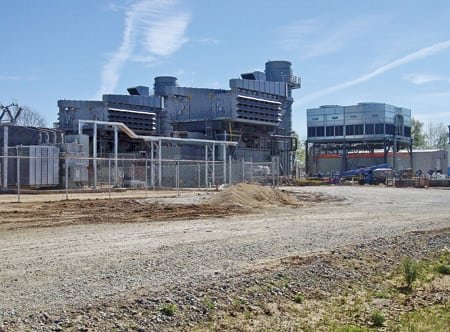
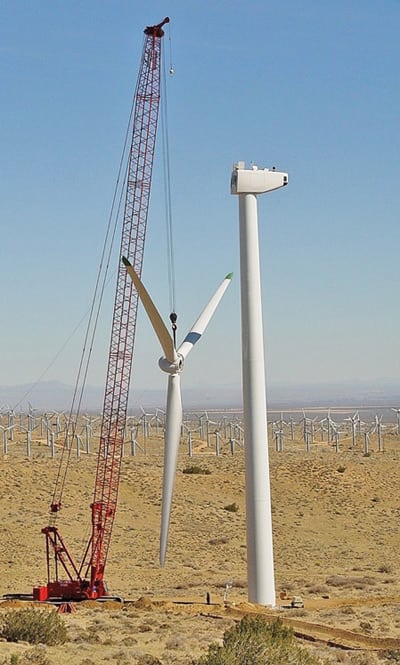
2. Heavy lift. A crane lifts an entire blade assembly into place during construction of the 60-MW Oasis Wind Power Project. The project uses 50 Mitsubishi turbines rated at 1 MW each, and its output is sold to San Diego Gas & Electric Co. Courtesy: Mitsubishi Heavy Industries
|
Catching the wind yourself
Finding a site for a wind farm has been made more difficult by booming demand for the clean, CO2-free energy source. According to the American Wind Energy Association, the U.S. is on track to add well over 3,000 MW of wind power capacity this year, topping last year’s record of 2,454 MW. California ranks second nationally, behind Texas, in installed wind generating capacity, with 2,376 MW.
Location. With wind power in such demand, many of the sites with the best wind profiles—the most consistently high average wind speeds, in other words—have already been spoken for. The three areas in California with the best wind profiles are Altamont, Tehachapi, and Banning Pass.
As land owners in these areas have become more aware of the enhanced value of their property, many are now less interested in selling their land to developers and utilities and keener on leasing it to them at rising market rates, in the hope of creating a perpetual revenue stream. Of those landowners willing to sell, some have even sold their wind rights and land-use rights to different parties (based on precedents legalizing the separation of mineral rights from land-use rights), with contracts stipulating that the new land-use owner will provide easements enabling the new wind-rights owner to erect turbines on the property.
Wind profiles in the U.S. heartland are very favorable, but moving wind-generated electricity over heavily loaded existing lines to California remains problematic. Many Midwest states are planning new transmission, but the lines typically terminate in Utah, under the erroneous assumption that existing transmission capacity from there west is sufficient.
When you look for a site, try to find one where the average wind speed (confirmed by a year’s worth of readings from anemometers) is at least 16 miles/hr, which would generally give your turbines a capacity factor of 30% or better. Proximity to transmission lines with excess capacity also is important. For economies of scale, your wind farm should have an installed capacity of at least 100 MW—anything less might make your per-kWh price uncompetitive.
Large wind turbines require terrain that is fairly level, so the site should not have significant grades. If the surrounding terrain makes the site difficult to access, construction costs go up drastically. I’ve found that some inaccessible sites require a lot more road building than wind farm development.
To avoid this problem altogether, go offshore. In fact, there are more advantages than disadvantages to building a wind farm offshore, as compared with those on land. On the plus side, delivering large components—like blades hundreds of feet long—to terrestrial installations usually is more problematic than shipping them to offshore sites. More often than not, offshore sites also have stronger and steadier winds than land-based sites. And then there’s the blade advantage. Terrestrial turbines typically use three blades to make them quieter. Offshore, noise is no problem, so two-blade turbines are more common there. Because turbine blades are among the most expensive components of a wind farm, the capital cost savings can be substantial.
The biggest disadvantages of offshore wind farms are the higher cost of building them at sea and the need for long transmission cables to bring their output onshore. Construction costs vary from site to site and depend on seabed geology and water depth. Less is known about how much more it costs to operate and maintain an offshore wind farm. But experience from the many installations offshore of Europe (see Cover Story, Burbo Bank) is accumulating rapidly.
Ownership. Because you may be investing hundreds of millions of dollars in a site, it behooves you to control it for an extended period. For that reason, buying land is generally better than leasing it. But if you must lease, or choose to do so, get a lease for at least 30 years with an option to extend the term. In most instances, the facility’s infrastructure and installations are worth far more than the land itself. So if you sublet the land to a developer, structure the contract so that if he defaults, you retain the lease rights.
Size. How many turbines can be squeezed onto a wind farm? That number is a function of the size of your farm and the length of your turbine blades. As rules of thumb, figure that each turbine in a row will be three to five diameters (or roughly six to 10 blade lengths) from its neighbor, and that the rows will be five to nine diameters apart. Packing turbines too tightly hinders the reforming of wind between two machines and may cause the turbulence produced by a turbine to adversely affect its neighbors.
Buying wind power wholesale
The booming wind power market has increased the number of developers willing to build a wind farm and sell it or its electrical output to you. Most IOUs are opting for ownership, but some larger developers are balking at relinquishing it. Given the high percentage of proposed plants that fail to come to fruition, be sure that a prospective developer has firm control of the proposed site before taking the trouble to negotiate a contract; doing so will weed out a good portion of the pseudo-projects. Another way to ensure the viability and security of your wind farm is to deal only with larger developers, or developers backed by substantial guarantors. Finally, determine how far along the project is in its environmental review, as that may be the critical path for setting an in-service date.
Contracts. Before starting full-fledged negotiations, establish a confidentiality agreement and exclusive negotiation rights. That will save you the frustration of almost reaching a deal only to have it pulled away at the last minute. If you plan on multiple capacity acquisitions, develop an in-house pro forma contract to use as a template. Doing so will allow you to be intimately familiar with contracts at the start of negotiations. After a few deals, you’ll become familiar with the likely “pushback” points and the industry standards for various clauses. You should also be aware of the typical rates of returns for investors underwriting the project: 9% to 11% for tax-exempt investments, and 14% to 16% for tax equity investments.
When it’s time to negotiate, start by getting your developer to commit to a commercial operation date (COD). Be sure your contract includes both incentives for the developer to beat specified project milestones and penalties if milestones or the COD are not met (see POWER, November 2007, “Milestones on the road to commercial operation,”).
It is also useful to have the value of the wind farm be predetermined for any time during the contract period, including the precommissioned date. Insist on having the first right of refusal for any sale of the project in case of foreclosure, or at least the right of first offer. Doing so ensures that if the lender forecloses on the property, the utility will finish the project and make it operational without disturbing the schedule for RPS compliance.
Pricing. Be aware that there are two different pricing structures for wind energy: one for so-called “P99” wind (with a 99% probability of occurring) and another for P50 wind. Use the former when calculating rates of return on investment.
Compare developers’ proposals based on a levelized price for energy, with escalations only on the O&M component. I’ve found this to be the easiest way to compare the values of proposals, and lenders seem to like escalations on O&M because they know O&M costs increase. I’ve seen some offers start out with very low energy costs and have an annual inflation quotient applied to the entire energy cost (not just on the O&M component), making for very expensive energy.
Good neighbor policies
Wind projects must meet a series of legislative requirements related to environmental and construction issues. Before construction can begin, an environmental review may be needed to categorize and minimize potential effects upon plants and animals. According to the National Environmental Policy Act, any wind project selling power to a federal entity, moving power over a federal transmission line, or using federal funding or federal land must be analyzed to determine its potential environmental impact.
In California, the overall permitting process for a wind farm is usually much longer and more costly than in neighboring states due to stricter environmental regulations and much higher levels of public participation. Naturally, those factors also are reflected in environmental permitting. Wind plants built in the Golden State are subject to the California Environmental Quality Act (CEQA), which may require additional studies, public hearings, and documentation. Any significant environmental impacts identified in the subsequent environmental impact study must include a plan for monitored mitigation measures.
The time and money required to satisfy the requirements of CEQA are significant—often, as much as hundreds of thousands of dollars and up to three years. In addition, current state legislation is unclear as to whether municipal utilities can commit to wind projects prior to their CEQA certification. That uncertainty may drive wind farm developers to work only with utilities that are not directly subject to CEQA guidelines (IOUs, for example).
A problem often encountered by developers is the discovery of a local obstacle to construction after the site plan has been submitted for CEQA approval. The discovery of an endangered plant or animal, or a cultural or archeological resource at even one planned turbine site would typically require resubmittal of the CEQA with a revised routing plan. In most cases, such a discovery would cause an unplanned delay of the project.
One way to avoid this problem is to use a “micro-siting” plan. In initial site studies, provide for areas 20% larger than those dictated by turbine footprints. Then, if a local obstacle is discovered, there will be sufficient space to resite a turbine a short distance away but still within the scope of the CEQA submittal. This approach is now being tried in Oregon and Washington, and it may become acceptable to California regulators.
Bird and bat mortality has long been a concern and a source of litigation against wind farm developers. However, as wind turbine blades have gotten longer, their tip speeds have come down, somewhat mitigating these concerns. The exception has been potential fatalities of nocturnal migratory birds.
Other environmental laws that may have to be obeyed to build and operate a wind farm include the Resource, Conservation and Recovery Act; the Noise Control Act; the Endangered Species Act; the Archeological Resources Protection Act; the Occupational Health and Safety Act; and the Indian Religious Freedom Act.
Another issue to consider is a wind farm’s possible interference with military flight paths. As mentioned, most wind farms are sited in remote areas with low population density—just the kind of areas favored by the military for training pilots to fly at altitudes as low as 200 feet. Before investing too much effort in an area, check with local authorities about military activities nearby.
|
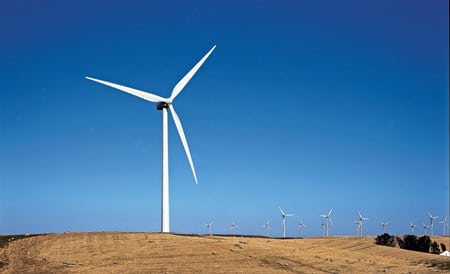
3. Perfect wind. Vestas supplied the ninety 1.8-MW turbines used by the High Winds Energy Center in the rolling hills of Solano County, 50 miles southwest of Sacramento. The plant is owned and operated by FPL Energy. Courtesy: Vestas Wind Systems A/S
|
Roll the credits
Wind power has value as a fungible commodity. But it also has intrinsically valuable “nonenergy” attributes—renewable energy credits (RECs), or “green tags”—that can be bought and sold on the open market as vehicles for meeting RPS goals.
California’s RPS program has helped spawn the Western Regional Energy Generation Information System (WREGIS), an independent renewable energy tracking system for utilities in the Western Electricity Coordinating Council. WREGIS performs the same function as tracking systems elsewhere in the U.S. (ERCOT, NEPOOL GIS, and MRETS, for example): certifying RECs for renewable energy production.
Although WREGIS is a voluntary program, it enjoys the support of most wind power industry participants and state and local regulators in the western U.S. Many expect it to become the national standard for tracking the generation and transfer of RECs. Since WREGIS went “live” in June 2007, it has made the market for RECs more credible and fluid. Most western IOUs and their regulators now use WREGIS data to verify RPS compliance.
Money matters
Wind farms typically require a capital investment on the order of hundreds of millions of dollars, so financing issues are critical to project development.
A boon to wind power financing arrived two years ago in the form of the Energy Policy Act of 2005. It provides a federal production tax credit (PTC) of 19 cents/kWh to any renewable energy facility built by December 31, 2008—the provision’s “sunset” date. Although the current PTC is likely to be renewed (as most of its predecessors were, eventually), your negotiations with developers should include calculations of the cost of wind energy both with and without the effect of the subsidy.
The salient feature of the current PTC is its size; 19 cents/kWh is enough to underwrite 20% to 30% of a typical wind farm’s total installed cost. The PTC is typically exhausted by the 10th year of a facility’s commercial operation. However, it is not directly available to tax-exempt entities, such as municipal utilities. To take advantage of the federal PTC, munis need to develop other models with other options. One is the early buyout, which entails having a third party, such as the developer, own and operate a wind farm until its PTC runs out and then sell the plant to the utility at its current market value. Many agreements also include a buyout option at the end of the contract term.
Another option that can retrieve 10% to 15% of wind energy’s production cost is to prepay for the energy. Though PTC provisions forbid the buyer of renewable energy from even partially funding development of a facility, prepurchasing the expected energy is allowable and provides money with which a developer can build a wind farm. This approach, however, imposes extra risk on the utility by replacing the traditional “pay as you go” approach with one requiring a much larger upfront investment. If the PTC is of little or no value to a utility, it makes sense for it to have the option to buy the facility when it comes on-line.
For many developers intent on building multiple projects, consolidating their developed assets is an attractive mechanism for addressing bankruptcy concerns. By financing at a higher level in the corporate structure than the particular project company, these developers can use several projects as security for the debt incurred at the holding company level. However, this strategy increases the buyer’s risk, because if one of those projects goes bankrupt, all of the projects listed as collateral may be subject to bankruptcy proceedings. The buyer of one particular project’s output can mitigate this increased risk by securing a mortgage on the project and subordinating all of its other indebtedness to the mortgage.
The costs of doing business
Even though wind turbines don’t require on-site staff for daily operation, you’re not finished with project costs once the site and turbines have been secured.
Power quality. Because wind farms produce asynchronous, intermittent power, their operating guidelines are more stringent than those of fossil-fueled plants. For example, a wind farm should be able to shed up to half of its generation within 20 seconds of the occurrence of a transmission contingency to avoid causing grid instability. Some utilities require this shedding to be accomplished within 2 seconds.
If sufficient shedding has not taken place within the specified time, a backup shedding system will start to open specified feeder breakers in sequential order. Most utility interconnection agreements impose additional operating constraints. One is the requirement that the wind farm be operated so the transmission line’s power factor ranges between 0.98 lagging and 0.98 leading.
Proper operation of a wind farm requires extensive studies, including steady-state load flow and dynamic analyses. Such studies, which cost between $50,000 and $100,000, determine what additional power quality equipment, like capacitors, is needed to meet the standards for interconnection to the local utility. They also provide information such as how quickly generation shedding needs to be accomplished in the event of transmission instability (2 seconds or 20 seconds, for example).
Communications. Most wind generation equipment comes with a prepackaged communication system. Although such systems provide valuable real-time operating information, they typically are not optimized with the end user in mind. Other communication systems, like those offered by Second Wind Inc. (www.secondwind.com), provide a superior wind energy measurement and control system that works well with many wind farm supervisory control and data acquisition (SCADA) systems.
Hierarchically, a SCADA system operates one level above a power plant’s real-time control system to control a process external to the SCADA system. At a wind farm, the SCADA system can work in concert with other control equipment to execute a “soft” shutdown of the wind turbines when a predetermined condition—such as the need for generation shedding—arises.
Maintenance. Because they have far fewer moving parts and no fuel-handling systems, wind farms require much less maintenance than comparably sized fossil-fuel plants. Some require only 30 hours of scheduled downtime annually, during planned outages that can be scheduled so that only a few turbines are out of service at any one time.
However, unscheduled maintenance is an issue that all plant operators must contend with. Unless the wind farm’s maintenance staff has extensive experience with wind turbines, it’s a good idea to try to get as long a turbine warranty as possible, to pass the turbines’ maintenance risk back to their vendor. A typical manufacturer’s warranty guarantees 95% availability for two years; some provide coverage for up to five years. However, a few manufacturers, such as GE Energy, offer a very limited service warranty on their turbines.
Many utilities have found that union or labor contracts restrict how much wind farm maintenance can be outsourced. Given that constraint, it’s wise to purchase a turbine warranty’s training option. That way, when your warranty period expires, your O&M staff will know how to maintain and fix the turbines and who to call at the vendor if they can’t. Of course (if your contracts permit), you could always farm out wind turbine O&M to a specialist such as enXco Inc. (www.forasenergy.com).
Another maintenance issue to consider is access to wind turbine components. Most turbines require maintenance techs to climb ladders up to 200 feet high to reach the rotor. The effort required to do so on a regular basis limits the pool of available technicians and their career longevity. Some newer wind turbines are equipped with service elevators to facilitate maintenance.
Reliability: Improving by design
Historically, the weakest link of a wind turbine has been its gearbox. As turbine sizes have increased, designing gearboxes able to handle the forces generated by longer and heavier blades has become problematic. Making matters worse, turbine loading is variable and hard to predict. It is not uncommon to have a gearbox fail in less than two years of operation.
Most gearbox failures have been due to movement of the machine chassis, which causes misalignment of the gearbox with generator shafts and leads to failure. Such failures typically occur in the high-speed rear gearing portion of the gearbox when the bearings become faulty. The frequency of failures can be reduced by regular, once-a-year turbine realignments.
Most manufacturers have made their turbines more reliable by improving the lube-oil filtration system in the gearbox so it can remove all particles larger than seven microns across. If a particle of that size breaks free of the meshing gears, it can damage other gears and bearings.
Some wind turbine vendors, like Enercon GmbH (www.enercon.de), are experimenting with increasing the number of poles in their machines, making it possible to eliminate the gearbox. Though most turbines have four or six magnetic fields from windings (pole pairs) and use a gearbox, if the generator has 50 to 100 pole pairs, the use of electronic control also can eliminate the need for a gearbox. Coupling the blades directly to the generator in machines without a gearbox also eliminates the mechanical or tonal noise produced by conventional turbines.
Other manufacturers, like Clipper Windpower Plc (www.clipperwind.com), have further improved reliability by using distributed gearing using multiple paths and multiple generators (see Cover Story, Steel Winds). The company claims this approach will ensure continued turbine operation even if one of the generators fails. But the claim will have to be verified by operating experience of the first plant to use eight of Clipper’s production-model, 2.5-MW Liberty I machines—the Steel Winds project near Buffalo, N.Y., which only entered service in April 2007.
Reactive power needs
Wind turbines typically drive an asynchronous generator that consumes, rather than generates, reactive power. Consequently, their power factor must be corrected before the wind farm can be connected to the transmission system. Compensation for the reactive power corresponding to no-load conditions is typically done using fixed capacitors within the facility. Any remaining reactive power consumption in excess of that must be compensated for by other methods.
Most turbines have integral inverters that can convert the turbine’s output to direct current and then back to alternating current at any desired power factor. However, using inverters for power factor correction may create problematic stray currents in the generator rotor. If a stray current is drawn to ground by arcing over the generator bearings, the generator will fail. Newer designs use permanent-magnet rotors to eliminate these stray currents and prevent failure.
Although placing an inverter inside a wind turbine’s nacelle (the hub housing, where the generator resides) is the rule in the rest of the world, in the U.S., General Electric has a patent on this technology (when used as a doubly fed induction generator to meet low-voltage ride-through requirements) that won’t expire until 2010. As a result, other manufacturers and developers have had to resort to various volt-amperes reactive (VAR) compensation schemes, some of which are company secrets. However, the patent restriction is not too limiting, because at wind farms with capacities larger than 20 MW it is more economic to collect all the output from the wind turbines and provide VAR support at one location.
A standard way to provide VAR support outside the turbine is to dynamically compensate for reactive power using static VAR compensators (SVCs). SVCs comprise parallel banks of capacitors and a reactor, some or all of which are controlled by thyristors. Their control circuitry performs a number of functions, such as determining the best time to switch in the capacitors to avoid unnecessary voltage stress on the system.
Using SVCs for VAR support costs about half as much as using inverters. However, SVCs operate more slowly than inverters (in one cycle, vs. ¼ cycle), and not over the full voltage range needed for uniform VAR support. What’s more, SVCs have substantially less low-voltage ride-through capability—not enough to meet FERC Order 661. In addition, any SVC installation needs to be thoroughly analyzed for possible harmonic resonance in the system. This analysis is made more complicated because SVCs modify the resonance frequencies of a system, depending how the SVC is operated.
Consider a typical 100-MW installation that requires 30 MVAR for dynamic stability. Because the MVARs are only required for dynamic support, the overload capability of the power inverters can be used to meet this criterion. For example, DSTATCOM inverters from American Superconductor (www.amsuper.com) are designed to handle 2.6 times the rated VAR output for 2 seconds. Twelve MVARs of DSTATCOMs meet the dynamic requirement, and another 38 MVAR of capacitor banks will be required to meet the power factor requirements.
|
4. Canadian connection. Nordex Energy supplied 20 model N60 wind turbines rated at 1,300 kW for Canadian Hydro. The turbines, located in Pincher Creek, Alberta, near the Rocky Mountains, are equipped with special cold weather upgrades. Courtesy: Nordex Energy GmbH
|

Integrating wind power
When trying to couple a wind farm to a transmission system, one of the first technical problems encountered is that wind’s load profile is usually out of sync with what the system needs. Though the typical utility’s summer weekday peak demand occurs between 1 p.m. and 5 p.m., a wind farm’s production typically peaks in the late evening and early morning. This situation leads both to underproduction during peak demand periods (which utilities must address by dispatching peaking plants) and overproduction at other times.
There are likely to be a few hours during the year when a wind farm sends a utility more power than it needs. In such cases, the utility may need to reduce thermal generation or use the excess power to “recharge” the reservoirs at its pumped-storage plants (if it has any). Otherwise, the utility may have to sell the excess power on the spot market at a loss. Because utilities cannot depend on wind power being available during peak-demand periods, they typically have had to bring on-line gas turbine–based peaking plants at those times. Now, however, some may have another option for filling the gap: dispatching both wind farms and photovoltaic power plants. Such a combination may prove a less expensive way to keep the lights on.
The average production of a typical wind farm has a very different profile than its hourly generation. An examination of hourly generation makes clear that wind production is much more erratic than one might expect. Though a wind turbine typically runs 60% to 80% of the time, it typically runs at 100% capacity only 10% of the time. This intermittent characteristic of wind generation can weaken the stability of a grid. A good rule of thumb is that if the rated capacity of a wind farm exceeds 2% of the “fault duty” at its point of grid connection, measures should be taken to minimize the impact of dispatching the farm on the grid’s power quality. In such cases, dynamic compensation is usually the preferred measure.
Historically, utilities have been able to integrate wind power up to 20% of their portfolio’s total generating capacity. More than that can lead to stability problems on the transmission lines. The 20% figure is just a rough estimate, however, because utilities with larger hydro capacity can accommodate much more. For example, hydro-rich Denmark successfully integrates 60% wind into its grid.
Furthermore, due to wind’s intermittent nature, utilities must reserve the full capacity of a wind farm on the transmission system, although they can only reasonably expect it to have a capacity factor of 30% to 40%. This situation may lead to lost revenues from transmission capacity sales. How much wind energy a particular utility can handle depends on a number of operational factors, including: the amount of hydro generation, fast-starting generation, and spinning reserve available; the minimum loading and loading rates of fossil-fuel plants on the system; and the system’s load shape.
Low rider
An unresolved issue in the area of wind integration is how to meet FERC’s new Order 661A, which requires wind farms to remain on-line during system disturbances in which system voltages drop to zero volts. This requirement is much more stringent than that of Order 661, which required a low-voltage ride-through of 0.625 seconds. Stated another way, Order 661 required a wind farm to demonstrate its ability to remain on-line for 0.625 seconds after the system voltage dropped to 15% of normal due to a system disturbance. This requirement ensured that the wind farm would be available to support the system when there was a normally cleared fault on a single element, which typically took four to eight cycles.
Order 661A recognizes that a fault occurring near a wind farm could cause the voltage at the point of interconnection to fall to zero during clearing, and requires wind farms to remain on-line during that time. Because clearing a fault normally takes four to eight cycles, wind plants now are required to remain on-line for nine cycles, or 0.150 seconds, at zero volts.
Though SVCs and inverter-based VAR support schemes could be developed to meet the low-voltage ride-through requirement of Order 661, the zero-voltage ride-through requirement of Order 661A is problematic for those wind turbines that do not use inverters in each nacelle. The solution may require the use of energy storage devices such as ultra-capacitors.
—Robert D. Castro (robert.castro@alumni.usc.edu) teaches graduate-level power classes at the University of Southern California and negotiates wind generation contracts for a local utility.