Because combined heat and power (CHP) plants optimize energy use, they cut fuel costs and pollution. Even though U.S. power plants have been using CHP for decades, today’s energy experts have a newfound appreciation for its ability to promote sustainable energy use.
Many veteran power professionals are somewhat surprised that combined heat and power (CHP), a well-established approach to the generation of electrical power and thermal energy, especially in Europe (see sidebar), is gaining popularity among energy analysts looking for solutions to America’s growing need for sustainable electrical generation.
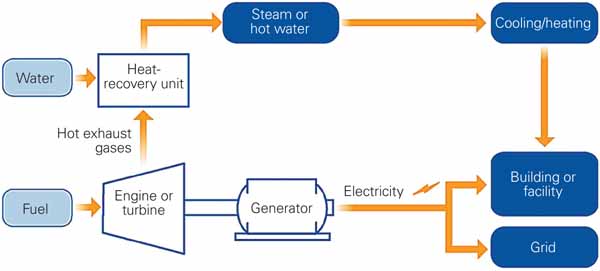
CHP, also called cogeneration, is the concurrent production of electricity or mechanical power and useful thermal energy (heating and/or cooling) from a single source of energy. CHP plants may use one of several generation technologies (from gas turbines to Stirling engines), which means that they can use a variety of fuels to generate electricity or power at the point of use, allowing the heat that would normally be lost in the power generation process to be recovered to provide needed heating and/or cooling (Figure 1).

1. Waste not, want not. More than two-thirds of the fuel used to generate power in the U.S. is lost as heat (shown as conversion losses in this diagram). Source: Oak Ridge National Laboratory
CHP is typically a feature of distributed generation, which, unlike central station generation, is located at or near the point of consumption. Instead of purchasing electricity from a local utility and then burning fuel in a furnace or boiler to produce thermal energy, consumers use CHP to provide these energy services in one energy-efficient step (Figure 2). As a result, CHP improves fuel efficiency and reduces greenhouse gas emissions. In addition, newer CHP applications show a trend toward the use of cleaner fuels. For optimal efficiency, CHP systems typically are designed and sized to meet the users’ thermal baseload demand.
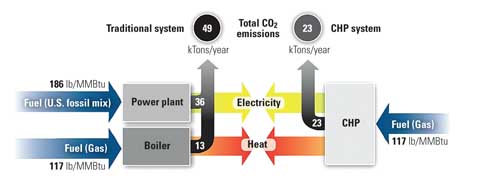
2. Increased efficiency results in reduced carbon emissions. An example of the CO2 savings potential of CHP based on a 5-MW gas turbine CHP system with 75% overall efficiency operating 8,500 hours per year providing on-site steam and power compared to a separate heat and power supply consisting of an 80% efficient on-site natural gas boiler and average fossil-fueled electricity with 7% transmission and distribution losses. Source: ICF International
ORNL’s Report on CHP and Sustainable Energy
In December 2008, Oak Ridge National Laboratory (ORNL) published the report "Combined Heat and Power: Effective Energy Solutions for a Sustainable Future" (www.chpcentermw.org/pdfs/ORNL_Report_Dec2008.pdf), which highlights the sharpened focus on using CHP to deal with environmental and business challenges in the U.S.
CHP is one of the most promising options in the U.S. energy efficiency portfolio, according to the authors of the ORNL report. It can provide reliable electricity, mechanical power, or thermal energy at a factory, university campus, hospital, or commercial building — wherever the power is needed.
Because it captures and utilizes waste heat, CHP requires less fuel than equivalent separate heat and power systems to produce the same amount of energy services. And, by placing distributed generation near large loads, CHP can relieve grid congestion, increase the energy security of CHP customers, and eliminate the losses that normally occur in the transmission and distribution (T&D) of electricity from a power plant to the user.
The ORNL report describes in detail four key areas in which CHP has proven its effectiveness and holds promise for the future:
-
Environmental advantages: It significantly reduces CO2 emissions through greater energy efficiency.
-
Promotion of competitive business practices: It increases efficiency, thereby reducing business costs.
-
Local energy benefits: It is deployable throughout the U.S. and may be able to use locally sourced, renewable fuels (depending on the generation technology chosen).
-
Advancing infrastructure modernization: As a distributed generation resource, it can relieve grid congestion and improve energy security.
Challenges Faced by Traditional Energy Sources
In making the case for CHP, the report contrasts its benefits with the growing constraints on traditional energy supplies. Although domestic coal is relatively plentiful, environmental concerns limit its use. Moreover, the cost of building traditional coal-fired power plants has been escalating, driven by pollution control requirements, high construction levels globally, tightness in the equipment and engineering markets, and high prices for raw materials. Overall, capital costs for coal power plants have risen 78% since 2000. General Electric gives estimates of $2,000 to $3,000 per kW for new conventional coal-fired plants, and Duke Energy is proposing to spend $1.83 billion to build an 800-MW plant in North Carolina ($2,300/kW). At $2,500 per kW installed, the delivered price of electricity from Duke Energy to consumers would be roughly 10 to 12 cents per kWh — more than 60% above current average industrial electricity prices.
The report underscores that because CHP facilities are typically placed near large customer loads, less investment in new T&D infrastructure is needed than would be the case for a new conventional central generating station. Additionally, placing generation closer to large customers reduces the likelihood of grid congestion on already-constrained T&D infrastructure.
Hurdles to Overcome
Although the benefits of added CHP capacity are promising, current market conditions and technical barriers continue to impede the full realization of CHP’s potential, according to the ORNL report.
Challenges include unfamiliarity with CHP, technology limitations, utility business practices, regulatory ambiguity, environmental permitting approaches that do not acknowledge and reward the energy efficiency and emissions benefits, uneven tax treatment, and interconnection requirements, processes, and enforcement. Addressing these challenges will require a holistic approach involving policy, regulatory, and technical solutions. Improving the fuel efficiency and fuel flexibility of CHP and developing optimized, integrated packaged systems can also lower costs and expand the application of cost- effective CHP.
CHP Success Stories
The following case studies are illustrative of a growing number of facilities that are cutting costs and increasing their energy generation efficiency through the use of CHP.
Kent State University. With enrollment of 34,000 students across eight campuses, Kent State University (KSU) is Ohio’s second-largest university. The 880-acre main KSU campus in Kent contains 115 buildings. Its electricity load is 80 million kWh annually and rising. With continued expansion of campus buildings and residence halls, total electricity demands are likely to reach over 18.5 MW. Seeing this increase in demand on the horizon, KSU engineers began to consider CHP as a strategy to meet growing energy loads and control costs.
KSU, in conjunction with the U.S. Department of Energy and Dominion East Ohio, undertook a study to investigate the benefits of deploying expanded CHP technology at its new power plant facility. The primary objectives were to reduce fuel consumption, decrease emissions, and lower the cost of electricity. The study concluded that all of these objectives could be met through cogeneration units. What made KSU such an excellent candidate for CHP was not just its need for power but also the fact that it has a substantial year-round steam demand. The university uses almost all of the steam from the turbines in both the winter and summer.
The system consists of a fuel-flexible Taurus 60 turbine (which can run on natural gas or fuel oil) and a Taurus 70 generator capable of generating 7.2 MW of electricity. Both feature heat-recovery steam generator (HRSG) units, which enable plant operators to use waste steam to chill water. The 60,000 pounds of steam captured by the HRSG units provide more than half of the campus’s steam needs. In winter, the generators are able to provide almost 90% of KSU’s electricity needs; in summer they meet 60% of the load. In the event of a power outage, KSU’s power system can island itself from the grid and produce enough power for most of the university’s functions.
The power plant was built in two phases at a total cost of $23 million. The savings on fuel costs are substantial enough to eclipse the CHP system’s annual maintenance costs of more than $400,000. Total annual savings are expected to be more than $700,000.
Reliant Energy Minnegasco Dakota Station CHP Facility. The Dakota Station, located in Burnsville, Minn., 10 miles south of Minneapolis and owned by Reliant Energy, is a natural gas, peak-demand-shaving facility that is part of the Minnegasco gas distribution system. In the spring and summer months, when natural gas prices are lower and there is lower gas demand, the facility cools natural gas to –260F to liquefy it and then stores it in a 12 million – gallon holding tank for use in the winter months, when the demand for natural gas is higher. The liquefaction process draws about 500 kW. The stored gas is equivalent to approximately 1 billion cubic feet of natural gas. By storing natural gas like this, Minnegasco can ensure lower costs for its customers and offset the need to provide additional expensive pipeline capacity to meet peak natural gas demands in the winter.
Dakota Station applies the exhaust heat from a 30-kW microturbine, used to reduce the peak energy demand during the liquefaction process, to provide dehumidification in the summer and heating in the winter to the facility. Basically, the facility saves on energy costs by balancing energy demand; it stores energy (liquefying gas) when it is less expensive (summer) and then makes it more readily available when it is more expensive (winter).
Although the Dakota Station is not a typical commercial installation, it clearly exemplifies the positive results of using CHP, in that it:
-
Reduces monthly energy costs by offsetting grid usage. (Installed cost was $45,000, with a simple payback of 2.5 years.)
-
Provides further energy savings through use of exhaust heat for plant cooling and heating.
-
Achieves the highest efficiency when exhaust heat is recovered for use in heating or cooling applications.
-
Reduces maintenance costs versus other electric generation technology.
-
Reduces emissions versus other electric generation technology.
-
Contributes to utility customers’ understanding of advanced energy technology.
A Solution That’s Ready Today
CHP is first and foremost an energy efficiency option. It allows users to produce needed electricity, heat, and mechanical energy while using as little fuel as possible. As an efficiency technology, CHP can lower overall energy demand, reduce reliance on traditional energy supplies, make businesses more competitive, cut greenhouse gas emissions, and reduce the need for infrastructure improvements.
Because of its inherent efficiency, performance, and reliability, CHP is an effective near-term solution that can address the nation’s current and future energy needs (see table).

Significant energy and carbon savings today, but more tomorrow. This estimate of the potential for CHP used 2006 data (first data column) to compute the annual fuel use and CO2 emissions of existing CHP facilities. Savings are based on comparison with facilities using separate heat and power consisting of on-site thermal energy supplied by the same fuel type and average fossil-based electricity generation with 7% transmission and distribution losses. The second column of data extrapolates existing CHP performance to proposed 2030 capacity, using the same assumptions as for the 2006 base case. Source: U.S.EIA Annual Energy Outlook 2008 and eGRID, EPA
—Angela Neville, JD is POWER’s senior editor.