Most countries are trying to increase the percentage of their electricity supply that comes from renewable sources. But because capital costs for renewable generation still, in most cases, are higher per kilowatt-hour than for fossil-fueled power, governments are looking at all options for encouraging the development of greater renewable capacity. Feed-in tariffs (FITs) are one policy tool that has been used, most notably in Europe. Now North America is testing FITs as well.
Feed-in tariffs (FITs), which have been credited with driving renewable energy growth in Europe, have been enacted in 63 jurisdictions around the world and are quickly gaining momentum in other ones, such as China, India, and Mongolia. Because of the high capital costs and financing challenges associated with renewable energy, more and more U.S. policy makers also are examining the mechanism that guarantees a minimum government-set price for renewable energy that is paid to generators by utilities under “standard offer contracts.”
Defining FITs
According to the FIT Coalition—a San Francisco Bay Area–based group advocating the quick adoption of FITs through development of the wholesale distributed generation market (projects of 20 MW or less)—“feed-in tariff” is a literal translation of Germany’s 1991 Stromeinspeisungsgesetz ( StrEG), the law on feeding electricity into the grid, and is the term used in Germany, France, and Spain. “In North America, a ‘tariff’ sounds like a tax, and ‘feed-in’ sounds like a buffet binge, so FITs sometimes go by other names,” the group says on its website. These include: standard offer contracts (SOCs), advanced renewable tariffs (ARTs, a term used by FIT advocates in Ontario, Canada), renewable energy rates (RE rates), renewable energy dividends, and renewable energy payments (a term used by organizations such as the Alliance for Renewable Energy).
The U.S. Department of Energy, too, concedes that no standard, official definition of FIT exists. In a January 2010 report (http://bit.ly/dh2hwJ) commissioned by state utility commissions in conjunction with the National Association of Regulatory Utility Commissioners (NARUC), the National Renewable Energy Laboratory (NREL) sets down a broad working definition of “state-level feed-in tariff”:
a publicly available, legal document, promulgated by a state utility regulatory commission or through legislation, which obligates an electric distribution utility to purchase electricity from an eligible renewable energy seller at specified prices (set sufficiently high to attract to the state the types and quantities of renewable energy desired by the state) for a specified duration; and which, conversely, entitles the seller to sell to the utility, at those prices for that duration, without the seller needing to obtain additional regulatory permission.
To simplify, the main, common characteristics of FIT-like programs (whatever their official name) is that the price of electricity generated by renewable or other specified sources is determined by government policy or public utility commission rather than a wholesale market and is typically (though not necessarily) set at higher than market prices as a way to encourage the development of a particular power source. Renewable FITs for small-scale generation are the most common, but FITs can also apply to other high-first-cost sources such as combined heat and power (CHP).
In addition to tariff, the size of projects qualifying for FITs varies by country and state. Germany has no limit on project size, nor does France for wind energy, though France limits solar PV to 12 MW. Ontario’s program (see sidebar "Ontario Ushers in the MicroFIT") limits contracts to 10 MW. As is typical of distributed generation generally, sources qualifying for FITs are usually (though not always, especially in Europe) smaller than what is typically considered “utility scale.” (See the web supplement to this story, "Feed-in-Tariffs Around the World," for more details on the specifics of programs in a variety of locales.)
FIT vs. RPS
Unlike many European countries, which opted for FITs over renewable portfolio standards (RPS), the RPS is the most common state-level policy in the U.S. One of the main distinctions between the two approaches is that an RPS mandates how much customer demand must be met with renewables (a “stick”), whereas properly structured FIT policies support new supply development by providing investor certainty via guaranteed prices (a “carrot”).
Another useful distinction is that an RPS establishes a generation portfolio goal—without regard to financial incentives—whereas a FIT establishes a financial incentive by setting a premium price for a particular type of generation. However, an RPS isn’t necessarily at a total disadvantage. In the U.S., investment and production tax credits (ITCs and PTCs) have been introduced to help encourage renewable capacity building. (Though it is beyond the scope of this article to detail the pros and cons of ITCs and PTCs, a search for either of those terms at https://www.powermag.com will yield several useful articles and commentaries.) In other countries, FITs have been a more common approach to clearing the financing hurdle.
As NREL describes it, “FIT policies are typically designed to provide a renewable project with revenue streams sufficient to cover development costs, plus a reasonable return. They are focused on setting the right price to drive [renewable energy] deployment. In contrast, most RPS policies are focused on the quantity, leaving the price up to competitive bidding.” However, some stakeholders disagree with NREL’s assessment. A June 2010 research document from NARUC notes, “FIT rates are not always aligned with the market and program costs may be high in comparison to an RPS program, and therefore some argue that RPS may be a more sustainable policy in the long run.”
Stromeinspeisungsgesetz: The First FIT
Germany’s FIT program has been widely cited as the best example of an effective FIT law. The first electricity feed-in law, Stromeinspeisungsgesetz (StrEG) (literally, “law on feeding electricity into the grid”) was introduced in 1990. The one-page bill required utilities to buy power produced from small hydro stations and wind energy installations at a rate of 65% to 90% of the average tariff charged per unit to end users. Because it did not guarantee tariffs for other renewable sources such as biomass—and because it was based on a percentage system, which meant that deregulation in 1998 significantly reduced incomes for renewable energy producers— StrEG was modified in April 1998 and again in 2000.
The latter bill, known as the Erneuerbare-Energien-Gesetz (EEG), or the Renewable Energy Sources Act, included a differentiation in tariffs depending on the renewable energy type, size, and site. It also extended the range of technologies to be covered, and replaced the StrEG’s percentage-based rates with fixed rates over fixed periods—20 years from the start of operation for each new qualifying plant.
The tariffs were reportedly determined by scientific studies, which suggested a tariff figure that would allow profitability and the use of state-of-the-art technology. In 2004, Germany amended the EEG, setting a renewable energy target of 12.5% by 2010 and at least 20% by 2020. Tariffs in the 2004 amendment ranged from €0.0539 per kWh for electricity generated from wind, to €0.5953 for solar electricity from small façade systems.
Today, Germany’s FIT policy is largely credited for the country’s tremendous growth of renewable energy (Figure 1), which has made it a world leader in both wind and solar power production, as well as in the manufacture and export of wind and solar components. Critics say, however, that the increase has come at a significant increase in the cost of electricity to consumers: From 2000 to 2007, the cost of generation, transmission, and marketing increased 42%, while the cost of the FIT premium increased 407%.
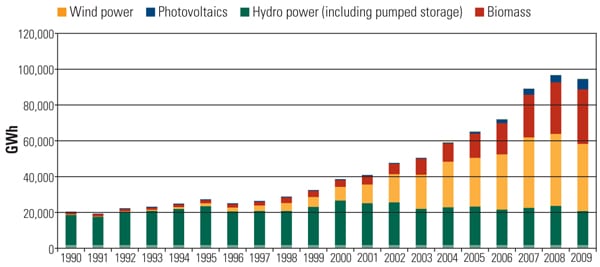 |
| Renewable power generation in Germany. Largely due to its FIT policies, Germany’s share of renewable energy has grown from 3.2% in 1991 to 16% today. Source: Volker Quaschning |
Meanwhile, the outlook for German FITs isn’t projected to be rosy. Current solar FIT payments for systems installed in 2010 stand at €0.39 per kWh—nearly eight times higher than market electricity prices. The large decline in PV system costs in 2009 led the German parliament earlier this year to propose a 16% payment reduction for solar PV to reduce unnecessary costs to the ratepayer—though the regional government assembly calls for relaxed payment cuts of no more than 10%. The steep cuts would hurt the industry, suggests banking firm Landesbank Baden-Wuerttemberg in a research report, because European and German manufacturers would no longer be able to compete with the prices of Asian producers. Additionally, the firm suggests that returns would fall under the critical 7% level, dampening investor interest.
FITs are sometimes touted as preferable to ITCs and PTCs because the duration of the contract is typically longer, thereby providing greater investor certainty. However, the FIT experience in Germany and Spain (see sidebar "Spain’s FIT Falters") shows that changing political and economic conditions can make FITs as vulnerable to change as other financial incentives.
Some advocates argue that FITs and RPSs can be implemented together because they can complement each other: The RPS sets a goal for renewable generation and a FIT can help fulfill that goal by providing a predictable revenue stream to deploy more renewable generation resources. In the U.S., California and Vermont currently have both RPSs and FITs, and many of the 28 states that have an RPS are considering FITs.
North America FITs
The growing popularity of FITs around the world has led to a rash of proposals across North America. But not all feed-in tariffs are created equal. “Some are good, and some are so weak as to be ineffective,” writes Paul Gipe, a widely cited FIT policy expert, in his May 2010 paper “Grading North American Feed-in Tariffs.”
Gipe’s survey finds that FITs in North America have gained traction since 2004, after the Ontario Sustainable Energy Association (OSEA) launched its campaign for ARTs in the province of Ontario (see sidebar "Ontario Ushers in the MicroFIT"). In the U.S., at least 6 MW of FIT projects have been installed in California; signed contracts for FIT programs exist in California (34.67 MW total) and Vermont (49 MW). In addition, Hawaii, Maine, and Oregon have legislation requiring pilot or full-blown FIT programs. Indiana, Ohio, Washington, and Wisconsin have current or recently proposed FIT legislation, and several states, including Arizona and Nevada, have opened dockets on FITs to explore their potential.
FITs are even popping up at the municipal level: Gainesville, Fla.; Madison, Wis.; Sacramento, Calif.; and San Antonio, Texas. And one utility, Consumer’s Energy, developed its own FIT program for solar PV that was quickly oversubscribed.
Nevertheless, few U.S. programs stack up to those in Germany, France, and Spain, Gipe says, which “set the gold standard for comprehensive systems of FITs.” He concludes that many could be improved, noting that European FIT programs have been amended several times. “The program that has made Germany famous, the system of Advanced Renewable Tariffs (ARTs), began in 2000 and has been revised every four years since. The Germans have had a decade to get it right,” he says. Similarly, France has revised its tariffs twice since 2001, as has Spain, since its program began in 2004.
A FIT Future for North America?
Industry analysts agree that the future for FITs in North America will be contingent upon long-term policies that contain several key elements. These include procuring renewable energy at the price it costs to produce it; not including caps; allowing for a diversity of energy sources; and differentiating prices by size or application (rooftop or ground-mounted photovoltaics, for example) for each technology.
Another primary concern is resolving who has jurisdiction to set FIT rates. When the transaction resulting from a FIT is a wholesale sale of electricity from renewable seller to a retail utility, it triggers one of two federal statutes: the Public Utility Regulatory Policies Act of 1978 (PURPA) or the Federal Power Act of 1935 (FPA). The issue is at the heart of a contentious debate: Opponents have long argued that FITs are illegal in the U.S. because state-level feed-in tariffs are preempted by federal law.
Responding to legal questions raised by Southern California Edison about the California Public Utility Commission’s (PUC’s) authority to set FIT rates, for example, California’s Attorney General Edmund Brown concluded in a June 2009 brief that the state has sufficient authority “to promote the adoption of distributed generation” while complying with federal law. Brown argued that the Federal Regulatory Commission (FERC) has given the states “wide latitude in implementing PURPA,” going so far as to say that FERC “disavowed control or expertise as to what is the correct price [for avoided costs].”
But a DOE-funded January 2010 report, “Renewable Energy Prices in State-Level Feed-in Tariffs: Federal Law Constraints and Possible Solutions,” concludes that FITs must be structured in a way that meets federal requirements set by PURPA and the FPA, because “each of these statutes does in fact limit the discretion of state-level tariff designers.” The report’s authors, led by the National Regulatory Research Institute’s Scott Hempling, add that the European or Canadian approach of setting specific tariffs directly does not comply with current U.S. federal law or its interpretation.
Even so, the report finds—and charts—ways to implement non-preempted state-level FITs under current federal law. Under PURPA, FITs can be legal if they are “voluntarily” offered by the utility, or if rates are based on “avoided cost” (a contentious calculation whose discussion is beyond the scope of this story) and any other payments needed to make workable tariffs, and which are derived from renewable energy certificates, subsidies, and utility tax credits. Power producers must apply to FERC to be certified as a qualifying facility under this path, however. As the report notes, these forms of “supplemental compensation” fall outside FERC’s PURPA jurisdiction and are therefore not preempted.
On the other hand, under the FPA—a contract-based statute—“it is unlawful to make a sale at wholesale without a contract, and without FERC approval of that wholesale contract,” the report states. “Put more directly, a state-level tariff cannot lawfully command the utility to purchase at the state-set price.” The report points to Sections 205 and 206 of the FPA, which state that the seller must prove to FERC that the contract, including its price, is “just and reasonable” and not “unduly discriminatory.” This would be done one of two ways: opting for tariffs that are cost-based or market-based. Both would be tedious, it says. If the tariffs are cost-based, each contract must be reviewed by FERC, and if they are market-based, such as through an “auction,” the seller must issue a “market-power” report to FERC every three years.
The report attempts to provide solutions to these and other constraints. It suggests, for example, that state regulatory commissions could ask FERC for a “clarification” that above-avoided-cost tariffs would qualify automatically for the less than 20-MW exemptions if they met certain conditions. (As the "FERC Issues First Major FIT Order" sidebar explains, that approach was recently taken in California, with mixed results for FITs.) The report notes that this solution wouldn’t entirely resolve the issue: “First, this path is not available to non-[qualifying facilities (QFs)], or QFs exceeding 20 MW. Second, FERC would need to modify or reinterpret existing FERC precedent … that if the seller is a QF, it is bound by PURPA’s avoided cost cap even if the buyer’s obligation to buy arises from state law rather than PURPA.”
The ideal fix for weeding out these and other regulatory concerns would be if “Congress could modify PURPA and the FPA to allow states to establish feed-in tariffs unconstrained by current federal law,” the report concludes. “The intent behind such an amendment would be to create exceptions from PURPA, the FPA, or both, for renewables sellers in states that promulgate tariffs having certain characteristics. The result would be to vest in the sellers an automatic right to sell under state programs.”
— Sonal Patel is POWER’s senior writer. Managing Editor Gail Reitenbach contributed to this story.