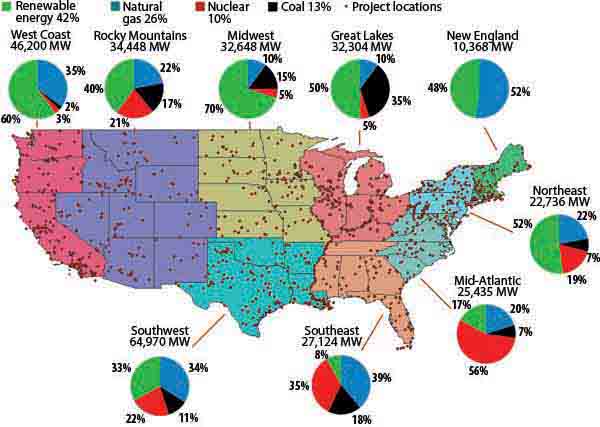
Continued economic growth in the U.S. over the next several years will inevitably drive growth in electricity consumption (Figure 1). Meeting the projected 40% increase in national demand by 2030 that today’s double-digit annual growth rates will produce will require building a lot more power plants—some to replace the capacity of retired units (Tables 1 and 2).
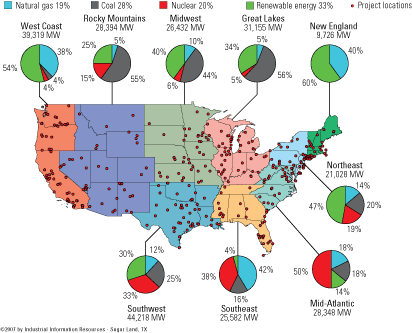
1. Double digits across the board. New generation capacity is being developed that has planned commercial start-up dates between 2008 and 2012. Source: Industrial Info Resources

Table 1. Actual and planned U.S. power generation resource growth (1998-2008) by state. Source: Industrial Info Resources

Table 2. U.S. power generation construction kickoff summary (2000-2008) by generation technology. Source: Industrial Info Resources
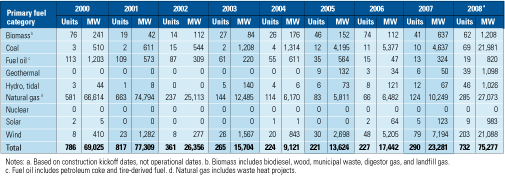
Table 3. U.S. power generation construction kickoff summary by primary fuel type (2000-2008). Source: Industrial Info Resources
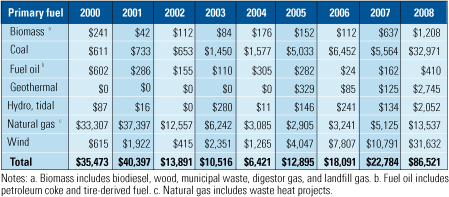
Table 4. Total installed cost of generation by construction kickoff year (in 2006 dollars) by fuel type, in millions of dollars. Source: Industrial Info Resources
Coal: The king still gets no respect
Despite the best efforts of environmentalists and renewable-energy advocates, coal still fuels about 50% of U.S. electricity generation, and its share may rise. A boom in coal plant construction is in full swing: 27 units totaling 12,000 MW, collectively worth more than $20 billion, are already past the groundbreaking phase. Those 12,000 MW represent 34% of all capacity currently being built in the U.S. Of the total, 1,174 MW are expected to come on-line this year, to be followed by 5,888 MW in 2009 and 4,700 MW in 2010.
The near-term units signify only the beginning of a longer-term expansion of U.S. coal-fired generation. In addition to the 27 units that have already poured concrete, another 243 units representing 74,000 MW and worth $120 billion are on the drawing boards of utilities and independent developers. Of that total, 26,000 MW are scheduled to break ground this year, with the rest following between 2009 and 2011.
Utilities have proposed building 84 of the 243 longer-term units to increase their generating capacity by 31,300 MW. They envision building 44 units with a total capacity of 16,300 MW as greenfield plants. The other 40 units, representing 15,000 MW, would be additions to existing power stations.
In contrast, private energy producers have proposed 159 coal-fired generating units able to produce 42,700 MW. Of these, 120 units and 31,900 MW are planned to be part of greenfield plants while 39 units and 10,800 MW will be added to existing plants.
The vast majority of the projects in development will rely on conventional pulverized coal combustion. But an increasing number plan to use integrated gasification combined-cycle (IGCC) or circulating fluidized bed (CFB) boiler technology. Specifically, 40 IGCC plants totaling 23,000 MW, and 22 CFB units totaling 6,600 MW have been proposed nationwide.
New coal plants are being proposed not just to meet future demand but also to replace coal plants scheduled for retirement. Since the beginning of 2002, 102 coal-burning units totaling 5,200 MW have been decommissioned. Another 83 units representing 9,363 MW are scheduled to be shut down for good by the end of 2012.
Natural gas: Still a contender
During the past decade, an aggressive push to build gas-fired generating capacity resulted in 300,000 MW being added to U.S. grids. But economic downturns, questionable industry business practices, and closer scrutiny of demand forecasts combined to slow that boom. It ended in 2005—the worst Atlantic hurricane season on record—when storms damaged many rigs in the Gulf of Mexico, driving gas prices above $15/mmBtu. The price surge was a message to the U.S. power industry that depending heavily on one fuel is risky business.
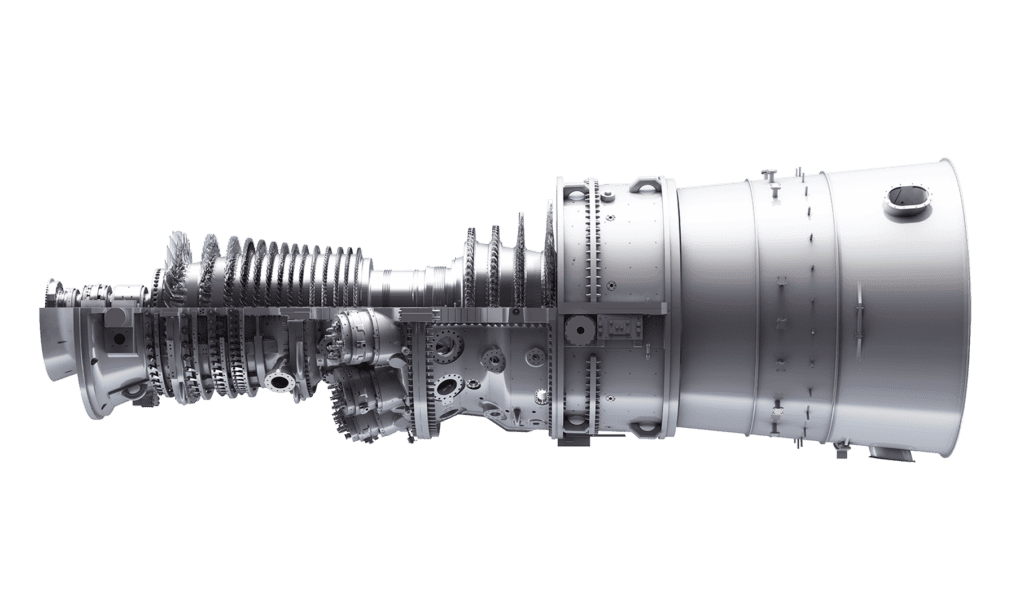
Despite the recent slowdown in activity, natural gas is expected to remain a leading power plant fuel. Gas-fired combustion turbine plants, operating either in simple-cycle or combined-cycle mode, still run cleaner than coal plants (making their permitting easier) and are much faster to build.
Construction kickoffs for gas-fired generating units began declining steadily from their peak in 2001, when units representing more than 73,000 MW broke ground. The slide continued through 2004, when only 5,600 MW of gas-fired capacity followed suit. Since 2005, the pace has picked up, and it looks likely to accelerate. For example, 158 gas-fired units totaling 15,469 MW are currently in construction. The latter number comprises 7,000 MW being built as part of greenfield units and 8,456 MW being added to existing plants.
To help meet longer-term demand, 438 gas-fueled units totaling 50,900 MW are in various stages of development. Of those totals, 18 units totaling more than 2,000 MW were scheduled to have broken ground before the end of 2007 (after this issue goes to press), with the other 48,000 MW and change slated to follow by 2015. This year alone will see construction kickoffs for at least 9,000 MW of the 24,000 MW currently under development. The round numbers are necessary because permitting and financing difficulties could delay some projects.
Nuclear: Making a comeback
The drive to diversify generation’s fuel mix may be helped by the possible licensing of dozens of new reactors. They would be the first ordered in the U.S. since 1978, one year before Unit 2 of the Three Mile Island plant in Pennsylvania partially melted down. Currently, nuclear generation supplies about 20% of America’s electricity. Although nuclear plants are more expensive than coal plants (taking into account the costs of licensing, decommissioning, and waste disposal), nuclear fuel is half the price of coal, so the plants’ total production costs are about the same: about $30/MWh. Notably, unlike coal plants, nuclear plants emit no CO2, a major contributor to global warming.
Early this decade, reactor vendors and utilities began lobbying the federal government to reduce the considerable financial risks of building new plants. They succeeded by having the Energy Policy Act of 2005 include tax incentives and loan guarantees for up to 6,000 MW of new nuclear capacity. Earlier, the Nuclear Regulatory Commission (NRC) had streamlined the lengthy processes for permitting and licensing new reactors by creating a new system for issuing combined construction and operating licenses (COLs) for plants and approving reactor designs in advance.
The NRC says it expects to receive applications for 12 new reactors at seven sites within the next few years and 15 more applications over the longer term. Four consortia have already applied for early site permits, using a separate process in which the NRC reviews and approves the suitability of a site before its prospective developers apply for a COL.
In all, developers are currently proposing building 47 new reactors in the U.S. They would be part of 33 projects totaling more than 60,000 MW and would be valued at more than $106 billion. Given the length of the site permitting and COL processes, it’s conceivable that 19 of the proposed reactors could break ground in 2010, but that’s a very optimistic estimate. Until the timetables are firmed up and financing issues are resolved, the U.S. nuclear power industry will have to be satisfied with incremental upgrades of reactor capacity. At present, 12 projects of that type totaling $600 million are in the works.
Renewables: Finally going mainstream
Citing the need to displace the use of fossil fuels to reduce CO2 emissions and help lessen America’s dependence on imports, 24 states and the District of Columbia have enacted renewable portfolio standards (RPS) that require their regulated electric utilities to get an increasing share of their supplies from wind farms, solar cells, and biomass and geothermal plants. The standards currently in place call for development of more than 55,000 MW of renewable capacity by 2020. Nine other states have introduced RPS bills, and several of the 24 states that have imposed standards are considering moving up the deadline to meet them.
In December 2007, the U.S. Congress extended the federal production tax credit (PTC) for renewable energy plants by one year, through December 31, 2008. That was the second time Congress approved extension of the PTC just before it expired. From 1999 until 2004, the credit was allowed to expire on three separate occasions, and each time it put a damper on renewable energy development. The PTC provides a 1.9 cents/kWh tax credit for all electricity generated by a renewable-fuel plant over its first 10 years of operation—if the plant qualified by entering commercial service before the deadline.
With the RPS and PTC incentives in place, investment in renewable energy projects is expected to surpass that in gas-fired projects for the third year in a row. More than 5,000 MW of renewables-fueled plants valued at $7.7 billion broke ground in 2006. That’s a 67% increase over the prior year. For comparison, investment in new gas-fueled plants covering both years totaled $5.9 billion.
More than 5,200 MW of renewable-fueled units broke ground last year by September, and another 2,800 MW were scheduled to follow suit by year’s end. All told, 8,000 MW, representing more than $11.7 billion in investments, were expected to begin construction in 2007, while over 4,000 MW were scheduled to go commercial by New Year’s Eve.
Dwarfing those annual totals are the more than 82,000 MW of renewable energy projects being developed that have construction kickoffs between 2008 and 2012. Significantly, 87% of the planned capacity will be wind power, a generation niche in which the U.S. has long been far behind Europe.
Prospects for U.S. wind power have become brighter for two reasons: renewal of the PTC and the development of larger and more-efficient wind turbines. Thanks to the federal subsidy, wind farms at sites with favorable characteristics can now compete on price with fossil-fueled plants. Noticing that, investors pushed spending on wind power projects in 2007 to record levels.
Last year in the U.S., new wind farms totaling more than 4,000 MW were expected to come on-line. By September, 33 projects representing 3,635 MW had done so. Another 41 farms in 20 states, totaling 3,600 MW, were under construction; another 1,600 MW were in advanced planning for start-up this year. Even if some are delayed, bringing the total for 2007 and 2008 below the expected 8,800 MW, new wind capacity still will represent a significant increase over the 4,873 MW total for 2005 and 2006.
Aside from the need for new or upgraded transmission to link remote wind capacity to the grid, the rising costs and tighter supply of wind turbines remain the technology’s biggest obstacles. Neither situation is likely to improve for some time. For example, most of the turbines that will roll off the assembly line this year have already been purchased.
The worldwide equipment shortage has spurred most of the leading wind turbine manufacturers to boost supplies destined for use in the U.S., where demand is set to peak:
- Since 2001, Spain’s Gamesa has built two state-of-the-art turbine factories in Pennsylvania.
- In 2005, homegrown Clipper Windpower expanded the annual capacity of its factory in Cedar Rapids, Iowa, from five turbines to 150.
- Last year, Siemens Power Generation’s new plant in Fort Madison, Iowa, shipped its first wind turbine blade; Acciona Windpower opened a new factory in the same state; Suzlon Rotor Corp. inaugurated a wind blade nose cone manufacturing plant in Pipestone, Minn.; and Molded Fiberglass Companies broke ground on a factory in Aberdeen, South Dakota, that will build blades for 1.5-MW turbines designed and assembled by GE Energy.
- This year, Vestas Wind plans to open a turbine blade factory in Windsor, Colo. Meanwhile, in Newton, Iowa (where the legendary Maytag washer/dryer factory is scheduled to close by year’s end), TPI Composites will begin manufacturing blades for GE’s 1.5-MW machines.
- Further out, TECO-Westinghouse and Composite Technology Corp. have agreed to build a plant in Round Rock, Texas, to make turbines for the latter’s subsidiary, DeWind Inc. Separately, Hendricks Industries plans to open a big, $34 million wind turbine tower manufacturing plant in Keokuk, Iowa, creating 350 jobs.
The top three general contractors, which together are building more than 80% of the wind farms under construction, are M.A. Mortenson, D.H. Blattner & Sons, and RES American Construction.
—Britt Burt is VP of Power Industry Research and Shane Mullins is VP of Product Development for the electric power industry at Industrial Info Resources. The company provides comprehensive market intelligence about industrial processing, heavy manufacturing, and electric power generation. For more information on IIR’s products, call 800-762-3361 or visit www.industrialinfo.com.