The 16th Annual Joint ISA POWID/EPRI Controls and Instrumentation Conference—also known as the 49th Annual POWID Symposium—was held this June in San Jose, Calif. Many of the trends driving this important aspect of power generation were on full display in technical sessions with titles such as Power Plant Control Systems, Power Plant Instrumentation, Data Management, and C&I Technologies. Several papers and presentations described new and innovative control techniques that more than a few of the 200 attendees surely found worthy of further discussion with their plant colleagues and managers.
Nothing, however, seemed to sound alarms more than the sad state of digital controls at U.S. nuclear plants. In a session dedicated to this topic, Jerry Mauck—formerly of the Nuclear Regulatory Commission and now a consultant—summed up activities in the field (actually, the lack thereof) with a question: "Is there a digital impasse?"
The question proved rhetorical. As Mauck explained:
- U.S. nuclear plants are falling behind.
- There’s no rush to retrofit aging systems.
- One flagship project involving two Midwestern plants died "a quick death."
- "No large-scale digital application has been implemented or accepted."
Nuclear neighbors
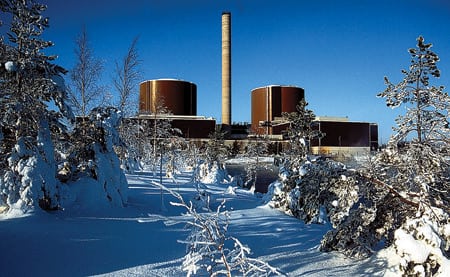
Yet nuclear plants in Korea, China, Taiwan, Finland, the Czech Republic, France, and other countries have digital-based safety systems. Despite the numerous benefits of digital controls, Mauck conceded that finding projects with favorable cost/benefit ratios is difficult.
John Stevens, of Doosan/HF Controls Corp. (Addison, Texas), then described how different the situation is in the Republic of Korea. By 2010, 12 nuclear plants will have digital controls there, while the plants to be built later will use "soft" controls. Shin Kori 3-4, for example, will have total soft control for the nuclear steam supply system and balance of plant. Construction is expected to begin in 2010.
Stevens noted that standardization guides all new plant designs in Korea. Yet no off-the-shelf control systems can meet the specifications put forth by Korea Power Engineering Co. Although safety and non-safety systems are still isolated in Korean control system designs, data still are wheeled between them. An interesting feature of the Korean design philosophy is that engineering must be able to remotely guide plant operators through any emergency. Korea’s nuclear industry demands that control system vendors be willing to support their system for 25 years to warrant consideration.
Not everything is stalled in the U.S., however, as Larry Bethel of St. Louis–based Emerson Process Management reminded the audience. For example, by upgrading a feedwater regulator valve at its Fort Calhoun station to digital control, Omaha Public Power District reduced the valve’s setup and calibration time by a factor of four while cutting 40 man-hours of labor from the job. The operational benefit: The steam generator level at Fort Calhoun is now much more stable. On an overall basis, the retrofit has saved the plant more than $200,000 annually.
Another example cited by Bethel was Edison International’s $800,000 annual saving at its San Onofre Nuclear Generating Station, the result of having switched to digital positioners, changing out valve trims, and retuning controllers on feedwater heater control valves. A third he described was a similar retrofit of feedwater regulator control valves at Florida Power Corp’s Crystal River station. Bethel was quick to note that these plants have yet to fully harness the diagnostic capabilities of their new digital controls.
Security vs. standardization
Plant IT system security was the topic of another timely session. Tim McCreary, president and CEO of HF Controls, correctly pointed out that making control schemes more flexible and easier to implement inevitably compromises their security. Though customers desire "plug and play," common databases, and standard communication protocols, these characteristics lead to undue system complexities, vulnerabilities, and a proliferation of portals through which evildoers can virtually enter the plant. "It’s like trying to plug all the holes in a colander," McCreary noted, in all seriousness.
Some of McCreary’s suggestions for secure design include:
- Embedding PC technology and the human machine interface inside plant controllers.
- Using flash memory preprogrammed by system designers.
- Allowing one-way movement of data from the control system, but no access point back into it.
- Maintaining proprietary peer-to-peer communications between and among controllers.
Robert Webb—a consultant based in San Carlos, Calif.—had a similar take on the problem. Even though we’ve been complaining about "islands of automation" for decades, "they’re not bad" from a security perspective, he said. Both Webb and Joseph Weiss of the technical/management consultancy KEMA Inc. (Burlington, Mass.) lamented the lack of participation by power plant and substation owners in the North American Electric Reliability Council’s Critical Infrastructure Protection Committee. As a result, the efforts of the committee are skewed toward transmission providers.
Weiss offered the audience at least four points to ponder:
- Policies, procedures, and culture regarding control system security are inadequate.
- Networks generally lack defense in depth.
- Detailed security requirements should be included in all design specs.
- Remote access should be controlled through the electronic security perimeter, and all wireless communications should be treated as remote access points.
Automating corrosion monitoring
On-line corrosion monitoring has always been considered a valuable, but elusive, tool in power plant process control. According to a presentation by Dawn Eden of Houston-based Honeywell International Inc., such a tool may be close at hand. Honeywell has developed and field-proven a real-time device "with a heat transfer efficiency and corrosion measurement that provides a comprehensive understanding of unit operating conditions and fouling/scaling activity in cooling water systems and heat exchange equipment." The device works by analyzing measurements of three variables: electrochemical noise, linear polarization resistance, and harmonic distortion. Its output is a general corrosion rate, a proxy for localized corrosion behavior.
Eden noted that the technologies powering the device make it possible to incorporate and automate multiple corrosion measurements into a single instrument. Corrosion data and trends now can be grouped with other key performance indicators used to control and optimize generating assets. The device also allows corrosion and process engineers to cooperate in real time. A corrosion engineer now can monitor the data, be notified of problems, and provide immediate input during process upsets, rather than waiting until corrosion damage has already occurred.
Time is money
Engineers from GE Energy and GE Global Research (Schenectady, N.Y.) reported on a model predictive control (MPC) technology that reduces the start-up times for combined-cycle units by leveraging knowledge of thermal dynamics, steam-to-metal heat transfer, and critical stresses of the unit’s components. A new module based on the technology also incorporates optimization routines for current and future operating constraints and effective protection logic for overstress events.
The module regulates the gas turbine’s load at the maximum rate allowed by the steam turbine’s rotor stress constraints. It includes optimization algorithms that calculate the GT loading profile that leads to the fastest start-up. At a 480-MW combined-cycle plant that hosted a test of the MPC module, it shortened start-up times by over 50 minutes, reduced fuel consumption by a remarkable 1.3 billion Btus, and avoided over 100 pounds of NOx emissions on a single cold start. According to Fernando D’Amato of GE Global Research, no additional sensors or actuators are needed to implement the technique.
Plant-level problem-solving
Not all of the presentations at the 49th Annual POWID Symposium involved advanced control technologies and techniques. Several offered solutions to common plant problems. Among them were those that close this article.
Donald Andrasik of Mirant Mid-Atlantic LLC described a program to evaluate ways to eliminate coal-burner pipe-flow stoppage at Morgantown Generating Station, which hosts two 625-MW tangentially fired boilers. At the heart of the solution ultimately implemented were acoustic flow devices, which monitor the flow in the coal pipes. The data delivered by the devices are then trended by, and alarmed in, the plant’s distributed control system (DCS).
Engineers from Oklahoma City–based OG&E Electric Services—a regulated electric utility serving 735,000 customers in Oklahoma and western Arkansas—discussed a programmable logic controller upgrade of aging ash-removal system controls at Muskogee Generating Station. The retrofit has yielded a more flexible and reliable system for handling bottom ash, flyash, and pyrites.
Sandeep Shah of Atlanta-based Clyde Bergemann Inc. told of Xcel Energy’s efforts to integrate a water cannon–based intelligent sootblowing system with the DCS at Xcel’s Tolk Station in Muleshoe, Texas, in the hope of achieving closed-loop control. Tolk, with two 540-MW units that burn Powder River Basin coal, had experienced severe slagging events before the water cannons were installed several years ago.
David Runkle and other engineers from the Lower Colorado River Authority described a project at Sim Gideon Power Plant to achieve ramp rates of 10%/min over a wide load range for a 350-MW gas-fired unit. The speed was deemed essential so the plant could meet its new dispatch obligations in the Electric Reliability Council of Texas market. The important elements of the control scheme implemented are MPC in the DCS, modified sliding-pressure operation for the boiler/turbine-generator, and a feedback loop from an on-line turbine cyclic life estimator to the turbine’s front-end controls. Before the plant had achieved this critical flexibility for the unit, said Runkle, "the smell of mothballs began to permeate the organization."