In any technology-based business, after its scientists unlock nature’s secrets, its engineers use that knowledge to design new products that we eventually can’t live without. Without scientists, there are no technical advances. Without engineers, there are no products. One of the greatest challenges for a technology-based company is to focus its R&D investments in areas with the greatest potential payoff. Such is the case for the U.S. nuclear power industry.
This article summarizes the relative merits of several nuclear power systems that are under development and competing for attention and investment. To get a sense of how stiff the competition is, consider this comparison: Last year, Microsoft spent over $7 billion in R&D to stay competitive in the burgeoning market for online services, with the expectation of earning many times that sum in the future; the DOE’s total budget for “science & technology” for this fiscal year is $3.9 billion.
Generation next
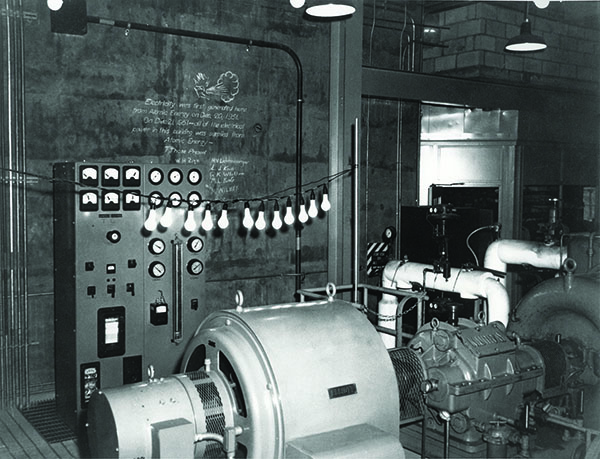
Three generations of nuclear power systems, derived from designs originally developed for naval use beginning in the late 1940s, are operating worldwide today (Figure 1). The first generation consisted of early prototype reactors from the 1950s and ’60s, such as Shippingport (1957–1982), Dresden-1 (1960–1978), and Calder Hall-1 (1956–2003) in the UK. There are only two commercial Generation I (Gen I) plants still operating: Oldbury nuclear power station, owned by the British Nuclear Group and scheduled for closure this year, and Wylfa nuclear power station in Wales, scheduled for closure in 2010.
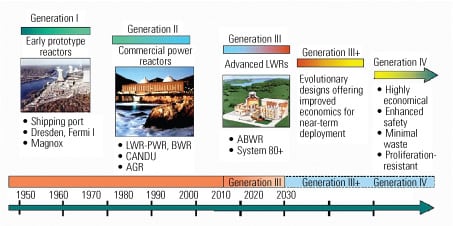
1. The evolution of nuclear power reactors. More than two dozen Generation III+ reactors based on five different technologies are planned for the U.S. Generation IV reactors are expected to be available around 2030. Source: DOE
The Gen II systems began operation in the 1970s and comprise the bulk of the world’s 400+ commercial pressurized water reactors (PWRs) and boiling water reactors (BWRs). These reactors, typically referred to as light-water reactors (LWRs), use traditional “active” safety features involving electrical or mechanical operations available on command. Some engineered systems still operate passively (for example, using pressure relief valves) and function without operator control or loss of auxiliary power.
Time is money
A few Gen III plants have already been built. The most visible is an advanced BWR that entered service in Japan in 1996. None are in service today in the U.S., although the Nuclear Regulatory Commission (NRC) lists more than two dozen in its certification queue. All of the proposed reactor designs being scrutinized by the NRC are considered Generation III+ designs: Areva’s evolutionary pressurized water reactor or EPR, GE’s enhanced simplified BWR or ESBWR, Westinghouse’s APR1000 as amended, and Mitsubishi Heavy Industries’ advanced PWR or ABWR.
The only examples of a Gen III reactor design in operation are six ABWRs, including four in Japan. Hitachi carefully honed its construction processes during the building of the Japanese units. For example, Kashiwazaki Kariwa Unit 7 broke ground on July 1, 1993, went critical on November 1, 1996, and began commercial operation on July 2, 1997—four years and a day after the first shovel of dirt was turned. If the U.S. nuclear power industry were to adopt Hitachi’s construction techniques (for details, see POWER, May 2007, p. 43) in coming years, many billions of dollars and years of time could be saved.
There’s no denying that the first three generations of nuclear reactors have been economically successful, after enduring the usual reliability growing pains early in their lives. According to the Nuclear Energy Institute, U.S. nuclear power plants in 2006 supplied the second-highest amount of electricity in the industry’s history while achieving a record-low average production cost of 1.66 cents/kWh. In fact, average production costs have been below 2 cents/kWh for the past eight years while capacity factors have remained higher than 90%. What’s more, efficiency improvements to operations over the past decade have yielded the equivalent of some 20 new nuclear plants.
The Gen III and Gen III+ systems began development in the 1990s by building on the operating experience of the American, Japanese, and Western European LWR fleets. Perhaps their most significant improvement over second-generation designs is the incorporation of “passive” safety features that do not require active controls or operator intervention; instead, they rely on gravity or natural convection to mitigate the impact of abnormal events. This feature, among others, will help expedite the reactor certification review process and thus shorten construction schedules. Once plants using the Gen III and Gen III+ reactors come on-line, they are expected to achieve higher fuel burn-up (reducing fuel consumption and waste production (see sidebar, "Now you’re cooking with thorium") and operate for up to 60 years.
Generation after next: The options
Nuclear scientists have left implementation of the Gen III+ designs in steel and concrete to the engineers and moved on to developing the “generation after next” nuclear alternatives—commonly called Gen IV.
Conceptually, Gen IV reactors have all of the features of Gen III+ units plus the ability to support hydrogen production, thermal energy off-taking, and perhaps even water desalination. In addition, these designs include advanced actinide management. An actinide is an element with an atomic number between 89 (actinium) and 103 (lawrencium); the term is usually applied to elements heavier than uranium, which are also called transuranics. Actinides are radioactive, typically have long half-lives, and constitute a significant portion of the spent fuel wastes from LWRs.
The DOE’s Office of Nuclear Energy (DOE-NE) has taken responsibility for developing the science required for five different Gen IV technologies. The table summarizes the characteristics and operating parameters of six Gen IV reactor system alternatives, including the molten salt reactor, which is included for the sake of comprehensiveness even though the U.S. is not currently researching it. Each of the technology concepts has been prioritized to reflect its technology development status and its potential to meet the program’s and national goals.
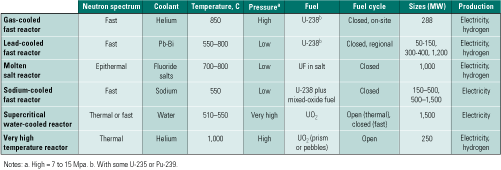
Characteristics and operating parameters of the six Generation IV reactor systems under development. Source: DOE
In general, Gen IV systems include full actinide recycling and on-site fuel cycle facilities based on either advanced aqueous, pyrometallurgical, or other dry processing options. On-site reprocessing minimizes the transportation of nuclear materials, which increases the chance of their proliferation. The DOE has expanded its coordinating activities to include a number of national and international entities (see sidebar, "Organizations suporting the development of Generation IV reactors") and formed the Global Nuclear Energy Partnership (GNEP), which emphasizes fast reactors and fuel reprocessing.
Following are synopses of the development status of the six Gen IV reactor system alternatives.
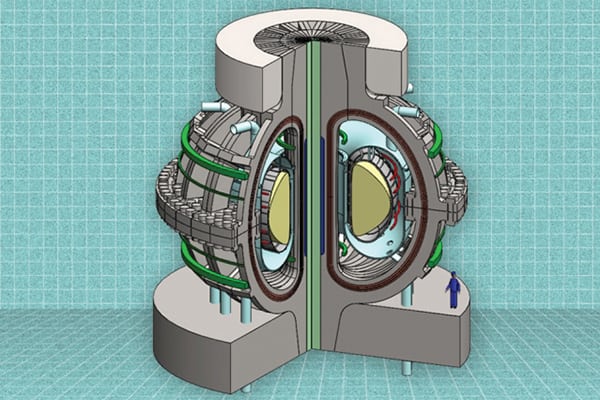
The gas-cooled fast reactor (GFR). The GFR (Figure 2) is primarily designed for electricity production and actinide management, but it may be able to support hydrogen production as well. The reference GFR system features a fast neutron spectrum, a Brayton-cycle helium-cooled reactor, a closed fuel cycle for actinide reprocessing, and a plant efficiency of 48%. In November 2006, the GFR System Arrangement was signed by the European Atomic Energy Community (Euratom), France, Japan, and Switzerland.
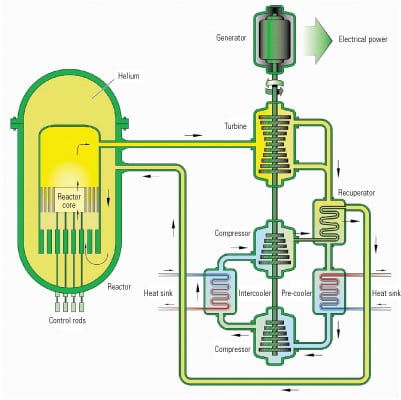
2. The gas-cooled fast reactor. Source: DOE
The several forms of fuel (ceramics, fuel particles, and ceramic-clad elements) being considered for the GFR have one thing in common: They will allow the reactor to operate at very high temperatures yet ensure excellent containment of fission products. Core configurations will be either pin- or plate-based fuel assemblies or prismatic blocks. Performance enhancement possibilities still being researched include the use of materials with superior resistance to fast neutron fluence (flux integrated over time) at very high temperatures, and the development of a helium-cooled turbine capable of super-efficient electricity production. Target values of some key parameters, such as power density and fuel burn-up, are sufficient for reasonable performance of a first-generation technology.
Two GFR projects have been constructed in the U.S. The first—Peach Bottom 1, in York County, Pa.—was a 40-MW experimental helium-cooled, graphite-moderated reactor that operated from 1967 to 1974. The other was the Fort Saint Vrain Generating Station in Colorado; it operated from 1979 to 1989, burned uranium-thorium fuel at a high temperature, and was capable of producing 330 MW. Fort Saint Vrain’s fuel elements had a hexagonal cross section, and their energy density was low enough that losing the primary coolant did not result in an immediate overheating of the reactor core. Operators had several hours to shut down the reactor before incurring damage to the core. The Fort Saint Vrain site was converted to a natural gas combined-cycle plant in 1996.
Other ongoing demonstrations of GFR technology include Japan’s graphite-moderated high-temperature test reactor (HTTR), which reached its full power of 30 MWth in 1999. It uses long hexagonal fuel assemblies, unlike competing particle-bed reactor (PBR) designs. Testing has shown that the core can reach temperatures sufficient for hydrogen production.
Separately, a 300-MWth pebble-bed modular reactor (PBMR) using a closed-cycle gas turbine power conversion system is being designed for deployment by the South African utility Eskom.
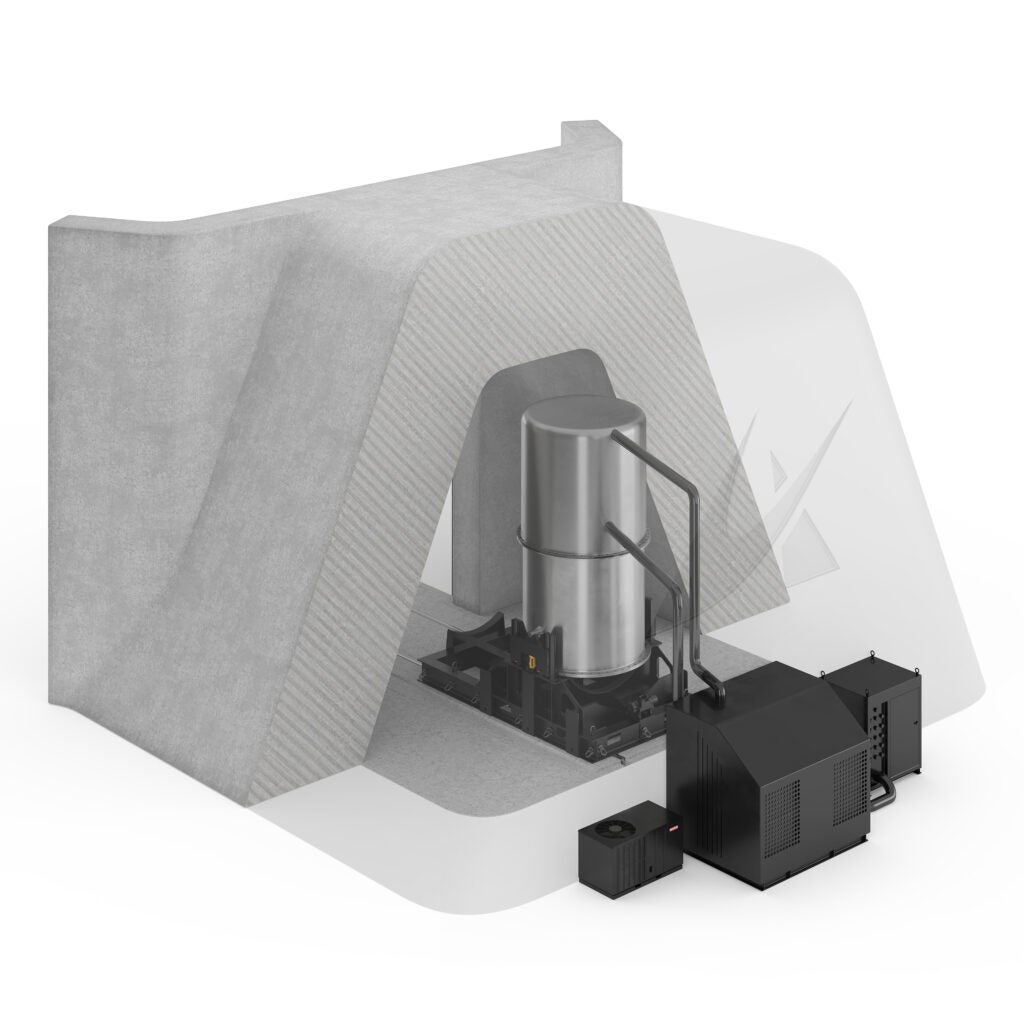
Finally, a consortium of Russian institutes is designing a 300-30 MWth gas turbine-modular helium reactor (GT-MHR) in cooperation with General Atomics. The entire GT-MHR plant (Figure 3) is essentially contained in two interconnected pressure vessels enclosed by a below-ground concrete containment structure. The GT-MHR core is being designed to use any of a wide variety of fuels (including thorium/high-enriched uranium and Th/U-233); it may even be able to convert weapons-grade or reactor-grade plutonium fuel to electrical energy.
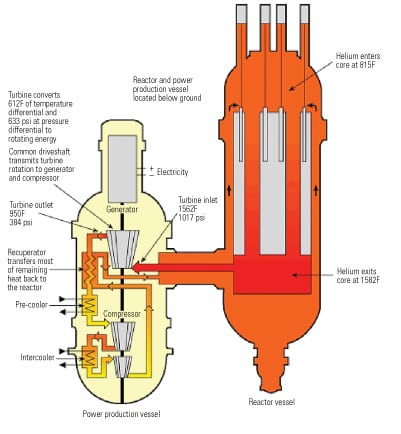
3. The gas turbine-modular helium reactor. Source: General Atomics
The lead-cooled fast reactor (LFR). The LFR (Figure 4) is a fast neutron spectrum reactor designed for electricity and hydrogen production as well as actinide management. Three key technical aspects of the LFR are its use of lead for cooling, a long cartridge-core life (15 to 20 years), and its modularity and small size (potentially suiting it for deployment on small grids or at remote locations).
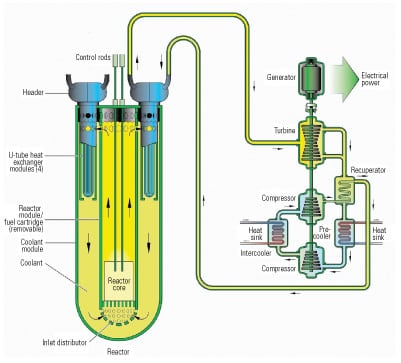
4. The lead-cooled fast reactor. Source: DOE
The LFR envisioned by DOE-NE’s Generation IV program would be based on the small secure transportable autonomous reactor (SSTAR) concept. The main mission of SSTAR development is to provide incremental energy generation to match the needs of developing nations and remote communities lacking a grid connection. LFR technologies have already been successfully demonstrated internationally. A prime example is Russia’s BREST fast “breeder” reactor, which both consumes reactor-grade plutonium as fuel and produces it as raw material. BREST technology builds on Russia’s 40 years of experience with lead-bismuth cooling of the reactors powering its Alfa-class submarines.
The molten salt reactor (MSR). The MSR (Figure 5) is a liquid-fueled reactor that can be used for actinide burning and production of electricity, hydrogen, and fissile fuels. In this system, the molten salt fuel flows through graphite core channels. The heat generated in the molten salt is transferred to a secondary coolant system through an intermediate heat exchanger, and then through another heat exchanger to the power conversion system. Actinides and most fission products form fluorides in the liquid coolant. The homogenous liquid fuel allows for the addition of actinide feeds without requiring fuel fabrication.
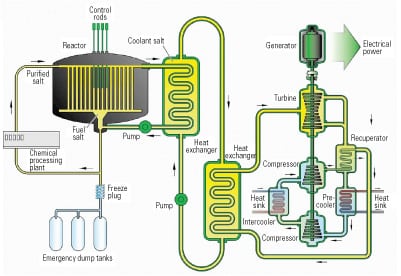
5. The molten salt reactor. Source: DOE
During the 1960s, the U.S. developed a molten salt breeder reactor as the primary back-up option for a conventional fast breeder reactor. Recent work has focused on lithium and beryllium fluoride coolants with dissolved thorium and U-233 fuel. The DOE plans to continue its cooperative work with Euratom MSR programs in the future.
The sodium-cooled fast reactor (SFR). The primary development goals of the SFR (Figure 6) program are actinide management, reduction of waste products, and more-efficient uranium consumption. Future, lower-cost designs are expected to not only produce electricity but also supply thermal energy, produce hydrogen, and possibly enable desalination as well. The SFR’s fast neutron spectrum could make the use of available fissile and fertile materials, including depleted uranium, much more efficient than it is in today’s LWRs. In addition, the SFR system may not require as much design research as other Generation IV systems.
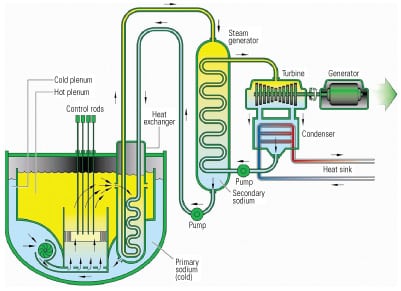
6. The sodium-cooled fast reactor. Source: DOE
A Gen IV technical readiness and operating experience comparison of the GFR, LFR, and SFR systems led to the selection of the SFR as the primary fast-reactor Gen IV candidate for near-term deployment. The decision was based on more than 300 reactor-years’ experience with fast neutron reactors in eight countries.
Important safety features of the SFR system include a long thermal response time (the reactor heats up slowly), a large margin between operating temperatures and the boiling temperatures of coolants (less chance of accidental boiling), a primary system that operates near atmospheric pressure, and an intermediate sodium system between the radioactive sodium in the primary system and the water and steam in the power plant.
The supercritical water-cooled reactor (SCWR). The SCWR (Figure 7) promises significant economic advantages for two reasons: the plant simplification that it makes possible and its increased thermal efficiency. The main mission of the SCWR is to generate electricity at low cost by combining two proven technologies: conventional LWR technology and supercritical fossil fuel–fired boiler technology. Design studies predict plant thermal efficiencies about one-third higher than those of today’s LWRs.
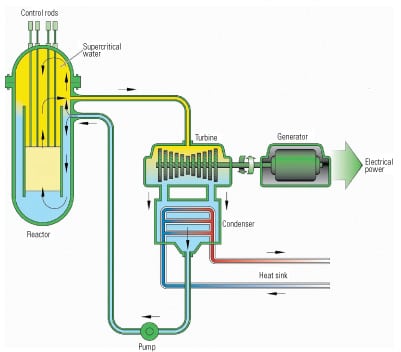
7. The supercritical water-cooled reactor. Source: DOE
As the figure shows, an SCWR’s balance-of-plant systems and passive safety features, similar to those of a BWR, are much simpler because the coolant does not change phase in the reactor. The supercritical water drives the turbine directly without any secondary steam system. An international effort, with Japan in the lead, aims to resolve the most pressing materials and system design uncertainties needed to demonstrate the technical viability of the SCWR.
The very high temperature reactor (VHTR)/next-generation nuclear plant (NGNP). The main mission of the VHTR/NGNP (Figure 8) is to produce both electricity and hydrogen. The reference system consists of a helium-cooled, graphite-moderated, thermal neutron reactor. Electricity and hydrogen are produced using an indirect cycle in which intermediate heat exchangers supply a hydrogen production demonstration facility and a gas turbine generator. Process heat also could be provided for applications such as coal gasification and cogeneration.
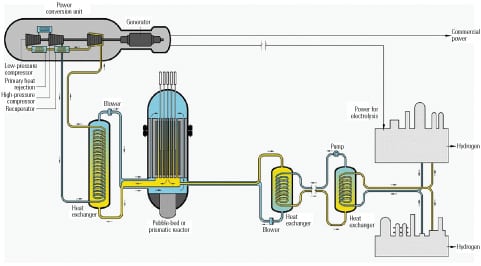
8. The very high temperature reactor. Source: DOE
The VHTR gets high economic marks for its high hydrogen production efficiency and high safety and reliability grades due to the inherent safety features of the fuel and reactor. It also gets good ratings for proliferation resistance and physical protection, and a neutral rating for sustainability because of its open or once-through fuel cycle. Although the VHTR/NGNP requires R&D advances in fuel performance and high-temperature materials, it should benefit from earlier GFR, GT-MHR, and PBMR advancements.
The VHTR/NGNP is expected to be available for near-term deployment as early as 2015. The DOE-NE program’s objective is to have the other Gen IV systems available for deployment by about 2030, when many of the world’s nuclear plants’ operating licenses will be at or near their expiration dates. Like the Gen III+ program, the Gen IV program coordinates with the DOE’s Nuclear Power 2010 Program—to ensure that the results of all efforts complement the agency’s new risk-based and technology-neutral licensing approach.
The VHRR/NGNP is also special for another reason. Although the DOE is subsidizing research into several reactor concepts, the VHTR/NGNP has top priority because it was singled out in Sections 641 through 645 of the Energy Policy Act of 2005. There, $1.25 billion was earmarked for the design and construction of a prototype NGNP project at the Idaho National Laboratory by no later than 2021. This prototype is expected to have a thermal efficiency of 48%, produce hydrogen as well as power, and make process heat with a zero carbon footprint available to a broad range of applications such as syngas production and the conversion of coal to liquid fuels.
The pluses of particle management
Actinide management, common to all the Gen IV alternatives, would reduce the volume of nuclear waste in the mid-term and provide assurance of nuclear fuel availability in the long term. This mission overlaps a national responsibility addressed in the Nuclear Waste Policy Act, namely, the disposition of spent nuclear fuel and high-level waste. The mid-term (30 to 50 years) actinide management mission consists primarily of limiting or reversing the buildup of the inventory of spent nuclear fuel from current and near-term nuclear plants.
Actinides may be a waste product for an LWR, but they are fissionable in a fast reactor. As mentioned earlier, a transuranic is a very heavy element with a higher atomic number than uranium (92); it is formed artificially by neutron capture and possibly by subsequent beta decays. Extracting these long-lived radionuclides from spent fuel and irradiating them in a closed fuel cycle using fast reactors does more than generate electricity. It also transmutes the long-lived radionuclides that would otherwise require isolation in a geologic repository such as Yucca Mountain into shorter-lived radionuclides. Transmutation changes atoms of one element into those of another by neutron bombardment that causes neutron capture and/or fission. In the longer term, the actinide management mission can beneficially produce excess fissionable material, currently supplied through mining and the enrichment of natural uranium, for use in systems optimized for other energy missions.
Making the most of uranium
Fast reactors play a unique role in the actinide management mission because they operate with higher-energy neutrons than LWRs and thus are more effective in fissioning the actinides and transuranics recovered from an LWR’s spent fuel.
Theoretically, a fast reactor can recycle all of the uranium and transuranic radionuclides. In contrast, thermal reactors, such as LWRs, use lower-energy neutrons and extract energy primarily from fissile isotopes. The only naturally occurring fissile isotope is U-235, which has only 0.7% natural uranium; enrichment increases this natural concentration of U-235 to about 3% to 5%, which is enough to enable operation of an LWR. But because LWRs cannot be used for complete recycling, over 99% of the uranium initially mined ends up in their spent fuel and in the residue from the enrichment process. Fast reactors maximize the use of uranium because they support multiple fuel recycles that make all of the fuel’s heat content usable.
Kick-starting the hydrogen economy
Another feature of many of Gen IV reactors is their ability to produce hydrogen as a by-product. Realizing this potential could make the use of fuel cells for transportation and power generation more economic and environmentally benign while reducing America’s dependence on imported oil.
Sufficient quantities of hydrogen for commercial use would be produced during off-peak periods, improving the operating economics of nuclear baseload plants. A long-term objective would require dedicated Gen IV nuclear plants, operating at higher temperatures, to produce hydrogen at a steady rate for storage and subsequent use by large (>1,000-MW) banks of fuel cells to address daily peak demand.
—James M. Hylko (james.hylko@prs-llc.net) is an integrated safety management specialist for Paducah Remediation Services LLC and a POWER contributing editor.