Do you have enough women working in your power plant? Forget for a moment equal opportunity laws. More important is the knowledge that the programs and culture changes that would make women more likely to consider a plant career are the same ones that would make it more attractive to many younger men.
Recruiting women to enter the power generation industry is much more than a workforce diversity issue. The severity of the aging workforce problem varies from plant to plant, but it’s a well-documented constraint industry-wide and one that no company can afford to ignore indefinitely. If a generating company isn’t consciously doing all it can to attract women as well as men, it could be forfeiting the chance to hire some of the most qualified and motivated prospects.
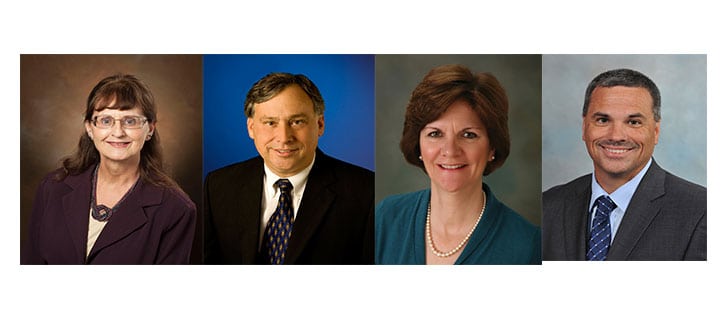
To help answer the question of whether power generators are doing all they could be doing to make power plant careers visible and appealing to all potential candidate pools, POWER interviewed 10 women holding senior positions in different regions of North America, at different types of generating companies (and one vendor), and at plants powered by a wide variety of fuels.
Some of the differences in the interviewees’ experience of power plant work may be attributable to the inevitable idiosyncrasies of individual plants — whether those variations are influenced by geography, size of community, median age of the workforce, or other factors. The differences that emerged are important for two reasons: They remind us that no demographic group is uniform in its attitudes and experiences, and they demonstrate that different companies present different sorts of hurdles to women seeking to build careers in power generation.
Only one woman who was approached about an interview declined, saying that she was "philosophically opposed" to a story that singled out women. Given how hard many women have had to work to gain legitimately earned respect from their peers in predominantly male fields, her reluctance to participate is understandable. However, the goal of this story was not to make women in the plant appear as oddities, nor to blame their employers for the small numbers of women in power plants even today. Instead, it was to create a virtual roundtable of senior-level female advisors so that they could share their backgrounds, insights about career paths, and recommendations in a way that could enhance opportunities for all employers and all potential employees.
The surprise is not that women excel in all sorts of power engineering, plant operation, and management positions; after all, you’ll find women excelling in all types of endeavors. The surprise is that power generators have given so little attention to recruiting, training, and advancing women who could make essential contributions to the industry. That’s especially true today.
The future’s bright — if you’re in the sun (or wind) business
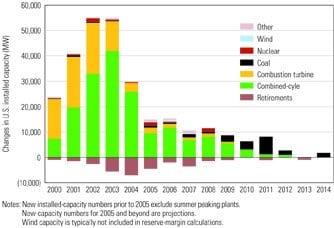
One factor that cuts across gender lines but that may make it especially hard to recruit women to fossil-fueled and nuclear generation jobs is the fact that renewable (and, maybe in the foreseeable future, nuclear) projects are growing while coal and gas projects are mostly stalled. It’s only logical that those choosing a career, and those advising them, would find a growing industry sector more promising than one that seems stagnant, or worse.
Add to that simple economic reality the fact of growing public awareness about climate change issues, and fossil plants have a bit of a PR problem. Take, for example, former Vice President Al Gore’s July 17 speech in which he laid down the gauntlet to have the U.S. provide all its electricity (including enough to power electric vehicles) from non-carbon-producing generation sources in 10 years. Quibble as you wish with his timeframe or even his thesis, but audacious goal-setting by someone with his clout has a wide-ranging effect on how young people and those who influence them think about jobs of the future.
Consider also the Engineer Your Life campaign developed for a high school audience by members of the engineering community and public television station WGBH Boston. The campaign, which aims "to change the perceptions high-school girls have about engineering and to encourage them to enroll in undergraduate engineering programs," includes a multimedia web site (www.engineeryourlife.org) that includes profiles of young female engineers. Among the dozen profiles is one related to power generation. Here’s the teaser: "Tanya Martinez helps Native Americans expand their renewable energy sources."
"But we still need workers in thermal plants!" some may argue. Fair enough, but to win some of the best and brightest could require shifts in strategy, culture, and career path. The relatively low-cost effort that some sectors of the power industry have made to recruit women is one indicator of where change is needed.
Industry’s role in career development
In June this year, the nonprofit Women of Wind Energy (WoWE, www.windustry.org/womenofwindenergy) launched an online mentoring program. "The purpose of the WoWE mentoring program is two-fold," said Louise Nemmers Mageli, program manager for WoWE in a press release. "First, to provide women with the leadership and technical skills needed to succeed in their current or future positions. Second, to grow future female leaders from within the wind energy industry." The organization also has about a dozen local chapters for in-person networking, including one in Canada (a rather large local area, to be sure).
Though WoWE is "sponsored" by Minneapolis-based Windustry, it is supported by a variety of "corporations, organizations, foundations, and individuals who value [its] goals and intentions."
For those in the solar field, Women in Solar Energy (WISE) presents a session at the American Solar Energy Association’s annual conference, where the group also hosts a networking lunch.
Other job training and development opportunities for both men and women are mushrooming in the renewables sector, from state-sponsored jobs programs to those sponsored by equipment manufacturers.
The nuclear industry has a well-established global nonprofit organization, Women in Nuclear Global (WIN Global, www.win-global.org) that supports the careers of women. Its current president is Cheryl Boggess, a senior project manager and principal engineer at Westinghouse, who has more than 28 years of engineering experience in the commercial nuclear power industry (see profile).
Though Boggess noted that WIN is "very integral" to the career success of women in her industry, the group is not focused on women only. Its charter is to communicate factually, considering emotions that the general public may feel about nuclear-related issues, and to engage the public in a dialogue about the role nuclear technologies play in everyone’s daily lives — from medicine to energy.
WIN "draws on women’s strengths to promote understanding of the industry," Boggess explained. As for supporting the careers of women in nuclear, WIN "is about breaking down barriers." In words that I could imagine coming from any competent professional’s mouth, Boggess said, "I have my position not because I’m female but because I’m qualified."
Training, recruiting, and mentoring programs for women are thriving in nuclear, wind, and solar sectors of the industry. Yet the sector responsible for the largest percentage of megawatts lacks such an organization (or has made it so invisible that none of the senior-level women I spoke with knew of it). For some women, as you’ll see below, having such an organization would have made a difference.
A traditional career path
Debbie Powell (Figure 1) came to power plant engineering via a career path that’s familiar to many men in the industry: the military. After earning her degree at the U.S. Naval Academy, she was commissioned and "did a couple odd jobs" but couldn’t go out on combatant ships because she was a woman. When the rules changed in the mid-’90s, she joined the surface warfare community, because she "wanted to be where the action is." Eventually, she headed up the engineering department on two ships.
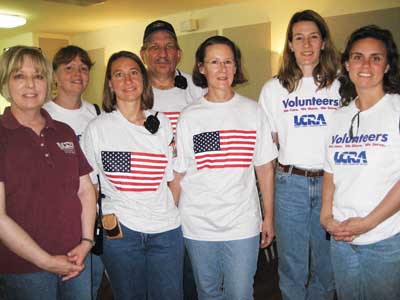
1. Staff from the Thomas C. Ferguson Generating Station in Marble Falls, Texas, managed by Debbie Powell, assisted with community Earth Day clean-up efforts in April 2008. Front (L to R): Budget Analyst Janice McGill, Senior Environmental Coordinator Wendy Schreiber, Plant Engineer Catherine Roberts, Administrative Associate Julia Adams. Back (L to R): Storekeeper Debbie Herwig, Operations Supervisor Bucky Brady, and Plant Manager Debbie Powell. Courtesy: Lower Colorado River Authority
Her last ship in the Navy was 26 years old and was decommissioned soon after she left it for the even older (34-year-old) gas-fired Thomas C. Ferguson Generating Station in Marble Falls, Texas. "Something happens every day," she said, laughing.
Powell, plant manager for the Lower Colorado River Authority’s (LCRA’s) Ferguson plant, said aging workforce issues are "a pretty big deal in Texas. It’s something we talk about on a regular basis." Mitigation efforts at her plant include summer internships for engineering students and a company slogan — "Leave a Legacy" — that reminds the veterans to share their knowledge before they leave.
When asked if she thinks young people may be more attracted to careers in renewable power than fossil-fueled power generation, she answered, "I think our younger generation is very environmentally minded." Then she gave the example of a senior engineering student who was a summer intern recently. Even working with a stellar staff at a power plant recognized by the Marble Falls community for its efforts to be a good steward of the environment wasn’t enough to keep him around; he headed back to school for a master’s degree in green energy.
Nevertheless, she "absolutely" would encourage young women to consider this career. There are a lot of female chief engineers in the Navy, she said, and she has no qualms about encouraging other women to pursue a career in power plant engineering. The opportunities "are wide open — especially with an aging workforce. There are a lot of really good opportunities to get into the industry and opportunities for pretty quick progression."
Powell has several "phenomenal ladies" on her staff, including a mechanical engineer, an instrumentation and controls technician, and an environmental specialist. Seven of the 34 members of her staff are women, and all of LCRA’s facilities have women in senior-level positions.
Once the doors are opened, "it’s easier for every generation," she thinks. "I think our workforce has become much more receptive to the diverse workforce."
As in any field, those who love their jobs tend to excel at them and usually make the best ambassadors for the field. Asked if she enjoys her career, Powell answered, "Oh yeah! My husband talks about dragging me out of here kicking and screaming." Yet, when she graduated from college, if you’d have told her she’d be running a power plant, "I’d have laughed in your face," largely because she wasn’t encouraged to pursue engineering — though her brother was.
Any effort that encourages young women (and men, for that matter) to consider technical fields could help pave the way to a career like power plant engineering. Powell gave the example of a 17-year-old she met recently who impressed her enormously. The young woman not only had "her head on straight" but was attending a NASA summer camp, had participated in a robotics competition, and knows she wants to be an astronaut. The availability of such experiences at an early age is clearly making a difference in encouraging young people to consider certain fields.
Going it alone
Kimberly Pruett knows that she got her first break in the generation business because someone thought she was a man. In 1985, when she applied for admission to a training program for instrument mechanics, she was the only female in a batch of 8,000 applicants. Her application bore just her first initial and last name. When her female identity was discovered, she was told that the company would help her find a secretarial job, but Pruett, a newly single parent, insisted, "I have to make enough money to support my family."
Persistence and proving herself helped her hold her own in the training program and beyond, but it was never easy. Pruett was an instrument mechanic at Sequoyah Nuclear Plant for several years until Tennessee Valley Authority (TVA) did a "reduction in force." At that point she got involved with emissions controls at a fossil plant. These days, she’s on TVA’s corporate team with the title of Regulatory Specialist — Title IV CEMS.
Once a woman lands a job in a power plant, on-the-job training (still the only way to learn the specifics of a particular plant) can pose challenges. Let’s just say that when Pruett would ask coworkers how to do a given task, the responses were the opposite of collegial. "You have to find alternate routes to success" and rely upon yourself a lot more than male coworkers do, she explained.
One obstacle she noted is that male coworkers tend to build trust and get to know each other by socializing together after hours — golfing or fishing. But, in her experience, they rarely include a lone female colleague — often, she said, because most are married and, in the South, platonic relationships between the sexes are still uncommon.
Pruett is in the unusual position of having worked in both fossil and nuclear plants before moving into her corporate position, where she interacts with employees at fossil, hydro, and combustion turbine plants. Though the number of women is low even in nuclear plants, Pruett sees a difference in attitude and culture there. Though there’s certainly a glass ceiling, "it isn’t as thick" at nuclear facilities, she said. In contrast, at fossil plants that Pruett is familiar with, the explanation for why there aren’t more women in supervisory and management positions is likely to be, "This is the way we’ve always done it."
Pruett attributes the difference between fossil and nuclear plants to the fact that positions in nuclear plants require higher levels of education for comparable jobs. If employees have had exposure to different surroundings than the town where they grew up and now work — perhaps a larger community with greater diversity — and have studied side by side with capable women, they’re more likely to treat female coworkers more professionally, she thinks.
Pruett was TVA Fossil’s first female Instrument & Controls foreman (an ill-fitting term, she pointed out), and the only way to move up to corporate was to be a foreman. "You have to have a very strong desire to move [up]," she explained. "Most women with a desire for a career have moved away from power because there were no opportunities for promotion." Overall, though, she is happy with her career. These days some of the men finally trust her and know that she knows her stuff. And even though she’s "ecstatic" to be working at corporate now, after struggling in the plant environment for 25 years, she said, "My favorite thing is helping people from the plant."
When I asked Pruett if she’d encourage young women these days to consider a career in a power plant, there was a long silence. Finally, she replied, "No. I honestly wouldn’t." Though she enjoys her work, she knows that "it takes a unique personality" to cope with the uncomfortable work environment that can result "if you’ve got 300 men and you’re one woman." Perhaps the most telling comment came from Pruett’s daughter. When, at age 15, she visited the fossil plant where her mother was working, she asked, "This is what you went to school for for four years?!"
Instead, Pruett said, "I’d encourage [women entering the power industry] to work at corporate," though she noted that the situation in nuclear plants can be more conducive to a successful career.
What can utility and plant managers do to encourage women to consider — and stick with — plant jobs? Pruett’s advice: "It’s pretty simple. Tell them to follow the rules. You have federal laws written to protect minorities. If upper management wants a more secure workforce… don’t treat women differently. Don’t allow it. When you have women who report that they’ve been treated differently, it makes other women not want to enter the field." That word of mouth can be particularly powerful in communities where the pool of prospective workers is smaller. "If women would see that treatment is equal, they would consider the field. That doesn’t mean treat women better, but give them a chance. Find another way to help the men get to know their female coworkers."
Pruett added that when Widows Creek Fossil Plant Manager William G. Cronin asked what advice she’d give to management about this subject, she suggested that the men at all levels in the plant "ask themselves if they would like their daughters or wives to be treated this way."
Pruett gives Cronin credit for helping change the culture at his plant to one of equal treatment for all. He once asked Pruett, "What would you like to be doing in five years?" Pruett noted: "That was the first time in 29 years I’d been asked that." Her comments about Cronin also point to the fact that, as in every hierarchical organization, change has to be modeled from the top. When Cronin first arrived, "he couldn’t imagine why I wasn’t working at the fleet rather than the plant level," Pruett said.
A couple of weeks after we talked, Pruett added one more observation: "I have had so many women approach me and ask questions about this job and my plant experience. It never fails that I end up hearing the problems these women are having and I ask them why they don’t go to their management and air their issues. The answer is the same with them as it was for me: It is very difficult to communicate effectively with someone who can’t empathize with your situation. How can a management team of men empathize with a female who struggles to attain their position? It’s a harsh reality, but we’re all human, and thank God for it. But being human, we have to realize we were made to complement each other, and that can’t be done without each other!"
Be flexible; embrace change
Cheryl L. Boggess (Figure 2), who earned bachelor’s degrees in both biology and mechanical engineering, began her power generation career straight out of college because she took her Oakland University career counselor’s advice to listen to recruiters she might not automatically consider. When she saw that she could use both of her degrees at Westinghouse, her career path was set. Boggess’s experience points to the importance of winning the ears of both prospective employees and those who influence them.
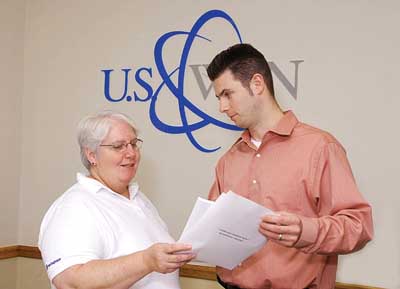
2. Cheryl L. Boggess and Matthew Kelley discuss an ongoing materials aging management project. The project meeting just happened to be in the Women in Nuclear Conference Room at the Westinghouse headquarters in Monroeville, Pennsylvania. Courtesy: Westinghouse
All the recent studies indicate that the most desirable young employees these days expect and thrive on change. Consequently, they are likely to prefer employers that offer ongoing opportunities for training and job variety over those looking to permanently fill a hole on today’s organization chart. As Boggess, a Westinghouse senior project manager and principal engineer, put it, "My personal opinion is that you can’t put someone in a cubby hole and not let them out." She thinks that utilities operating all types of plants are moving toward having their staffs "interact on a broader level" across the organization.
Boggess’s own career has afforded her a great deal of flexibility. Her experience has included integrated design, physical hardware, purchasing, project planning, participation in getting ASME code cases through the system, and work with the Nuclear Regulatory Commission. A broad canvas appeals to her, which is why, if she were choosing between the vendor and the utility/plant routes today, she’d choose the corporate route, because it appeals more to her personality.
Though she works on the vendor side, Boggess has spent a great deal of time on plant sites. She was at Byron Nuclear Generating Station for the build and was responsible for routing pipe. In Taiwan she was the Westinghouse representative for piping and stress analysis hot functional testing at Maanshan Nuclear Power Station. And in her role supporting the fleet she has "taken calls on every holiday and every day of the week to support at-the-plant issues."
Beyond her involvement in Women in Nuclear Global, Boggess spends considerable time encouraging young people — including those in her own family — to consider a career in power generation. "I think we haven’t been effective at reaching talented women, for a multitude of reasons," she said before noting, "Westinghouse has some programs that are really good." Those efforts include on-site exposure to a variety of work environments for elementary, middle, and high school, and university students. A specific focus is on high school sophomores and juniors. For college career decision-making, that’s a critical age group; typical freshmen are too unfocused and unable to grasp some of the concepts the company wants to share, and seniors have usually chosen a path.
To help high schoolers focus without "distractions," Westinghouse high school programs train boys and girls separately. "If I’m going to engage a female in looking [at career options] and saying, ‘I do like science. I do like math. I’m not a geek,’ " then, she said, "don’t mix [boys and girls]" at that age. Westinghouse also works with Girl Scouts, which now has an energy badge.
The final piece of advice Boggess offered: "The biggest thing… is that you need to have a growth mentality — not just raw talent. You’ve got to be willing to grow — wherever you are." Though she has enjoyed her 28-year career, she said, "I think I’m peaking now [at 52]," whereas men are viewed as peaking in their forties. People are working longer because they want to."
Leveraging women’s strengths
Sharon Pfeuffer (Figure 3), director of downriver plants for DTE Energy, has a staff of 400 spread across three plants: Trenton Channel (a 720-MW coal plant), River Rouge (a 540-MW coal plant), and Conners Creek (a 240-MW gas-fired summer peaking plant in Detroit). "We’re definitely confronting the aging workforce issue," she said. Given Michigan’s economy, and the difficulties in the automotive sector, her company has "some slight advantage in our technical market," especially for engineers, but it is feeling the pinch with contract skilled trades.
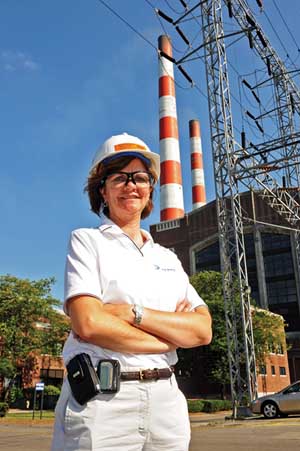
3. Sharon Pfeuffer stands in front of Trenton Channel Power Plant, one of the three for which she serves as plant director. This coal-fired plant southwest of Detroit was established in the early 1920s, and the current units were built in the 1940s (Units 7A and 8) and 1960s (Unit 9). Courtesy: DTE Energy
DTE’s efforts to address the challenge include conducting workforce planning studies and trying to get more proactive in hiring, especially for operator positions, which require longer-term training or retraining. As for hiring women, DTE "has targets and goals around diversity" and is "working to understand what it takes to attract and retain a diverse workforce."
Pfeuffer thinks that as "part of the greater societal shift," in the past few decades, it’s "been more socially acceptable" for women to pursue careers in the power generation industry. She had an older sister who was an engineer, and her own interest in a technical career was sparked by a research project she did early in high school, when a teacher pointed her toward engineering and she visited a friend’s father, who worked for DTE at Conners Creek Power Plant. While she was at the University of Michigan, however, she was a "chemical engineering generalist."
After graduating, it was coincidental, she said, that she got a job offer from Wisconsin Electric, where she worked for three years in water chemistry and environmental projects. Then she married and went to work for Florida Power & Light (FPL) for 13 years at the Fort Myers plant. FPL "didn’t limit your career path based on what your specific degree was," she explained. That openness to flexibility enabled her to hold "a wide variety of jobs from plant performance engineer to business leader of the power plant" when it transitioned from an oil-fired to a gas-fired combined-cycle repowered unit. "Repowering a plant was a pretty exciting and challenging project."
Pfeuffer, who returned to Michigan when she saw opportunities with DTE, said, "I really love this work…. Power plants get in your blood." She likes the type of people who work in plants and the complexity of the work. "It’s always a challenge. It’s not easy work. It’s complicated…. You can never know everything," which appeals to her. The downside is that "it can include long, variable hours, and is sometimes a hot, dirty, stressful environment."
Pfeuffer would encourage both women and men to enter this industry but cautions that "a two-career family can face challenges in this job." Plant leaders with families need a support system to help them deal with the inevitable overtime and emergency situations. Nevertheless, "There are a lot of us who enjoy the intensity of a plant environment." Pfeuffer, who has also held "central engineering jobs" is always ready to go back to the plant.
The fact that there were few women in the plant when she began her career "was difficult," she said. She started at FPL while it was beginning to grapple with EEOC [Equal Employment Opportunity Commission]/Hostile Work Environment policies. There was "no peer support network of women. There was some mild level of… discrimination…. There were different battles to be fought back then." The plant management was all male, there were still posters and calendars up that could make the environment uncomfortable, and not everyone was comfortable with having women in the power plant. There were, for example, no women operators and no women in the trades in the late 1980s at Ft. Myers. And, because it takes time to advance to management positions, there are few women in senior positions even today. Pfeuffer noted that at one recent industry gathering of 55 plant managers, only one was a woman.
Pfeuffer had the support of many male colleagues, and she had some good bosses and some bad ones, but "there wasn’t always a helping hand stretched out; there was a lot I had to figure out on my own." Would the existence of a professional group for women in fossil-fueled generation have helped? "Yes, definitely," she answered, because even finding a support network within one’s own organization can be difficult. "It’s nice to have people to share experiences and ideas with."
How has her own experience of going it alone shaped how she interacts with others? "I’ve tried to fill that role for other women and men. I’ve listened to their challenges, shared my experiences, and tried to make it easier for the next generation."
Pfeuffer would encourage women to consider a power plant career because "it’s exciting work, with good pay and benefits, and a good future outlook for jobs. They shouldn’t let the stereotypes, or the fact that it’s been a very male-dominated industry in the past, deter them. It’s a great job."
As Pfeuffer moved into management positions, she learned that the differences between men’s and women’s leadership styles are "not a bad thing. For me, women’s leadership styles in general in the plant tend to be less hierarchical. I rely often on intuition and empathy."
Her advice to utilities needing to recruit women or men: Bring in a diverse workforce and work to embrace those differences.
A perspective from the head of the table

4. Connie Lau
Connie Lau (Figure 4) is chairman of the board of Hawaiian Electric Co. as well as president and CEO of its parent company, Hawaiian Electric Industries. She is one of only 20 female chief executives of Fortune 1,000 companies and one of 14 women leading a U.S. electric utility. Here’s how she responded to questions from POWER.
How would you describe the value of having women in power plant positions — other than the obvious value of their technical skills?
What’s nice about gender diversity is that women can bring different communication styles, interests, and perspectives that encourage different approaches to problem solving.
What is your company doing to make plant operation and maintenance career paths more visible to women?
We focus on making sure recruitment is broad enough so that women are in the applicant pool to compete for these and other positions.
This includes detailed steps such as:
-
Reviewing position descriptions to ensure that the experience and other qualifications stated are free of inadvertent bias, thereby establishing a consistent standard for selection among all candidates for employment or promotion.
-
Posting positions internally, so employees — women included — are informed of opportunities and are allowed to compete. Departments select the best-qualified person, which may be a woman.
-
In succession planning, our Human Resources area will question when women candidates might be missing.
-
For our union positions, we typically hire at the entry level, so it is important that our external recruitment includes women. If selected, they can move up the lines of progression to positions of greater responsibility and pay.
In addition, we have many outreach partnerships that help bring women into the mix of possible candidates for jobs throughout our organization, including:
-
Partnerships with community colleges: For example, we’ve joined with one community college to establish a control operator training program. Hawaiian Electric employees are instructors, so we get to preview potential employees, including women.
-
Internships: We have a successful internship program for areas throughout the organization. Of our current crop of interns, nine of the 24 interns are women, working in engineering, finance, and human resources. Three of the women engineers worked in Power Supply and two in our Energy Delivery (Transmission and Distribution) area.
-
School-to-Work/Tech Prep program: This program provides high school students exposure to trades and crafts jobs.
-
Mentorship programs where our women engineers are paired with female high school seniors to encourage women to pursue careers in engineering.
-
Miscellaneous other actions such as having our women engineers as guest speakers to discuss their experiences in operations or as participants in career fairs.
What advice would you offer other utilities and power generators about the hows and whys of recruiting women for plant positions?
Provide opportunities where women can perform and the return will come. Our Human Resources area recently asked a superintendent at the power plant about the idea of having women in his operations. Frankly, he didn’t see it as a big deal. To him, it seemed like a natural thing, and his answer was along the lines of "Balanced workforce. Just like the community." Perhaps it’s because Hawaii has always had a large proportion of women in the workforce because of our high cost of living.
One thing of note: We’ve conducted focus groups in the past and the consistent message from the women who were doing well in their nontraditional jobs was they did NOT want to be singled out. They didn’t want a women’s "support" group." They had found their way into their positions through traditional hard work, and they didn’t want their success to be labeled as "because she’s a woman." They did want opportunities to be available, and then were willing to earn it. We’ve worked hard to make those opportunities equally available to men and women.
A [single] seat at the table
As planning and engineering superintendant at Hawaiian Electric Co., Inc. (HECO), Karen Mark’s responsibilities include providing technical support to all O&M groups and improving planning processes for daily maintenance and unit overhauls at three oil-fired generating stations and two diesel-fired turbines used for peaking power on the island of Oahu.
Mark (Figure 5) noted that her company (see the sidebar) is concerned about meeting the demand for qualified plant personnel as many of its workers face retirement age. Mark, who started her career on the nuclear side of the shipyard industry, switched to the utility after a few months.
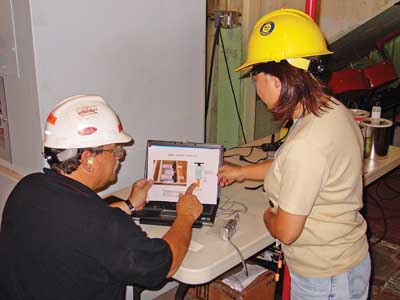
5. Planning and Engineering Superintendent Karen Mark with a generator consultant, discussing generator bushing repairs being performed on one of the Hawaiian Electric Co. generators at Waiau power plant. Courtesy: Hawaiian Electric Co., Inc.
She first got into engineering because she had "always been inquisitive about how things work" and liked math. At HECO, she started in engineering design but wanted field experience, so she transferred to plant operations in 1989 and has been happy with her career choice.
"You have everything — in terms of interacting with people (I like to interact with people), in terms of diversity and challenges in solving problems," which, she noted, run the gamut from "easy fixes" to solving mysterious equipment tripping problems. She also enjoys the opportunity to be involved in training. "For me," she says, the job "involves a lot of diversity and change," which she enjoys. "The people who like this fast-paced environment thrive in it."
HECO is typical in that women still constitute "a very small percentage" of the workforce on the generation side. At meetings, only one or two women may be sitting at a table of a dozen of so staffers.
Mark would encourage young people to consider utility work and noted that interest in renewables and emissions controls are opening up whole new fields. However, she sees a stumbling block in the absence of industry-related courses and hands-on experience in engineering programs. She also observed that the younger generations have different expectations that may not synch well with a hot, dirty environment and long hours.
Seeing is believing
Jennifer Didlo (Figure 6), president of AES Deepwater Inc., would "absolutely" encourage young people to enter the power generation industry. "They’d have their choice of where to work, because we’re so short of qualified workers," she said. She first considered the field when the utility conducted on-site interviews at her college. The promise of outdoor work and being able to "crawl around a boiler and solve problems every day" appealed to her.
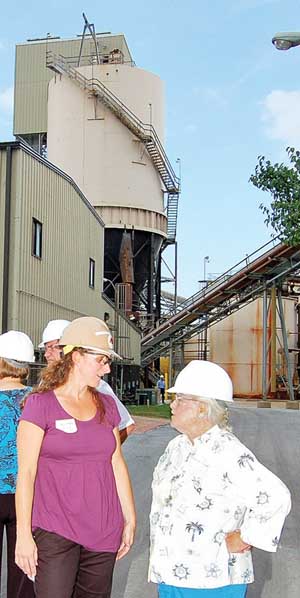
6. AES Deepwater Inc. President Jennifer Didlo (left) during a tour she conducted at the plant for the Pasadena Citizens Advisory Council on May 27, 2008. Courtesy: AES Deepwater Inc.
Though she didn’t know the percentage of women at AES in plant work and didn’t know any other female plant managers, she noted that one of the company’s four U.S. regional vice presidents is a woman. "It’s incredibly rare that I’ll go into a meeting and there’s another woman," she said before noting that it’s worth looking at how to increase the number of women in the field.
In her case, being a woman "hasn’t made a difference at all" to her career. The openness to diversity of the prevailing culture wherever one is working can have some effect on how women are perceived in the workplace, at least at first, she noted, but "It’s a matter of the individual having enough confidence to do what you should do, regardless of your gender."
Given the industry’s ratio of men to women in general and the workforce challenges generators are facing, "It does seem like we’re falling short of having available resources" and need to find a way to tap into the entire population, she suggested.
Talking about the issue also is important, she said, as are mentors. Though AES has a mentoring program, it’s not gender-specific, and Didlo said that she tends to participate in industry-specific rather than gender-specific organizations anyhow.
If younger women can see that women are doing these jobs, they’ll consider them, she explained. "It’s a perpetuating process. The more women that decide to [enter the power industry], the more women are going to see them doing it" and consequently give it consideration. Organizations like the Society of Women Engineers (SWE) can help raise the visibility of engineering careers for young women. SWE "had a pretty big influence on me when I was in college," Didlo noted.
AES, which operates 15 regulated utilities and 123 generation facilities on five continents, is developing a global plant managers’ school and team-leader qualifications. It’s also increasingly trying to recruit people with college degrees. At AES’s non-U.S. generating plants, most people have at least one college degree, whereas in the U.S., according to Didlo, "the qualifications aren’t quite as stringent."
Didlo, who has an undergraduate degree in mechanical engineering as well as a master’s in mechanical engineering, says she wishes that instead of the engineering master’s she had earned an MBA. "I haven’t used my upper-level degree," she said, though the classroom manag ement training would come in handy for anyone in today’s complex and competitive independent power producer environment.
Early exposure
Melanie Green (Figure 7) literally got into power plants as a child. Her grandfather was a dual electrical-mechanical engineer who worked in a Missouri power plant operated by St. Joseph Light & Power Co. "When I was a kid, it was always fun to go to the power plant with grandpa," she recalled. Green also worked for years in her father’s auto repair shop because "the mechanical side of things just appealed to me." Though she began college in a pre-med program, she switched to engineering after two semesters. When asked to confirm that the personal exposure to power plant work was instrumental in her career choice, Green said, "I think that’s key."
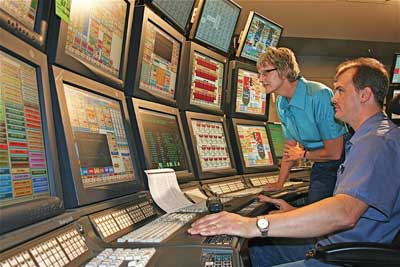
7. Plant Manager Melanie Green and Control Room Operator Richard Hernandez looking at control graphics and alarm history for J.T. Deely Unit 2. Courtesy: CPS Energy
Green, who has participated in numerous career days over the years and has done some mentoring, notes that most people have no idea where power comes from, so nobody considers it as a career. What’s more, "as an industry, we’ve tended to be rather low-key." However, she added, "I can’t think of a soul I’ve ever seen come into a power plant for a tour that didn’t walk out and just go, ‘Wow, I had no idea what it took to make electricity!’ "
Even in engineering school, there’s little exposure to power engineering beyond basic thermodynamics, fluids, and mechanical engineering. Green was lucky to take a power plant design class at the University of Missouri. The instructor was an engineer who worked for a large architectural engineering firm and periodically took a sabbatical to teach a power plant design course. But she noted that few schools offer any sort of power engineering course, so lack of awareness about the career, for both men and women, is a major problem.
When she began her career in the late ’70s, Green was the only woman on the project. "Most of the places I’ve worked, I’ve been the only woman engineer on site," she said. The gender balance hasn’t shifted much in three decades. The Fossil Division of CPS Energy runs an internship program that brings in engineering students for summer work. This year there’s one women in the group of eight, Green said. Nevertheless, she hasn’t felt that being a woman was a disadvantage.
Green started her career with a power plant construction and start-up project at a fossil-fueled plant in Texas. Then she spent a few years in the nuclear arena before returning to fossil-fueled generation, spent a couple of years in Alaska (working with another interviewee, Kate Lamal), moved back to her home state of Missouri, and eventually returned to Texas. Today, as plant manager, she’s responsible for about 150 staff in operations and maintenance at two CPS Energy plants in San Antonio, Texas: the conventional gas-fired two-unit O.W. Sommers Plant and the two-unit Powder River Basin coal-fired J.T. Deely Plant.
Though her tone of voice and easy laughter answered the question before I asked it, I asked anyway if she enjoys her career. "Love it," she confirmed. "Wouldn’t trade it for the world." She encourages young people to find something they enjoy doing — whatever it is. "I’m so blessed that I’m doing something that I really enjoy," she said. "It’s always exciting. It’s always different." As for encouraging women to enter this particular industry, she responded: "I wouldn’t discourage them," but "it is different. [If you’re in a plant,] your life revolves around a generator breaker."
Green doesn’t miss the absence of a "Women in Fossil-Fueled Generation" group. "I’m an engineer," she said, laughing. "I don’t really consider myself a ‘woman’ engineer."
A different way of thinking
You’ve heard of fuel-switching in power plants, but you may be less familiar with career-switching. After Kate Lamal (Figure 8) earned a master’s in geology in the early ’80s, she moved to Alaska to work in an underground gold mine in the Brooks Range. When the bottom dropped out of the metals market, she worked in the business of cleaning up contaminants. She transitioned from that work into an environmental permitting job with Golden Valley Electric Association (GVEA) in Fairbanks, Alaska, in the early ’90s.

8. Kate Lamal, standing by an emergency diesel engine. Courtesy: Golden Valley Electric Association
Now, as VP for power supply, Lamal spends about 80% of her time in a corporate office and 20% in plants. She is responsible for all GVEA power plants as well as the utility’s dispatch and SCADA system and fuel purchases. (GVEA uses coal, oil, and naptha in its plants; purchases power generated by gas; and is part owner of a hydro facility.)
Though her path to power plant work may be atypical, Lamal explained how her background in geology has been useful in her second career: "The training that I received as a geologist, the thought process that you are taught as a scientist — which is to look at facts, form a hypothesis, gather more facts, test the hypothesis, and continually modify — that type of thought process… is very very helpful in analyzing situations."
Whereas engineers tend to be linear thinkers, the recursive process of scientific study and thinking allows Lamal to be a "flexible" thinker — something that’s "very important for upper-level management. In Alaska," she added, "that [flexibility] is so important because we’re in the midst of such a severe energy crisis… plus the fact that we burn oil…. We’re pushing very hard to reduce our cost of fuel and electricity." (Many people in the interior of the state rely on oil for transportation, home heating, and electricity.)
As power generators everywhere face new challenges in the coming years, they may find that individuals with nonstandard but complementary education and career profiles could be just the types of problem-solvers they need, if they are willing to train new employees — even those in upper-level positions.
Only four of GVEA’s almost 120 union employees are women, and they have office or janitorial jobs. Lamal said she "would very much encourage" young people, including women, to enter the power industry, especially because the industry needs "creative thinkers… good negotiators, communicators to help the public understand what’s going on" — particularly with regard to the limits of currently available renewable energy options.
GVEA has had no trouble filling positions with very good people because, Lamal said, it’s a union employer and has excellent training and safety records plus apprentice programs run through the unions. Power plant jobs in Alaska are "fairly desirable" because, compared with many other union positions in the construction and oil and gas industry, they enable people to live and work at home rather than traveling great distances to field jobs.
Lamal’s advice to generators that may be facing workforce shortages is to "make the plants safe and keep them clean. Give your workers good tools to use, because they’re going to be your best marketers."
Reevaluate your assumptions
Cheryl Bucar (Figure 9), who was promoted last year to director of regional operations at BC Hydro, has held senior management positions on both the corporate and plant sides of the Canadian company’s generation and power supply business. When she started working in the field in 2000, running a small coastal group of hydro plants, she was the only woman at any of BC Hydro’s generation/power supply facility meeting tables. Until 2005, she was the only female plant manager.

9. Cheryl Bucar (eighth from the left, middle row) with her crew at the Mica Creek Generating Station, which includes a 1,804-MW hydro electric facility, the third-largest embankment dam in North America, and a 110-bed camp. At this plant’s remote site—950 miles north of Revelstoke, British Columbia, the closest town—the generation of hydro electricity on the Columbia River begins. Courtesy: BC Hydro
Prior to her current position, Bucar was area manager for Vancouver Island. Last summer she was given the developmental opportunity to cover for the director of northern operations. That six-week substitute stint "was really fun" and included overseeing the largest hydro facility in the company’s system: the W.A.C. Bennett Dam and 2,500-MW G.M. Shrum Generating Station. Today Bucar is responsible for a $42 million operating budget, several hundred million dollars in capital investment work, and just under 300 crew and staff who maintain 57 units at 28 hydro facilities.
Oh, and did I mention that Bucar doesn’t have an engineering degree? Probably the most important lesson that can be learned from Bucar’s career is that great power plant managers don’t need to have a technical background. In fact, not being an engineer has given her a demonstrable advantage.
Bucar holds undergraduate and graduate business degrees, a graduate degree in sociology (in "formal complex organizations"), and is working on a doctorate in management. She got her start in the industry developing leadership programs when she was hired as the head of strategic human resources at the time when BC Hydro was reorganizing and deregulating. The senior VP of the generation unit who hired her, now-retired Don Swoboda, became her mentor and was instrumental in charting a new course for a more diverse demographic in all positions at the utility.
Swoboda asked Bucar, "What’s it going to take to get more women in the field?" Bucar ran the numbers and determined that making a profound change within a decade would require laying off about 100 men and replacing them with women.
That wasn’t a viable approach, so instead, when there was an opening, the company made a conscious effort to "look at alternatives," especially women. The baseline for all candidates was that they be capable and competent, but where a male and a female applicant had equal qualifications, the position usually went to the woman. Today, Bucar guesses that BC Hydro has more female power plant managers than anywhere else in Canada — and maybe North America.
According to Bucar, BC Hydro doesn’t have a quota system; rather, its hiring policy is guided more by an understanding that "great leadership is key," and the company has experienced the benefits of having women in leadership positions.
The women aren’t any less competent and, in fact, as Bucar put it, "having a female in power plant situations, and leading predominantly male crews, changes the dynamic in a really positive way. It changes the energy that you get in the crew room."
For example, "Women are more collaborative and will deal with conflict in a way that allows conversation in a crew room to take place in a nonthreatening way." What that means is that problems and conflicts get resolved faster, on site, resulting in "a more positive, engaged crew."
When Bucar wanted to move from a corporate position to the line organization, she did undergo some technical training before taking the reins of a plant. She said that with that first plant management assignment, "I had the time of my life…. I just really found my calling. I’ve always loved people [and] I love business planning and execution. Running a plant is all about the people, the investment in the equipment, and getting the maintenance done. It was the skills that I had that were very transferable that helped me to be successful." Though she didn’t try to tell the technical staff how to do their jobs, she built great teams with those who had those skills.
What Bucar and her colleagues have seen is that women’s "social intelligence" (different from emotional intelligence) enables them to build relationships in a much quicker, different, and competent way than is typical with men. That ability is especially important these days, she said, as her company manages four generations of workers whose after-hours interests have expanded far beyond gathering with the guys on the golf course or in the bar.
"Women are more successful at building relationships with people where they’re at," she explained. Though she sees younger men showing more emotion and a tendency to be more adept at relationship building, women still have the competitive advantage, she thinks, perhaps because women have been doing social networking and building relationships for a long time.
Because she was the first woman in their shoes, Bucar is "pretty passionate about" mentoring women working in the field, even though BC Hydro does not have a formal mentoring program. As was her mentor, Bucar is a firm believer in the importance of leadership and people development and pointed out that running power plants isn’t just about generating megawatts. "We need technical expertise, but what we witnessed was that we didn’t have great leaders [in the engineering ranks]."
Her advice: "What utilities need is to get out of the paradigm that an engineer has to run a power plant."
—Gail Reitenbach, POWER’s managing editor, usually focuses on the editorial, production, and project management aspects of the magazine. Though her degrees are in English, she has worked in the energy industry for nearly a decade and is one of the rare nonemployees who has seen the inside of a coal-fired power plant.