Information technology (IT) projects foster organizational productivity and growth by improving business processes and enabling the development of new products and services. Surprisingly, given the diversity of project types, most project failures have common causes that can be attributed to inadequate planning. Management Concepts Inc. has identified five "deadly sins" that increase the likelihood of an IT project collapsing before it bears mature fruit. Fortunately, these causes of failure can be avoided by holding a facilitated project kickoff workshop (see below) that’s designed to keep projects aligned and organizational goals supported.
Why projects go wrong
According to a 2004 survey of a decade’s worth of IT projects at U.S. companies conducted by Standish Group International Inc., 18% of projects failed, 53% were over time or over budget, and only 29% succeeded. The survey found that one of the primary reasons for the low success rate is that many projects are launched without serious planning. To establish the foundation for flawless project execution and to maximize a project’s eventual value, avoid committing the following deadly sins of project start-ups.
Failure to review and incorporate lessons learned. "It’s hard to convince staff of the value of this review," says Jim Furfari, project leader in the Enterprise Project Office of Colorado Springs Utilities (CSU). "They think that because they’ve already captured core knowledge from one or more previous projects, there’s no need to record it. Yet, another employee working on a similar project might not know that just the right information exists to help solve a problem."
Because reviewing lessons learned takes lots of time, Furfari’s organization is adding a database of them to CSU’s suite of portfolio tracking tools. Historically, as a routine project management procedure, CSU used a form to list lessons learned when closing out a project’s paperwork. But managers of more recent projects told Furfari that they simply don’t have the time to scan volumes of paper in search of applicable lessons. Switching to a computerized, searchable database is expected to save considerable time and avoid missed opportunities.
Failure to create a project charter. Without a charter that clearly defines the scope and business purpose of a project (see table), its manager has no chance of accurately estimating its time or cost. Furfari stresses that it’s important for all project staff—not just the manager—to understand the business expectations of a project; anyone not in the loop will have "ownership issues," he says. Accordingly, Furfari suggests that all stakeholders and sponsors of a project participate not just in the creation of its charter but also in the presentation of its funding proposal to top management.
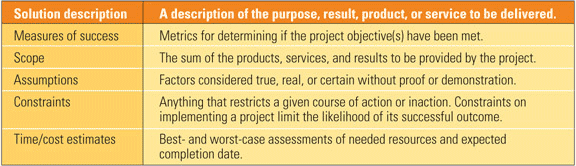
Essential ingredients of a project charter. Source: Descriptions adapted from Project Management Institute, A Guide to the Project Management Body of Knowledge, 3rd ed. (Newtown Square, Pa., 2004).
Failure to conduct a formal project kickoff workshop. A project kickoff workshop brings together all stakeholders to clarify the project’s objectives and scope. It should be conducted after the organization has made the decision to invest in the project, based on information presented when the business case is made (Figure 1).

1. Start on the right foot. A typical sequence of IT project planning and execution milestones. Source: Management Concepts Inc.
According to Furfari, if you skip a formal kickoff, you risk having someone who should know about a project be unaware of its existence. For example, if a facilities construction project and an IT project are under way at the same time, the managers of both projects should be informed about potential cross-impacts. Holding a workshop to formally kick off each project will ensure that everyone is appropriately informed.
Failure to establish a core team. A project’s core team should include one or more full-time, experienced IT professionals as well as multiskilled subject matter experts. A typical core team would comprise a project manager, a business visionary, a system engineer/technical lead, and a business analyst. One of the key decisions made by the team is determining when additional expertise is needed. The core team’s initial responsibilities are to conduct the project’s feasibility study and to prepare its business case.
After the project is approved, the core team conducts the project kickoff workshop and begins detailed planning. The Enterprise Project Office at Colorado Springs Utilities learned first-hand the benefits of including the project’s manager on its core team. "In one case, the project manager contributed some valuable understanding of some early design considerations. By insisting that they be funded, he improved the fit of the project in our overall infrastructure," says Furfari. "Another benefit is obvious: Once the project is approved, the project manager can hit the ground running." Figure 2 depicts a traditional project team structure, whereas Figure 3 illustrates the core team structure.
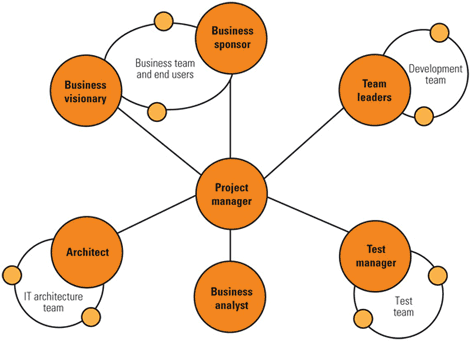
2. Old school. A traditional project team. Source: Management Concepts Inc.
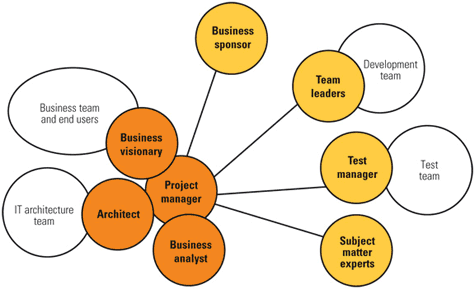
3. Latest and greatest. The core project team (in orange) concept in practice. Source: Management Concepts Inc.
Failure to involve management. Just as the stars of winning professional sports teams rely heavily on a coach for strategy and tactics, core project teams need the help of a project sponsor. The sponsor serves as the voice of the management team and keeps the project focused on strategic imperatives. Ideally, the project sponsor would be located just down the hall from the core team’s work room and be available 24/7 to remove barriers that might slow progress.
If any of these five deadly sins is committed, a project is at risk of being late, over budget, or undelivered. The work may also be incomplete, fail to meet requirements or expectations, fail to deliver expected benefits or return on investment (ROI), or all of the above. Several steps can be taken, however, to avoid these sins and improve a project’s odds of being successful.
Critical success factors
One such step has already been discussed: Establish a core project team of four to six staff members with the needed expertise. The team should be capable of breaking down even a large, complex IT project into manageable, incremental deliverables. It is crucial to physically colocate the core team so that its members can work together on the project 100% of the time and avoid wasting precious time on travel and logistics. The project sponsor also should be available to resolve issues quickly and maintain momentum.
A second critical step toward success would be to set up a project management office to cultivate "strategic" projects. The management office would differentiate truly strategic projects from merely discretionary ones by using a solid portfolio management process to select and fund the projects it deems most valuable to the organization. Utilities are no different than other large enterprises in this respect: Their IT shops can be paralyzed by too many projects competing for too few resources.
A third way to improve the prospects of a project—before its launch—is to conduct a feasibility study to determine if it indeed is the best means toward a desired end. Such a study can steer investment toward the best alternatives to take advantage of a new business opportunity. It also would educate owners and operators of business processes about the relative risks and rewards they may experience as a result of the change initiative that the project represents.
Because implementation of any of these measures may change the current business environment, some resistance among stakeholders is to be expected. Executives are used to making decisions that benefit their own areas of responsibility, as opposed to the entire enterprise. Unless self-serving attitudes and management practices change, organizations will continue to invest millions of dollars in projects that offer no way to measure ROI.
The facilitated project kickoff workshop
A facilitated project kickoff workshop is a strategic tool that enables organizations to quickly and successfully plan and launch a project. The workshop is a facilitated meeting in which key stakeholders and decision-makers meet to define critical aspects of the project. The purposes of the workshop are to:
- Formally launch the project to build a common understanding of its definition, scope, and approach.
- Obtain stakeholder buy-in on the project’s objectives and scope.
- Determine ways to measure success.
- Build a strong project team with a common vision.
- Finalize and present the project baseline in the form of a charter and related documentation for approval to move forward with the project.
Participants in the workshop include the project manager, technical and business subject matter experts, and key stakeholders from groups or organizations involved in or impacted by the project. The purpose of the workshop is to make key decisions about the project structure, so it is essential that participants are empowered to make decisions for their organizations. Additionally, there should be at least one facilitator and one master scheduler who fully understand the initiation and planning processes. The facilitator/scheduler team will conduct the kickoff workshop to complete the initiation process and then hold small-group, facilitated sessions to complete the planning process.
Typically, the workshop is held at an off-site facility to minimize distractions. Depending on the size and scope of the project, the workshop may be held over a period of one to three days. During the workshop, participants engage in activities geared toward creating, organizing, and revising critical project information that will be captured in the project charter and project management plan. Thus, the project manager is able to quickly define the full project scope and create a charter document with the consensus of the key stakeholders. This charter document then serves as an agreement or contract among the project team, the project sponsor, and key project stakeholders, thereby providing a strong foundation on which to begin planning project details.
It’s a process, not an event
Launching a project successfully begins with the basics. Bring the core team together to break down the project requirements into manageable releases. Most important, let the team determine how to structure the project (that is, choose between Figures 2 and 3). Don’t expect to launch a large, complex project with everyone in agreement and running all operations full steam ahead from day one. Instead, let the core project team work on the first component of the total solution, implement it, obtain feedback, make changes, and then move on to the next component.
By taking this step-wise approach, a team can deliver value to the organization quickly, employees are more likely to accept change, and costs can be held to a minimum as the project builds incrementally. Avoiding the five deadly sins by doing their opposite makes it much more likely that a project will meet its organizational goals.
—Kathleen Hass, PMP, leads the project management practice of Management Concepts Inc. She can be reached at 703-790-9595 or via www.managementconcepts.com.