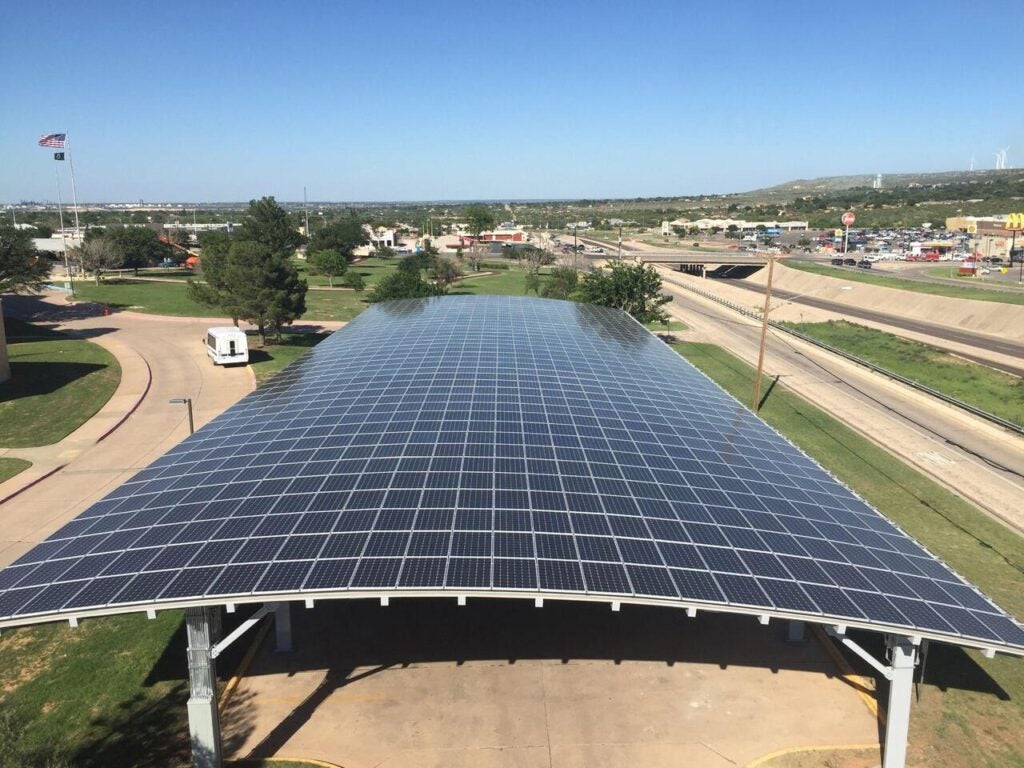
For decades, the solar energy industry has struggled to become cost-competitive with other sources of power generation. Recent technology innovations and creative ways of installing solar generation are beginning to enable solar power to increase its share of the electricity market.
Solar energy is everywhere, yet its use for electricity production remains a faint sliver in the pie that represents total U.S. power generation.
The U.S. Department of Energy’s Energy Information Administration, using data compiled in 2007, shows that 3.1% of the country’s electricity was derived from all forms of renewables. Less than one-third of that amount — less than 1% of the current U.S. generation mix — comes from solar sources, according to the Solar Energy Industries Association (SEIA), a U.S.-based organization dedicated to promoting solar energy technologies.
However, the deployment of solar energy has been increasing rapidly since 2005 in the form of utility-scale photovoltaic (PV) plants and different forms of concentrating solar power (CSP) systems.
To learn what’s hot in solar power, in October, POWER interviewed representatives from two leading solar energy trade associations, two national laboratories, two solar energy technology manufacturers, a software manufacturer, and a national law firm.
The Contenders: Concentrating Solar Power and Photovoltaics
For background, here’s a brief review of the available options for generating power from sunlight. They fall into one of two categories: using solar energy indirectly (CSP) or directly (PV).
Concentrating Solar Power. CSP plants are utility-scale generators that produce electricity by using mirrors or lenses to efficiently concentrate the sun’s energy. CSP, or solar thermal technologies (see our August 2006 issue, p. 84 or http://tinyurl.com/yew4692 for technical descriptions of the different CSP technologies) include the following:
-
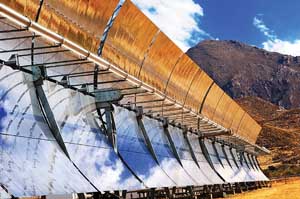
Parabolic trough systems use parabolic curved, trough-shaped reflectors to focus the sun’s energy onto a receiver pipe running at the focal point of the reflector (Figure 1). Because of their parabolic shape, troughs can focus the sun’s energy at 30 to 60 times its normal intensity on the receiver pipe. This concentrated energy heats a heat transfer fluid in the pipe that is then used to generate steam to power a turbine, which in turn drives a generator.
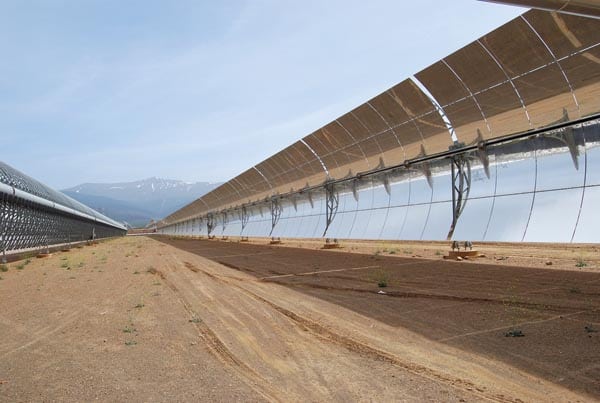
1. Enjoying its place in the sun. Increasing in popularity, the parabolic trough is a long, trough-shaped reflector that uses pipes containing clear oil that absorbs heat reflected from the trough. Heat from the oil flows through a heat exchanger to heat water to make steam for electricity generation. This parabolic trough is being used at solar power station in Adasol, Spain. Courtesy: Solar Electric Power Association
-
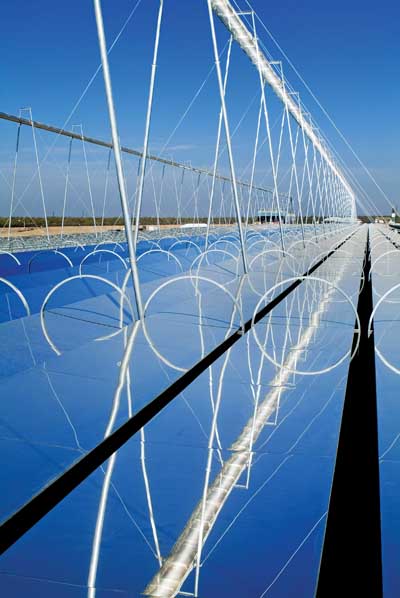
Power tower systems use a field of computer-controlled flat mirrors, called heliostats, to focus solar energy on a central collector tower (Figure 2). The energy at this point can be used to heat water to produce steam (and run a central generator), or it can be transferred to a heat transfer material (typically, liquid sodium), which can then store the heat for later use.
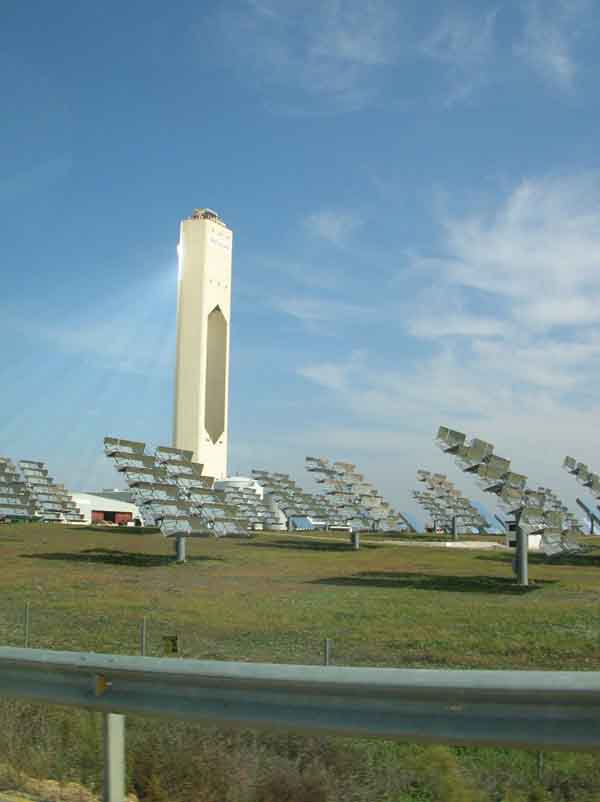
2. Shedding light on power towers. Central receiving towers, often referred to as power towers, are tall structures with a boiler on top that contains water. Surrounding the tower are many rows of mirrors called heliostats, which turn to face the sun and focus the reflected sunlight on the boiler throughout the day in order to heat the boiler to create steam. The tower shown was manufactured by Abengoa Solar. Courtesy: Solar Electric Power Association -
Compact linear Fresnel reflectors use flat reflectors moving on a single axis while using a Fresnel lens to concentrate the solar thermal energy onto collectors. The flat mirrors used in this system allow for a greater density of reflectors in the array, increasing the efficiency of land use.
-
Dish systems use a large concave dish to track the sun and focus its energy onto a high-efficiency power conversion unit (a heat engine that is sometimes referred to as a Stirling engine), which generates electricity directly. Dish systems typically produce upward of 25 kW.
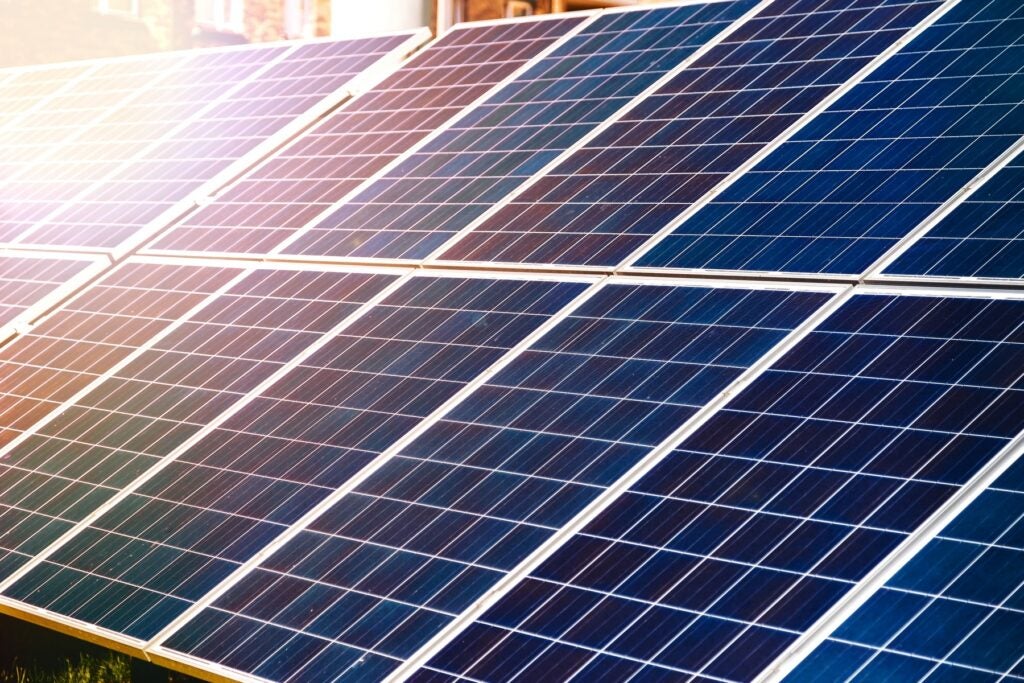
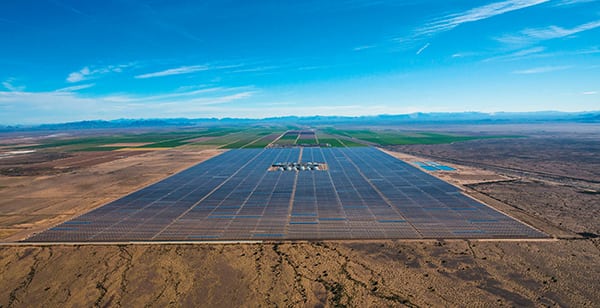
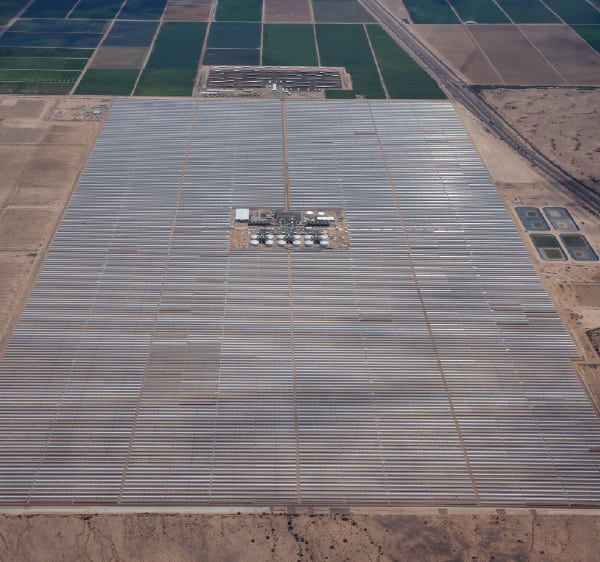
Photovoltaics. In contrast to CSP, which is only viable financially on a larger scale, PV technology can produce electricity at just about any scale (Figure 3). PV devices generate electricity directly from sunlight via an electronic process that occurs naturally in certain types of semiconductor materials. Electrons in these materials are freed by solar energy and can be induced to travel through an electrical circuit, powering electrical devices or sending electricity to the grid. PV devices can be used to power anything from small electronics to homes and businesses or utility-scale solar power facilities.
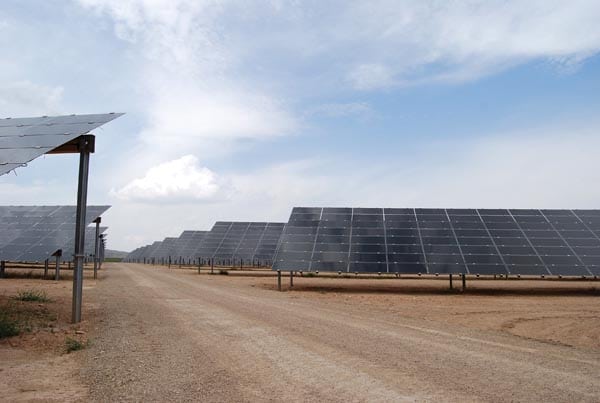
3. With solar energy, the sky’s the limit. These photovoltaic arrays are located at a solar power facility in Spain and were manufactured by First Solar. Courtesy: Solar Electric Power Association
Most modern solar cells are made from either crystalline silicon or thin-film semiconductor material. Silicon cells are more efficient at converting sunlight to electricity, but they generally have higher manufacturing costs. Thin-film materials typically have lower efficiencies, but are simpler and less costly to manufacture.
Recent CSP Technology Innovations
One way or another, recent improvements to CSP technologies improve efficiency or system economics.
Chuck Kutscher, PhD, PE is the principal engineer/group manager of the thermal systems, electricity, resources, and building integration division at the National Renewable Energy Laboratory (NREL), which has been involved in several recent projects. "NREL worked with Acciona (the Spanish company that develops renewable energy projects) to help test parabolic troughs that employ a new all-aluminum space frame support structure," he said. "These collectors are operating successfully at the 64-MW Nevada One Solar plant near Las Vegas. NREL works with a variety of manufacturers to test the shape accuracy and reflective properties of their reflectors."
NREL also partnered with industry to develop ReflecTech, a polymer reflector film that can be applied to an aluminum substrate that is more lightweight and less expensive than glass mirrors. The film is being used by SkyFuel to produce a lighter-weight parabolic trough collector, the SkyTrough.
"We also have focused our efforts on improved receiver tubes," Kutscher said. "We test manufacturers’ receivers in the laboratory to measure their heat loss. We also developed and transferred to industry a system that uses an infrared camera to rapidly assess which receivers in a field may suffer from loss of vacuum with attendant increases in heat loss. In addition, we are developing a new ‘Distant Observer’ capability that will use a camera mounted on an aerial platform such as on a blimp to observe an entire collector field, either an existing plant or a new plant undergoing installation, and that will quickly assess where any optical errors exist and will identify the specific source of those errors."
Two significant technical innovations over the past two decades have enabled leading solar thermal energy companies, including BrightSource Energy, to advance their technology from parabolic trough design to the more efficient and cost-effective power tower design. Keely Wachs, senior director of corporate communications at BrightSource Energy, described his company’s recent innovations:
-
The first is the creation of more-efficient steam turbines, which today can use steam that is 550C (1,022F) to 650C, enabling more efficient production of electricity.
-
The second major breakthrough is the advancement of software optimization. Progress in the software industry has made it possible to accurately track and control hundreds of thousands of heliostats.
"We have a very thoughtful commercial scaling plan in place," Wachs said. "Our Solar Energy Development Center in Israel is a 6-MW thermal facility and our first plant to use the Luz Power Tower. Consisting of approximately 1,700 heliostats and a 200-foot tower, the facility has been operating for more than a year now and is consistently producing the world’s highest temperature steam from solar energy, as evaluated by an independent engineering firm."
Describing his company’s recent innovations, Robert Rogan, senior vice president, Americas, talked about eSolar’s development of advanced, proprietary sun-tracking algorithms. "This marks a pivotal technological innovation in the concentrating solar thermal power industry and forms the foundation for our competitive advantage," he said. "Noting the computing inefficiencies inherent in other CSP plants, eSolar leveraged Moore’s Law to create a dual-axis tracking system capable of efficiently controlling a large number of smaller, less costly heliostats. Our tracking system follows both the horizontal and vertical movement of the sun, using cameras to calibrate the mirrors and effectively concentrate the sun’s heat on the central towers. Previously, CSP plants were limited in how many heliostats they could control. Our company has overcome this limitation, which enabled the use of smaller heliostats on smaller parcels of land. Our heliostats are uniquely small and flat."
Recent PV Innovations
Several researchers around the world are developing and testing different materials, including polymers, for use in the direct conversion of sunlight to electricity (see p. 11 of our June 2009 issue or http://tinyurl.com/yftsfm6). For example, NREL has a team that conducts research in semicondutor materials, device properties, and fabrication processes to improve the efficiency, stability, and cost of PV solar energy conversion. Among its many accomplishments, the NREL team recently achieved a record efficiency for p-wafer silicon heterojunction solar cells with a confirmed efficiency of 18.2%.
"As far as I am aware, currently, most of the largest commercial or utility-scale PV thin film deployments use cadmium telluride (CdTe) technology," Mahesh Kailasam, PhD, the industry lead – energy with software company SIMULIA, Dassault Systemes, told us. As an example, he gave Germany’s 40-MW Waldpolenz Solar Park, the world’s largest thin-film PV power system. (Sempra Energy plans to eclipse that record with a future, 50-MW expansion of its 10-MW El Dorado Energy solar installation. "However," Kailasam added, copper indium gallium selenide (CIGS) thin film technology has also been commercialized enough that it will be available to be used by utilities in the near future."
CIGS solar cells are not as efficient as crystalline silicon solar cells, but they are cheaper due to much lower material and fabrication costs, which would make CIGS thin film technology more affordable for commercial use.
The Perennial Goals: Lower Cost, Increased Efficiency
NREL’s Kutscher explained his lab’s admittedly ambitious goal of greatly reducing the cost of solar energy: "Our goal is to lower the levelized cost of electricity from parabolic trough plants from today’s value of about 14 cents per kWh to 7 to 10 cents per kWh by 2015," he said. "Manufacturers have not stated specific cost reduction goals. However, they are looking at ways to reduce the cost of the reflectors, support structure, receivers, and drive systems so that they can sell more products or systems in an increasingly competitive market."
BrightSource’s Wachs agreed with Kutscher’s conclusions that the goal of all CSP solar technology providers must be to drive down the levelized cost of electricity. There will no doubt be cost reductions through construction and operations efforts, but the single greatest driver of cost reductions is efficiency. Looking at the history of solar thermal power plant performance, cost reductions come largely from incremental efficiency gains, he explained.
"For example, by using proprietary software to track the sun and control thousands of heliostats, we are able to effectively reflect and manage the sun’s heat on a boiler atop a tower," he explained. "This direct solar-to-steam approach allows the BrightSource LPT 550 system to reach higher temperatures and also avoid parasitic losses endemic in parabolic trough plants, which use a transfer fluid to create steam."
SIMULIA’s Kailasam noted that the main goal for PV researchers and manufacturers too is increasing efficiency of the systems while keeping manufacturing costs as low as possible. "From a technology point of view, this means continuing to develop various thin film technologies such as amorphous silicon, cadmium telluride, copper indium gallium selenide or even organic solar cells in a cost-effective manner while also looking at multifunction PV cells to provide far greater efficiency than is currently possible," he said.
Another approach to improving efficiency and keeping costs down is to use concentrating PV, which reduces the number of PV cells needed. However, this requires additional costs for the tracking equipment, Kailasam explained. In addition, he pointed out that there are some efforts under way to improve the efficiency of multicrystalline silicon cells that could open up opportunities for more traditional solar cells.
Thomas R. Mancini, CSP program manager at Sandia National Laboratories, addressed another challenge that national laboratories and private companies face in testing innovative solar technologies: "The primary barrier to deploying power tower technology today is securing the investment required to build the plants," he said. "Of course, this is the case for all CSP technologies, but it is even more difficult for molten salt (high-temperature) power towers because they have not been deployed before. Our focus is on helping to ‘buy down’ the perceived technical risk by working with industry to test molten salt components and materials."
Usage Trends
Sometimes, progress is measured not in terms of technology innovation but by how that technology is used, as these trends demonstrate.
Using Software to Gain an Edge. In addition to the uses of software previously mentioned, software is being used in several different ways by solar technology manufacturers. For example, according to SIMULIA’s Kailasam, the production of stable thin-film PV cells requires very good control over temperature uniformity within the glass substrates during the vacuum deposition process. The software Abaqus, which was developed by SIMULIA, is being used to simulate and optimize the effects of radiation and conduction heat transfer at a commercial-scale deposition station to ensure adequate levels of temperature uniformity that is critical for the performance of thin-film PV systems.
Using simulation software for this and other applications helps solar technology manufacturers develop superior designs and evaluate the viability of new technologies at much lower costs than would otherwise have been possible. Simulation reduces the need for physical prototypes and costly evaluation of material options or manufacturing processes.
Utilities Warm Up to Distributed Solar Generation. Transmission is probably the largest or second-largest significant hurdle to the development of solar resources, explained Jerry Bloom, head of the energy practice group at the law firm of Winston & Strawn LLP. "Simply put, there is not enough transmission capacity to move the kilowatt-hours to the load centers from large utility-scale thermal and PV plants under development or contract and proposed in the future," he said. "Getting the necessary transmission lines permitted and built is seen by many as the biggest hurdle to solar development. However, these same challenges do not exist for smaller-scale PV facilities developed in or near load centers. Examples include rooftop solar and distributed generation facilities."
Utilities are starting to recognize the potential of downsizing solar plants. "Traditionally, utilities were involved in a more passive approach, interconnecting customer-sited systems," said Mike Taylor, director of research and education at the Solar Electric Power Association (SEPA), a U.S.-based organization dedicated to the advancement of solar energy technologies. "But in the last two years, there have been a significant number of developments related to what SEPA is calling utility solar business models (USBMs). Now utilities are becoming integrally involved in reducing costs, increasing scale, expanding markets, and in the long term, the actual solar value chain."
One of the most common USBMs that is emerging is what is known as the "distributed solar power plant," he explained. The three major California investor-owned utilities, as well as Public Service Enterprise Group in New Jersey, Duke Energy in North Carolina, and other northeastern utilities, have proposed aggregated utility-owned, customer-sited, utility-side-of-the-meter distributed PV installations. Essentially, the utility owns PV systems on its customers’ roofs, but the power is sent directly to the distribution system.
For example, Southern California Edison (SCE) is implementing a new distributed solar program with its commercial customers and has PV installations online on two customers’ roofs. It seeks to have a total of four square miles of PV systems on customers’ roofs, explained Vanessa McGrady, SCE media relations director. "Currently, the customer’s rooftop in Fontana, Calif., is producing 2 MW and the customer’s rooftop in Chino, Calif., is online with 1 MW," she said. "SCE expects to install 250 MW at a rate of 50 MW per year during the next five years (2010 – 2014). Once SCE receives the California Public Utility Commission’s approval of its renewable alternative power solicitation for an additional 250 MW to be installed by independent power producers, that process will begin."
SCE’s goal is to have 500 MW generated by distributed PV installations, which would make it the largest program of this type in the U.S.
This distributed model provides scale, avoids transmission issues (because the solar generation is already grid-connected), locates generation close to load, reduces costs with scale and forward contracting, helps meet a renewable energy standard, and can be implemented more quickly than a centralized project. And because the utility owns the project, distributed PV is a "carrot" that provides a return on investment for shareholders.
From Rivals to Partners: Solar and Fossil Fuels. Solar thermal technologies can partner with natural gas to create hybrid facilities, which offer multiple benefits, including faster start-up time, reduced carbon emissions, reliable power, and a cost advantage for utility customers, BrightSource’s Wachs explained. Hybrid thermal plants can also enjoy a distinct reliability and cost advantage over other intermittent renewable resources, including PV solar and wind plants. (For examples, see "Options for Reducing a Coal-Fired Plant’s Carbon Footprint, Part II," in our July 2008 issue and "Fossil Fuels + Solar Energy = The Future of Electricity Generation" in the April 2009 issue.)
"For example, when clouds cover the sun, a PV solar field experiences a significant decrease in power output," Wachs said. "This negative spike in output creates a potential reliability challenge for utilities and grid operators that are unable to rely on this energy to meet demand. As a result, utilities are forced to back up intermittent resources with fossil-burning peaker plants that can be fired up in the event of this type of output interruption. The construction of peaker plants results in additional costs to the utility customer and greater amounts of CO 2 emissions from the peaker plants."
A hybrid solar thermal plant avoids the need for peaker back-up because it includes a conventional gas-fired boiler in its design and because the system contains an inherent form of storage created by the thermal inertia stored in the system, according to Wachs.
NREL’s Kutscher pointed out that studies have looked at using a solar collector array to inject heat into the steam cycle of a combined-cycle natural gas plant. In addition, the Electric Power Research Institute and Florida Power & Light are studying the addition of a parabolic trough collector array to a conventional coal plant to decrease the amount of coal that needs to be burned.
"Because all the power cycle equipment (boiler, turbine, condensers, etc.) already exists, the addition of solar only involves the construction of the collector array and piping. Thus, the solar cost for such a plant is significantly reduced," Kutscher said. "This cost reduction could even make solar look economically more attractive in regions of the country that do not have very clear skies and thus do not have the best solar resources needed for CSP such as direct normal, beam, or radiation."
Persistent Challenges
Although cost is the most obvious challenge to the wider deployment of solar power, that factor is intertwined with others.
Cost-Competitiveness. "California has done some work on creating a standardized process for these types of comparisons: the California Energy Commission’s draft report ‘Comparative Costs of California Central Station Electricity Generation,’ which was prepared in August," SEPA’s Taylor said. "But even within a study like this, which is very complex, solar prices have dropped much more dramatically than predicted, and on a net present value basis, both PV and CSP are cost-competitive, or nearly so, with new natural gas and nuclear facilities."
He argued that, although this development does not mean that solar can operationally replace baseload plants today, the cost of energy is converging. A lot of solar energy can be integrated into the grid without storage (see sidebar), both at the distribution and transmission levels, but grid operators do need to develop capabilities to manage this variable generation, as they have with wind energy.
In contrast, attorney Bloom noted that, "Today, on a cents per kWh basis, energy generated from solar resources is far more expensive than energy generated from the majority of other resources, including wind resources. However, there have been substantial technological breakthroughs, and the cost is forecast to come down significantly. Just as the cost of wind generation came down over time and today wind is often competitive with many conventional generation resources, the cost for solar energy will come down over time. The challenge is to keep investment in the sector robust so the R&D to bring down the cost can occur."
For comparison, coal generation costs about 4 cents per kWh, gas-fired generation costs about 5 to 6 cents per kWh (depending on the price of natural gas), and the cost of solar generation is thought to be at least three to four times higher, according to Bloom. These figures do not factor in the externalities that clearly make solar much more cost competitive, but the economic debate over the externalities is complicated and at best leaves unanswered whether society at large or the electric ratepayer should be asked to absorb such costs.
SIMULIA’s Kailasam had a different view of solar energy’s ability to compete with fossil fuels in the area of costs. He pointed out that an important factor that is not yet clear is the impact that rapid large-scale demands on solar energy will have on the costs of materials used to manufacture the solar technology. For example, he was concerned about possible supply limitations of raw materials such as cadmium telluride and even silicon, despite its current low prices.
Investment Tax Credits. Tax incentive programs are often needed to make new generation technologies economically competitive, but their availability for renewables has been uncertain in the past. The current federal investment tax credits (ITC) provide a solid foundation through 2016 for consumers, the solar industry, and utilities to invest in solar projects large and small, explained SEPA’s Taylor. He thinks that certainty is key for developing long-term project plans, as well as the value-added jobs and manufacturing investments that come with these projects. He thinks it’s likely that, as solar costs decline, state and utility incentive programs will adjust their incentives downward to keep solar markets moving but without over-incentivizing projects, leaving the federal ITC as the final foundation for future solar grid parity goals.
"The tax credits are absolutely critical," agreed Bloom. "Without them, there would not be the development of solar and other renewable resources. While other countries use feed-in tariffs and other means to make renewable development economical, the U.S. has chosen to do so through tax breaks. Today, the ITCs and the federal production tax credits (for wind energy projects) have been extended for the foreseeable future, and there is a grant in lieu program that can also be utilized by developers of solar resources. This is the main mechanism in the U.S. to subsidize and support the development of renewable resources."
Political and Regulatory Challenges. "The political and regulatory hurdles for renewable energy initiatives are enormous [and have] the potential to make the health care debate look tame," Bloom said. "While many politicians have endorsed and campaigned on renewable energy platforms, the reality is that approximately 70% of the power produced in the U.S. comes from inexpensive fossil-fuel resources."
Displacing these resources with, or proposing that new generation should be limited to, what is perceived as relatively higher cost renewable resources that operate on an intermittent basis raises significant political, social, and economic issues, he pointed out. The political opposition comes not only from coal, oil, and natural gas companies that seek to protect or increase their market shares in the generation sector but also from politicians and regulators in the states highly dependent on generation from these resources where electric rates are relatively low. The economies of many states are in no small way tied to their abundance of fossil fuels, which are used both in-state and throughout the U.S.
With the economy in severe recession, the economic hurdles are higher, Bloom added. The argument will be that solar energy has great promise, but the cost far exceeds what the nation can afford now and into the foreseeable future. Others will vigorously argue that there is not enough money to fund both health care and renewable energy. The cost for solar is coming down dramatically, and advancements in technology are on the horizon that will mitigate the intermittency of the solar resources, but the challenges for the solar industry are formidable.
Forecast: Partly Sunny
Overall, the experts we spoke with were optimistic about solar energy’s increasing impact in the U.S. over the coming decades. For example, Winston & Strawn’s Bloom presented the following long-term projections about solar energy’s growing importance: "Today the percentage of solar power generated in the United States is approximately 1%," he said. "While that percentage will increase in the next five years, it likely will remain a relatively insignificant portion of the power generated in the United States. However, this does not mean that we should in any way diminish our current commitment to the development of solar generation resources. But it does mean that solar should not be misperceived as the answer to energy independence and global warming. It is an absolutely crucial component of the answer, but it is not the sole component."
As the solar industry matures, the technology will be refined and improved, and the cost will come down, as occurred in wind energy industry during the past 20 years, he explained. Solar is where wind was many years ago, and the cost curve analysis over time looks very similar. This is good news for solar and those regions of the country with great potential for the deployment of solar resources.
As the country moves toward a cap-and-trade system for greenhouse gas emissions, the cost of fossil fuel generation will increase. With the tax benefits and the push for a national renewable portfolio standard, expect more utilities to seriously consider the solar option in the future.
Sandia’s Mancini predicted that "molten salt power towers most effectively integrate the collection and storage of thermal energy of any of the systems currently proposed for deployment," he said. "I believe that they may very well represent the next transitional phase of CSP deployment. Within the next five years, we may see two plants deployed. Within the next 20 years, I believe that we could see up to 1 GW of high-temperature power towers deployed in the U. S."
According to NREL’s Kutscher, there are currently contracts for about 4,500 MW of CSP in the Southwest: 1,400 MW of troughs, 1,750 MW of Stirling dish installations, 1,200 MW of power towers, and a 177-MW project of linear Fresnel. "These are slated to be built in the next few years, but with the economy being what it is, how much of this is built will depend on the extent to which financing can be raised," he said. "Also, applications to lease land from the U.S. Bureau of Land Management for solar energy projects have totaled 97,000 MW of which about 40% are troughs and 20% are power towers. These would be longer-term projects, and, again it is difficult to know how many will actually be built."
BrightSource’s Wachs commented that solar thermal energy will play an increasingly large role. Currently, there are roughly 6,000 MW of solar thermal power purchasing contacts with U.S. utilities. He emphasized that how much solar energy comes online in the U.S. depends on a number of factors, including the ability of policymakers to create a clear set of policies that encourage development and the ability of companies to permit, finance, and build these projects.
"I expect solar energy to only play an incremental role in generating electricity in the short term in the U.S.," Kailasam, the SIMULIA scientist, said. "This will most likely be in the form of a few large centralized power plants, but mostly in the form of distributed generation spurred along by state and federal government subsidies and renewable energy mandates. In the long term, as storage technologies mature, efficiencies of solar energy conversion become much higher, grid interconnectivity and efficiency increases, and costs become competitive, centralized power plants will become more common along with more widespread adoption of distributed generation. So in the longer term solar energy-based electricity will probably be a significant fraction of the overall electricity production."
The eSolar executive, Rogan, took the position that solar energy stands to play a major role in how the U.S. generates its electricity both in the near and long term. "Currently, 24 states and the District of Columbia have mandatory or voluntary renewable energy portfolio standards in place, with California mounting the most aggressive campaign to spur the development of utility-scale renewable energy projects," he said. "Utilities nationwide are realizing that we can’t rely on fossil fuels forever, especially as energy prices are increasingly volatile and energy security concerns intensify. The combination of these policy mandates, the disparity between our traditional energy sources and our growing needs, and our abundance of renewable resources (the Southwest in particular has a tremendous wealth of solar well-suited for CSP) make solar and CSP well-positioned to play a growing and permanent role in our national energy mix."
Like all other energy resources in the U.S., solar energy has its strengths and weaknesses. But as we look to the future, we must understand the true value of each resource and figure out how they all can fit together to create a reliable, cost-effective, and clean energy mix.
—Angela Neville, JD, is POWER’s senior editor.