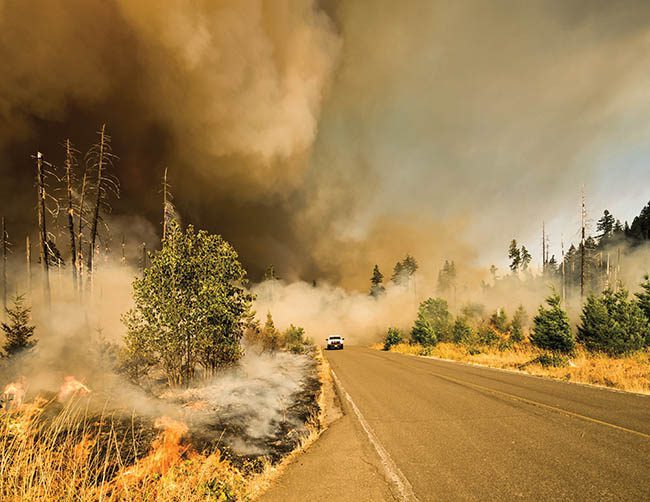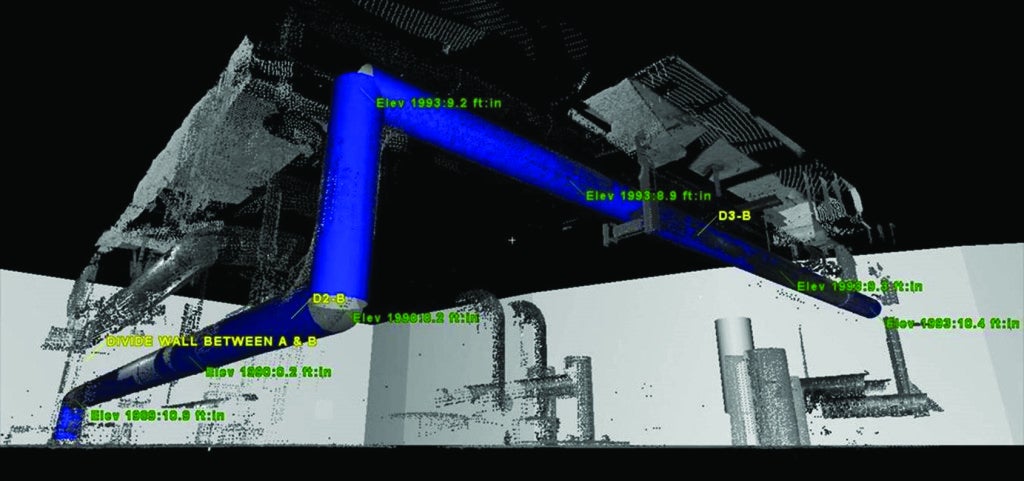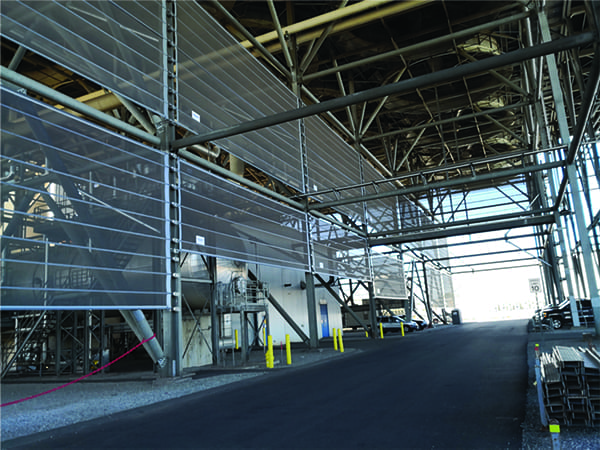
A key maxim of the military is "train like you fight, and fight like you train." The same applies to emergency response training, which should be a part of a plant’s routine operation. Don’t risk waiting until an accident occurs to test your response plan.
At approximately 8:30 a.m. on a Tuesday morning, the Paducah Gaseous Diffusion Plant (PGDP) was operating normally, and only routine plant maintenance activities were scheduled for the day (see sidebar). Facility maintenance employees and other contractors were beginning the day’s assigned work. Outside, a fully extended man-lift was being used to hoist a technician up to a malfunctioning ventilation stack on the roof of a building. A safety representative was on the ground observing the evolution.
While maneuvering the extended man-lift, a maintenance technician accidentally bumped the directional controls, thereby causing the man-lift to become unstable and tip over. The man-lift bucket struck and severed an overhead fluorine distribution pipe, a 2-inch air line, and a 1-inch nitrogen line as it fell to the ground.
Fluorine gas is a highly toxic, powerful oxidizing agent. It has a sharp, pungent odor and is corrosive to the eyes, respiratory system, and skin. Although fluorine gas is colorless, a release may appear white in color due to its interaction with moisture in the atmosphere that forms hydrofluoric acid (HF), which creates severe threats to worker safety. Inhalation of fluorine gas is extremely life-threatening for the same reasons.
The impact from the fall injured the technician and left him in need of immediate assistance. Within seconds, plant control room alarms blared the news that the fluorine and compressed air header pressures were quickly dropping. Another audible alarm indicated oxygen was present in the nitrogen line. Within seconds of the accident, the safety rep on the ground rushed over to assist the injured employee and both quickly exited the area by evacuating upwind. Once in a safe area, the safety rep reported the man-lift accident to the control room by radio.
Two maintenance employees driving a company truck in the vicinity of the accident were exposed to the fluorine release and attempted to immediately leave the area. The driver of the truck was overcome by the fluorine gas, lost control of the vehicle, and was injured after crashing into a utility pole. The passenger was able to report the vehicle accident over the radio to the control room.
The Paducah Gaseous Diffusion Plant
The Paducah Gaseous Diffusion Plant (Figure 1) in Paducah, Kentucky, is the only operating uranium enrichment facility in the U.S. The plant is leased and operated by the United States Enrichment Corp. (USEC), a wholly owned subsidiary of USEC Inc., and employs about 1,200 people. The plant’s primary mission is to use gaseous diffusion to produce low-enriched uranium fuel for commercial nuclear power plants in the U.S. and around the world.
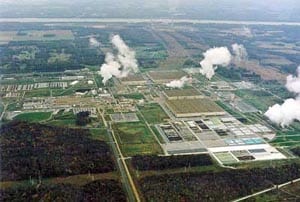
1. One of a kind. The Paducah Gaseous Diffusion Plant is the only operating uranium enrichment facility in the U.S. The United States Enrichment Corp. operates the plant, which is leased from the U.S. Department of Energy. Courtesy: USEC
The Nuclear Regulatory Commission (NRC) provides regulatory oversight of USEC enrichment activities to ensure compliance applicable to gaseous diffusion plants. The NRC Operations Center is notified of an emergency by USEC if one occurs, and the NRC evaluates the protective actions to ensure that all reasonable and appropriate actions are taken to mitigate an emergency.
Quick incident response
The PGDP plant superintendent responded to the incident scene as the hazardous materials (hazmat) incident commander (IC) as soon as he was notified by the control room of the situation. The PGDP on-scene emergency response organization (ERO) also was immediately dispatched to the accident scenes.
The ERO consists of a safety officer, security detail, emergency squad (E-squad), fire services, and chemical operations departments. ERO worker responsibilities are in addition to the staff’s normal job duties in plant operations, utilities, and maintenance. Primary and alternate personnel are ready to respond 24 hours per day. Plant E-squad members, for example, have job-specific experience and are trained in firefighting, hazmat, emergency medical treatment, health physics/radiation protection, and environmental response and will respond to any emergency situation at the plant. The squads are trained and operate under the direction of the IC during emergency conditions.
Leaking gas spotted
Upon arrival at the scene, a representative from the ERO reported seeing the white HF gas cloud discharging from the damaged overhead piping. Within minutes, an on-scene command post vehicle arrived near the accident scene equipped with communication capabilities and other resources required to manage the incident (Figure 2).
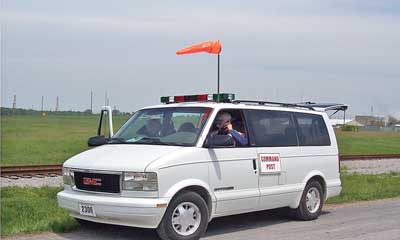
2. Authority figure. The incident commander (IC) establishes a command post to control the point of entry to the scene. The command post vehicle provides the IC and emergency response personnel with a base as close as possible to the actual scene from which they can operate and assess the situation. The command post can be relocated to other areas of the plant in response to changes in weather or an escalation of the emergency. Courtesy: USEC
Additional equipment at the scene includes hazmat response vehicles for responding to a radiological and/or hazardous chemical release, an ambulance for stabilizing and transporting patients to the on-site medical facility and/or local area hospitals, and fire/ladder trucks.
Safety elements were quickly established consisting of hot, warm, and cold control zones; industrial hygiene and radiological monitoring equipment; assigning personal protective equipment (PPE); and briefing entry teams. Decontamination and medical surveillance were managed by the PGDP safety officer (Figure 3).
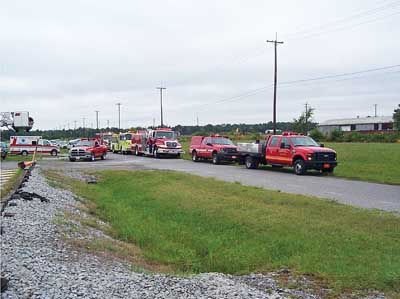
3. Many role players. Local community fire departments provide additional support and equipment to the PGDP when necessary. These support services encompass medical assistance, firefighting, evacuation, ambulance services, and law enforcement. Participating government agencies include the Federal Aviation Administration and the U.S. Coast Guard. Courtesy: USEC
Contaminants in the immediate area of the airborne release were considered extremely hazardous to life or health. E-squad personnel donned Level A PPE consisting of a fully encapsulated suit and self-contained breathing apparatus. Radios were used to maintain communication; however, the loud noise caused by the ruptured air line made communication difficult between the IC and the emergency medical technicians (EMTs) assisting injured personnel at the scene.
Declaring an Alert
Emergency action limits (EALs) had already been established for classifying this type of event based on previous accident and computer code analyses. The EALs are used in concert with the Nuclear Regulatory Commission’s (NRC’s) emergency classification system in 10 Code of Federal Regulation (CFR) 76.91, "Certification of Gaseous Diffusion Plants — Emergency Planning," and Regulatory Guide 3.67, "Standard Format and Content for Emergency Plans for Fuel Cycle and Materials Facilities." The EALs consist of specific, predetermined, observable criteria (such as source term release, instrument readings, and alarms) used to detect, recognize, and determine the appropriate emergency classification — either an Alert or a Site Area Emergency (SAE).
An Alert is an incident that could lead to a release of radioactive or other hazardous material within, typically, the facility boundary, whereas an SAE is an event extending outside the facility boundary. Events that do not meet these criteria are not classified but are responded to by the plant’s E-squad. The plant supervisor declared this particular event — a severed fluorine line — an Alert.
Activating the EOC
The Emergency Operations Center (EOC) was activated as soon as the Alert was declared. The EOC consists of:
-
A main EOC room where senior managers and advisors operate, coordinate activities, and communicate with on-site and off-site personnel.
-
A site management room where responders oversee events and provide advice and policy interpretations.
-
A technical assessment room where staff provide environmental, safety, and health support.
-
A meteorological room in which plume analysis is conducted.
The airborne release pathway represented a time-urgent situation requiring a rapid, coordinated response. Areal Locations of Hazardous Atmospheres (ALOHA) and HOTSPOT computer codes for chemical and radioactive releases, respectively, were used to calculate on-site and off-site consequences. For this event, ALOHA, an atmospheric dispersion model that allows the user to estimate the downwind dispersion of a release based on the characteristics of the chemical and atmospheric conditions, was used to predict the movement of the fluorine gas release.
Adjacent to the EOC is the plant superintendent’s office containing controlled plant documents and drawings necessary to support event response and mitigation. Meteorological data was displayed and used in the EOC to ensure safe response from an upwind direction, facilitate plume dispersal modeling, and develop appropriate protective action recommendations.
The plant superintendent assumes the role of crisis manager (CM) for an emergency during its early stages. After the EOC became operational, the PGDP general manager relieved the plant superintendent as CM and then began to direct all EOC activities. If the EOC were not activated, the plant superintendent would maintain responsibilities of the CM until the event was terminated.
The CM ensured that federal, state, and local agencies, such as the Paducah-McCracken County Office of Emergency Management (OEM) and the Kentucky Division of Emergency Management, were notified within 15 minutes of declaring the Alert. If needed, the CM possessed full authority to activate the public warning system and Emergency Alert System (EAS) radio or television announcements to provide notification in the event of a release within approximately a 2-mile radius from the Paducah plant center. The EAS messages associated with siren activation for nearby residents would be to either shelter in place or take no action. Additionally, the CM could recommend closing roads that traversed the site. For off-site protective actions beyond the PGDP boundaries, the CM is responsible for notifying appropriate state agencies, such as the Paducah-McCracken County OEM and the Kentucky Division of Emergency Management.
With key positions staffed, the EOC was declared operational and the CM, plant superintendent, EOC cadre, and technical support personnel then began dealing with the details of responding to and transporting the injured to the hospital, securing the fluorine gas leak, and dealing with the potential operational problems caused by loss of service air. However, the first order of business was to ensure there were no further injuries within or outside the facility as a result of any chemical release (Figure 4).

4. Mock-up. Controllers monitor mock-up scenarios under simulated conditions that provide responders opportunities to hone their skills. Courtesy: USEC
Cool under fire
Protective action recommendations are the responsibility of the plant superintendent or CM and include advising people to shelter in place or evacuate to a designated area within the PGDP boundaries to prevent potential health hazards resulting from a release (Figure 5). Site emergency response officials would provide directions for specific assembly points or evacuation routes based upon facility conditions and wind direction using the plant’s communication systems (public address system, plant radios, and the like).
5. Smokers welcome. A smoke machine was used to simulate conditions associated with a facility fire or toxic gas release. Courtesy: USEC
Either on-site or off-site protective actions would be required if certain guidelines were exceeded, such as the Environmental Protection Agency’s Protective Action Guides for radionuclides and the American Industrial Hygiene Association’s Emergency Response Planning Guidelines (ERPG-2) for chemicals. The ERPG-2 level is defined as the maximum airborne concentration below which it is believed that nearly all individuals could be exposed for up to one hour without experiencing or developing irreversible or other serious health effects or symptoms that could impair an individual’s ability to take protective action. Because an Alert addresses limited releases of radioactive and/or hazardous material, on-site monitoring and assessment actions by field monitoring teams was required.
One of the most likely protective actions for facility personnel during an emergency, including contractors and visitors, is evacuation of an area or building. Therefore it is essential to know that personnel have been positively located or that their off-site whereabouts are known because search and rescue operations may be initiated if a person is determined to be missing. If a person is missing in an area covered by an emergency, an E-squad search and rescue team may be assembled and directed by the IC to locate that person.
Depending on the severity of their injuries, personnel injured during an emergency may be treated on-site or transferred to a local hospital. The plant’s on-site medical facility is available during the day shift and the plant EMTs and firefighters provide coverage during night shift, weekends, and holidays. PGDP health services personnel also may be called to respond during off shifts, as deemed necessary.
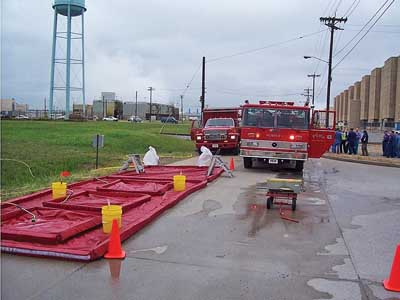
The facility has supplies, equipment, and personnel to treat most injuries, including those contaminated with radioactive materials (Figure 6). Those include a shower for contaminated ambulatory patients, radiation survey instruments, and decontamination supplies. The medical personnel assess patient condition, provide necessary emergency care, and determine appropriate supplemental treatment. If transportation is needed to a nearby hospital, the PGDP maintains a 24-hour ambulance service that meets U. S. Department of Transportation Emergency Medical Service standards.

6. Clean up the mess. Decontamination lines are established at the scene for drill scenario participants who may be contaminated with chemical or radioactive agents. Courtesy: USEC
This is a drill… this is a drill…
Fortunately, the events described above were staged as part of a routine drill scenario that had been planned for several months. However, if one or more of these events were to occur, plant personnel would be ready to respond in a timely manner.
According to April Tilford, emergency management analyst and PGDP exercise coordinator with the United States Enrichment Corp. (USEC), "A coordinated program of annual drills and exercises is an integral part of an emergency management program and is conducted to develop, maintain, and test response capabilities of site emergency personnel, facilities, equipment, procedures, and training." The results of these drills can be used to resolve deficiencies or improve specific functional areas to enhance sitewide response, evacuation, and take-cover protective actions.
To address any of the dozens of postulated incidents, a scenario package is developed for each drill. It describes the emergency events to be tested that serve as the basis for emergency response actions. Scenarios are varied from exercise to exercise and can involve either field response or table-top exercises; however, no scenario information is given to participants prior to an exercise.
Jerome Mansfield, a USEC emergency management specialist, discussed various enabling objectives for the drill participants: "The Incident Commander, for example, will be able to initially establish, then maintain throughout the incident, a strong, visible, and effective on-scene command presence. The command organization will be able to analyze physical and chemical hazards on-scene; assign a safety officer; develop a site safety plan for the incident; provide for the safety of emergency responders, victims, and evacuees; and implement on-site protective actions. To ensure a successful response, the IC must be able to set strategic objectives and execute them in a tactically correct manner."
Tilford noted that "Preplanning and training are just as important for the drill participants since scenario events are introduced through use of controlled messages by the controllers. The controlled messages combined with a simulated accident scene provide the opportunity to evaluate field responders performing a particular activity. Also, any hazardous or radioactive material releases can be simulated by smoke machines or by using photos. Any injuries and contaminations can be simulated using mock-ups. However, accounting for employees in designated locations and taking protective actions (evacuation or sheltering in place) are performed in real time."
Off-site assistance
The severity of some emergencies may warrant including off-site individuals, organizations, and government agencies. Therefore, USEC emergency management personnel maintain and review letters of assistance, mutual aid agreements, and memoranda of understanding with off-site support organizations to provide assistance in the event of an emergency situation at the PGDP. USEC personnel meet annually with these organizations to review emergency plans and procedures and any changes relevant to the PGDP emergency management program. The agreements are maintained by USEC and revised every four years.
Mansfield added that, "At the state level, the Commonwealth of Kentucky Emergency Operations Plan provides guidance on dealing with these types of disasters or emergency incidents. The state plan outlines the state and county response to incidents at the Paducah site. The Commonwealth of Kentucky has a permanent EOC in Frankfort, Ky., that has been designed and equipped to be the direction and control center for major emergencies in the state. The EOC is manned 24 hours a day and has the capability to provide almost instantaneous communications with the governor and key state officials."
Finally, it is the responsibility of the CM to determine when the recovery phase of the emergency can be initiated. Once corrective and protective actions have established control over the situation, the emergency is officially terminated and the recovery phase begins. Recovery includes those actions necessary to return the incident site and the surrounding environment to pre emergency conditions.
Post-op critique
After a drill ends, a critique process is conducted by participating organizations — such as the EOC, E-squad, and fire department — to collect feedback on accomplishments and areas for improvement that were discovered during the scenario. Programmatic improvements and corrective actions can be identified at any time following actual emergencies, drills, or exercises, which are then incorporated into the emergency management program.
—James M. Hylko (james.hylko@prs-llc.net) is an integrated safety management specialist for Paducah Remediation Services LLC and a POWER contributing editor.