If coal is to be a viable long-term fuel for a significant percentage of electricity generation, research and development is needed to increase thermal efficiency, demonstrate cost-effective and secure carbon dioxide capture and storage, further improve emission controls, and reduce water demands.
Coal-fired power plants currently supply nearly half of the electricity consumed worldwide. Globally, coal continues to be the primary fuel for affordable and reliable electric power production due to its low cost and because many countries have indigenous coal resources, which provide a level of energy independence.
However, if coal-fired generation is to remain a major source of electricity, it faces significant economic and environmental challenges. Although solutions to these challenges are possible, much is unknown or untested. Meeting the challenges of coal will require research to improve existing technologies and to develop new breakthrough technologies. It will also require a commitment to an aggressive schedule of technology development, demonstration, and scale-up in a broad array of design processes.
The Electric Power Research Institute (EPRI) has proposed a strategy to meet future global rising electricity demand by deploying a “full portfolio” of clean energy technologies (assuming a carbon-constrained future) that simultaneously reduces pollutant emissions and water use. This full portfolio includes not only renewable energy resources, end-use energy efficiency, advanced light water reactor nuclear plants, and electric transportation, but also advanced coal generation with carbon capture and storage (CCS).
To capitalize on coal’s advantages and help mitigate its weaknesses, research and development (R&D) needs to achieve the following five key goals:
- Improved plant efficiency, via high-temperature materials and higher turbine inlet temperatures.
- Cost-effective, scalable CO2 capture, in new or retrofit applications.
- Environmentally safe and permanent storage of CO2.
- Improved emission control systems, producing near-zero emissions (NZE) of all pollutants.
- Advanced cooling and water management methods to reduce water demand and pollutant discharges.
Improving Efficiency
R&D to improve the thermodynamic efficiency of coal power plants is a key part of any strategy to make coal generation more viable in the future. Increased efficiency, produced by operating at higher steam temperatures, reduces fuel costs and the amount of CO2 generated per unit of plant output; a 9 percentage point efficiency gain results in a 20% reduction in CO2 emissions, as Figure 1 shows. Higher-efficiency plants can also have better part-load operation and operating flexibility, making lower emissions of other pollutants possible and cutting balance-of-plant costs, due to reduced size, water consumption, and waste generation and consumables.
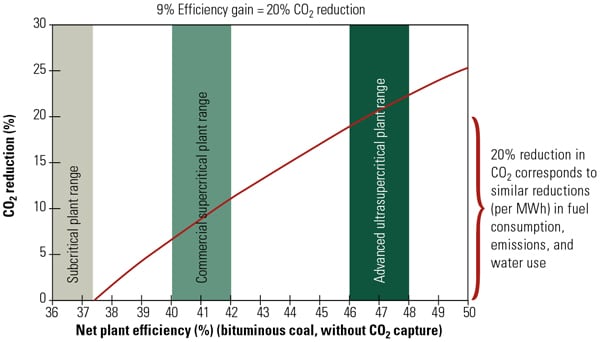 |
| 1. Highs lead to lows. High-efficiency advanced pulverized coal power plants substantially reduce fuel costs as well as CO2 and other emissions. (Efficiencies are based on higher heating value.) Source: EPRI |
Currently, the majority of pulverized coal (PC) plants in the U.S. are subcritical, with an average efficiency of about 33% (based on higher heating value [HHV]). Supercritical plants, which typically operate at 3,600 psi and temperatures up to 1,050F, provide significant efficiency improvements over subcritical units, achieving efficiencies of 38% (HHV). Ultrasupercritical (USC) plants, which have been in operation for years in Europe and Japan, and more recently China, have main steam conditions of 4,200 psi and 1,100F and generating efficiencies of up to 42% (HHV). In the U.S., the first new USC PC plant, American Electric Power’s (AEP’s) John W. Turk, Jr. Power Plant, is expected to be commissioned in late 2012.
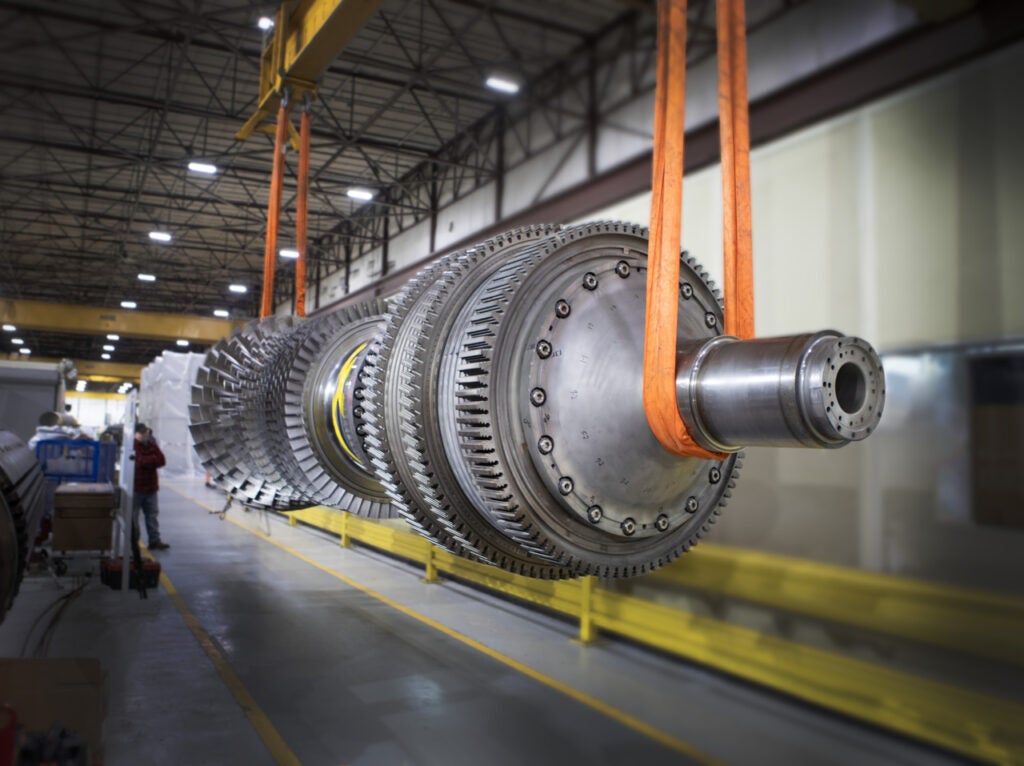
The primary technology advance needed to enable construction of coal-fired boilers and turbines with even higher efficiencies is the development of metal alloys that retain their strength at very high temperatures and resist corrosion, creep, and other aging mechanisms. These materials also must be cost-effective to manufacture and fabricate into boiler and turbine components.
Aggressive R&D programs for alloy development and evaluation in Europe, Japan, and the U.S. have identified ferritic steels capable of meeting the duty requirements of USC plants up to approximately 1,150F. Several European projects have researched achieving steam conditions of about 1,290F and 5,500 psi with the help of nickel-based alloys.
In the U.S., the Advanced USC (A-USC) Project is under way to build on these capabilities. The project aims to identify, evaluate, and qualify high-temperature materials technology for construction of coal-fired boilers and turbines. The U.S Department of Energy (DOE), through the National Energy Technology Laboratory (NETL), is the majority funder; significant co-funding comes from the Ohio Coal Development Office. Energy Industries of Ohio is managing the program, and EPRI is providing overall technical direction and coordination. The U.S. project seeks to achieve steam temperatures up to 1,400F for an A-USC plant.
As part of this project, two research teams (one for boilers and one for turbines) have been working to identify, fabricate, and test advanced materials and coatings with mechanical properties, steamside oxidation resistance, and fireside corrosion resistance suitable for higher temperatures. These A-USC plants are anticipated to become commercially available after 2020, following successful operation of a demonstration plant.
CO2 Capture
Three primary approaches to CO2 capture are being investigated (Figure 2):
Post-combustion capture (PCC) technologies are used to absorb CO2 from flue gas, at atmospheric pressure, from coal-fired boilers using PC, circulating fluidized-bed combustion, and other combustion systems.
Pre-combustion capture technologies are applied to pressurized synthesis gas, prior to combustion in the gas turbine of an integrated gasification combined-cycle (IGCC) unit.
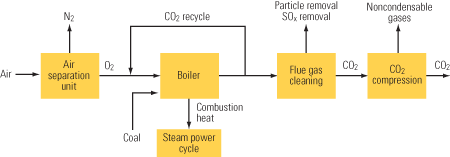
Oxy-combustion technologies eliminate most of the nitrogen in air prior to combustion, thereby producing a flue gas containing primarily CO2 and water, allowing relatively simple purification, primarily by cooling and condensing out the water.
 |
| 2. Three paths to removing CO2 from power plants. Source: EPRI |
Post-combustion Capture. Most of the furthest developed PCC technologies pass flue gas through a packed tower–type absorber, where a chemical solvent selectively absorbs CO2. The CO2-laden solvent passes to a regenerating column (also called a stripper in some designs), where it is heated to release a nearly pure CO2 stream that is then returned to the absorber.
The steam and auxiliary power requirements for solvent capture and CO2 compression may reduce net plant output by about 20% to 30%. Numerous approaches for PCC are in development; all hope for substantial reductions in costs and parasitic energy losses.
Many of these approaches focus on development and testing of new solvents. One area of investigation involves improving amine-based solvent technologies so that they have greater absorption capacity, require less energy for regeneration, and have a greater ability to accommodate flue gas contaminants. For example, one advanced amine-based solvent is the KS-1 sterically hindered amine solvent developed by Mitsubishi Heavy Industries (MHI) for its KM-CDR process. Southern Company is testing MHI’s KM-CDR process at Alabama Power’s Plant Barry, where a slipstream PCC system equivalent to about 25 MW (~150,000 tons CO2/year) will be demonstrated. EPRI will participate by providing independent testing of the capture system for an industrial collaborative.
Another area of PCC research involves developing potential alternatives to amine-based solvent technologies. For example, Alstom Power Inc. has developed the chilled ammonia process (CAP). This technology involves the use of a chilled, concentrated ammonia solution to chemically bind the CO2, followed by thermal regeneration to liberate the CO2 for collection and use or storage. The CAP underwent testing with a flue gas flow equivalent of 1.7 MWe at We Energies’ Pleasant Prairie Power Plant in Wisconsin. (See “Alstom’s Chilled Ammonia CO2-Capture Process Advances Toward Commercialization,” in the Feb. 2008 issue of POWER or the archives at https://www.powermag.com.) Tests by EPRI showed the technology was capable of removing 90% of the incoming CO2 from a slipstream of the plant’s flue gas.
AEP has scaled up the CAP to a 20-MWe (~110,000 tons CO2/year) equivalency at the Mountaineer Station in West Virginia. The plant started CO2 capture in September 2009. Approximately 40,000 tons of CO2 have been captured to date, with 80% to 90% capture efficiency achievable and 99.9% CO2 purity. EPRI is also participating in this demonstration, providing independent testing of the system for an industrial collaborative, as with the Plant Barry project. As a next step, AEP is investigating scale-up to a 235-MWe equivalent demonstration unit; start-up is expected in 2015.
In addition, the DOE/NETL has funded development of the National Carbon Capture Center (NCCC), an engineering-scale demonstration site adjacent to Alabama Power’s Plant Gaston in Wilsonville, Ala. EPRI and several power and coal companies are co-funders of the NCCC and provide guidance through an Industry Advisor Board. Part of the NCCC includes a test module with multiple slipstreams for evaluation of PCC technologies, with a range of flue gas throughputs.
Pre-combustion Capture. In pre-combustion capture systems, raw syngas is treated with a water-gas shift process that uses a catalyst to assist the reaction of carbon monoxide with steam to form CO2 and hydrogen. CO2 separation can then be achieved with an extraction and stripping process that uses a physical or chemical sorbent (solvent) or membrane process.
Applying the shift reaction and currently available solvent processes for 90% CO2 removal will reduce the thermal efficiency and net output of an IGCC unit by roughly 20% to 24% and impose large increases in capital and operating costs (Figure 3). As a result, a variety of R&D efforts are under way to reduce these penalties.
 |
| 3. Net power output and efficiency for IGCC with and without CO2 capture. Source: EPRI |
The DOE/NETL currently is funding development of pre-combustion CO2 capture technologies that have the potential to provide significant improvements in cost and performance compared with current solvents. Research is focusing on alternative physical solvents, solid sorbents, and membrane-based systems for the separation of hydrogen and CO2.
EPRI recently completed a study for the Canadian Clean Power Coalition that explored each area of a base IGCC plant for technology advancements that could improve the efficiency and/or cost of the plant. Results showed recent developments in coal preparation and feeding, air separation, gasification, syngas and CO2 processing, and power production could deliver a coal-fired power plant, including 90% CO2 capture, with net plant efficiency higher than a present-day IGCC plant without CO2 capture.
Oxy-combustion. Oxy-combustion separates oxygen from air and combines it with recycled flue gas, so that combustion occurs in the presence of oxygen and CO2, producing a flue gas rich in CO2 (70% to 90%, dry basis). This combustion process allows the CO2 produced during coal combustion to be more easily purified and compressed prior to transport and storage.
Oxy-coal technologies are at an earlier stage of development than pre- or post-combustion CO2 capture technologies, and to date, no commercial-scale oxy-combustion power plants are in operation.
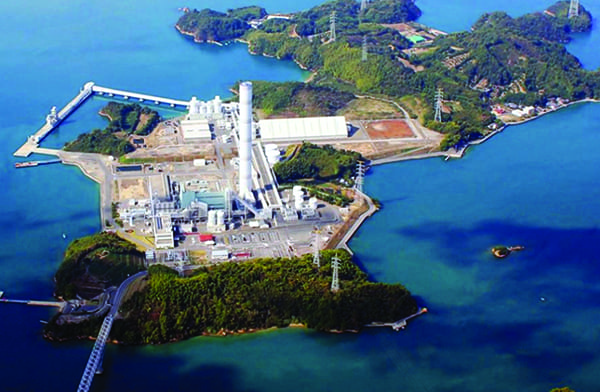
In the U.S., the DOE/NETL-funded FutureGen 2.0 project plans to repower Ameren Energy Resources’ 200-MW oil-fired Meredosia Unit 4 with Babcock & Wilcox’s oxy-coal technology and to construct a CO2 pipeline and geological storage facility. The project plans to capture over 90% of the CO2 and sequester 1.2 million tons/year. The schedule calls for the engineering and environmental assessments to be completed by 2012 and the plant to begin operation in 2016. (See “Oxy-Combustion: A Promising Technology for Coal-Fired Plants,” Jan. 2011.) [Editor’s note: We regret that the year given for this article was incorrect in the print version of this story.]
Two commercial oxy-coal plants are planned in Europe—Vattenfall’s 250-MWe plant in Germany and Endesa’s 300-MWe plant in Spain—and a 30-MWe pilot plant is under construction in Australia by CS Energy.
Oxygen-fired IGCC and oxy-combustion processes require large amounts of oxygen, which imposes a significant cost and energy penalty. An innovative technology called ion transport membrane (ITM), developed by Air Products (AP) under a cooperative agreement with the DOE, could help reduce these costs. The ITM process uses a ceramic material under temperature and pressure to ionize and separate oxygen molecules from the air, and unlike conventional cryogenic air-separation units, it requires no electric power. EPRI has been involved in the project since 2008, when EPRI formed a collaborative to perform technical tasks, assess overall progress, and provide industry input to AP and the DOE.
Estimates by AP and EPRI suggest that oxygen plant capital costs and operating power consumption could be reduced in IGCC applications by using ITM. Other potential benefits include reduced cooling water and plant space requirements. Preliminary modeling of ITM applied to oxy-combustion shows similar economic and efficiency benefits.
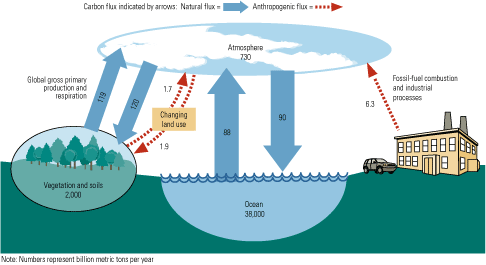
Retrofit CO 2 Capture. The U.S. has more than 330 GWe of existing capacity in PC plants. To meet anticipated greenhouse gas reduction targets, the U.S. electric power industry may need to retrofit existing coal plants with PCC systems. More broadly, some analysts believe worldwide PCC retrofit is essential to stabilize atmospheric CO2.
The challenges of retrofitting plants for carbon capture are significant: Sites would need space for capture and compression equipment (about 6 acres for a 500-MW unit), the low-pressure steam turbine potentially could need to accommodate extraction of 25% to 30% of its steam for the CCS system, the demand for cooling water supply could increase by as much as 100%, and pollutant controls may need to be upgraded to be capable of reducing emissions below currently permitted values to protect the solvent used in some of the capture processes.
EPRI is in the midst of a large, multi-company project to conduct plant-specific studies to determine the thermal and economic impacts of retrofitting a plant with an advanced amine PCC technology. The studies are being conducted at five plant sites, representative of typical configurations across North America. The project team is modeling the process flow and the heat and mass balances to identify the most practical CO2 capture configuration based on each site’s constraints, determine the space required for the capture technology, estimate the performance and costs for the capture and compression systems, and reveal each plant’s features that materially affect cost and feasibility of retrofitting.
New Capture Processes. Many research teams, including EPRI, are doing considerable work to develop new capture processes (primarily for post-combustion applications) aimed at significantly reducing the costs and inherent energy penalty. In particular, the DOE/NETL is funding development of several advanced PCC technologies. In some cases, through its Technology Watch function, EPRI has identified potential new breakthrough processes, usually those being developed at a university or by a small firm, and has nurtured them along for a few years until they were ready to compete for DOE funding.
The new processes generally fall within five categories:
- Absorption: Research focuses on developing novel solvent processes such as complexed ionic liquids, oligomers, and phase separation.
- Adsorption: Novel designs of packed and fluidized beds are being investigated in parallel with new sorbent materials, such as those based on carbon or metal organic frameworks with the desired thermodynamic properties and robustness.
- Biological: Research focuses on quantifying the carbon-mitigating potential of various utility-connected algae systems, with emphasis on life-cycle analyses for net CO2 accounting.
- Membranes: Developers are working on polymer membranes that remove CO2 from flue gas with both high selectivity and permeability. Although they are still largely untested for this application, membranes have potential to lower the energy penalty.
- Mineralization: Flue gas is scrubbed by a base solution to form a solid product, thereby capturing CO2 without requiring compression or underground storage. Obtaining the base solution at low energy demand remains a challenge.
EPRI supports the early stages of R&D on new capture processes through its Technology Innovation program, performing due diligence, process simulations, materials development, and lab testing. Through industrial collaboration, EPRI also provides support and funding through bench tests, pilot-scale projects, and larger-scale demonstrations of capture technology (see sidebar).
CO2 Compression, Transport, and Storage
Although as much as 80% of the cost of CCS is attributable to the capture process, most of the uncertainties surround the means of permanently storing CO2. The industry and public need to be confident that CO2 can be safely injected and stored in underground formations over very long periods without undesirable side effects. Beyond the scientific investigations related to geologic sites and injection technologies, there are regulatory, legal, and long-term liability issues that some analysts believe will be the biggest obstacles to widespread CCS commercialization.
The process of transporting CO2 via pipelines is commercially established. However, energy requirements for CO2 compression are substantial. Compression is estimated to account for one-third to one-fourth of the total energy demand of a CCS system on a power plant. Southwest Research Institute is investigating two novel compression systems with the potential to reduce CO2 compression power requirements by 35%. One concept is a semi-isothermal compression process in which the CO2 is continually cooled using an internal cooling jacket (intra-stage cooling) rather than conventional inter-stage cooling. The other concept involves the use of refrigeration to liquefy the CO2, so that its pressure can be increased using a cryogenic pump, rather than a compressor.
The DOE/NETL is supporting development by Ramgen Power Systems of a supersonic shock wave compression technology, similar to an aircraft ram-jet engine. The compressor design, known as Rampressor, features a rotating disk that operates at high peripheral speeds to generate shock waves that compress CO2 with higher efficiency than conventional technologies. (See “Capturing CO2: Gas Compression vs. Liquefaction,” June 2009.)
Around the world, geologic sequestration of CO2 is being demonstrated by numerous small-scale projects. In Canada, Norway, and Algeria, large-scale projects sequester a combined total of ~5 million metric tons of CO2 per year—the approximate output of a baseload 750-MWe coal-fired power plant.
The most promising formations for geologic storage of CO2 include depleted oil- and gas-bearing formations, saline formations, and deep, unminable coal seams. To adequately qualify a site for geologic sequestration of CO2, characterization studies must confirm the site’s storage capacity and ability to safely store CO2.
In the U.S., the seven regional partnerships of DOE’s nationwide Regional Carbon Sequestration Partnerships program are conducting pilot-scale CO2 injection validation tests in differing geologic formations. These pilot-scale tests are to be followed by larger-volume tests involving storage of ~1 million metric tons of CO2 or more, along with post-injection monitoring to track migration of the CO2. EPRI is responsible for most of the field work at the southeastern regional project (pilot-scale and larger volume injections) and also for the drilling and testing of one or two characterization wells in Arizona.
EPRI is engaged in a multiyear research and information exchange program to determine how pure a CO2 stream must be when delivered to an injection formation. The objective is to understand the purity that enables a target injection formation to realize its maximum injectivity and capacity, while avoiding excessively high costs in the capture system due to unnecessarily tight purity requirements.
In 2010, EPRI initiated a field study to evaluate potential impacts of dissolved CO2 on groundwater quality. By injecting carbonated groundwater into a shallow aquifer system and observing the effects, the field study simulates a hypothetical CO2 leak from a deep geologic storage reservoir into an underground source of drinking water. Results from this study will help improve our fundamental understanding of the geochemical processes that lead to the introduction into groundwater of CO2-induced mobilization of heavy metals and organics along a potential CO2 leakage path from the injection formation to an underground source of potable drinking water.
EPRI also is teaming with industry collaborators to study the integration of larger-scale carbon capture systems with storage technologies. Projects include AEP’s Mountaineer Station and Southern Company’s Plant Barry. AEP is injecting the captured CO2 into two distinct, deep saline reservoirs and monitoring the underground acceptance of the CO2 by the porous formation, its interactions with rocks and fluids in the formation, and its movement underground. The first injection of CO2 from coal-derived flue gas was performed in October 2010. In the Southern project, CO2 will be transported by pipeline ~10 miles to a saline formation. EPRI is working with the Southern States Energy Board to manage the storage site. Permitting and environmental assessments are under way, and the site is being prepared to accept CO2 by the end of 2011.
Near-Zero Emissions
A critical element in research for future coal generation is the development of NZE plants.
A number of factors drive the need for NZE R&D. In the short term, coal plants will need to meet upcoming regulations covering emissions of NOx, SO2, SO3, mercury, selenium, particulates, and a number of organics. These regulations include the U.S. Environmental Protection Agency’s Maximum Achievable Control Technology rule, proposed in 2011, and the Clean Air Transport Rule, proposed in 2010. In the longer term, the need for NZE technologies has become linked to commercializing PCC processes, because several CO2 capture technologies require inlet flue gas with extremely low levels of SO2 and NO2.
Current air pollution controls can reduce emissions of NOx, SO2, SO3, and mercury to very low levels, but usually not to NZE target levels on all coals, consistently throughout the year. Technology advances, enhanced instrumentation, and, most likely, a final polishing step would be required to attain NZE target levels.
In the near term, to meet existing and upcoming regulatory requirements, a number of new technologies must be developed and demonstrated, such as:
- Controls consistent with 90%-plus mercury reduction for all applications and fuels.
- Selective catalytic reduction (SCR) catalyst regeneration strategies, as well as SCR catalyst management systems consistent with year-round system operation at 90+% NOx removal, minimum SO3generation, and maximum oxidation of elemental mercury in the flue gas.
- Robust, reliable flue gas desulfurization systems for all coals, including those with low sulfur.
- More wear-tolerant, low-pressure-drop/ultra-high-efficiency baghouses for control of particulates from a wide range of fuels; improved performance of electrostatic precipitators (ESPs) for applications not suited to baghouses or amenable to upgrading in existing power plants; and demonstrated wet ESPs for acid mist and fine trace metal particulate capture.
- Resolution of balance-of-plant issues and long-term operability issues for recently installed environmental controls.
For pollutants with newly proposed regulations (such as selenium, acid gases, and organics), R&D initially will focus more on the underlying mechanisms as well as independent assessments of emerging emission controls.
Water Use in Coal Power Plants
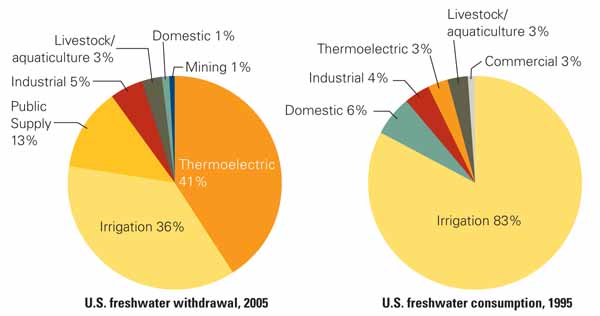
Reducing water use is emerging as a top priority for the power generation industry, including coal-fired plants, due to shortages in and competing demands for water. This issue will become even more acute with the drive to reduce carbon emissions. When CO2 capture is included in a plant design, water use per net MWh is expected to increase by 30% to 90%. (See “Determining Carbon Capture and Sequestration’s Water Demands,” Mar. 2010.)
The majority of water use in power plants is related to process cooling (mostly low-grade heat rejection). Conventional cooling is achieved through once-through cooling, which withdraws water from a nearby water body, pumps it to a condenser, and discharges the heated cooling water back into the water body. Where local water resources cannot support once-through cooling, use of a wet cooling tower reduces water withdrawals but increases consumption and may impose a heat rate penalty.
To reduce water use, research efforts are focusing on alternative cooling technologies and options for reducing plant cooling loads. For example, dry cooling systems, or air-cooled condensers (ACCs), can be used as the heat sink for the various cooling duties in a power plant.
A wet-surface, air-cooled heat exchanger (WSACHE) allows use of high cycles of concentration or low-quality makeup water. In some plants with dry ACCs, WSACHEs are used to remove heat from a closed-loop auxiliary cooling system serving turbine lube oil coolers and other small loads. Hybrid wet-dry cooling systems can minimize the negative impacts of dry cooling during hot weather by using an evaporative cooling tower to handle a portion of the cooling duty during those periods. (See “Appraising Our Future Cooling Water Options,” June 2010.)
Power plants also can decrease the impact on freshwater supplies by using nontraditional sources of water for make-up. One potential source of water for a power plant is its own wastewater. One method for upgrading and reusing wastewater in a power plant is to include a “zero liquid discharge” (ZLD) system. ZLD systems use evaporative or reverse osmosis processes to concentrate the impurities in the wastewater for disposal while producing a water stream of suitable purity for reuse.
EPRI’s Advanced Cooling Technologies project supports research to increase water use efficiency and conservation at fossil, nuclear, and renewable power plants through engineering and economic analysis, improved dry and hybrid cooling, reduced water losses from cooling towers, use of degraded water, and enhanced water resource management and forecasting. The project is examining cooling water availability impacts on power plant siting, meteorological impacts on ACCs, indirect dry cooling, hybrid tower designs, water-recovery options, wet-surface air coolers, advanced bottoming cycles, and methods to preserve once-through cooling options.
Conclusion
It is technically feasible to reduce CO2 emissions from coal-fired generation, cut other emissions to near-zero levels, and reduce plant water use and discharge. However, many of the necessary technologies are not yet at the level of developmental maturity required for affordable widespread deployment, and time is needed to test and validate new technologies. Achieving these goals will require acknowledging the urgency of the challenges and a sustained commitment to a broad program of aggressive public- and private-sector R&D.
— Dr. Andrew Maxson (amaxson@epri.com) is a project manager for EPRI’s Industry Technology Demonstration program, and Dr. Jeffrey Phillips (jphillip@epri.com) is the program manager for EPRI’s CoalFleet for Tomorrow program.