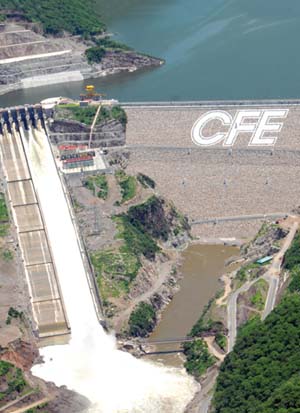
State control of the electricity sector may mean fewer customers, but it also can mean clearer expectations.
Working with the Comisión Federal de Electricidad (CFE) can be a difficult, yet financially rewarding activity. In the past 15 years the Mexican electrical sector has gradually attracted an increasing number of international players, often to the detriment of local companies.
Becoming the CFE’s Preferred Partner
Felipe Ochoa, founder and president of Felipe Ochoa y Asociados, a consulting company specializing in strategic planning for national and international clients, believes that the influx of foreign companies has been a major challenge for local firms, many of whom now have difficulties in winning bids with the CFE. He says, "We need the international participation of these companies for their investment and expertise; however, we also need to promote our domestic industry. Our country needs to have a strong engineering base complemented by the presence of these international firms. At this point in time most of the [independent power producer] contracts have gone to international firms. I believe that we need a stronger local content on these projects. So far there haven’t been many joint ventures or extensive collaborations."
The problem for small companies is that they do not have adequate access to finance, unlike many multinationals. This hinders their ability to scale up and bid for large-scale projects that the CFE and Petróleos Mexicanos (PEMEX) normally tender out. They can tender to be a subcontractor for a specific part of the original contract, but that is considerably less profitable.
Santiago Barcón is director, Power Quality and North America for Arteche, a Spanish multinational designing and manufacturing quality instrument transformers, relays, and substation-integrated protection and control devices. The company is also known as Inelap in the local market. Barcón argues that there are two main drivers behind the lack of local participation. First is the difficulty of accessing competitive financing for local companies. Second, the evolving nature of the Mexican legal framework makes it difficult for the CFE or PEMEX to take legal action against their suppliers. As a result, they require very detailed, complicated contracts to ensure that they are appropriately protected, but that can put off potential entrants to the sector.
According to Arturo Carillo, general manager of Cimaltec, a Mexican engineering company, "The main challenge to serve global markets is the lack of financing. The Mexican industry has the capabilities, talent, and knowledge, but there is no funding, and that is a big problem." He goes on to argue, "In order to get the necessary resources, we need the international banks to strengthen their confidence in Mexico, and this is a problem."
Winning the Deal
This problem of bidding is elaborated on by Thomas Riedel, partner at ASM Mexico, who distributes C.C. Jensen’s filters for the conditioning of oil and other fluids for the CFE’s plants. He argues that while the CFE is a valued customer, it took a great deal of time and effort to win the CFE over. He has had to go to the plant managers to explain his product and then to the zone chief, who had the purchasing authorization, as well as numerous other departments. "The CFE is an important client for us, but we feel that there needs to be a quicker way of introducing new products and services to them. We may manage to convince one plant manager to introduce our products, but then we have to repeat that process more than 100 times to cover the whole CFE."
Other leading voices in the Mexican energy sector, such as Enrique González, country head of Schneider Electric Mexico, argue that the fact that the CFE is big and unified actually makes it easier to do business. He considers the CFE to be a genuinely world-class organization and a key pillar of his growth strategy. Unlike other countries, such as the U.S. or the UK, where there are many utilities, Mexico has just one: "In many of the other markets we are involved in there are a plethora of different authorities, different buyers with different needs, and different demands. Here we only have one person to deal with, which certainly makes it easier for us," he enthuses.
Jorge Lozano, president of Prolec GE, a joint venture between GE and the Mexican company Xignus, producing a complete line of transformers, seconds this view: "One of the big advantages to working with the CFE is that you only need to supply one variety of product, and due to the integrated planning, you know what to expect and when to expect it."
Of course, neither Schneider Electric Mexico, with 7,500 employees and 11 factories in Mexico, nor Prolec GE, with the largest integrated transformer manufacturing facility in the Americas, suffers from the problems of access to financing that may hinder smaller companies. Ricardo Arratia, director of Brio Mexico, a business intelligence company that works extensively with the CFE top management, and part of SCAP holding group, argues that the secret to working with the CFE is winning their trust and properly understanding their aims and needs: "The CFE are looking for partners who can help them improve themselves, not just a supplier. The way we sell is by creating solutions together. We do not have a typical client-supplier relationship. People, tools, and the knowledge of the client are key."
As well as larger companies, there are many subject matter experts that work for the CFE. Geraldo Maltos and Manuel Gomez, who head up SYSCE, a Monterrey-based engineering company focused on the transmission sector say, "We are both former CFE employees, and in many ways that is an advantage. However, we have been much more successful in selling our products outside of Nuevo Leon (the state encompassing Monterrey) than here. When we sell something to our former colleagues we have to try twice as hard!" Maltos and Gomez, who won an international innovation prize in 2006 with SYSCE, do, however, add that although the CFE is an important client, to become a top-tier company, Mexican leaders need to expand their reach to beyond the public sector.
Marcelo de Zamacona is founder and general director of Grupo Dielec, a distributor for the electricity sector supplying equipment to the CFE that has recently started sales to South America. He argues that the CFE’s bidding process is helpful: "Bids are published online, but we do have the opportunity to interact with the CFE — we can ask questions, we can give them feedback on the bids. In the past the CFE asked for a lot of paperwork, but we feel that has decreased over the past few years. In fact, we find it easier to work for the CFE than the private sector. With the CFE you have certainty, there are no surprises, and you will be paid."
Financing Challenges
Mexico’s exposure to the most recent financial crisis was late and deep. At the time of writing, Mexico is just beginning to emerge from one of the deepest recessions of its recent history. In December 2009, Mexico’s credit default swap levels were wavering around the 200 basis point mark, compared to the double digits of European countries, but way down from the 600 that it reached just after the Lehman Brothers collapse in October 2008. Figure 1 shows that international markets have become more relaxed about Mexico’s debt, despite the recent downgrading of Mexico’s sovereign debt by Finch to BBB, two grades above junk rating.

1. The credit default swap spread on Mexican bonds. Source: Standard & Poor’s Mexico
Mexico’s gross domestic product is expected to have fallen by 7.5% in 2009, before recovering to record a predicted 3% growth in 2010. In the first three quarters of 2009 industrial production fell by 5.7%. Consumer inflation reached a high of 6.5% in 2008 before dropping to a predicted 4% in 2009, according to Standard & Poor’s. In addition to this drop in activity, liquidity on the Mexican market remains elusive. Despite this, the mood remains optimistic within the energy sector.
Mauricio García, director general at CMS International, a 40-year-old Mexican company manufacturing and distributing products within the gas and electric sector, specializing in valve production, notes that Mexico emerged strongly from crises in 1982, 1994, and 1997. That history makes him optimistic about a quick recovery from the latest financial crisis. Mexicans are used to dealing with unstable circumstances and fluctuating financial conditions, and this crisis is perceived as being no different from the previous ones.
Despite these turbulent financial conditions, Carlos Álvarez, VP Mexico of Intergen, insists that working with the CFE gives credibility on international markets. Alvarez explains the financing of his company’s Campeche and Chihuahua acquisitions: "The project financing deal for the acquisition of these new plants was a tricky one. It was certainly challenging to go to the international market at a very difficult time and put this deal together. In fact, these deals were put together in 2008, just after the collapse of Lehman Brothers. This willingness to push through the deal shows the commitment we had to the expansion as well as the credibility our company has on the markets. I believe that the fact that we are dealing with the CFE also helps financing these deals, as the CFE has considerable credibility with the international markets."
Luis D’Acosta, general manager of SEL Mexico, known in the U.S. as Schweitzer Engineering Laboratories, argues that while Mexico has suffered from a downturn, the effect of stimulus money on the energy sector played a part in cushioning the fall. He points to the record high margin factor, arguing that the coming few years will be vital once the stimulus money dries up. Nevertheless, Eduardo Zenteno, president of AMDEE (the Mexican Wind Association), argues that financing wind energy projects in Mexico is difficult and that there is little deal history to date.
This claim is backed up by Abel Clemente, director general at Equipamentos y Suministros Industriales, a water treatment company moving into biogas operations. Clemente maintains that "Lack of access to financing is preventing the growth of [small and midsize enterprises] in Mexico."
Another curious fact about financing in Mexico concerns the opening of the Mexican market in the mid-1990s. This resulted in vast swathes of the Mexican economy being purchased by foreign companies, especially in the banking sector. Santander, Banamex, and HSBC are three of the most prevalent names in Mexican project financing. However, as the independent power producer (IPP) market and the Mexican electricity sector in general has a prevalence of multinational firms, the regional office may find difficulties in raising finances, and banks would normally only permit limited credit exposure to a certain company. Normally, energy companies can get around this via local banks with local credit lines to compliment the money they raise on the international markets. In Mexico, however, some international energy companies are having problems doing this due to the lack of local Mexican banks.
The Pervasive Influence of Hydrocarbons
Mexico’s hydrocarbon sector is all-pervasive and permanently intrudes on all areas of the Mexican economy, electricity being no exception. PEMEX, the state-owned monopoly, is one of the largest electricity users in the country and, following reforms in PEMEX’s structure in 2008, now has the ability to cogenerate electricity (that is, be a partner in owning power generation infrastructure) rather than being tied to the CFE. PEMEX recently tendered a 300-MW cogeneration plant, a bid won by Spanish giant Abengoa.
Both electricity generation and the oil and gas sector are seen as key strategic areas by the state. The oil and gas sector has traditionally provided the finances, while the electricity sector was key to the development of the country. The hydrocarbons sector has usually been extremely profitable, and these resources were reinvested in electricity generation, which was a net drain on PEMEX’s resources.
David Shields, editor of Energia y Debate, a local energy-focused publication, explains that oil production in Mexico, specifically at the Cantarell field, is currently going though a period of decline. Cantarell production has fallen from 2.1 million barrels per day at the start of the decade to 772,000 in 2009.
Giovanni Aloi, director general of GE Energy Mexico predicts: "My own belief is that oil and gas will rise in price in the near future. The days of cheap petrol and gas are over. We have to look to heavy deep sea oil, which is considerably more expensive to extract."
Thus, despite a potential rise in oil and gas prices, Mexico’s revenue will fall due to the lack of new fields coming online (Figure 2). This drop in revenue will have profound effects on the Mexican budget.

2. Crude oil production (million barrels per day). Source: PEMEX
Juan Carlos Machorro of Santamarina y Steta, a law firm, says: "It seems clear that from 2010 the government will suffer from a lack of revenues due to a decline in oil exports. There will be a big black hole in the Mexican budget of 2010."
What remains to be seen is how the government will be able to commit the same level of investment to the electricity sector in the future. Allowing more opportunities for private sector involvement might be forced upon the Mexico’s future administrations.
The CFE’s Position Seems Safe
Mexico is in a unique position. So far the CFE has ensured adequate investment in the electricity sector, ensured rural electrification, and attracted private investment through IPPs. It has attracted the best companies from all over the world to work with, but perhaps it needs to do more to help local companies.
However, all of gains to date were made possible by the large profits derived from the state oil company, PEMEX. Mexico was able to afford investments in electricity without seeking substantial private investment.
The next few years, together with the change in government, will be key for the future of the Mexican electricity sector. Should either the left or the centre win, as expected, the CFE can expect to retain its comfortable position, limiting further private investment. Should the pro-business Partido Acción Nacional (PAN) retain the presidency and gain control of Congress, we can expect significant changes.
— Written and researched by Clotilde Bonetto (clotilde@gbreports.com) and Mark Storry (mark@gbreports.com) of Global Business Reports.