At least 10 workers have died from natural gas piping explosions in the past 12 months. The most recent disaster, which occurred during gas system purging at the Kleen Energy Systems plant, claimed five lives and injured 27 workers. It’s time the industry understood the unique design and safety requirements for working with and purging natural gas piping.
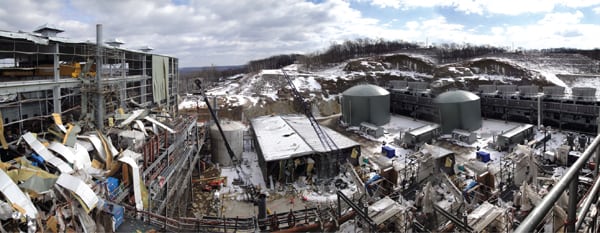
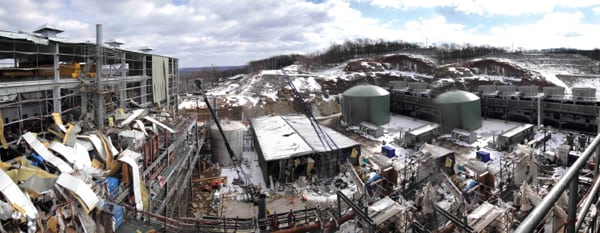
Gas piping design, operation, and safety require a very specialized level of expertise. Recent events graphically illustrate the inherent hazards of improperly designed natural gas piping that is commissioned in a poorly planned and haphazard manner. Beyond the obvious risk of death and injury, explosions on the scale of the Kleen Energy Systems plant in Connecticut can cause extreme property damage worth hundreds of millions of dollars, cause significant lost production time, and irreversibly damage a company’s reputation (Figure 1).

1. Preventable tragedy. Workers at the Kleen Energy Systems plant in Middletown, Conn., attempted to clean debris in the plant’s fuel gas line with 650 psi natural gas. The gas purge, vented inside the plant building, found an ignition source and exploded. Six workers were fatally injured. Courtesy: Chemical Safety Board
To avoid a repeat of this and similar disasters, engineers and designers must be thoroughly trained in the code and practical design requirements for natural gas piping. Contractors should be especially cognizant of the safety requirements and worker training required when purging natural gas piping. In our experience, few engineers and contractors have the necessary knowledge or experience to safely purge and start up natural gas piping systems. It’s time to take a deep breath and reevaluate our commitment to safely handling natural gas in utility plants (Figure 2).

2. Never completely clean. Weld slag and contamination are rarely completely removed from a piping system. A well-designed pipe purge configured with strainers and sediment traps can be safely accomplished with the right planning and training. Courtesy: CEC Combustion Safety Inc.
What’s So Special About Gas Pipes?
We have also found that many designers, engineers, contractors, and maintenance workers do not understand that natural gas piping is quite different from the more familiar fluid or air piping, and therefore requires special knowledge and training. There is often a huge and dangerous lack of knowledge among those who routinely manage or perform gas piping repairs.
Six major steps are taken when performing a gas piping repair. Each of these steps should be the subject of hours of careful consideration. In general, these six important steps are:
-
Planning/layout
-
Isolation
-
Making the repair
-
Pressure testing
-
Post-repair purge
-
Re-introduction and light-off (the most dangerous part)
Step 6 may be the most important step because it is clearly the most dangerous. Whenever gas piping is repaired, extended, or newly installed, it must be purged. However, a safe and successful re-introduction of natural gas into the pipe and start-up of the equipment only occurs when good planning and execution occurred during the first five steps (see sidebar).
Chemical Safety Board Shares Lessons Learned from Gas Purge Explosions
On the afternoon of June 9, 2009, five workers were fatally injured and dozens of others were hospitalized after an explosion at the ConAgra Foods facility in Garner, North Carolina. In addition, the explosion caused serious structural damage to the 87,000-ft 2 facility, including a roof collapse (Figure 3).
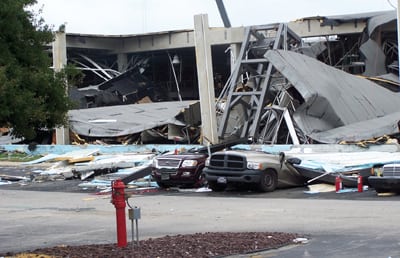
3. Deadly consequences. Workers at a ConAgra plant vented natural gas used to purge a fuel supply pipe to a water heater into an enclosed space. An ignition source ignited the gas, causing an explosion that resulted in fatalities. Courtesy: Chemical Safety Board
The U.S. Chemical Safety and Hazard Investigation Board (CSB) has yet to issue its final report on the incident, although the facts about the cause of the explosion were included in its interim report. In sum, natural gas used to purge a pipe was vented inside a centrally located utility room intermittently over a 2.5-hour period and was somehow ignited. The complete report is available on the CSB website: www.csb.gov.
The CSB published key lessons learned from the ConAgra Slim Jim plant explosion in a September 2009 Safety Bulletin, hoping to draw attention to the serious dangers endemic to fuel gas purging operations. The CSB bulletin highlights the following five key lessons learned that the agency recommends for increasing workplace safety.
-
Purging new or existing gas piping into buildings can be highly hazardous due to the possible accumulation of gas above the lower explosive limit (LEL) and the associated danger of fire and explosion. LEL, also known as the lower flammable limit (LFL), is defined as "that concentration of a combustible material in air below which ignition will not occur." See Recommended Practice for Handling Releases of Flammable and Combustible Liquids and Gases (NFPA 329, 2005).
Wherever practicable, directly vent purged gases to a safe location outdoors, away from people and ignition sources. This can be done using a temporary hose or piping or permanently installed vent pipes, depending on the facility design.
-
Purging indoors should only be done in limited circumstances where purging outdoors is not practicable. In such cases:
-
Nonessential personnel should be evacuated.
-
All ignition sources should be controlled or eliminated.
-
Ventilation should be adequate to maintain the gas concen tration well below the lower explosive limit at all times.
-
-
Never rely on odor alone to detect releases of fuel gases. An odorant, such as T-butyl mercaptan (typically described as having a "skunk-like" odor), is typically added to fuel gases, such as natural gas and propane, to warn workers and consumers of releases. However, the perception of odor is highly subjective and varies from one person to another. People also become desensitized to odor during prolonged exposures. Additionally, new gas pipes and containers can react with or otherwise remove the odorant, an effect known as "odor fade."
-
Always use combustible gas detectors that show the combustible/flammable gas concentration as a percentage of the LEL, to monitor the gas concentration during purging operations. To provide the most accurate information about combustible gas levels, sampling should be conducted frequently or continuously at appropriate locations.
The evaluation of appropriate locations for combustible gas monitoring should include consideration of the purge location, characteristics of the gas (lighter or heavier than air), stratification or mixing of the gas, and existing ventilation. See the International Society for Automation (ISA) RP 12.13, Recommended Practice for the Installation, Operation, and Maintenance of Combustible Gas Detection Instruments (2003) and the American Petroleum Institute 2009, Safe Welding, Cutting, and Hot Work Practices in the Petroleum and Petrochemical Industries (2002).
-
Ensure that personnel involved in gas purging operations are fully trained and knowledgeable about safe gas venting practices, the proper use of gas detectors, and the danger of relying on the sense of smell alone to detect gas releases. Include training on the problem of odor fade in new gas piping systems.
— Dr. Robert Peltier, PE is POWER’s editor-in-chief.
Even those conducting the work often misunderstand the fundamental rules and best practices for handling gas piping system start-up. But if a good plan is prepared by engineering experts and the correct precautions are taken by the contractor, you can have an incident-free project.
Consider this short list of important tasks and key questions when planning a gas-piping repair:
-
Is there a written purging plan (pre-repair and post-repair) that identifies all of the pressure-testing needs and standards that must be complied with? Does everyone on the team understand the plan and the role they play in its execution?
-
Has a gas re-introduction plan been prepared? Has re-introduction and start-up been discussed with the start-up team, including any unique hazards?
-
Were the local emergency services or fire department involved in the planning? Is fire fighting equipment centrally located for workers?
-
Has the gas piping design been reviewed for mechanical issues, including piping materials, rated valves and fittings, purge points, and blinds? Where are the isolation points, and how will isolation be safely achieved?
-
Is there a natural gas isolation and equipment lockout plan? Is there a plan for cleaning lines and re-testing automatic valves after the project has restarted? Verify that all special shutoff valves are serviced. Verify that all piping is properly marked.
-
Is the gas utility involved in the purge process (or should it be)? Do they have any special requirements?
-
Have you determined the amount of nitrogen needed for the purges and leak checks and how it will be introduced to the piping system? Does everyone understand nitrogen hazards? Conduct safety training on the use of nitrogen as part of the planning process.
-
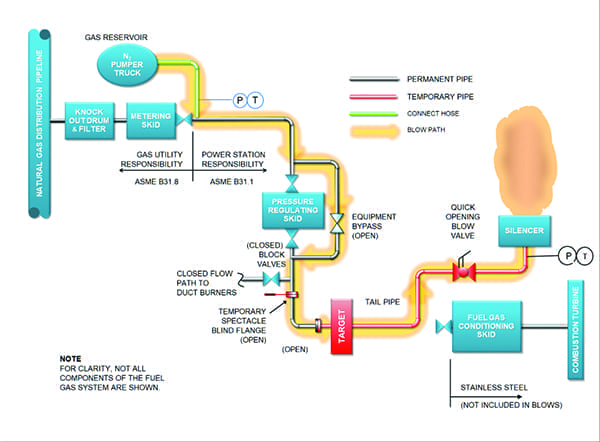
Where will the purge be directed? What are the prevailing winds? Are there building vents or other equipment air inlets nearby? If a high-pressure pipeline blowdown or pressure release is to occur, modeling of the plume may be helpful (Figure 4).
-
Are all electrical services secured in the area of the gas purge and where the venting of natural gas may occur? An explosion can only occur when an ignition source is nearby.
-
The portion of the project site where gas purges take place should be cleared of all workers, except those performing the gas purge. Spectators should not be allowed.
-
Document all of the pressure testing results (such as test pressures and how long they were held).

4. Vent safely. This is a typical piping vent. Unfortunately, it points straight down in an attempt to keep rain water from entering the pipe. Releasing a high-pressure line through vent configuration can create a ground level flammable cloud. Courtesy: CEC Combustion Safety Inc.
What Codes and Rules Apply?
There are many codes that can have some application to natural gas piping repairs. One such code is OSHA 1910.147 for lockout/tagout of hazardous energy sources. Much has been written about these requirements, and most workers make some attempt to comply with them — at least for electrical devices. However, the OSHA requirements also cover other plant systems, such as natural gas and steam piping. For instance, we often find a lock on electrical disconnects, but seldom on a closed gas valve.
Even when workers attempt to isolate equipment correctly, we find that they often do not understand the issues surrounding lubricated plug valves used in gas lines. Lubricated plug valves, which represent 60% to 80% of natural gas piping system manual shut-off valves, have a small gap between the plug and the valve body. If a sealant is not applied annually, as required by code and the manufacturer, gas will leak past the plug even when the valve is in the closed position. We find that most facilities do not have the knowledge or the equipment to seal these and have never sealed them during the life of the valve. Hence, closing or locking out a valve in this condition does not necessarily isolate the energy source. The more serious issue is that if these are not regularly sealed, the valve can become impossible to close. This means you can have an emergency and lack the ability to secure the gas supply.
The other code that applies to natural gas piping is NFPA 54: The National Fuel Gas Code (www.nfpa.org). The rules are rather lengthy, and it does take time and effort to fully understand the intent and requirements of the code. Often we run across consulting engineering firms and contractors that do not understand the basic code requirements. This lack of understanding often appears with a plant design that lacks isolation points (that is, blanks, blinds, and pancakes) and/or purge points. There seems to be little thought given to the NFPA requirements in the installation of the gas pipe or to how the gas pipe will be commissioned after installation or will be inspected and serviced in the future.
Top 10 Gas Piping Hazards
During our years of inspecting and testing fuel trains, we’ve repeatedly come across many of the same gas piping issues and hazards. Our top 10 most common hazards involved in conducting natural gas piping installation and repairs are provided below, along with insights on how to avoid them. Any time natural gas piping systems are designed or worked on, these potential hazards should be evaluated and addressed. Although the process is not simple, it can be completed safely if well-planned and properly implemented. These tips and techniques should be incorporated into your procedures for natural gas piping purging and equipment start-up.
-
Purge Points. Purge points are pipe nipples installed at strategic locations in the piping system for the purpose of introducing or removing nitrogen and natural gas at various stages of the process (Figure 5). These are generally 1-inch schedule 80 nipples (thicker and stronger than common schedule 40 pipes) with natural gas – rated ball valves on the ends. It is important to select locations or orientations that ensure that these are less susceptible to damage from things like vehicle traffic (being run into with a tow motor or scissors lift).

5. Good design practice. Typical purge points should be designed into piping systems. Courtesy: CEC Combustion Safety Inc. -
Isolation Points. Ensure that your fuel trains are not exposed to excessive pressures that can damage components during pressure testing. Use line blinds to isolate components that are pressure sensitive. Valves can accidentally be left open or leak when in the closed position. Blinds provide positive isolation and eliminate the possibility of damaging devices in a fuel train that are not rated for the elevated test pressures, such as regulators and pressure switches (Figure 6).

6. Leading the blind. Spectacle blind installations should be designed for permanent insertion. Positions can be changed depending on the need. Courtesy: CEC Combustion Safety Inc. -
Piping Support. During repairs, sections of piping may be disconnected to allow the addition of tees or to install blinds. It is important that adequate pipe supports exist to ensure that sections of pipe will not fall when disconnected. The closest support may be on the other side of the disconnected joint.
-
Gaskets. NFPA 54 does not allow the reuse of flange gaskets even if they appear to be in good shape. To ensure leak-free joints, it is important that new gaskets are used as well as properly rated bolts for the flanges. Remember that if you are mating up flanges, it is raised face to raised face and flat face to flat face.
-
Material Specifications. It is important that only proper-rated pipe and fittings are used. Validate that reputable suppliers are used and that material is free from manufacturing and installation defects. This would include checking for pinholes in cast fittings, misaligned threads, and pipe that is not the proper grade.
-
Nitrogen. The air we breathe is 78% nitrogen, but two full breaths of pure nitrogen can kill you. This inert gas is nothing to fool with. Make sure that everyone understands this hazard and ensure that purge points are marked and located in well-ventilated areas. Also, verify pressure ratings of hoses and regulators; large liquid nitrogen tanks are capable of producing high discharge pressures. When discharging nitrogen, the purge discharge areas need to be monitored. Everyone involved in the purging and pressure testing needs to be trained on the safe handling of nitrogen.
-
Discharge Locations. Make sure that purge end points where natural gas may be released are outside and located away from air intakes, building openings, and ignition sources. NFPA 54 has just released an emergency TIA (tentative interim amendment) that provides more details on this aspect of repair safety.
-
Sampling Devices. Having the proper instrumentation during natural gas introduction and removal is also important. Stopping the process due to instrumentation error can create a hazard. Make sure that two high-quality, recently calibrated lower explosive limit (LEL) meters are available. One LEL meter can be used as a barrier protector for the people near the purge end point; the other can be used with at least a 6-foot-long sensing tube that can monitor conditions at the actual discharge point for parts of the process. Do not actually stand in harm’s way at the discharge point. Instead, do a timed and measured discharge and then, while the flow is stopped, carefully approach to do an LEL check in the end of the purge hose. You will need to flush the piping at least three times, regardless of what the LEL meter reads. You will also need a different metering technology like a PID meter for the gas re-introduction and possibly even the initial purge process. Most LEL meters are not designed to be used in oxygen-deficient atmospheres.
-
Piping Integrity. NFPA 54 requires that you have documentation of pressure testing for new or repaired piping systems prior to introducing natural gas. The results of these tests should be retained for the life of the piping system. Any section of piping that has undergone recent additions or repairs should be evaluated if no test records exist. As a best practice, our firm uses pressure chart recorders to document all test results. These paper and pen battery-powered recorders come with very small pressure increment gradations (1 psig) and provide an excellent record of pressure and hold times of tests (Figure 7).

7. Test your plugs. The typical lubricated plug valve must be sealed and tested for function on an annual basis. Courtesy: CEC Combustion Safety Inc. -
Emergency Isolation. After the post-repair purge, it is imperative that the natural gas source valve be continuously attended during the re-introduction of natural gas. Communication with the individual observing the source should be continuously maintained. If a problem is detected, the supply of natural gas will need to be immediately isolated. In addition, valves should be serviced, handles installed, and valve function verified.
Managing the Risks
So whose job is natural gas piping and purging safety? The design engineers may prepare the drawings to the applicable codes and standards but may never even visit the project site. The project manager must ensure that the project meets those codes and standards but is usually consumed with schedules and budgets. Contractors are focused on meeting the project specifications, staying on schedule, and making a profit. The project safety director is usually worried about lock out, trip hazards, slips and falls, tie-offs, and other more common issues. Most city inspectors don’t understand the intricate details of gas piping commissioning because there aren’t any local ordinances with which the project must comply.
In the most recent disasters, very experienced people were conducting the work. However, in the heat of battle, many safety issues can be overlooked. There are countless daily stresses and pressures on a construction site. That’s why proper planning and commitment to safety from the top down is needed to provide the focused disciplined that can make the difference between success and failure. When the responsibility for safe natural gas pipe purging is everyone’s responsibility, then it’s no one’s responsibility.
—John Puskar, PE (jpuskar@combustionsafety.com) is a principal with CEC Combustion Safety Inc. He serves as an alternate on NFPA 86 and ASME CSD-1 committees and also serves on the NFPA 85 committee.