From the mid-1990s until about four years ago, natural gas–fired combined-cycle plants dominated new capacity additions in North America. They became the technology of choice for all the right reasons: low emissions, short construction schedules, combustion efficiency, and—most important—low fuel costs. For almost a decade, natural gas prices were moderate and stable at about $2 to $3/mmBtu.
Then, in 2002, demand for natural gas began to outstrip supply, and the price of the fuel responded in classic fashion—by rising and becoming volatile. The upward trend has continued until today (gas prices have passed $7/mmBtu), and so has the volatility, making predictions of future levels pure guesswork. The odds are that natural gas prices will never again fall below $5/mmBtu on a consistent basis.
Obviously, the higher prices have exacted severe economic penalties on combined-cycle plants. Bear in mind that for such plants, fuel costs account for about 70% of operating expenses. So the typical plant that earned big profits when gas prices were $2/mmBtu found itself just breaking even when the price hit $4 and losing money as prices rose above that level. As the production of many combined-cycle plants became too costly to dispatch, the plants were run much less often, sometimes less than 10% of the time. With no end in sight to the run-up in natural gas prices, the long-term economic viability of gas-fired combined-cycle plants became questionable at best.
For owners of existing combined-cycle plants saddled with high gas prices, the solution is to find a cheaper fuel to burn. Coal immediately comes to mind. Although the price of "steam" coal (including Powder River Basin coal) in the U.S. generation market has risen sharply over the past year, coal still costs far less per Btu than its main fossil-fuel competitors—natural gas and oil (Figure 1). What’s more, coal’s abundance makes its price inherently more stable and predictable over the long haul.
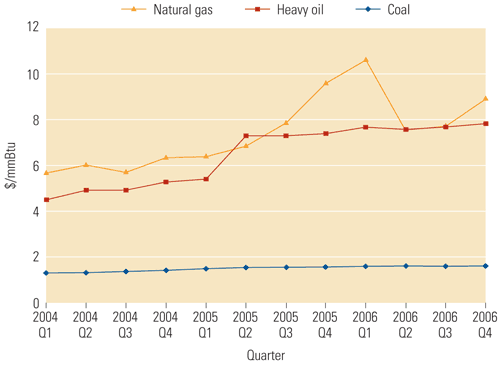
1. Short-term price outlooks for coal, oil, and natural gas, as of July 2005. Source: U.S. Energy Information Agency
Making a purely economic case for burning coal, rather than gas, in combined-cycle plants is easy. It’s much harder, however, to make a convincing argument that the technology is available to do so at reasonable cost. After all, existing combined-cycle plants were designed to burn gas or oil (a liquid), not a solid fuel such as coal. The remainder of this article examines the current state of technologies for gasifying coal. Included are management-level analyses of the technical considerations and economic consequences of adapting an existing combined-cycle plant to burn coal rather than natural gas.
Gasification options
A number of demonstration plants and some commercial gas turbines have burned synthesis gases (syngas) for years. Syngas is produced by gasifiers operating on feedstocks such as coal or petroleum coke. Many different kinds of gasifiers have been developed over the past 30 years.
Experience indicates that the burners and other components of the gas turbines of a combined-cycle plant must be modified to allow the turbines to burn syngas efficiently, cleanly, and cost-effectively. The extent of the required modifications is largely a function of the gasification process chosen.
For this reason, considerable research has been done—and continues to be done—on the technological development and economics of integrated gasification combined-cycle (IGCC) plants. Significantly, the body of evidence indicates the following: Assuming a coal price of about $2/mmBtu, an IGCC plant would produce electricity at a lower cost than a gas-fired combined-cycle plant of identical capacity—but only when the price of natural gas is above $5 to $6/mmBtu. Having passed that threshold, production of syngas for burning in combined-cycle plants should now be economically viable—at least in theory.
Existing gasification processes have proven capable of producing quality syngas. Figure 2 (p. 34) is a simplified diagram of a generic process. The four most familiar production processes are illustrated in Figure 3, with their parameters detailed in Table 1.
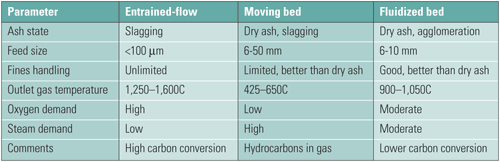
Table 1. Syngas process parameters. Source: WorleyParsons
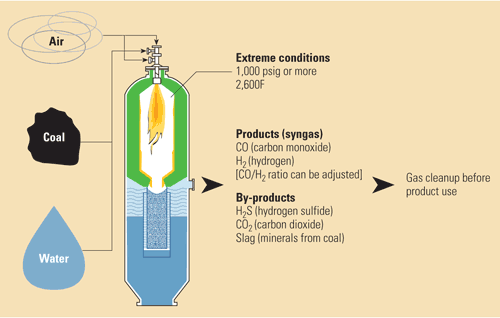
2. Gasification: The essentials. Source: WorleyParsons
In the race to supply the gasifiers of IGCC plants, three main competitors are still in the running. All three companies use entrained-flow gasifiers similar to the one in Figure 3. GE Energy recently purchased and is marketing Texaco’s technology. ConocoPhillips is commercializing its E-Gas technology. Shell is marketing technology it developed on its own. Table 2 presents the salient characteristics of the three gasification technologies.
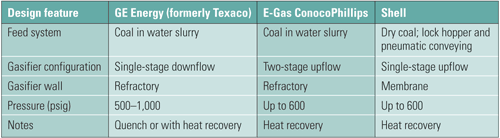
Table 2. Syngas production technology suppliers. Source: WorleyParsons
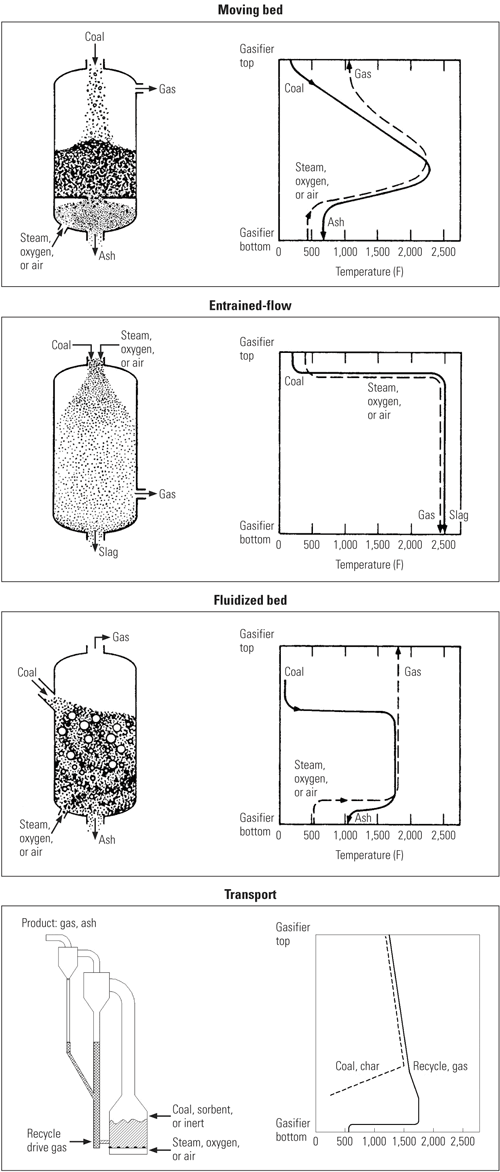
3. The four most familiar gasification technologies. Source: WorleyParsons
Integration considerations
Commercial gasification processes still struggle to achieve the high availability that power producers require, but progress is being made. Partial refueling (combining syngas with natural gas), with natural gas serving as the backup fuel supply, could reduce the impact of reduced availability, particularly during the first few years of an IGCC plant’s life. Other possibilities for improving availability include installing a spare or redundant gasifier.
Integrating the gasifier and the power plant helps maximize the economic benefit of the lower cost of coal or pet coke. Figure 4 is a simplified view of a complete IGCC plant.
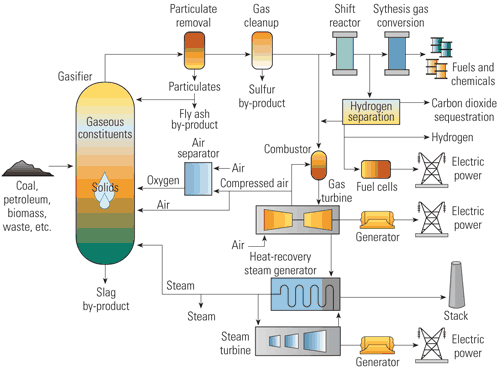
4. Block/process diagram of a typical IGCC plant. Source: WorleyParsons
A coal or coke gasification facility requires significant on-site space for itself and its fuel unloading, storage, and handling systems. The footprint of a complete IGCC plant could be as much as five times larger than that of a gas-fired combined-cycle plant of similar capacity. As with any plant that uses coal, emissions and fugitive dust from handling the fuel are concerns. Nonetheless, an IGCC plant—including the gas cleanup needed between the gasifier and the gas turbine(s)—would produce far less air pollution than the cleanest coal plant in service today. On the other hand, due to the substantial size and amount of its coal-related equipment, an IGCC plant might be twice as costly to build as a gas-fired combined-cycle plant.
Modifying the existing plant
Evaluating and pricing the effects of IGCC refueling of a combined-cycle plant requires analyzing a plethora of impacts. For categorization purposes, the list below identifies nine plant areas and equipment in them that may have to be modified. Some of the items listed for consideration can be dismissed easily, whereas others may require detailed evaluation.
Site
- Space for retrofit.
- Distance from gasifier to combined-cycle plant.
- Larger gas turbine enclosure and more extensive balance-of-plant.
- Area for gasification plant.
- Accessibility for gas turbine modification.
- Accessibility for plant construction.
- Coal availability and accessibility.
Materials handling
- Coal transport means and delivery.
- Coal handling and storage.
- By-product handling and storage.
- Reagent sourcing, handling, and storage.
Site utilities
- Additional cooling water.
- Process water consumption.
- Additional wastewater discharge.
Environmental
- Permitting of coal plant, vis-a-vis natural gas plant.
- Site environmental recharacterization.
- Revised air modeling.
- Local impact of coal and by-product transport.
- SCR/ammonia system capability.
Gas turbines
- Firing temperature needs to be reduced to mitigate adverse effect of high flame temperature of hydrogen on component life.
- Fuel/exhaust flow ratio increases significantly, requires less combustion air.
- Output and exhaust flow increase; heat rate and exhaust temperature decrease.
- Typical emissions from burning syngas: 15 to 25 ppm NOx/CO.
- Output can be maintained fairly constant over wider range of ambient temperatures.
- Need start-up fuel that can be used for co-firing or as full backup.
- Compressor (air extraction, adjustment to some compressor stages).
- Combustor: Dry, low-NOx burners must be replaced by multinozzle quiet combustors (MNQCs). Need to add diluent and start-up fuel connections, modify/replace caps, liners, and flow sleeves.
- Replace turbines’ first-stage nozzle, support, and retaining rings.
- Generator capability must be verified.
- Auxiliary skids (fuel and diluent skids, ventilation, purge, fire protection).
- Control systems (additional I/O and integration with gasifier process).
Heat-recovery steam generator and accessories
- Thermal performance to be revisited, based on new gas turbine exhaust data.
- Back-end temperature may have to be raised to remain above acid dew point.
- Higher exhaust flow may increase backpressure and impact gas turbine performance.
- CO and SCR module sizes to be revisited for higher gas turbine emissions and flow.
- Impact of "S" bearing compound on SCR system performance needs to be verified.
- IGCC process steam supply and integration of intermediate- and low-pressure steam from process need to be verified.
Steam turbine and accessories
- Thermal performance to be revisited, based on new process conditions.
- Integration of additional IP and LP steam from process.
- Generator capability needs to be verified.
- Steam turbine-generator bypass system to be revisited.
Power cycle
- Verify ratings of major equipment and piping for any potential changes. Operating conditions may change somewhat.
- New steam piping to and from gasifier must be added.
- Condenser makeup flow may have to be increased. External deaerator may be needed due to large makeup requirements.
Balance-of-plant systems (BOP)
- Verify capability of electrical system (bus ducts, step-up transformers, switchyard, etc.) due to increased rating of the power train.
- Add new electrical supply system for gasifier.
- Verify capacity of water treatment and ammonia storage and handling systems, demin water storage and handling systems.
- Add diluent piping for gas turbines.
- Impact on other BOP systems should be revisited, based on integration of common systems with the IGCC process.
Although the sheer number of items that need to be considered is daunting, the evaluation can be completed quickly if the team doing it is experienced. Making a handful of initial decisions can speed the process and clarify the consequences of refueling on the extent of required modifications. These decisions will involve:
- The extent of refueling. Changing the plant’s fuel mix from 100% natural gas to a 75/25 mixture of natural gas and syngas, for example, might require minimal or no significant modifications.
- Availability/capacity factor. If the refueled plant must be nearly 100% available, modifications should enable an easy return to burning the backup fuel—the existing natural gas supply—whenever the gasifier goes down.
- Higher plant rating. Because switching to burning syngas may significantly increase the output of a gas turbine, the rating of its generator and the size of bus ducts and some balance-of-plant equipment may have to be increased accordingly.
Running the numbers
Given the immaturity of coal-gasification technology, it might make economic sense not to put all your eggs in the syngas basket. A conservative refueling strategy, for instance, would entail replacing just 25% of power plant’s natural gas fuel with syngas. Doing so would deliver two big benefits: a smaller bill for natural gas purchases and a lower retrofit cost.
Determining whether the break-even point is 25% or some other percentage requires making some assumptions (Table 3). As a back-of-the-envelope calculation, replacing 25% of the plant’s natural gas fuel (priced at $10/mmBtu) with syngas (which costs $6/mmBtu to produce, including the capital cost effects) would reduce the plant’s annual fuel bill by 10%. With this lower effective fuel cost, the plant would likely be dispatched significantly more. And as the last five rows of Table 3 make clear, lowering the marginal dispatch cost of a combined-cycle plant by refueling it—even partially—would significantly improve its capacity factor.
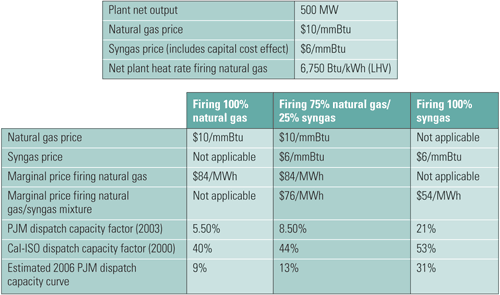
Table 3. Economic assumptions for a partial-refueling case. Source: WorleyParsons
Depending on the natural gas/syngas price differential, IGCC refueling could significantly improve the profitability of your combined-cycle plant. But the only way to determine whether gasification is in your future is to conduct a study of your specifics—the cost of required modifications, the cost of building a gasification plant, site conditions, prevailing dispatch prices and capacity factors, and the like. As always, you have to spend some money to make some money.
The data and diagrams in this article were derived from various DOE projects performed by WorleyParsons under the direction of Richard Weinstein.