Even though the U.S. Environmental Protection Agency (EPA) is now CAIR-free, a lot of folks at the agency’s air quality program aren’t very happy.
The federal court decision issued on July 11 that struck down the Clean Air Interstate Rule (CAIR) blindsided both regulators and power industry professionals and left them shaking their heads. To make matters worse, this decision came after another federal court decision in February that threw out the Clean Air Mercury Rule (CAMR).
But the surprise packages don’t stop there. On April 2, 2007, the U.S. Supreme Court ruled in its Massachusetts v. EPA decision that the Clean Air Act (CAA) authorizes the EPA to regulate greenhouse gas (GHG) emissions from automobiles if the agency determines they pose a threat to human health. On July 11, EPA Administrator Stephen Johnson responded to the Supreme Court’s ruling by announcing that the CAA is “the wrong tool” to regulate GHG emissions and that Congress should act on developing new legislation to control GHGs.
To figure out where industry now stands in the wake of these recent topsy-turvy events requires taking a closer look at these legal actions and at the EPA’s ability to regulate air pollution in the future.
Closing the door on CAIR
CAIR established a cap-and-trade program for controlling fine particulates and smog-causing emissions. The EPA estimated the rule would cut sulfur dioxide and nitrogen oxide pollution by as much as 70% by 2025. In a surprising alliance, the power industry and most environmentalists generally supported the program (Figure 1).
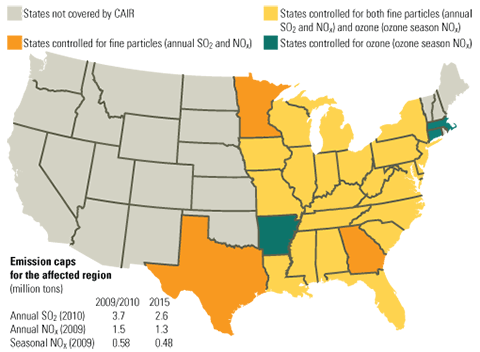
1. Removing the cap. The Clean Air Interstate Rule was focused on reducing emissions of principally SO2, NOx, and particulates in 28 eastern states and the District of Columbia. CAIR was declared void by the U.S. Court of Appeals on July 11. Source: EPA
Despite CAIR’s popularity, the U.S. Court of Appeals for the District of Columbia dismissed the rule and declared it was illegal because it failed to require each state to analyze its own contribution to poor air quality. The court stated that the trading program should connect a state’s emissions reduction with its contribution to pollution.
The court did acknowledge concern that throwing out the entire CAIR rule–as opposed to letting the EPA fix the problems cited in the opinion–would delay the substantial emissions reductions that would be achieved by the CAIR program. Such an acknowledgement provides small consolation to affected stakeholders, such as power plants that spent huge sums of money trying to comply with CAIR.
Mercury regulation: Back to the drawing board
Under the Clean Air Mercury Rule, many coal-fired power plants in the U.S. would have been mandated to cut their mercury emissions below current levels by 2010, and additional reductions were scheduled to take place by 2018. CAMR also established a national mercury emissions trading program to reduce industry compliance costs (Figure 2).
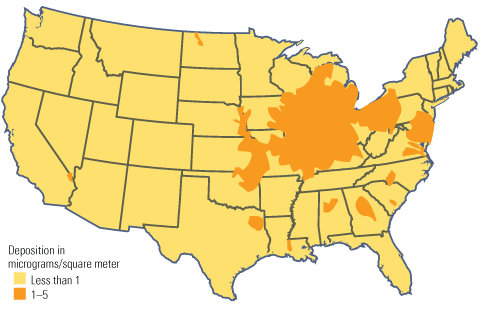
2. Projected mercury deposition from power plants in 2020 with CAIR and CAMR. Equipment added to power plants to meet CAIR also provided significant mercury removal co-benefits. Source: EPA
A companion rule issued along with CAMR reversed the 2000 Clinton Administration finding that utility emissions of mercury and other hazardous air pollutants must be regulated under a maximum achievable control technology (MACT) standard, which is much stricter than the 70% reduction required under CAMR. In February 2008, however, the U.S. District of Columbia Circuit Court of Appeals dismissed CAMR by saying the EPA’s delisting of mercury from the list of hazardous air pollutants (HAPs) that require higher removal rates implemented over a shorter schedule (Section 112) was wrong.
In its ruling, the court stated: “We hold that the delisting was unlawful. Section 112 requires EPA to regulate emissions of HAPs. Section 112(n) requires EPA to regulate EGUs [electric utility steam generating units] under section 112 when it concludes that doing so ‘is appropriate and necessary.’ In 2000, EPA concluded that is was ‘appropriate and necessary’ to regulate mercury emissions from coal- and oil-fired power plants under section 112 and listed these EGUs as sources of HAPs regulated under that section. In 2005, after reconsidering its previous determination, EPA purported to remove these EGUs from the section 112 list. Thereafter it promulgated CAMR under section 111. EPA’s removal of these EGUs from the section 112 list violates the CAA because section 112(c)(9) requires EPA to make specific findings before removing a source listed under section 112; EPA concedes it never made such findings. Because coal-fired EGUs are listed sources under section 112, regulation of existing coal-fired EGUs’ mercury emissions under section 111 is prohibited, effectively invalidating CAMR’s regulatory approach.” (For more analysis of this topic, see “Future of national mercury rule now uncertain,” in POWER’s May 2008 issue.)
The EPA is still regrouping and evaluating the impact from the recent court decision and has not dismissed a cap-and-trade system under a new mercury rule. The ruling has serious implications for coal-fired power plants that are seeking permits or have already received permits because they now have to achieve at least a 90% mercury removal rate. This regulatory backflip underscores the need for utilities to develop more effective mercury capture systems as soon as feasible.
In the meantime, almost 20 states have enacted or are in the process of adopting some form of mercury control rules that are usually more stringent (up to 95% removal rate), effective sooner, and, in most cases, without provisions for trading mercury emission credits. This crazy quilt of regulations will only make design of a national plan for mercury control more tedious for the next administration.
Why is it that so many states are able to write, implement, and enforce mercury emission rules, yet the EPA is so ineffective?
Tackling greenhouse gases
On July 11, EPA Administrator Johnson confirmed that the Bush Administration will not make a determination before the end of its term as to whether GHGs pose a potential threat to human health. Johnson also released the Advanced Notice of Proposed Rulemaking (ANPR, www.epa.gov/climatechange/anpr.html), which is a lengthy document that details options his agency could exercise for reducing GHGs under the CAA and their possible consequences. According to Johnson, the ANPR reflects the complexity and magnitude of the question of whether and how GHGs could be effectively controlled under the CAA.
“If our nation is truly serious about regulating greenhouse gases, the CAA is the wrong tool for the job,” Johnson said. “It’s really at the feet of Congress to come up with good legislation that cuts through what is likely to be decades of regulation and litigation.”
Besides looking at options for regulating GHG emissions from various sources, the ANPR also mentions concerns about the impact such actions would have on jobs and the U.S. economy. The document was published in the Federal Register on July 30; comments are due by November 28.
The business community and environmental groups complained about the EPA’s actions regarding GHGs for different reasons. For example, the Heritage Foundation, a conservative, free market-oriented think tank, issued a statement in July saying that if the EPA were to regulate GHGs under the CAA, it would be a “prescription for substantial economic pain for little or no environmental benefit.”
In contrast, the Union of Concerned Scientists (UCS), which favors regulation of GHGs, released an announcement accusing the EPA under President Bush of taking a “do-nothing approach to global warming.”
“By ignoring calls for action from scientists and the public at large, EPA Administrator Johnson is passing the monumental problem off to the next administration,” said Lexi Shultz, deputy director of the UCS’s Climate Program.
Tired of the regulatory roller-coaster
No doubt many professionals in the power industry are worn out from dealing with the recent wild gyrations in federal air pollution regulations. Power utilities, like other U.S. industries, need predictability in environmental laws in order for them to run their operations cost-effectively and budget for the purchase and installation of expensive pollution control equipment.
In a recent interview with The New York Times concerning the impact of the federal appeals court’s overturning of CAIR, Brent W. Dorsey, the director of corporate environmental programs at Entergy, stated, “With this thing thrown out, we’ve basically thrown the baby out with the bathwater.”
“Right now we find ourselves in the Twilight Zone,” Dorsey said. “How do you proceed now? Do we continue to buy emissions allowances? Do we work on putting scrubbers in, or what?”
Just like their counterparts in industry, a number of environmental groups also appear frustrated with some of these recent reversals of major air quality laws. For example, in July, Eric Schaeffer, director of the Environmental Integrity Project, released a statement in which he commented that the court’s overturning of CAIR would further weaken environmental emission standards.
“Since this administration has proved incapable of reading or following the law, Congress and the next president will have to write the standards we need to protect the public health from air pollution,” said Schaffer.
For more commentary on the future of CAIR, CAMR, and the impact of GHG regulations proposed in the ANPR, see the July/August issue of POWER’s sister publication, COAL POWER (www.coalpowermag.com).
States fill the void
Given the recent setbacks and federal-level inaction in regulating major air pollutants, states have begun working together within regional groups to enact regulatory policies to control certain air pollutants. As of May 2008, 19 states had implemented a GHG target, six states had implemented GHG caps, and four states had implemented GHG performance standards or CO2 offset requirements for the power generation industry.
For example, the Regional Greenhouse Gas Initiative (RGGI) is a program in the U.S. Northeast that was set up to cut GHGs. Participating states include Maine, New Hampshire, Vermont, Connecticut, New York, New Jersey, Delaware, Massachusetts, Maryland, and Rhode Island. Currently, the RGGI is designing a cap-and-trade system for CO2 emissions from power plants. At the time this article was written in July, emission permits were scheduled to be auctioned beginning in September, and the first three-year compliance program was set to start on January 1, 2009.
Operating along similar lines, the Western Climate Initiative (WCI) has the following partners: the U.S. states of Arizona, California, Montana, New Mexico, Oregon, Utah, and Washington, and the Canadian provinces of British Columbia, Manitoba, Ontario, and Quebec. WCI’s goal is to establish an international cap-and-trade program that would involve both the U.S. and Canada. At press time, the program was in the process of conducting workshops to determine the design of its regional cap-and-trade program and was expected to release final design recommendations in mid-September.
Of course, if in the near future the Congress does pass climate change legislation that’s approved by the next president, the new federal laws would preempt the regional and state programs that have already been set up and possibly stir up a storm of protest from states that have enacted more stringent regulations. Once again industry is being put in the position of trying to comply with air pollution control laws that are a moving target.
Looking beyond, to 2009
It’s clear that no matter which presidential candidate–either John McCain or Barack Obama–wins in November, come January 20, 2009, the EPA will begin to move toward more aggressive environmental policies. McCain and Obama have similar positions on how to deal with climate change (see “Not a quarter’s worth of difference,” in POWER’s July 2008 issue). Both support market-based cap-and-trade systems to reduce carbon emissions. Obama’s proposed program, however, is more ambitious in that it seeks to cut emissions 80% below 1990 levels by 2050. In contrast, McCain’s plan seeks to reduce emissions by 60% below 1990 levels by 2050. Working with Congress to pass legislation to deal with the issues of climate change and energy will certainly be near the top of each candidate’s agenda if he is elected.
In early 2009, the next president will need to move rapidly to pick a chief administrator of the EPA who shares his vision of how the agency should pursue the goal of protecting the environment and reducing industrial pollution. Given the recent upheavals in the EPA’s air quality program, it is particularly important that the new administration advance air quality initiatives that seek to achieve the optimum protection of human health while also promoting reasonable and consistent compliance goals for industry.