Distributed generation (DG) can be configured in many different ways, with many kinds of technologies and equipment. Among the choices are gas turbines, reciprocating engine-generator sets, photovoltaic arrays, and wind turbines. Fossil-fueled DG systems can take the form of cogeneration or combined heat and power (CHP) plants. On-site power systems that partially shed electrical load or remove load during peak demand periods also fit the definition of DG. All of these systems reduce the load that the local utility must serve and benefit the end user with lower energy bills and improved reliability.
Perfectly matching a DG system to its application isn’t always easy, but it is usually well worth the effort. The choice of the system’s fuel is determined by local availabilities and the fuels’ relative Btu content and impact on the environment. Money matters, too; being able to use all of the energy produced by a DG system is a key aspect of its financial viability.
DG’s high efficiency, compared with that of utility power (85% to 90% for CHP applications, vs. 33% for central station units), affords tremendous potential for conserving energy and reducing greenhouse gas emissions. Efficient, fossil-fueled DG systems release less CO2 per kWh or Btu generated than less-efficient generation.
Recips dominate
While exotic generating technologies capture the attention of the media, the most widely used on-site generating technology is the workhorse reciprocating engine-generator, fueled by natural gas, landfill methane, or diesel. If the application can make use of the waste heat from the engine, the installed system will also include heat-recovery equipment to produce hot air, hot water, and/or steam.
Economics also plays a big role in the decision to generate your own power. Favored locations have both relatively high electric rates and low prices for natural gas or diesel. Another plus is a government subsidy or incentive to increase efficiency or reduce air pollution. Interconnecting to the local utility still poses a problem in some areas, but the financial viability of most on-site power systems has not hinged on the willingness of utilities to buy surplus electric power produced by end users. The fact is, the power and heat have much more value when they can be fully utilized on-site.
The variability of DG applications is quite broad, and although the hardware may be similar from one application to the next, the ways in which the electric power and/or heat are used vary widely. The following six case studies represent a spectrum of applications that use reciprocating engine technologies to generate on-site power and heat.
Landfill gas helps power Scottish cement plant
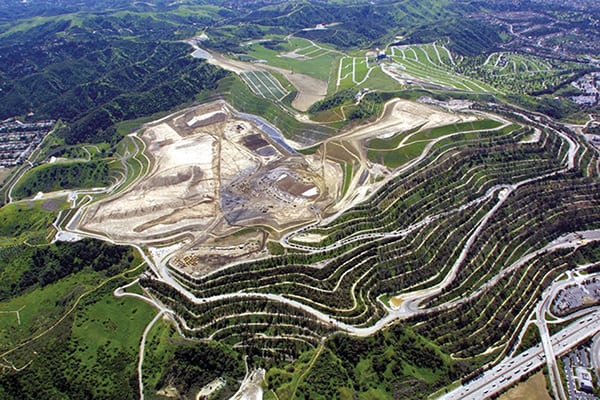
In Dunbar, Scotland, Viridor Waste Management, one of the UK’s largest operators of municipal landfills, manages a 193-acre site that uses two gensets fueled by low-Btu landfill gas to produce 3.5 MW of electricity (Figure 1). As paper and other organic materials decompose in landfills, a natural by-product of that decay is methane, one of the major flammable components of natural gas. Though this natural release of methane is dilute, it is still a greenhouse gas with 20 times the global warming potential of CO2. The gensets extract energy from the methane that would otherwise be wasted, while protecting the environment.

1. Over the fence. The power building at a landfill in Scotland houses two 1.75-MW gensets that convert low-Btu landfill gas to electricity, which is sold to a nearby cement plant. Courtesy: Cummins Power Generation
The two 1.75-MW gensets operate in parallel. Each is powered by an engine that was modified to run on dilute methane. The engines have an enlarged fuel delivery system, double-safety gas shutoff valves, and special coatings and bearing materials to withstand any corrosive contaminants in the landfill gas.
The two gensets are housed in a power building with room for two more units. Additional units will be installed as the landfill grows and methane production increases, doubling the DG system output to 7 MW. At current "tipping" rates, the landfill is expected to operate for the next 30 years.
The first two gensets were chosen for their high power output relative to capital cost and because Cummins Power Generation and its local distributor helped design the complex connection for exporting their electricity to the nearby Lafarge Cement works, which purchases the power. The cement plant’s total electrical demand is about 23 MW, and the gensets supply about 15% of that, at a lower cost than local grid power.
The project’s bottom line also benefits from supplemental revenue in the form of renewable obligation certificates (ROCs), part of a UK government scheme to encourage usage of renewable energy like landfill methane. Every megawatt-hour of electricity generated produces one ROC that can be sold. At current market prices of about US$80 to $90 per ROC, the system’s net cost of generation is competitive with utility grid power. In other words, Viridor can generate electricity from the landfill gas, sell it to the cement plant below the cost of local power, and make enough money to recoup the system’s capital cost over time.
Smaller electric bills in Brazil
Across the Atlantic, the World Trade Center (WTC) in São Paulo, Brazil, is making use of distributed generation to cut costs and provide more reliable electric power for its tenants. The 1.75-million-square-foot complex includes the state-of-the-art WTC Business Tower, the elegant Hotel Gran Meliá São Paulo WTC, and one of Latin America’s most upscale malls, the D&D shopping center.
In 2003, the WTC installed three natural gas�powered gensets that have reduced demand for high-cost grid power during peak demand periods by as much as 30%. With the help of a black-start diesel-generator also installed as part of the project, the gensets even ensure that the lights and air-conditioning will stay on during a utility outage. The power system, which is housed in a separate building (Figure 2), has done such a good job of reducing tenants’ electric bills and improving reliability that the WTC features it in rental advertising.
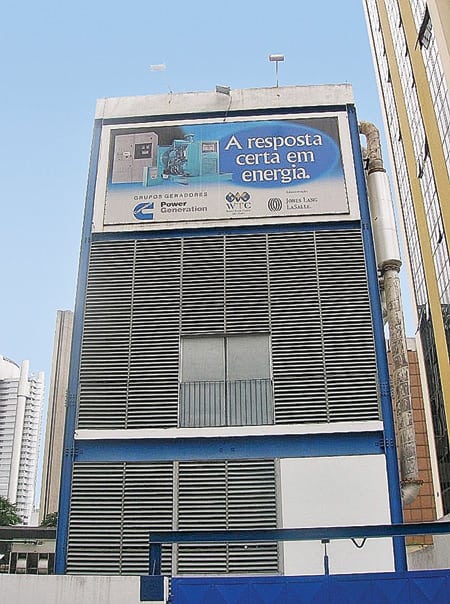
2. Keeping costs down. This power building adjacent to the World Trade Center in São Paulo, Brazil, houses three natural gas�powered gensets with a total generating capacity of 5.25 MW. By producing power during afternoon periods of peak demand, they have lowered tenants’ electric bills by as much as 30%. Courtesy: Cummins Power Generation
The WTC São Paulo system comprises three 1.7-MW lean-burn gensets that produce enough power for a city of 5,000. Natural gas was the only fuel considered because city environmental rules specify its use for power generation in commercial and residential areas.
The gensets’ main mission is to cut tenants’ costs during peak demand periods. They usually are run Monday through Friday from 6:30 p.m. to 9:30 p.m. during the Brazilian summer and from 5:30 p.m. to 8:30 p.m. in the winter. During those periods, the load on the generators varies from 3.5 to 4.9 MW.
When the generators are running, they are in parallel with the local utility grid but do not export power. In the event of a blackout, they are automatically isolated from the grid and become WTC São Paulo’s sole source of electricity. During off-peak periods, the gensets can power the entire complex; during peak demand periods, some load shedding typically is required.
Pasta factory turns to CHP
Near Bogotá, Colombia, a large manufacturer of pasta products often had to shut down its production line due to grid failures and voltage instabilities. Pastas Doria, a food processing giant, also was seeing its expenditures for electricity and fuel oil (used to produce process steam) skyrocket.
To keep the production line up and running and to cut its energy costs, Pastas Doria installed a natural gas�fueled CHP system whose electrical output is more reliable and stable than local grid power. The system also exhausts 3.4 million Btu/hr of waste heat to the factory’s boilers, pasta-drying equipment, and space heaters, reducing their oil consumption considerably.
Pastas Doria has produced a wide variety of pasta products in Colombia for 53 years. It currently makes more than 50,000 metric tons annually—about 40% of all the pasta consumed in the country. Since installing the CHP system, the company has seen its electricity and oil bills fall by 60% and 70%, respectively. The combined savings total about $50,000 monthly. Burning gas rather than oil also reduces the factory’s emissions of air pollutants.
The CHP system consists of a lean-burn reciprocating engine-generator, a heat exchanger at its exhaust to provide the waste heat and switchgear and controls. The engine-generator (Figure 3), rated at 1.75 MW, operates 24/7 and in parallel with the local utility grid, helping to stabilize its voltage. Should there be a grid outage, the CHP system would disconnect but continue to operate.

3. Pasta plant says, "Basta!" This 1,750-kW gas-fired reciprocating engine-generator in Colombia is the heart of a CHP plant that has considerably reduced a pasta factory’s electricity and oil consumption. Courtesy: Cummins Power Generation
Diesel cogen plant does triple duty
Some DG systems run on diesel fuel, typically if natural gas is unavailable or too costly. In India, Gujarat Fluorochemical Limited (GFL), a manufacturer of refrigerants, installed a 3-MVA diesel-powered cogeneration system (Figure 4) at its factory when it grew tired of experiencing up to four local utility power outages each month. The blackouts interrupted GFL’s 45-day refrigerant gas production cycle, and the breaks resulted in lost materials and delayed deliveries.
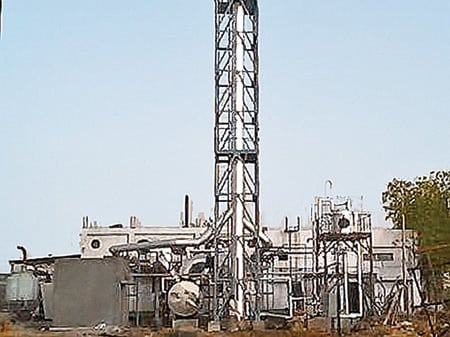
4. Running hot and cold. This 3-MVA diesel-fueled cogeneration system in India produces electricity, process steam, and chilled water for a refrigerant manufacturing plant. Courtesy: Cummins Power Generation
There was another reason on-site power production made sense to GFL. With the worldwide phase-out of CFC (chlorofluorocarbon) refrigerants, the factory’s production and sales were waning. As a result, GFL left no stone unturned in its quest to cut operating expenses for power and process steam.
GFL’s top priority for the cogen project was becoming able to purchase or generate cheaper kilowatt-hours than those available from the local utility. Another goal was to increase the factory’s operational reliability to more than 8,000 hours annually (including uninterrupted power in blocks of at least 1,000 hours) to accommodate the 45-day production cycle. Finally, GFL wanted the system to be as versatile as possible because the manufacturing process requires electricity, steam, and chilled water.
The on-site power system that was installed consisted of two 1.5-MVA gensets with remote radiators and a heat-recovery boiler and associated control equipment for utility paralleling. The two units can produce 2.1 MW on a continuous basis, and they can burn diesel fuel, light diesel oil, or superior kerosene oil. The choice of fuel depends on its local supply and price.
When the engine-generators are operating, the heat-recovery boiler produces 2,000 lb/hr of steam at 12 bar for manufacturing processes. For the GFL application, the system’s option of running a chilled water generator on energy from the engines’ cooling jackets is particularly useful.
More-reliable feed production
California’s soaring electricity and natural gas prices drove a large manufacturer of animal feed in the San Joaquin Valley to do something to reduce its energy costs. Western Milling, based in Goshen, turns grains into a full range of liquid, bagged, and bulk animal feed products and food by-products. The company’s conveyors, mixers, grinders, blenders, and pellet mills run 24/7, so they use a lot of electricity, steam, and hot water.
After considering its on-site generation options, Western Milling decided to buy and install a CHP system powered by natural gas. At its heart is a lean-burn engine-generator that produces 1.2 MW, 2,200 lb/hr of steam at 115 psi, and 30 gallons per minute of water at 190F.
For the project to pay off, the system would have to be efficient and available at least 95% of the time. So far, it has been both. As a result, the reliability of electrical service and the supply of steam and hot water to the feed factory have improved. The original system for producing steam and hot water consisted of two steam generators. If one was down for repair, the other could generate only 85% of the steam needed for feed processing. Now, with the CHP system operating, the plant can operate on one steam generator, leaving the other one for backup.
Another plus of DG systems powered by reciprocating engine technology is their speed of installation. Western Milling commissioned its CHP system (including a circuit for running it in parallel with the local utility) just 12 weeks after placing the order.
In California, DG systems must comply with the world’s most restrictive air-pollution standards. For example, the exhaust of the Western Milling CHP plant goes into a selective catalytic reduction (SCR) system that uses urea injection to reduce the plant’s NOx emissions to 5 ppm, about half the local permitted level. The CHP plant and the SCR system are enclosed in an Independent System Operator-style container and located outside the processing facility (Figure 5).

5. Clean and mean. Inside this container are a CHP plant and a complete selective catalytic reduction system for reducing its NOx emissions. The plant delivers 1.2 MW of electricity, 2,200 lb/hr of steam, and 30 gallons per minute of hot water to a California feed processing facility. Courtesy: Cummins Power Generation
Expanding CHP options
In a novel CHP application, the Belgian utility Electrabel now uses gas-fired reciprocating engine-generator sets to generate electricity and thermal energy for its gas distribution center in Brussels (Figure 6). The power generated by the gensets is sent to the national power grid, while waste heat from the engines is used to preheat high-pressure pipelines used for gas pressure reduction and distribution.
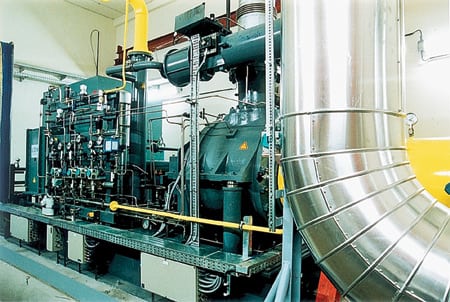
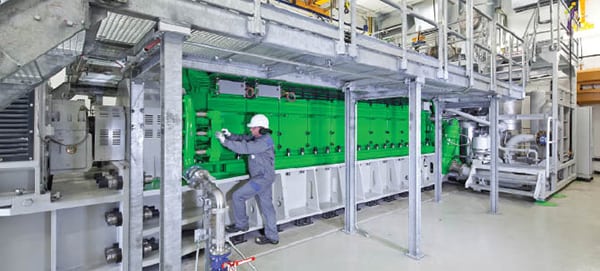
6. Under pressure. A unique turboexpander is part of an on-site power system in Brussels that extracts energy from high-pressure natural gas, with the help of waste heat from reciprocating engine-generators. Courtesy: Cummins Power Generation
The Electrabel facility reduces the pressure of natural gas from as much as 14 bar to about 1.7 bar before putting it into the gas distribution network. The network serves about 300,000 domestic and industrial natural gas customers in north Brussels and in seven surrounding municipalities in the Flanders region.
Configured as a CHP system, the gensets produce 2.7 MW of electricity and 3.5 MW of thermal energy. Most of the thermal energy is used to preheat pipeline gas entering a pressure-reducing turboexpander.
In traditional gas transmission and distribution systems, the reduction or regulation of pressure in the system is usually controlled by a special valve. The energy lost by this process can represent a large portion of the energy originally used to compress the gas. An alternative approach uses a turboexpander (Figure 6) instead of a valve to simultaneously provide a controlled reduction of gas pressure and produce useful work by turning an electrical turbine.
In the Electrabel application, as the gas passes through the turboexpander, its pressure is reduced and energy is extracted by the turbine blades to turn a 2.6-MW alternator. However, because the gas expands in the process, its temperature drops, causing any moisture in it to freeze. To prevent this from happening, the incoming gas is heated with 2.7 MW of waste heat from the gensets. Most of the heat is produced by the gensets’ exhaust, and the rest is recovered from the engines’ cooling water jackets and oil sumps.
Excess waste heat from the engines not used to heat the pipeline is used for space heating during the winter. During the summer, this excess heat is dispersed by roof-mounted radiators.
Together, the CHP plant and the turboexpander-driven alternator produce 5.3 MW of electricity that is fed directly into the grid. Electrabel chose a cogen plant rather than a conventional boiler to preheat the gas because it can put the output of the plant to good use. The system has raised the efficiency of the distribution system to about 86% and made it more reliable as well.
—Keith Packham (keith.packham@cummins.com) is gas applications manager for Cummins Power Generation, Ramsgate, UK.