Renewables require rethinking just about everything
Renewable portfolio standards (RPS) are here to stay, with nearly half of U.S. states having adopted some measure to push regulated utilities to use more power generated by the wind, the sun, or biomass. In some states it took quite a while for regulators or legislators to decide that some level of RPS makes sense. The most recent law, enacted in Arizona in November, was the culmination of three years of "study." It requires utilities to get 15% of their supply from renewables by 2025. Where that number came from, and its relation to the current level of 1.1%, are anyone’s guess.
Another "known unknown," as former Defense Secretary Donald Rumsfeld might call it, is whether the invisible hand of the free market will ultimately pat or slap the practice of allowing each state to decide for itself what a renewable is (see this month’s Legal & Regulatory column for California’s latest definition of a renewable), the mandated penetration level, and the penalties for noncompliance. The wide variation in state RPS rules is understandable, given that they are promulgated by political appointees who tend to treat ratepayers paternalistically. POWER’s research indicates that, although most ratepayers are risk-averse, the majority say they are willing to pay a minor "subsidy" to add renewables to their local utility’s resource mix. But far fewer answer "yes" when told that increasing renewables" share may significantly raise their monthly bills or make power outages more frequent.
Today there are finite numbers of renewable projects under development but an increasing number of utilities under the gun to add renewables-fueled capacity. Economics 101 tells us that when a resource is in short supply, its price will rise if demand remains constant—and skyrocket if it grows. With RPS, states are effectively forcing regulated gencos either to pay higher prices to developers, build capacity themselves (where allowed), or pay the penalties. In Massachusetts, the latest renewables request for proposals received bids at just a few cents under the penalty price. Where’s the motivation in that?
Comments by two members of the Arizona Corporation Commission (ACC) after passing the new RPS frame the debate nicely. Bill Mundell noted, "This truly is an historic vote that will lead to environmental benefits, economic development, higher-paying jobs, and less dependence on fossil fuels that originate in volatile regions of the world." Mike Gleason expressed a contrarian view: "The ACC passed a rules package that does not control the cost and will probably degrade the reliability of the western electric grid. In its haste to enact the rules, the Commission has allowed Arizona utilities to use ratepayer dollars to buy renewable energy credits from distributed generators located anywhere." Time will tell which side is right.
Most renewable energy plants are much smaller than traditional, utility-size facilities being developed—coal-fired and nuclear plants. But that doesn’t make them any less interesting or significant. The next four stories provide a virtual tour of some renewable, alternative, and unique energy projects we find particularly fascinating. Although there’s something here to intrigue every reader, we confess to having an ulterior motive. We want to pique your interest in our feature article on osmotic power (from the sea) and our Special Report on wind power. In the latter, two technology-focused articles take a close look at the challenges that wind farm developers face now, or will soon.
Torque-splitting drive train improves wind turbine reliability
Over the past decade, land-based wind turbines have grown from about 700 kW to well over 2 MW. This upscaling, however, has subjected turbine gearboxes and other components to greater loads and stresses. Traditional gear and bearing manufacturers are struggling to scale their current technologies to keep pace while maintaining tolerances.
"As wind turbines get bigger, so do the design challenges," said Charles D. Schultz, chief engineer at Chicago-based Brad Foote Gear Works and author of An Introduction to Gear Design, a primer on the subject. "Wind turbines are one of the most demanding applications for gearboxes due to variable loads that are extremely difficult to predict," he explained.
Massive torque, for example, is transmitted through the three-stage planetary gearboxes typically used in multi-megawatt turbines. In response, manufacturers have developed huge, expensive ring gears and bearings, stretching the limits of current technology and driving some designers to investigate new configurations.
"Planetary gearboxes suffer too many failures due to bearing issues and excessive loads," said Amir Mikhail, senior vice president of engineering for Clipper Windpower Inc. (www.clipperwind.com). "We decided that to maintain reliability, we had to take a different approach to the gearbox—and one that doesn’t increase its maintenance requirements."
Over the past four years, Clipper has developed a 2.5-MW wind turbine with a compact two-stage helical gearbox. Known as the Liberty, the patented design reduces loads, minimizes the likelihood of damage, and increases gearbox lifespan. Its use of multiple generators and a multiple-path, distributed gearbox both appear to be unique.
Eight was too many. Development work on the Liberty was initially funded by the U.S. DOE as part of the agency’s National Renewable Energy Laboratory’s (NREL’s) low–wind speed turbine program. Clipper won a grant from NREL to develop a prototype known as the D-Gen. NREL then put the D-Gen through its paces at its dynamometer testing facility using drive train tests that are difficult, if not impossible, to conduct in the field. According to NREL, the Clipper machine achieved endurance load for full-speed operation at 30% above its power rating.
The D-Gen was an eight-generator, 1.5-MW, variable-speed drive train notable for its quiet operation, robustness, small size, and low weight. Its nacelle, for instance, was about 6 to 18 feet shorter than those of turbines of similar capacity. The multiple generators increase reliability the old-fashioned way—through redundancy.
The Liberty C-93 Turbine (Figure 1) has inherited many of these concepts. But further refinements have been made. Instead of eight generators, four high-speed output shafts are now employed. These generators distribute the load by a factor of 16—four times more than commercially available gearboxes do.
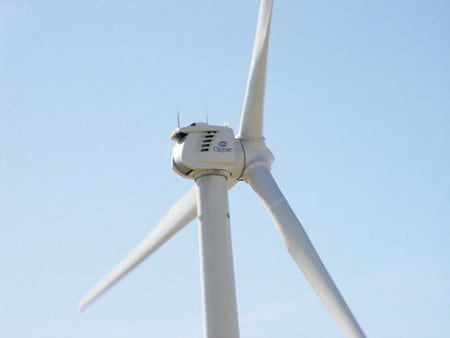
1. Four of a kind. The drive train of the Clipper C-93 Liberty turbine splits the torque among four generators operating in parallel. Courtesy: Clipper Windpower Inc.
If one generator goes off-line, the other three continue. In normal wind conditions the drop in output isn’t noticeable; only with high winds will the capacity fall—by 25%. To simplify maintenance, a single 650-kW generator can be removed and lowered to the ground by an onboard crane. Another boon to service: The high-speed gear sets can be replaced without having to remove the gearbox.
Lighter gearbox. "The Clipper C-93 Liberty turbine uses an innovative gearbox design which uses torque splitting to feed the mechanical power to four advanced permanent magnet generators," explained Bob Thresher, director of NREL’s National Wind Technology Center. "The multiple-drive path design radically decreases gearbox loads and stress by splitting the load path four ways. This also reduces the size and weight of the drive train."
While the gearboxes of comparable turbines weigh 50 to 70 tons, the one in the Clipper (Figure 2)—including the brakes and housing—weighs just 36 tons. Low-speed tapered roller bearings are used to handle thrust loads on the main shaft.
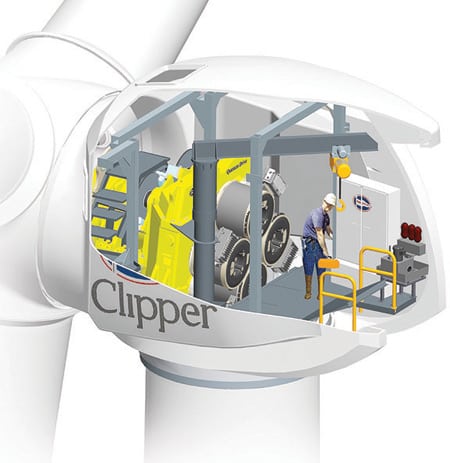
2. Featherweight. The gearbox of the 2.5-MW Clipper weighs only 36 tons, as much as 50% less than units in machines of comparable capacity. Courtesy: Clipper Windpower Inc.
The turbine control system incorporates the high-speed microprocessors needed to execute algorithm computations, which are repeated every 50 milliseconds. Unity power factor is maintained down to a low rated power percentage, reducing the need for volt-ampere-reactive (VAR) correction. The control system can ride through a low-voltage condition for up to 3 seconds. It also reduces loads by anticipating resonant conditions within the drive train structure and generators.
Putting it to the test. Clipper’s Liberty I prototype has been running at a remote site in Medicine Bow, Wyoming, since March 2005. The site has offered up a wide range of weather conditions, including temperature extremes, high-turbulence wind squalls, lightning, ice, and snow. Together, the elements and limited maintenance infrastructure have both challenged the machine and taught the testing team and maintenance crew plenty of lessons, which they are applying to the Liberty.
Over the course of its latest testing period, Liberty performed well within its design expectations. The power curve, turbine architecture, and system design have been confirmed by NREL. Other tests verified that the power balance between generators was within the 7% design spec.
More to come. Using international industry standards, Germanischer Lloyd WindEnergie GmbH has certified the Clipper wind turbine and its blades for rotors of 89-, 93-, and 96-meter diameter. Independent engineering reviews were conducted by Garrad Hassan, a wind power consultancy. Testing and evaluation of the 2.5-MW turbine confirmed that the new drive train design mitigates gearbox stresses, and first-year operating data suggest that it will be more reliable than standard gearbox designs.
Clipper Windpower has opened a manufacturing and assembly facility in Cedar Rapids, Iowa. The first Liberty wind turbines have already rolled off the line. Mikhail said he expects about 40 to be produced this year, with 250 anticipated in 2007 and 500 in 2008.
Waste gas–burning engines reach milestone
Fans of integrated gasification combined-cycle (IGCC) plants claim they’re ready to put conventional pulverized-coal plants out of business in the U.S. But no IGCC plant has yet been equipped to capture CO2, and the operating experience of existing gasification plants in process industries is not universally translatable because coal feedstock characteristics vary significantly from region to region. In the rush to prepare for stricter emissions standards, developers may have overlooked a proven technology for burning low-Btu gases cleanly.
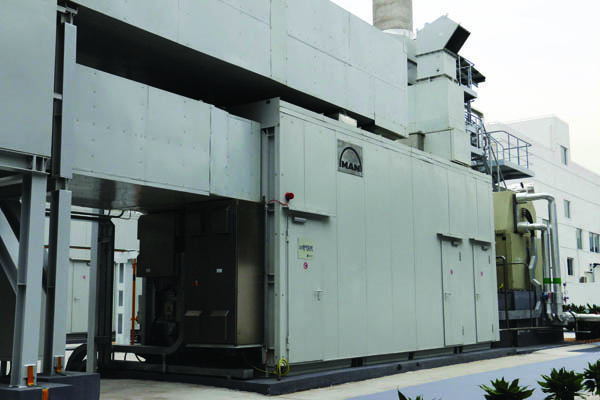
For example, GE Energy’s Jenbacher gas engines fueled by steel industry waste gases in one country alone now have accumulated 1 million operating hours. A total of 26 Jenbacher gas engines installed at three sites in northern Spain are burning either coke oven gas or LD-converter gas—created during the Linz Donawitz (LD) process that converts pig iron to steel—as fuel. By doing so, the steel factories are able to reduce their energy costs.
Steel production typically creates large volumes of specialty waste gases. Coke oven gas, generated during the conversion of bituminous coal to coke, mainly consists of hydrogen and methane. The primary component of LD-converter gas is carbon monoxide. Jenbacher installed its first engines in Spain for using coke oven gas in 1995 and for LD-converter gas in 2004.
In the past, operators had mainly used these steel waste gases to produce steam in gas-fired boilers. However, Jenbacher technology allows steel factories to also generate electricity while avoiding the need to vent the gases to the atmosphere. The three sites are:
- Profusa’s coke factory in Bilbao. In late 2005, Productos de Fundición S.A. (Profusa), one of Spain’s leading producers of coke, marked the 10th anniversary of its coke oven gas-fueled power plant. Profusa S.A.’s pioneering waste-gas-to-energy plant uses 12 Jenbacher generator sets (model number JGS 316 GS-S/N.L) to generate 6 MW on average (Figure 3). Special engine controls enable efficient, clean burning of gases with widely varying composition.
- Nalón Energóa’s coke factory in Asturias. GE Energy supplied two Jenbacher cogeneration units (each powered by a JMS 620 GS-S/N.L engine) to the Industrial Quómica del Nalón Energóa, S.A. coke factory in Sama de Langreo, in the province of Asturias. The factory, one of Spain’s largest producers of high-quality foundry coke, supplies excess coke gas to the cogen units. In return, they produce enough electricity and heat to supply most of the factory’s energy needs.
- The Aceralia steel factory in Avilés. Installed in 2004, a dozen Jenbacher engines (type JMS 620 GS-S/N.LC) are powering a unique cogeneration system fueled by LD-converter waste gas produced by the Aceralia steel factory in Avilés, in northern Spain (Figure 4). The 1.7-MW units are owned and operated by Generaciones Especiales I, S.L. (part of the HC Energóa Group), a renewable/alternative energy specialist.

3. Mixes well with coke. A dozen Jenbacher engines serving as a waste gas-to-energy plant at Profusa S.A.’s coke factory in Bilbao, Spain, have quietly and cleanly generated about 6 MW for the past 11 years. Courtesy: GE Energy
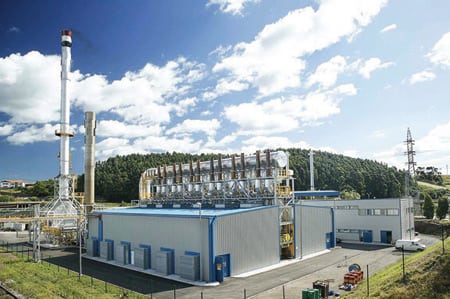
4. Waste not, want not. The Aceralia steel factory in Spain uses a dozen Jenbacher engines, each rated at 1.7 MW, to generate power from waste gas that would otherwise be flared. Courtesy: GE Energy
Hybrid power plant targets pipeline losses
FuelCell Energy Inc. (www.fce.com) has announced initial production of a multi-megawatt hybrid system that produces electricity from energy normally lost during natural gas pipeline operations. The direct fuel cell–energy recovery generation (DFC-ERG) system mates a 1.2-MW Direct FuelCell (DFC) unit with a 1-MW unfired gas expansion turbine. Installed at pipeline letdown stations, the system is said to be capable of producing 2.2 MW with minimal emissions.
As the term implies, letdown stations are facilities where a gas pipeline’s high transmission pressure is reduced for distribution to end users. Think of them as the equivalent of electric power substations. Just as substations have losses, letdown stations bleed valuable energy. At present, that energy is not put to use. What’s more, the pressure reduction at the stations cools the natural gas. To ensure reliable pipeline operations, this cooling must be offset by burning some of the gas in boilers just to raise the temperature of the distribution supply to an acceptable level—a glaring system inefficiency.
The new DFC-ERG system (Figure 5) is designed to recover some of this lost energy. Its unfired turbine will expand some of the high-pressure gas, producing electricity, as the integrated fuel cell electrochemically converts some of the gas, producing the same result. The heat normally generated by the fuel cell will warm the gas to its proper distribution temperature, eliminating the need for a boiler (and its emissions). FuelCell Energy expects the hybrid system to operate at better than 60% efficiency.
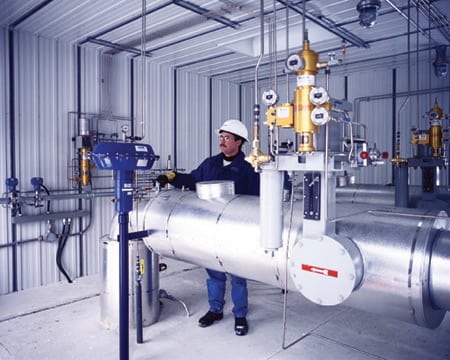
5. From lost to found. Energy is wasted when letdown stations on natural gas pipeline networks reduce gas pressure from transmission to distribution levels. This hybrid system, combining an unfired expansion turbine with a fuel cell, eliminates the losses of the conversion as well as the need for a boiler to reheat the gas. Courtesy: Enbridge Inc.
"We anticipate that the DFC-ERG will showcase the ability of fuel cell power plants to deliver unparalleled energy efficiency, which is extremely important in this climate of rising fuel prices," said R. Daniel Brdar, FuelCell Energy’s president and CEO. "This system both addresses a significant need and creates new market opportunities for our company."
The hybrid power plant should be widely available in the third quarter of 2007. Enbridge Inc. (www.enbridge.com)—a major North American pipeline operator based in Calgary, Alberta—has signed up to be the first customer of the DFC-ERG. Enbridge has identified 40 to 60 MW of opportunities for the system in just one of its operating regions. According to the company, North America as a whole represents 200 to 300 MW of generating potential.
Major contributors to that potential market are the renewable portfolio standards in a half-dozen U.S. states that are considering adding fuel cells to their list of qualifying generating technologies. Hybrid fuel cell power plants are uniquely positioned to generate electricity with low environmental impact and deliver it to wholesale grids fed by large wind farms. The state of Connecticut, for example, already offers a ready-made contract path with its Project 100. And, farther north, Ontario is soon to release its Clean-Energy Standard Offer Program. Both initiatives are intended to encourage the direct embedding of ultra-clean generation sources in grids.
Power from paint
In a pioneering demonstration project, AmerenUE’s 855-MW Meramec Plant in South St. Louis County, Missouri, has recovered waste paint solids from a car factory and burned them successfully in its four coal-fired boilers.
The pilot program followed 18 months of extensive study by DaimlerChrysler, AmerenUE, the Missouri Department of Natural Resources, the St. Louis County Health Department, and other state and local agencies. Over the course of the program, 1,000 tons of the solids—which otherwise would have required disposal—replaced about 570 tons of coal.
"This unique program has been a win-win-win for AmerenUE, one of our largest industrial customers, and the environment," said Meramec Plant Manager Ozzie Lomax. "We’ve diversified our fuel mix, DaimlerChrysler has reduced its disposal costs, and some landfill space has been freed up."
Given the success of the project, DaimlerChrysler says it is considering doing something similar at its other manufacturing facilities. That pleases Tom Thompson, the Ameren account executive who started working with the carmaker two years ago to develop the program. "We’re always looking for ways to add value for our major industrial customers," he said. "DaimlerChrysler should be commended for the innovative thinking they’ve shown in working with us to put the pilot project together."
Gulf Coast Power Association conference report
Members of the Gulf Coast Power Association (GCPA) gathered in Austin, Texas, on October 4 and 5 for their annual meeting and a celebration of the group’s 20th anniversary. Hatched as the Gulf Coast Cogeneration Association in 1984 with 12 engineers, GCCA admitted Cogen Technologies as its first corporate member. During the 1980s, the upstart cogenerators competed with the much larger investor-owned utilities. In the ’90s, non-utility generators, independent power producers, and exempt wholesale generators were born with the creation of the wholesale market by the Energy Policy Act of 1992.
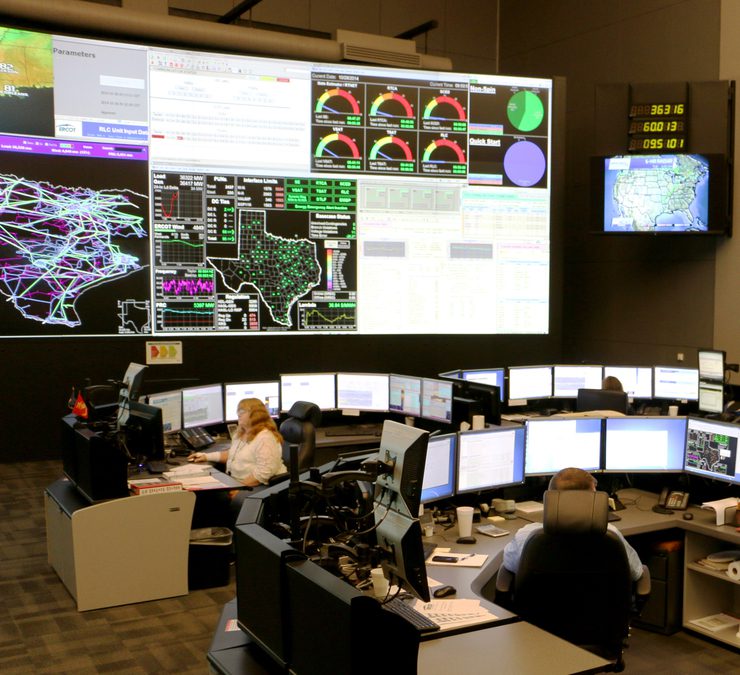
At the meeting, more than 350 attendees shared their assessments of the successes and failures of deregulation in the Electric Reliability Council of Texas (ERCOT) market. Most considered the Texas model a shining success that established the "truest" electricity market in North America. Addressing the theme of the meeting—"Building on Success: Adapting to the New Challenges in the Texas Electric Market"—almost all presenters called for three things: additional generation capacity, renewable energy, and demand response.
The guest speakers were considered the rock stars of deregulated power in Texas. Before a packed house over lunch, they shared what they"d learned in the recent past and gave their predictions for the future.
ERCOT gains momentum. The GCPA’s keynote address was delivered by Paul Hudson, chairman of the Public Utility Commission of Texas (PUCT) since 2003. Hudson said Texas really has three categories of customers:
- Non-ERCOT. These are end users in those portions of the state outside ERCOT’s electrical wiring diagram—in other words, customers of SWEPCO, SPS, Lubbock Power & Light, Entergy, and El Paso Electric whose rates are still regulated by the PUCT.
- ERCOT, retail open. These users are in portions of the state where retail competition was established in early 2002. Distribution grids there are owned by AEP, Centerpoint, and TXU. ERCOT has more than 100 registered retail providers.
- ERCOT, retail closed. These customers live in areas served by municipal and co-op utilities that choose not to offer retail choice. Two of the largest munis are operated by the cities of Austin and San Antonio.
Hudson discussed the issues that keep him awake at night and, in particular, his concern that new generating capacity won’t get built in time. ERCOT experienced record peak demand of 62,396 MW on August 18, 2006 (Figure 6 and table). Forecast demand for 2025 (plus a 12% reserve margin) is 100,000 MW. But the long-term supply/demand gap is actually greater than 30+ GW because much existing capacity is already 20 to 30 years old and thus will be need to be retired and replaced.

6. Everything’s bigger in Texas. This chart shows total generation in the ERCOT region in recent years. Source: ERCOT
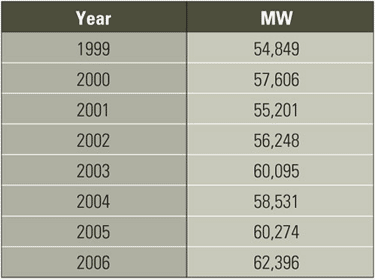
Peak demand history. Source: ERCOT
Turning to the shorter term, Hudson predicted that reserve margins in Texas will fall into the single digits between 2007 and 2009 due to the time it takes new projects to get permitted and constructed (Figure 7). Of the 8,500 MW of old capacity that have been mothballed, 1,100 MW have already been returned to service, and chances are that more will be called back between 2007 and 2009.

7. Lights out? These are the past and projected ERCOT reserve margins (the percentage by which total supply exceeds peak demand) from 1999 through 2011. The margin is expected to dip below the 12.5% "Safe level" by 2009. Over 26,000 MW of new generation were added after passage of Senate Bill 7. Since 1999, 2,800 MW have been retired and 8,700 MW have been mothballed (1,100 MW of which have been returned to service). Note that future generation is officially counted only if interconnection agreements are completed. Source: ERCOT
Hudson also expressed concern about the "gas hangover" from Hurricanes Katrina and Rita. In ERCOT, the current price to beat (PTB) ranges from 14.5 to 16.3 cents/kWh. The best retail prices range from 12.5 to 12.9 cents/kWh. The current 20-day forward rolling average price for gas is $7.74/mmBtu. Hudson then asked, if gas-fired generation produces more than 50% of the electrical energy in ERCOT and wholesale prices are falling, why hasn’t the retail price per kWh fallen as fast? He encouraged all retailers to take the gloves off now and to get aggressive on price. Remember, Hudson added, on January 1, 2007, the PTB officially goes away. So on that day the incumbents (TXU and Reliant are the gorillas) can reduce their prices to win back lost customers and attract new ones.
All eyes also will be on Entergy this coming New Year’s Day, because that’s when the utility will submit its "transition to competition" plan to the PUCT. The commission says it hopes to give a thumbs-up or -down to the plan within 180 days.
Hudson also touched on how to import capacity from outside ERCOT and how to pay for it. He noted that it would probably make sense to extend ERCOT’s transmission line 2 miles to pick up 1,000 MW—but not 1,000 miles to pick up 2 MW. Somewhere in the middle lies the right economic balance.
In September 2003 the PUCT ordered ERCOT to develop a nodal wholesale market design. Implementation is expected to deliver improved price signals and dispatch efficiencies as well as direct assignment of local congestion. The transition to the nodal market will require significant changes to ERCOT’s current business model, including the day-ahead market, reliability unit commitment, real-time or security-constrained economic dispatch, and congestion revenue rights. ERCOT’s cost to purchase and deploy computers and software could exceed $200 million by 2008.
ERCOT: A partnership in transition. Sam Jones, ERCOT’s CEO, followed Hudson by reviewing the history of ERCOT since it became the Federal Energy Regulatory Commission’s first independent system operator (ISO) in 1996. As Figure 6 shows, between 1995 and 2005 total electricity delivered in ERCOT increased 30% from 230 million MWh to 300 million MWh.
ERCOT may be proud of its success in creating choice for industrial, commercial, and residential customers, but plenty of challenges remain. The major near-term challenges are the aforementioned shrinking reserve margin and the dominance of natural gas (which currently fuels 72% of generation capacity) within the fuel mix (Figure 8). As Figure 7 shows, ERCOT expects its reserve margin to fall below the targeted "Safe" level sometime in the 2007–2009 time frame. Although project development activity has picked up, advanced development (as measured by the number of executed interconnect agreements) is lagging. Most of the advanced development is gas-fired, exacerbating the existing fuel-diversity problem. For this reason, ERCOT is establishing better incentives for voluntary load reduction by customers to reduce on-peak demand.
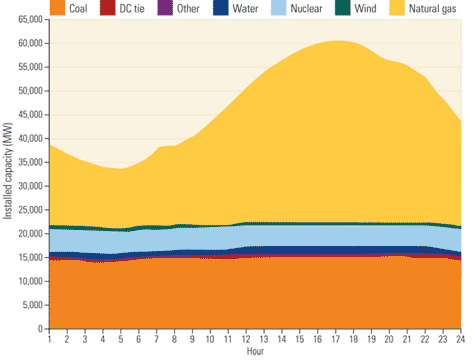
8. Cooking with gas. Typical ERCOT load profile (August 23, 2006). Source: ERCOT
Some interesting opinions were voiced by Tom Payton, VP for power at Occidental Energy Ventures. Payton challenged ERCOT to take leadership in the policy change arena and "not behave like a regulated utility" by simply taking direction from the PUCT. ERCOT needs to be a proactive leader, not just a facilitator, he said, adding that he feels ERCOT caters too much to stakeholders. "Stakeholders should not decide policy. ERCOT’s board should work for consumers," Payton advised.
Another hot topic was capacity payments. Currently, there is no payment for capacity in ERCOT, only for energy. It was noted that among the nine ISOs in the U.S., only two (ERCOT and MISO) offer no installed capacity or locational installed capacity payments.
Wind power in Texas. Texas is moving aggressively to increase the share of renewable energy in its generation mix. Indeed, this year it overtook California as the state with the most installed wind power capacity. During 2005, the Texas legislature passed Senate Bill 20 (SB20), which established renewable capacity goals of 5,880 MW by 2015 and 10,000 MW by 2025. About 95% of the renewable capacity is likely to be wind power. But although it takes only one or two years to develop and build a wind farm, it takes five years or more to install the associated transmission capacity.
SB20 includes a program being called Competitive Renewable Energy Zones (CREZ) to give priority for transmission funding to the sites with the best wind power potential. The PUCT is planning to fund up to $2 billion in transmission improvements to make sure that the renewable power gets to market. Projects will compete for transmission access. Developers would have to put up deposit money to reserve transmission space.
Developers, however, are already complaining that, although they must submit a completed interconnect agreement (accompanied by a deposit) at the front end of a project, financing won’t become available until a "certificate of convenience and need" (CNN) is obtained. Developers would like not to have to submit the deposit until receiving the CNN. Two other concerns of developers are that gas- and coal-fired projects will try to grab the allocated capacity and that one well-funded wind developer might try to hog a large proportion of the new transmission.
Resource adequacy in an energy-only market. At the GCPA annual meeting, there was a spirited debate among panelists suggesting the best market design to stimulate demand response (DR). Dan Gabeldon of Booz Allen Hamilton lamented the use of price caps, which usually are arbitrary, to create "missing money" from a free market that rightfully belongs to owners of peaking capacity. Steve Winn of NRG echoed these remarks and noted that, even without a cap, peakers normally quote below the true market price due to the bad image created by someone looking to exploit a supply shortage. Bill Bojorquez, director of system planning for ERCOT, felt that it was already too late to build and connect any new generation to avoid the reserve margin shortfall projected for 2007–2009. The only viable near-term choices, he said, are to unmothball capacity or come up with a DR program . . . immediately.
Trudy Harper of Tenaska presented her straw man DR proposal. In her scheme, each seller of electricity serving a real load would be responsible for arranging an additional 12.5% capacity. At the end of each month in which the reserve margin was less than 12.5% at the hour of peak demand, a penalty would be assessed the providers that did not have 12.5% reserve, and the money would be paid to the providers that did. Harper said that because an energy-only market would lead to capacity shortages, only a properly managed DR program would provide the needed capacity more cheaply than building new plants.
Nat Treadway of Distributed Energy Financial Group noted that, of the 1,800 MW of interruptible load in ERCOT today, about 1,150 MW are available at any moment. Other regions in the U.S. have done a better job of creating a competitive market for DR, he said. Another panel of technology experts pointed out that the infrastructure needed for a robust DR program would consist of intelligent meters with two-way communications capability. They added that the installed cost of a smart meter to a residential customer is in the range of $100 to $150—that is, if the program is implemented at full scale, not customer by customer.
Superstar panel discussion. Three of the people most responsible for creating and nurturing deregulation in Texas were presented awards by GCPA Executive Director John Stauffacher. They were: David Sibley, former Texas state senator; Steve Wolens, former Texas state representative; and Pat Wood, former chairman of both the PUCT and FERC (Figure 9).

9. Honoring industry leaders. The Gulf Coast Power Association honored (L to R) Pat Wood, former chairman of both the Public Utility Commission of Texas and the Federal Energy Regulatory Commission; David Sibley, former Texas state senator; and Steve Wolens, former Texas state representative, for their contributions to electricity deregulation in Texas. Courtesy: Mark Axford
In his remarks, Wolens recalled traveling to California in 1997 with Sibley and Wood to learn what not to do. They came up with the concept of the "price to beat" during another road trip to Pennsylvania and still consider PTB the bedrock of ERCOT’s success. The California PUC told them, "Be sure to spend money to educate the customers." Texas spent $18 million in 2003, but funding was slashed to $1.5 million per year thereafter as state budgetary pressure took its toll. Wolens noted, "We’ve come a long way, but there still isn’t enough difference in the prices offered by the many retail providers. We haven’t seen one company emerge with a truly unique approach and become the ‘Southwest Airlines of electricity.’ "
Sibley recapped the primary goals of Texas Senate Bill 7: To transfer risk to the seller and empower the consumer. He said he wished that he would have saved the napkin used to scratch out the PTB structure on the trip home from Pennsylvania. "One of the best things about the model is that the market moved us to plants that are more efficient," he added.
Wood (see box) rattled off a list of things that, with 20/20 hindsight, would have produced a better outcome. He said he felt that the march to deregulation was weak on innovative technology. Like Wolens, Wood agonized about the budget cuts for education needed to teach consumers about the market and their choices. The market design failed to account for negative stranded costs and did not envision the need to index the PTB to the cost of fuel. Also, there was not enough emphasis on tying ERCOT to adjacent regions in Texas. Wood is a big fan of the nodal market’s promise for relieving congestion, perhaps first at the wholesale level, then retail, and finally at the neighborhood level. Wood said he’s amazed that the prediction of 40% market share loss by incumbents in the PTB program was, in fact, very accurate.
—By Mark Axford, Contributing Editor