FutureGen picks Mattoon, Ill.
In mid-December, members of the FutureGen for Illinois taskforce, elected officials, local residents, and Governor Rod R. Blagojevich (D) celebrated the FutureGen Industrial Alliance’s decision to build the first near-zero-emissions coal-fired power plant in their state. Mattoon, a town of 18,000 about 180 miles south of Chicago, in the heart of southern Illinois’ coal belt, was the unanimous choice of the Alliance’s board of directors. It edged out Tuscola, Ill., and the Texas towns of Jewett and Odessa to secure the coveted $1.5 billion project.
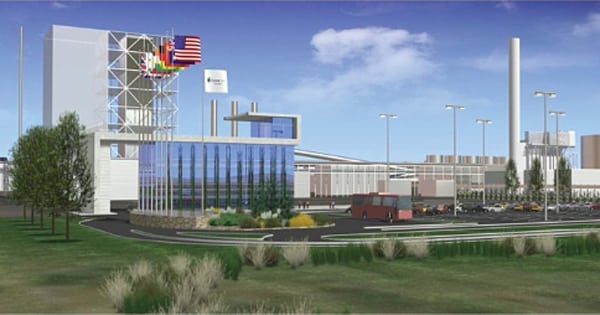
Announcement of the final site followed more than four years of extensive planning and preparation in Illinois and came nearly five years after President Bush first announced the project (Figure 1). The FutureGen Alliance is a nonprofit organization of utilities and coal companies that is partnering with the Department of Energy to design and build the project.
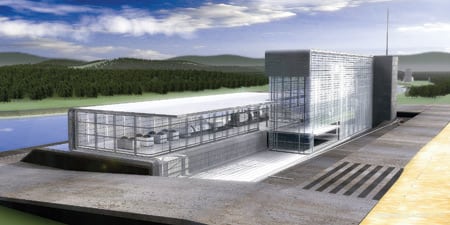
1. FutureGen finds a home. The FutureGen Alliance has selected Mattoon, Ill., as the site for the world’s first near-zero-emissions coal-fired power plant, shown here as an artist’s conception. Source: DOE
FutureGen will take the form of a near-zero-emissions, integrated gasification combined-cycle (IGCC) power plant that will capture 90% of its CO2 emissions and sequester them in geological formations more than one mile underground. The Mt. Simon Sandstone, as it’s known, is a saline reservoir underlying most of the Illinois Basin that has served as a natural gas reservoir, and scientists expect it will work well to store CO2 as well. The possibility of on-site injection at Mattoon was likely a key factor in its selection. Alliance officials said the on-site sequestration would both simplify operations and help with public education because visitors to FutureGen could just “step out the back door of the plant” to see where its CO2 is going.
“We are thrilled that Illinois will be home to FutureGen,” said Gov. Blagojevich at the announcement in the nation’s capital. “This decision represents the culmination of years of hard work and dedication, and we are honored that the FutureGen Alliance and the U.S. Department of Energy have entrusted us with this groundbreaking project. FutureGen’s near zero-emissions coal-gasification technology holds great promise to revolutionize our nation’s coal industry and ensure that coal continues to be an integral part of our energy future while reducing the greenhouse gases that cause climate change. As the entire world watches, Illinois is ready to get to work to ensure that FutureGen is a success.”
The site selection occurred during a period of apparent tension between the Alliance and the DOE, which would like Alliance members to shoulder more of the project’s growing development costs. The DOE included in its FY 2008 research budget request for the Office of Fossil Energy proposed legislative language that would change FutureGen’s current cost-sharing formula. The current formula calls for taxpayers and industry to pay 74% and 26% of the project’s costs, respectively.
In a December 2007 statement, James A. Slutz, the DOE’s acting principal deputy assistant secretary for fossil energy, said, “As [the DOE] has discussed with the FutureGen Alliance for the past several months, projected cost overruns require a reassessment of FutureGen’s design. This will require restructuring FutureGen to maximize the role of private-sector innovation, facilitate the most productive public-private partnership, and prevent further cost escalation.”
When President Bush unveiled the FutureGen proposal in 2003, the DOE estimated the plant would cost $950 million. The estimate has since risen to $1.5 billion, driven by sharp increases in the cost of steel and other essential construction components. Cost inflation also has wreaked havoc on private-sector proposals to build commercial IGCC plants. Michael Mudd, CEO of the FutureGen Alliance, noted that “Sticker shock . . . has been a very difficult hurdle [for private IGCC projects].”
Construction of the FutureGen plant is expected to begin in 2010, with full-scale operations commencing in 2013.
Duke applies for first greenfield COL
Duke Energy has submitted to the Nuclear Regulatory Commission (NRC) an application for a combined construction and operating license (COL) for a new nuclear plant in Cherokee County, S.C. The proposed two-unit William States Lee III Nuclear Station would get its generating capacity of 2,234 MW from Westinghouse AP1000 pressurized water reactors.
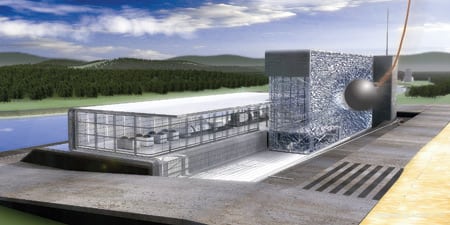
Duke’s application would reference Tennessee Valley Authority’s October application to build and operate two units of the same design at its unfinished Bellefonte Nuclear Plant site in Alabama (POWER, December 2007, p. 6), theoretically accelerating the approval process (Figure 2). The project is expected to be completed by 2017.
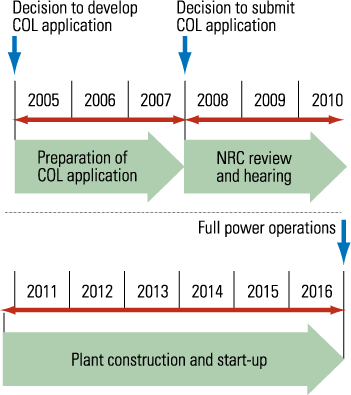
2. Nuclear timeline. Duke Energy has submitted a COL application to the NRC for the William States Lee III Nuclear Station, which would be the first new greenfield project of its kind in the U.S. in decades. The project schedule calls for commercial operation to begin in 2017. Source: Duke Energy
“Submitting this COL application to the NRC is an important step for our customers and company,” said Brew Barron, Duke Energy’s chief nuclear officer. “[It] allows us to move forward in keeping the new nuclear generation option available [to help meet] the growing energy needs of the Carolinas.” Duke Energy Carolinas expects its capacity needs to increase by 10,700 MW by 2027.
Duke Energy is the fourth company to submit an application to the NRC under the revised COL licensing process, but its filing is the first for a greenfield site.
In addition to submitting the COL, Duke Energy is pursuing expanded demand-side management and energy-efficiency programs, an 800-MW coal unit at Cliffside Steam Station in North Carolina, and licensing and permitting of new combined-cycle peaking units at the Buck and Dan River steam stations in North Carolina. It’s also evaluating options for building and acquiring renewable-fueled and other near- and long-term generating resources to meet its customers’ needs well into the future.
PPL to work with UniStar on another COL
PPL Corp.’s Nuclear Development LLC subsidiary will partner with UniStar Nuclear Energy to develop a COL application for a new nuclear reactor on a site adjacent to the Susquehanna Nuclear Power Plant (Figure 3) near Berwick, Pa.
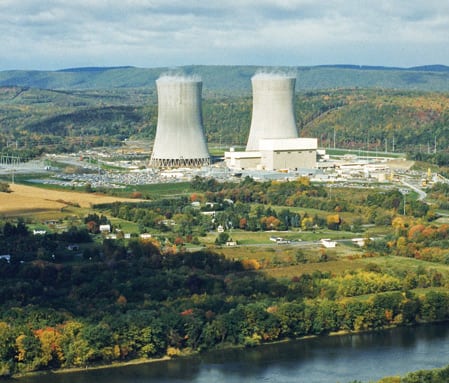
3. Expanded nuclear family? By the end of this year, PPL Corp. and UniStar Nuclear expect to develop and submit to the NRC an application to build and operate a reactor based on Areva technology on a site adjacent to the Susquehanna Nuclear Power Plant in Pennsylvania. Courtesy: PPL Corp.
Susquehanna is a two-unit, 2,360-MW plant that is operated by PPL Susquehanna and jointly owned by it and Allegheny Electric Cooperative Inc. A PPL spokesman said the company has already begun boring and testing at the site, and that it is the “most likely” location for a new reactor, although alternatives have been identified. Though PPL says it has not yet decided to move forward with construction, it plans to apply for a COL for the Berwick site in the fourth quarter of 2008, in time for the plant to qualify for production tax credits under the U.S. Energy Policy Act of 2005.
The yet-unnamed reactor would use evolutionary pressurized water reactor (EPR) technology developed by the French firm Areva. The announcement adds momentum to UniStar’s plan to build a fleet of at least four EPRs, each rated at 1,600 MW, in the U.S. by 2015. In November, the company—a joint venture of Constellation Energy and Electricité de France, France’s state-owned electric utility—announced it had chosen Alstom to supply the reactors’ turbine generators.
As it develops the COL application for Berwick with UniStar, PPL is actively seeking partners to build the plant. “[We] would not undertake nuclear construction alone,” said William Spence, PPL Corp.’s chief operating officer. “Because of the large capital commitment required, we would [do so] only as part of some type of joint venture arrangement.” Spence added that PPL is now “in talks” with Areva about the possibility of such an arrangement.
Areva seeks NRC certification of its reactor
In mid-December, Areva applied for NRC certification of its evolutionary pressurized water reactor (EPR) design. The application is ahead of schedule, making it more likely that the company will be able to meet its goal of deploying at least four reactors of that type in the U.S by 2015.
“By building on our considerable licensing experience in the U.S. as well as that gained through the detailed licensing processes in Finland and France, we have prepared what we believe is the most thorough design certification application the NRC has received to date,” said Tom Christopher, president and CEO of Areva NP Inc. “We were able to achieve a high level of detail and confidence in the design application because of the completeness of the global EPR design now under construction, and by working directly with a large and highly respected energy company, Constellation Energy. We look forward to a timely NRC review and continued success for the EPR in the U.S.”
The EPR is the only reactor technology in the industry’s Generation III+ design category currently under construction anywhere in the world (Figure 4). Safety-grade construction of the first Areva EPR began in Finland in 2005, and another reactor broke ground in 2007 in France. The EPR has begun the prelicensing phase in the UK, so the NRC’s certification of the design would authorize its use in a fourth country. The fifth licensing process will occur in China, where a contract for two EPRs was signed in November as part of the biggest deal ever in the history of nuclear power.
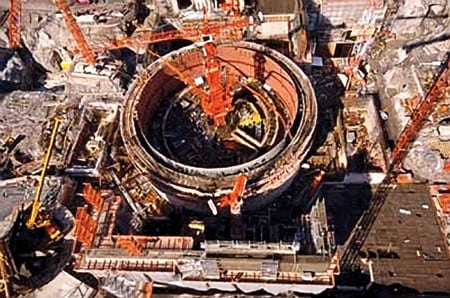
4. Coming to America? Areva has applied for NRC certification of its evolutionary pressurized water reactor (EPR) design. Shown is an EPR-based plant under construction at TVO’s Olkiluoto site in Finland that has an estimated start-up date of 2011. Courtesy: Areva NP
Areva’s application for NRC certification of the EPR design comprises 12,000 pages of documentation prepared by a project team of 325 engineers and 55 support staff. To ensure an efficient and timely review of the application, Areva began official discussions with the NRC in January 2005. Dozens of technical exchanges and planning meetings with the agency followed the initial meeting; during them, Areva provided topical reports and supporting materials in the hope of obtaining early approval of some parts of the design.
Mitsubishi also in line at the NRC
Mitsubishi Heavy Industries (MHI) has applied to the NRC for certification of its U.S.-advanced pressurized water reactor (US-APWR), a 1,700-MW design that the Japanese company hopes to deploy in the U.S.
Last year, TXU Energy (now Luminant), the Dallas-based electric utility, signed a deal with MHI to use the US-APWR design for two new reactors it is considering building at its Comanche Peak plant in Glen Rose, Texas.
PV project shines in Nevada
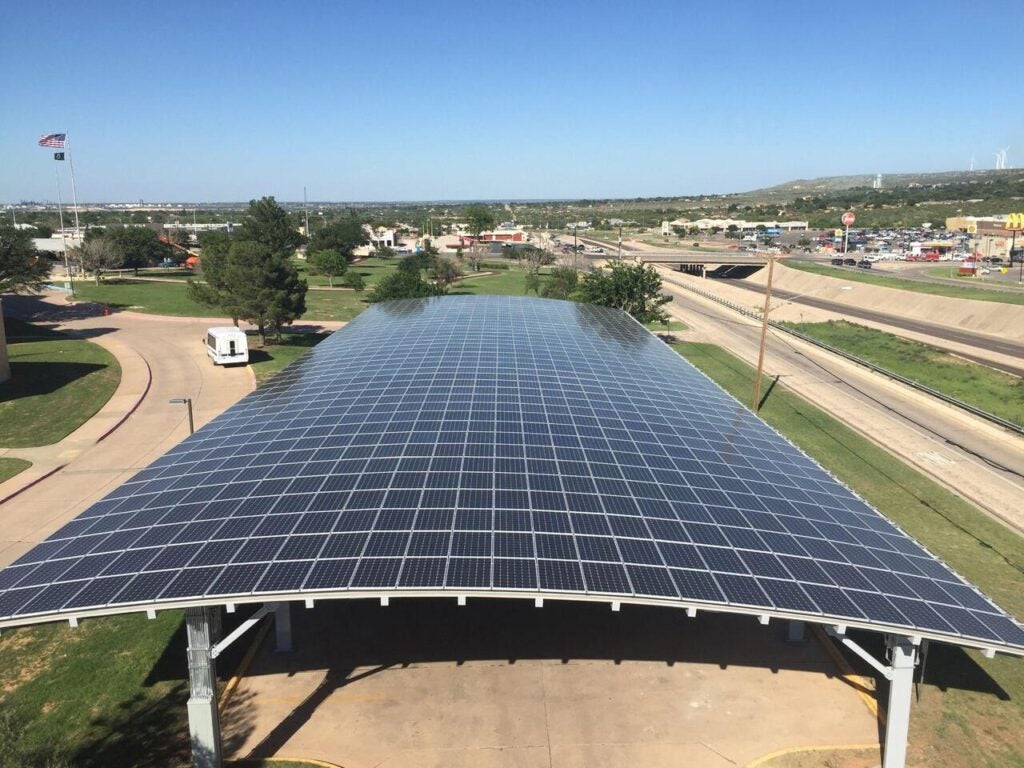
On December 17, 2007, the U.S. Air Force celebrated the completion of North America’s largest photovoltaic (PV) system at Nellis Air Force Base in northeast Las Vegas. A joint venture of MMA Renewable Ventures LLC, SunPower Corp., and Nevada Power Co., the 14-MW project (Figure 5) supplies about 25% of the power used by the base and its population of 12,000.
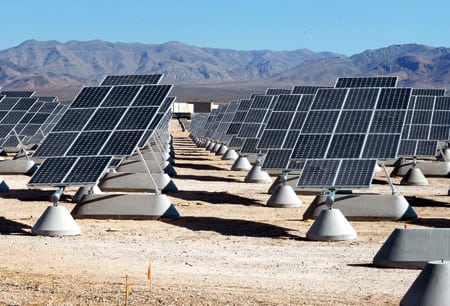
5. Air Force goes solar. These photovoltaic panels at Nellis Air Force Base use tracking devices to keep them pointed toward the sun throughout the day. Tilted toward the south, each set of panels rotates around a central bar. Courtesy: Nellis Air Force Base
Covering 140 acres of land at the western edge of the base, the system comprises 72,000 solar panels that use SunPower’s proprietary single-axis Tracker T20 technology to follow the sun throughout the day. According to the company, the technology delivers up to 30% more energy than traditional fixed-tilt ground systems.
MMA Renewable Ventures financed and operates the plant and will sell its output to the base under a guaranteed fixed-rate contract for the next 20 years. Nevada Power supports the project by purchasing the renewable energy credits it generates.
“This solar project at Nellis is a first step of many toward making renewable electricity integral to [our] operations,” said William Anderson, assistant secretary of U.S. Air Force Installations, Environment, and Logistics. “As the largest consumer of energy in the federal government, the Air Force is well-positioned to promote both solar technology and new approaches to its implementation. This pioneering initiative is a good example of how a creative approach to public-private partnership can make our energy supply more sustainable, more secure, and more affordable.”
“The best way to secure a healthy and prosperous economy is to develop our affordable, reliable local resources,” added Nevada Governor Jim Gibbons. “With these 14 megawatts, Nellis Air Force Base is leading the country in solar energy deployment, a move that is good for the environment and our nation’s energy security alike.”
SunEdison commissions Colorado PV plant
In late December, SunEdison announced the start-up of another PV plant, its 8.22-MW facility in Alamosa, Colo., ahead of schedule. The facility—the largest solar PV plant in the U.S. supporting substation loads for a major public utility—is expected to generate about 17,000 MWh annually. The solar plant was financed and built and will be maintained by SunEdison pursuant to an agreement with Xcel Energy under which the utility will buy both the plant’s output and the renewable energy credits it generates for the next 20 years.
The plant, on an 80-acre site near an Xcel substation, is notable for its use of three distinct types of solar technologies: a single-axis tracking array, a fixed-mount array, and a dual-axis tracking array with PV concentrator technology.
According to Karen Hyde, VP of resource planning and acquisition at Xcel Energy, “This is a unique facility—three types of solar technologies have been deployed in parallel. Performance monitoring will allow us to study the system’s performance and evaluate the relative benefits of each technology over the system’s expected 20-year lifespan.”
Big concentrating solar plant proposed
A consortium of southwestern electric utilities has issued a request for proposals (RFP) by developers to build a large (100-MW to 250-MW) solar thermal power plant in Nevada or Arizona by 2012.
Members of the Southwest Energy Service Provider’s Consortium for Solar Development would buy all of the plant’s output. Bids are due March 19 of this year. The consortium consists of Arizona Electric Power Cooperative, Arizona Public Service Co. (the group’s coordinator), Southern California Public Power Authority, Salt River Project, Tucson Electric Power, and Xcel Energy.
The RFP specifies that the plant must employ concentrating solar power technology like that used by Acciona Solar Power’s 64-MW Solar One project, which recently came on-line in southern Nevada (POWER, December 2007, p. 40). It also states that projects including thermal energy storage will be given preference. More information is available at www.aps.com.
Super Boiler celebrates first anniversary
An industrial boiler that operates at 94% thermal efficiency and produces fewer emissions than conventional boilers has operated successfully for a full year, producing high-pressure steam for a manufacturer of rubber parts. DOE officials attended the first birthday party for the “Super Boiler” (Figure 6) on November 30 at Specification Rubber Products Inc. in Alabaster, Ala.
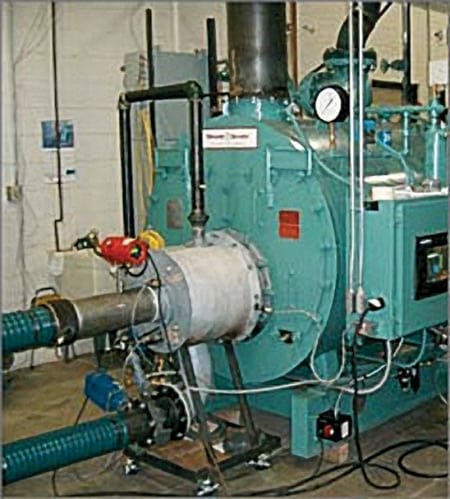
6. Happy birthday. The DOE-sponsored Super Boiler, developed by the Gas Technology Institute and Cleaver-Brooks Inc., recently completed its first year of service, racking up more than 6,000 hours of operation at a thermal efficiency approaching 94%. Courtesy: DOE
Since 2000, the DOE’s Industrial Technologies Program has subsidized the basic research that led to the Super Boiler to the tune of $4.2 million. The unit itself was developed by the Gas Technology Institute and its partner, Cleaver-Brooks Inc.
The boiler geometry incorporates a two-stage firetube design that is both compact and very efficient. Key innovations (Figure 7) include a transport membrane condenser (TMC), a humidifying air heater (HAH) that extracts sensible and latent heat from the boiler’s flue gas, compact convective zones with intensive heat transfer, and a staged/intercooled combustion system that minimizes emissions.
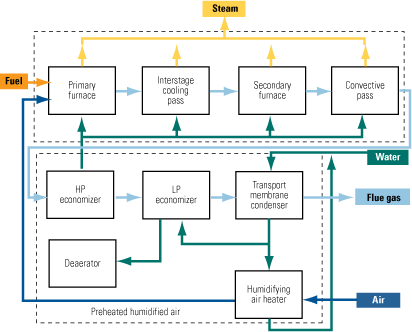
7. Saving Btus. The Super Boiler’s unique flow path improves its combustion efficiency. Source: DOE
The boiler at Specification Rubber Products is a single-stage, 300-hp, gas-fired TMC/HAH boiler that has been running 24 hours a day, five days a week with promising results. After more than 6,000 hours of operation, its efficiency converting fuel to steam has consistently been in the 93% to 94% range, producing annual gas savings of nearly 13%.
The Super Boiler’s unique design, which incorporates high-intensity heat transfer using extended-surface firetubes, has exhibited heat transfer coefficients about 18 times greater than those of boilers using plain firetubes. In laboratory tests, the technology reduced NOx emissions to as low as 3 ppm while maintaining CO levels below 10 ppm across the firing range. Maintaining excess-air levels at 3% or lower has delivered better efficiency than low-NOx burners that employ flue gas recirculation or high amounts of excess air.
With one year of successful operation under the Super Boiler’s belt, the next step in its evolution is further testing. New hosts will be the fruit-juice maker Clement Pappas & Co. (Ontario, Calif.) and Third Dimension Inc. (West Jordan, Utah), a manufacturer of boxes and packaging. Steam generation typically accounts for about one-third of the energy used by manufacturers.
Small fuel cell uses JP-8 jet fuel
Two core technologies developed at the DOE’s Pacific Northwest National Laboratory (PNNL)—a fuel desulfurization system and a fuel reforming system—were instrumental in the demonstration of a 5-kW fuel cell running on JP-8, a popular military fuel.
Portable fuel cell power units are quieter, cleaner, more reliable, easy to maintain, and up to three times more efficient than internal combustion engines such as diesels. But they are challenged by JP-8 fuel’s high sulfur content. The fuel desulfurization and reforming systems developed at PNNL reduce the sulfur content of JP-8 and generate a hydrogen stream compatible with an integrated fuel cell (Figure 8).
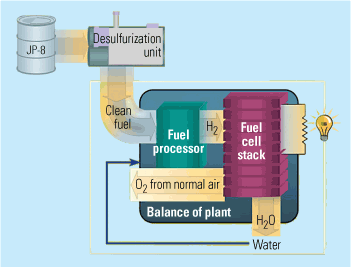
8. Stand up and salute. Converting JP-8 fuel to hydrogen for use by an onboard fuel cell has many potential applications, especially in the military. Source: PNNL
Although they are being developed for military use, the desulfurization and reforming technologies can be used with different liquid fuels to provide portable power almost anywhere that small size and high performance are important. For example, researchers at PNNL are looking to make the desulfurization technology compatible with diesel fuel.
The fuel cell–centric auxiliary power unit (Figure 9) is modular and can be reconfigured for a wide range of uses. Researchers envision using the technology to supply auxiliary power and heat for long-haul commercial trucks, which would eliminate the need for and cost of running less-efficient engines while the vehicles are stopped. Battelle, which operates PNNL for the DOE, operated a prototype system demonstrating these technologies during the three-day 2007 Fuel Cell Seminar last fall. During the demonstration, an integrated 5-kW electric power system successfully powered area lights and a commercial refrigerator.
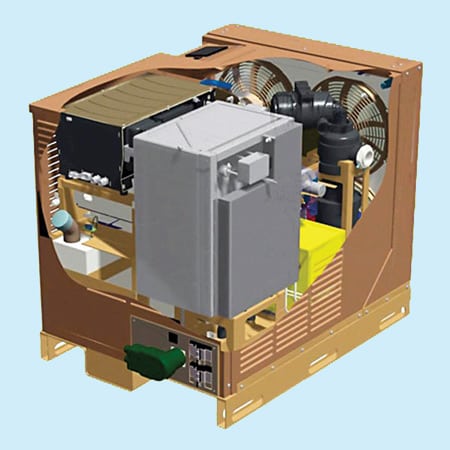
9. Clean and compact. This 5-kW electric power system incorporates a PNNL-developed fuel processor. Source: PNNL
The unique catalytic hydrodesulfurization process developed by PNNL removes sulfur from JP-8 fuel using syngas as the co-reactant in place of hydrogen. Gas-phase operation of the process allows for a significant increase in throughput as well as a decrease in operating pressure compared with conventional technology. The process doesn’t require consumables or periodic regeneration.
POWER digest
News items of interest to power industry professionals.
Oxy-combustion tests show promise. Babcock & Wilcox Power Generation Group (B&W PGG) has reached a major milestone on the road to commercializing a new technology that could greatly reduce CO2 emissions from new and existing coal-fired power plants.
B&W PGG became the first in the world to burn coal in full oxygen-combustion mode at a 30-MWt scale during recent testing at its Clean Environment Development Facility (CEDF) in Alliance, Ohio. The CEDF operated in full oxygen-coal combustion mode for over 250 hours as it burned more than 500 tons of bituminous coal.
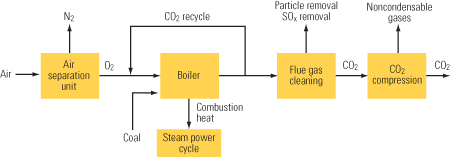
As the name implies, B&W PGG’s oxygen-coal combustion process uses oxygen, rather than air, to fire coal. Doing so keeps nitrogen out of the process, and as a result its exhaust gas is mostly relatively pure CO2, rather than a mix of nitrogen oxides and other pollutants. Furthermore, the exhaust gas has less volume, is easier to capture, and with further purification is ready for sequestration or injection into wells to enhance oil recovery.
Working closely with B&W PGG on this project was American Air Liquide, which provided the oxygen, engineering, and chemistry expertise related to combustion as well as the equipment and sensors needed for safe and efficient handling of the liquefied oxygen used during testing. An Oxy-Coal Combustion Advisory Group representing utility and merchant power generators also actively participated in the testing process.
B&W PGG will continue its oxy-coal combustion research at the CEDF through the second quarter of this year. Next up on the development schedule are tests of the process on subbituminous and Powder River Basin coals and lignite.
B&W PGG is currently seeking interested parties to conduct further oxy-coal combustion testing at a demonstration plant large enough to capture more than a million tons of CO2 annually. The Oxy-Coal Combustion Advisory Group will help B&W PGG evaluate applicants and select a site for this large-scale demonstration.
FERC licenses first wave energy pilot. The Federal Energy Regulatory Commission has issued the first U.S. license for a wave energy plant. It will operate as a pilot project for five years to demonstrate the potential—and work out the technical and environmental kinks—of the technology, which converts the kinetic energy of waves into electricity.
FERC said the 1-MW Makah Bay Offshore Wave Pilot Project off the shore of northwest Washington will be torn down after five years, as proposed by the developer, Finavera Renewables Inc.
Finavera Renewables’ planned offshore power projects consist of patented wave energy converters based on proven, marine buoy technology. Clusters of these modular devices, called AquaBuOYs, will be moored several miles offshore, where waves are taller than they are close to shore.
The project will consist of four steel buoys, each capable of producing 250 kW by harnessing the up-and-down motion of waves to drive power-generating equipment. The power will be sent to shore through a 3.7-mile underwater transmission cable that will be hooked into the distribution system operated by the Clallam County Public Utility District.
A cluster of AquaBuOYs would have a low silhouette in the water. Located several miles offshore, the wave power project arrays would be visible enough to allow for safe navigation but would be no more noticeable than a small fleet of fishing boats.
FERC has touted the potential benefits of bringing hydrokinetic projects on-line, saying that they could double the nation’s share of hydro capacity from its current 10% to 20%.
GE shortens turbine start-up time. GE Energy recently introduced a 10-minute start capability for its Frame 7FA gas turbines as an expansion of the company’s OpFlex gas turbine technology program.
When equipped with the feature, a 7FA gas turbine would achieve stable combustion and be ready for dispatching 10 minutes after receiving a start signal. During the start-up period, NOx and CO emissions would both be less than 9 ppm. When incorporated into GE’s next-generation Rapid Response combined-cycle power plant design, the feature would reduce the start-up emissions of a 207FA system (two gas turbines and one steam turbine) by as much as 20% and increase starting efficiency by up to 30%. Targeted for 60-Hz markets, the fast start-up feature will be available for simple-cycle applications in 2009 and for combined-cycle operation in late 2010.
“A power company using GE’s Rapid Response combined-cycle power plant design with 10-minute start capability can provide high-efficiency power when it is needed most,” said John Reinker, general manager of GE Energy’s heavy-duty and combined-cycle gas turbine product line. “It is designed for customers who want to extend operation under an emissions cap, are contemplating cyclic duty, or have an opportunity to tap into additional revenue from the ancillary market.”